
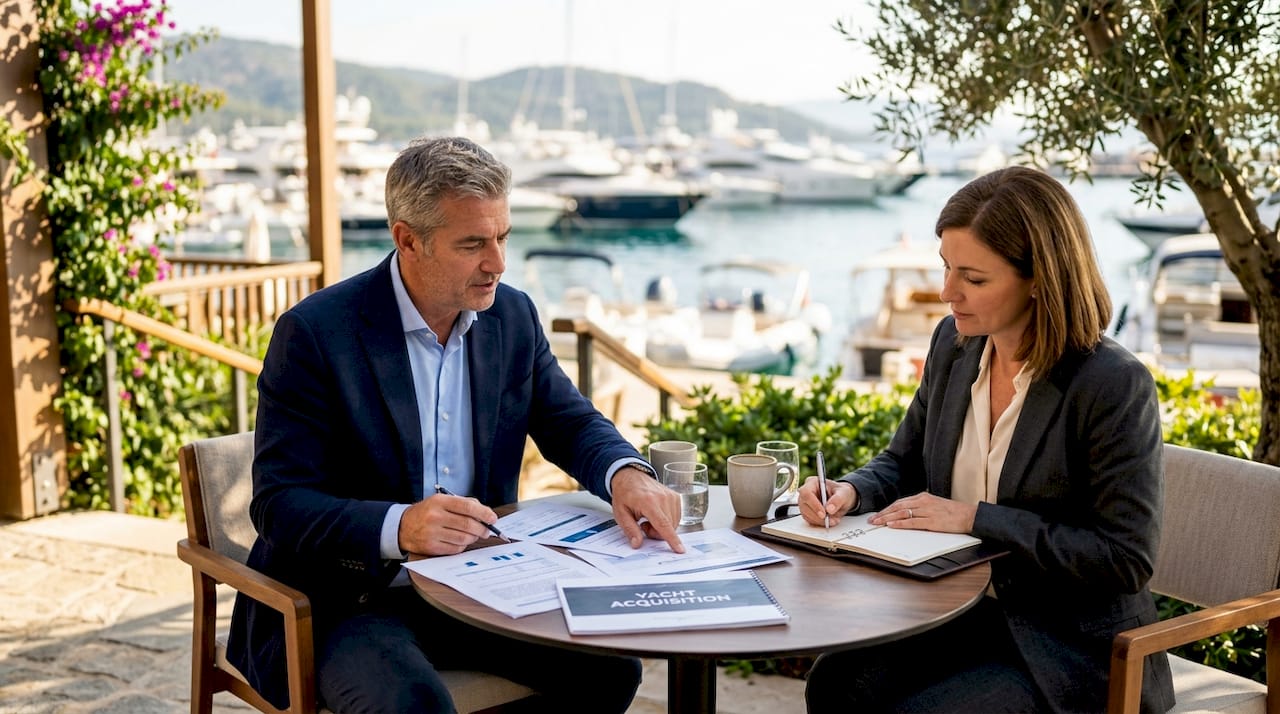
Corporate yacht acquisition is defined as a structured, phased process that moves from needs analysis through contract execution to final vessel acceptance. The corporate yacht procurement process explained correctly is not a single transaction. It is a sequence of deliberate steps, each building on the last, where missteps compound quickly and cost significantly. Industry standards like the MYBA Memorandum of Agreement (MOA) govern most transactions, and typical timelines run 12–24 weeks, with complex cross-border deals or custom builds exceeding 120 days. Baranofyachts works with corporate buyers at every stage of this process, from initial brief to delivery, ensuring each phase is executed with the care it demands.
What are the main phases of the corporate yacht procurement process?
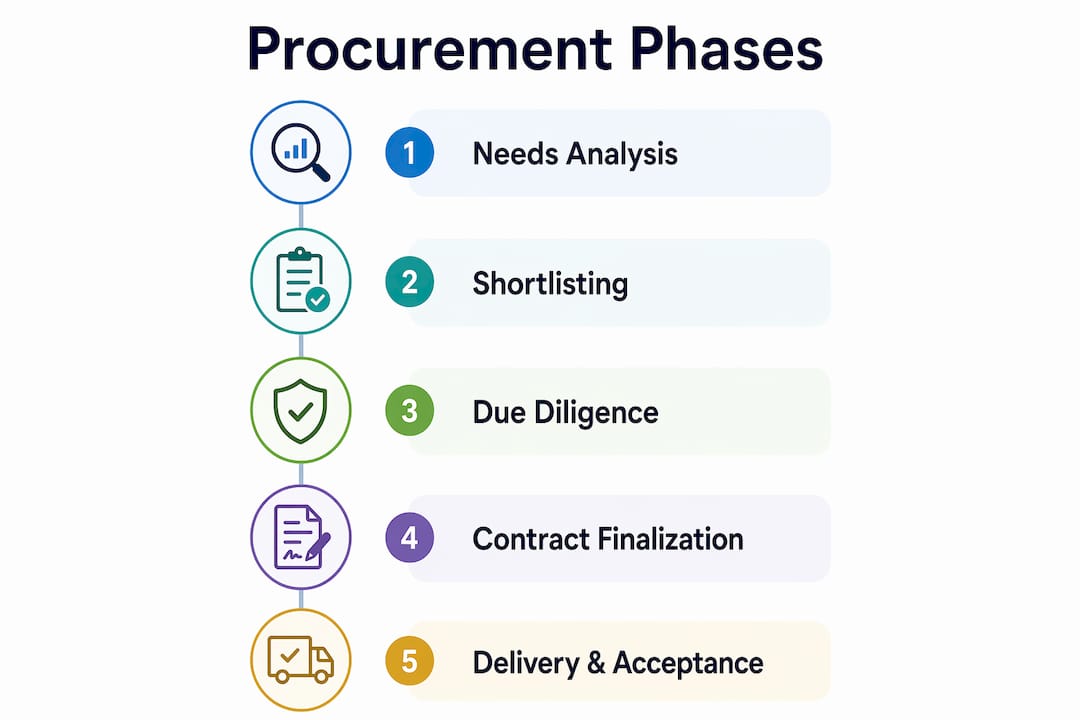
The corporate yacht buying process follows a clear sequence. Skipping or compressing any phase increases both financial exposure and the risk of acquiring a vessel that does not meet your operational requirements.
-
Needs assessment. Define the vessel’s purpose before searching. Will it serve client entertainment, executive travel, or both? Specify guest capacity, range, flag state preferences, and budget ceiling. This brief becomes the filter for every decision that follows.
-
Advisory team assembly. Appoint an independent broker, a maritime lawyer, and a qualified marine surveyor before you engage any seller. Advisory team independence is the single factor that most influences negotiation power and acquisition success. Each adviser must be free of financial ties to the selling party.
-
Yacht search and shortlisting. Your broker searches available listings against the brief. The shortlist typically contains three to five vessels. Each candidate is evaluated on specification match, age, flag, classification society status, and asking price relative to comparable sales.
-
Vessel visits and preliminary evaluation. Visit each shortlisted vessel in person. Bring your captain and, where applicable, your chief engineer. First impressions matter, but they must be validated by data, not emotion.
-
Letter of Intent and deposit. Once a preferred vessel is selected, a Letter of Intent (LOI) is submitted. On acceptance, the MOA is executed and the initial deposit is paid.
-
Survey, sea trial, and closing. The independent survey is conducted, followed by the sea trial. The sea trial includes your captain and chief engineer to confirm propulsion, navigation systems, and operational performance. Survey findings drive final negotiations. Closing follows with title transfer and balance payment.
Pro Tip: Never treat the shortlisting phase as a formality. A vessel that looks right on paper but fails the visit stage wastes weeks of timeline. Build in buffer time between visits and your LOI deadline.
How does due diligence protect corporate buyers in yacht procurement?
Due diligence in yacht procurement is the independent verification of everything the seller represents. It is not a courtesy step. It is the mechanism that protects your organization from inheriting hidden defects, disputed title, or regulatory non-compliance.
The survey phase is the core of due diligence. A thorough survey covers:
- Hull and structural integrity. Haul-out inspection of the hull below the waterline, including osmotic blistering, keel attachment, and through-hull fittings.
- Mechanical and propulsion systems. Engine hours, service records, shaft alignment, and gearbox condition.
- Electrical systems. Shore power connections, battery banks, navigation electronics, and bilge pump functionality.
- Paint and cosmetic condition. Topside and antifouling paint condition, which affects both aesthetics and maintenance cost projections.
- Safety equipment compliance. Life rafts, fire suppression systems, and EPIRB registration status.
Relying on the seller’s recent class survey is a critical mistake. A seller’s survey is produced to serve the seller’s interests. Corporate buyers must independently engage a team of specialists, including a marine surveyor and a systems engineer, for an unbiased assessment. The cost of a thorough independent survey is a fraction of the cost of a post-sale dispute.
Rushing the pre-purchase survey is the most common error in the procurement process. Budget pressure and emotional attachment to a vessel both drive buyers to compress the survey timeline. This undermines negotiation leverage and increases post-sale expenses significantly. Survey findings are not just a checklist. They are a negotiation tool. Deficiencies identified during the survey justify price reductions, seller-funded repairs, or, in material cases, a clean walk-away.
Pro Tip: Engage your surveyor before you sign the MOA, not after. Confirm their availability for your target inspection window so the survey does not become a bottleneck that pressures you into a rushed decision.
Logistics matter as much as the vessel itself. Proximity to a supplying dealer and strong local support networks are the most important factors in early ownership satisfaction. A vessel that cannot be serviced within a reasonable distance of your primary operating area will generate operational disruptions that erode the investment’s value. Review the yacht service provider network before you finalize any purchase.

What contractual elements and timelines shape the yacht procurement process?
The MYBA MOA is the industry-standard contract framework for superyacht transactions. Understanding its key terms is not optional for corporate buyers. It is the foundation of your legal protection throughout the acquisition.
| Contract element | Standard terms |
|---|---|
| Initial deposit | 10% of purchase price, paid on MOA execution |
| Closing and balance payment | 30–60 days after MOA execution |
| Survey and sea trial window | Scheduled within the closing period |
| Acceptance period | 24–72 hours post-delivery for inspection and rejection |
| Governing law | Specified in the MOA; varies by jurisdiction |
Standard MOA contracts require a 10% initial deposit, with the balance due 30–60 days later. That window is your working timeline for survey, sea trial, and any renegotiation. Compress it and you lose the ability to respond to survey findings with discipline.
The acceptance period is a critical but often misunderstood protection. Standard acceptance periods allow the buyer to reject the yacht for material non-compliance within 24–72 hours of delivery. This is not a general satisfaction clause. It applies to material defects that were not present or disclosed at survey. Corporate buyers should confirm this clause is clearly drafted before signing.
Legal considerations include governing law selection and contract jurisdiction. Cross-border transactions add complexity. A vessel registered in one flag state, sold by a seller in another, and delivered in a third jurisdiction requires a maritime lawyer who understands each layer. Jurisdiction choice affects dispute resolution, tax treatment, and enforcement of contract terms. This is not an area to address after the fact. Engage your lawyer before the LOI stage.
For buyers weighing speed against customization, stock boat purchases reduce financial risk by providing legal ownership immediately and faster physical delivery. A stock purchase compresses the procurement timeline considerably compared to a custom build. It is a viable path for corporate buyers who need certainty of delivery within a defined fiscal period. You can review current yacht market conditions in 2026 to assess whether stock availability aligns with your brief.
How should corporate buyers approach yacht ownership planning post-acquisition?
Ownership planning begins before closing, not after. The buyers who experience the most satisfaction in the first year are those who treat logistics as part of the procurement process itself.
- Establish service contracts early. Corporate buyers must integrate ownership logistics planning early, securing service contracts and dealer relationships before the vessel is delivered. Waiting until a problem arises to find a service provider is the most expensive approach.
- Keep the vessel close to your dealer in year one. Operating within easy reach of your primary service dealer during the first 12 months allows you to address teething issues quickly. Expand your operating radius as your crew and maintenance confidence grows.
- Budget for maintenance from day one. Annual maintenance costs for a well-maintained yacht typically run between 10% and 15% of the vessel’s purchase price. Build this into your corporate ownership budget before acquisition, not as a surprise line item afterward.
- Plan for upgrades at survey intervals. Classification society surveys occur at regular intervals, typically every five years for vessels under class. Use these scheduled events to plan upgrades to navigation systems, safety equipment, and interior finishes. Bundling work at survey time reduces yard costs and minimizes downtime.
- Assign internal ownership responsibility. Designate a corporate point of contact for the vessel, whether a fleet manager or a senior executive. Clear internal accountability prevents the vessel from becoming an unmanaged asset. Explore yacht management strategies to build a framework that fits your organization.
The craftsmanship evaluation guide from Baranofyachts provides a practical framework for assessing build quality during both the procurement and ownership phases, helping you set realistic maintenance expectations from the start.
Key Takeaways
A disciplined corporate yacht procurement process, built on independent advisers, thorough surveys, and clear contract terms, is the most reliable path to ownership satisfaction and asset protection.
| Point | Details |
|---|---|
| Timeline is fixed and sequential | The process runs 12–24 weeks; compressing any phase increases financial and legal risk. |
| Advisory independence is non-negotiable | Your broker, surveyor, and lawyer must have no financial ties to the selling party. |
| Survey findings drive negotiation | Deficiencies identified at survey justify price reductions, repairs, or a walk-away decision. |
| Contract terms define your protection | The MYBA MOA governs deposits, closing timelines, and the 24–72 hour acceptance period. |
| Logistics determine ownership success | Proximity to a service dealer and early maintenance planning outweigh vessel features in year one. |
What I’ve learned watching corporate buyers get this wrong
After years of working alongside corporate buyers in the luxury maritime space, the pattern I see most often is not a failure of budget or ambition. It is a failure of patience at exactly the wrong moment.
Buyers who have navigated complex corporate procurement in other asset classes often assume yacht acquisition follows similar logic. It does, structurally. But the emotional dimension of a yacht is unlike a fleet vehicle or a piece of capital equipment. The vessel is beautiful. It is experiential. And that experience creates attachment before the survey is even scheduled. Emotional attachment to a yacht is the biggest risk that impairs disciplined negotiation and due diligence. I have watched buyers accept a seller’s survey rather than commission their own, simply because they did not want to slow the process down. Every one of them regretted it.
The second mistake I see consistently is underestimating the logistics question. Buyers focus on the vessel’s specifications and overlook where it will live and who will service it. Logistics and support networks are the primary indicators of owner satisfaction, outweighing initial vessel features. A vessel with a slightly less impressive specification, serviced by a dealer 20 minutes from your home port, will deliver more satisfaction than a flagship model that sits waiting for a specialist to fly in from another country.
My advice to any procurement officer entering this process: treat the survey phase as the most valuable meeting in the acquisition. Protect it. Fund it properly. And never let a seller’s timeline pressure you into shortening it.
— Jason
Baranofyachts guides corporate buyers from brief to delivery
Corporate yacht procurement demands the kind of structured, expert-led process that most buyers encounter only once. Baranofyachts brings that structure to every engagement, from initial needs analysis through brokerage and negotiation to final acceptance and ownership planning.
Our luxury yacht planning guide walks corporate buyers through each phase of the acquisition in detail, with practical frameworks for evaluating vessels, assembling advisory teams, and managing the contract process. Whether you are acquiring your first corporate vessel or expanding an existing fleet, Baranofyachts provides the expertise and the network to get it right the first time. Reach out to our team to begin your consultation.
FAQ
What is the typical timeline for corporate yacht procurement?
The corporate yacht acquisition process typically spans 12–24 weeks. Complex cross-border deals or custom builds can exceed 120 days.
How much deposit is required when buying a yacht?
Standard MOA contracts require a 10% initial deposit, with the balance due 30–60 days after the agreement is executed.
Why is an independent survey required in yacht procurement?
An independent survey protects the buyer from inheriting hidden defects and conflicts of interest. Relying on the seller’s survey creates risk because that survey is produced to serve the seller’s interests, not yours.
What is the acceptance period in a yacht purchase contract?
The acceptance period is a 24–72 hour window after delivery during which the buyer can reject the vessel for material non-compliance. It is a standard protection under the MYBA MOA framework.
What is the most important factor in long-term yacht ownership satisfaction?
Proximity to a supplying dealer and strong local support networks are the most important factors in early ownership satisfaction, outweighing the vessel’s initial specification.
Recommended
Sold Listings
Design Your Yacht
"*" indicates required fields
Maximus III - PNW
As you step aboard MAXIMUS III, the first impression is her scale.
At 120 feet with an 8-meter beam and 294 GT of interior volume, this 2025 Crescent Custom tri-deck immediately feels open, balanced, and estate-like. A timeless look while still feeling fresh from the shipyard.
Currently Available


Get your yacht value Estimate
"*" indicates required fields