

Yacht management is the professional coordination of a vessel’s operations, technical systems, crew, and regulatory compliance to protect your investment and maximize your time on the water. For owners of vessels above 24 meters, ISM compliance alone demands a level of administrative oversight that goes well beyond what most owners can handle independently. Firms like Fraser Yachts and Burgess Yachts have built entire service divisions around this reality. Whether you own a private motor yacht or a charter superyacht, professional management is the difference between a vessel that performs and one that quietly drains capital.
What is yacht management and how does it work?
Yacht management is defined by four core functions: technical oversight, crew administration, financial management, and regulatory compliance. Each function is interdependent. A failure in crew certification, for example, creates a knock-on effect across insurance coverage, charter licensing, and flag state compliance. This is why professional management firms treat these functions as a single integrated system rather than separate tasks.
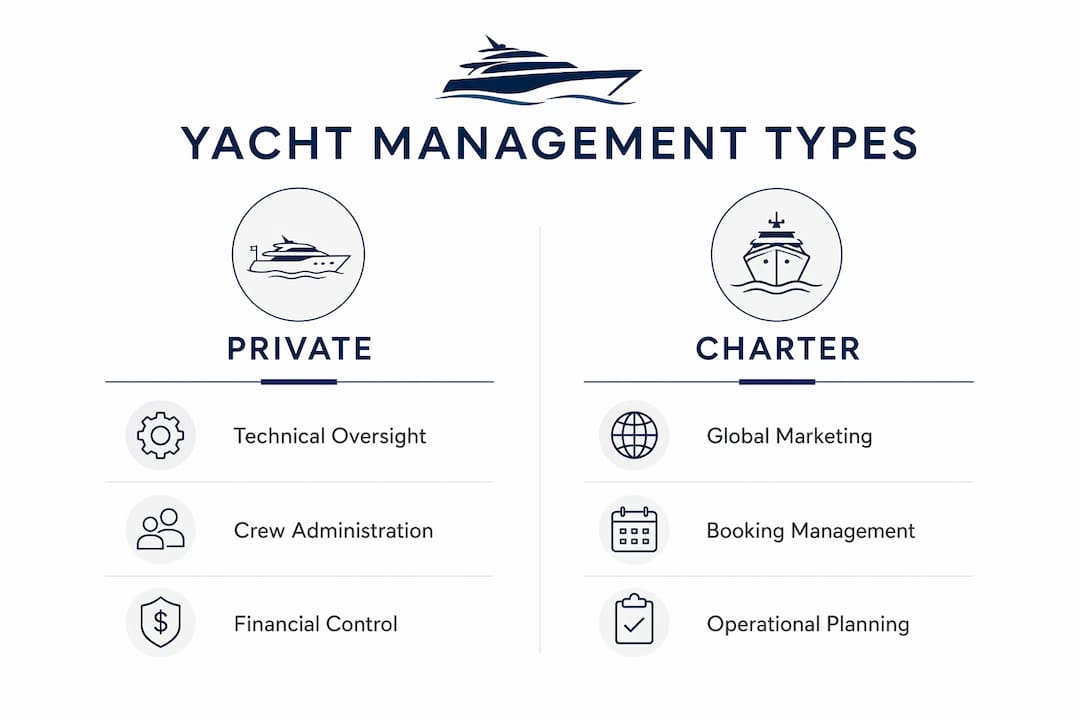
Technical management covers scheduled maintenance, classification surveys, safety equipment servicing, and systems monitoring. Commercial or charter management covers marketing, booking coordination, guest services, and revenue accounting. The best management companies, including those operating in the Mediterranean and Caribbean circuits, run both functions under one roof with dedicated department heads for each.
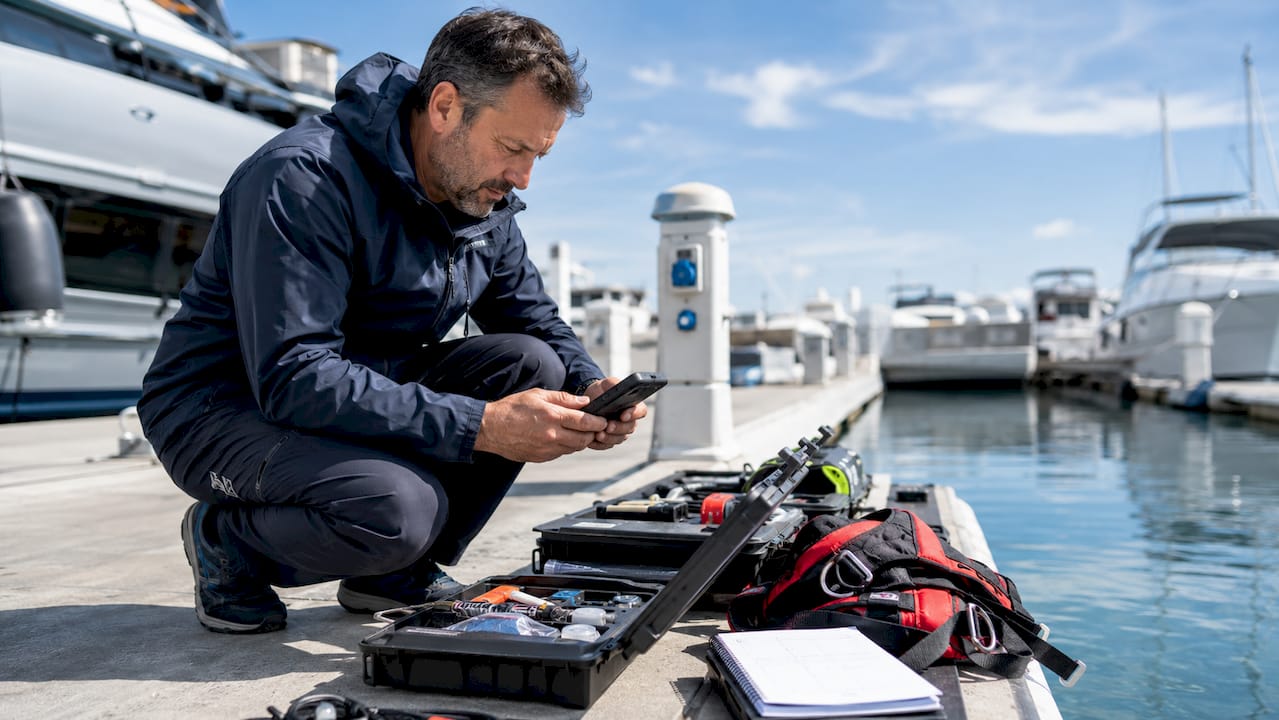
Charter management allows owners to turn a yacht into a financially viable asset through global marketing and operational oversight, including scheduling, guest services, and crew coordination. This matters because running costs on a 40-meter superyacht can exceed $1 million annually. Charter income, managed correctly, offsets a meaningful portion of that figure.
What are the main types of yacht management and how do they differ?
The two primary models are private yacht management and yacht charter management. Private management focuses entirely on keeping the vessel in peak condition for owner use, with no commercial activity. Charter management adds a revenue layer, requiring the management company to act as a commercial operator on your behalf.
| Management Type | Primary Focus | Revenue Potential | Owner Involvement |
|---|---|---|---|
| Private management | Maintenance, crew, compliance | None | High personal use |
| Charter management | Bookings, marketing, guest services | Significant offset of costs | Shared use periods |
| Hybrid model | Both private use and charter income | Moderate to high | Flexible scheduling |
Fee structures vary considerably across these models. Management fees typically range from 5% to 20% of gross charter income, or a fixed retainer scaled to vessel size and service scope. Hybrid fee structures, which combine a base retainer with a performance percentage, align the management company’s incentives directly with your charter revenue goals. That alignment matters more than the headline percentage.
- Fixed retainer: Predictable monthly cost, common for private management
- Percentage of charter income: Ties management compensation to booking performance
- Hybrid model: Base fee plus performance percentage, most common for active charter yachts
- Cost-plus model: Management passes through all expenses with a service markup
Pro Tip: Request a full fee schedule in writing before signing any management agreement. Vague language around “operational expenses” is where unexpected costs accumulate.
How to choose the right yacht management company
Selecting a management company is one of the highest-stakes decisions you will make as an owner. The wrong choice costs you money, crew stability, and charter reputation. The right choice gives you a conductor’s eye over every subsystem on your vessel without requiring your daily involvement.
Start your evaluation with these ten criteria:
- Experience by vessel size and type: A firm managing 30-meter motor yachts may lack the technical depth for a 60-meter sailing superyacht.
- Fleet capacity: Firms managing too many vessels per staff member deliver diluted attention.
- Fee structure transparency: Verifying ISM certification and understanding fee structures prevents costly management failures.
- Financial reporting quality: Monthly owner statements should include actuals versus budget, with receipts available on request.
- Crew management capability: Ask specifically about recruitment pipelines, STCW compliance, and payroll processing.
- Technical expertise: The technical superintendent should have sea-going experience, not just shore-based credentials.
- Regional presence: A firm with a physical office in your primary cruising region resolves problems faster.
- Reporting technology: Real-time owner portals are now standard among leading firms.
- Contract terms: Look for clear exit clauses, notice periods, and liability caps.
- References: Speak directly with at least two current clients of similar vessel size.
Red flags to watch for include high crew turnover within the managed fleet, vague financial reporting, contracts with automatic renewal clauses buried in fine print, and superintendents who are difficult to reach during business hours. These are not minor inconveniences. They are indicators of systemic management failures that will cost you money.
Pro Tip: Ask your shortlisted firms how they handled their last major refit overrun. Their answer reveals more about their operational culture than any marketing brochure.
What does effective yacht maintenance and refit coordination involve?
Routine maintenance and major refits operate on entirely different timescales and require different management approaches. Routine maintenance, covering engine servicing, antifouling, safety equipment checks, and systems calibration, follows a predictable annual cycle. Refits, which may occur every three to five years depending on vessel age and usage, require dedicated project management from start to finish.
Professional refit project management is essential because operational crews cannot fully absorb the complexity of managing a refit effectively. A captain and chief engineer are skilled at running a vessel. They are not trained to manage shipyard contracts, coordinate subcontractors, control scope creep, or enforce quality inspections across multiple trades simultaneously. Engaging a dedicated refit manager, or a management firm with an in-house refit department, is not a luxury. It is a cost-control measure.
A well-structured refit follows five stages:
- Condition assessment: Survey all systems, hull, and interior to establish a scope of work before approaching any shipyard.
- Budget development: Build a detailed cost estimate with a contingency reserve of at least 15% to 20% of the total project value.
- Shipyard selection: Compare facilities in Fort Lauderdale, Palma de Mallorca, and La Ciotat based on capacity, scheduling, and specialist subcontractor access.
- Scheduling and coordination: A well-executed refit requires continuous quality inspection and tight scheduling to prevent delays from cascading across trades.
- Quality assurance and sea trials: Every completed system requires sign-off before the vessel returns to service.
Delays and budget overruns most commonly stem from late planning or changing project scopes mid-refit. Owners who engage their management team six to twelve months before a planned refit consistently achieve better outcomes than those who begin planning three months out. You can explore refit timeline planning in detail to understand how sequencing decisions affect your overall project cost.
Pro Tip: Lock your refit scope before the vessel enters the shipyard. Every scope change after work begins costs two to three times what it would have cost in the planning phase.
How does crew management influence yacht operations and guest experience?
Crew management is the operational backbone of any well-run yacht. It covers recruitment, STCW and flag state certification, payroll processing, rotation scheduling, performance reviews, and onboard culture. For charter yachts, it also directly determines your revenue potential.
High crew turnover negatively impacts guest satisfaction and charter revenue. Stable, well-trained crews increase bookings and generate repeat clients. This is not a soft metric. Charter brokers at firms like Burgess and EYOS Expeditions actively track crew reputations when recommending vessels to clients. A yacht with a known, experienced crew commands a premium in the charter market.
The distinction between crew management for private versus charter yachts is significant:
- Private yacht crews prioritize owner preferences, discretion, and vessel readiness for spontaneous departures.
- Charter yacht crews must balance owner standards with guest hospitality, requiring training in concierge services, dietary management, and activity coordination.
- Training programs focused on the “Concierge Mindset,” a guest-first service philosophy adapted from luxury hotel management, produce measurable improvements in charter reviews and repeat bookings.
Maritime labor law compliance, including the Maritime Labour Convention (MLC 2006) requirements for rest hours, social contributions, and repatriation rights, adds another layer of complexity. A management firm with a dedicated crew department handles these obligations systematically, protecting you from liability. You can read more about professional crew management and why it matters for your specific vessel type.
Pro Tip: When evaluating a management firm’s crew department, ask for their average crew tenure across the fleet. Anything below 18 months suggests a retention problem that will eventually affect your vessel.
What practical steps maximize operational efficiency and ownership satisfaction?
Operational efficiency in yacht management comes from three sources: technology adoption, proactive planning, and clear communication between you and your management team. Owners who treat management as a passive service consistently underperform those who engage as informed partners.
Real-time reporting portals give owners direct visibility into maintenance schedules, financial accounts, and charter bookings without requiring daily calls to the management office. This technology builds trust and catches problems early. An unexpected engine hour spike visible in a dashboard triggers a conversation before it becomes a breakdown.
Practical steps that deliver measurable results include:
- Schedule quarterly owner briefings with your management team to review financials, upcoming maintenance, and crew performance. Structured owner briefings prevent small issues from compounding.
- Plan itineraries twelve months ahead for charter yachts. Early itinerary planning allows brokers to market specific destinations and dates, which increases booking conversion rates. Detailed guidance on optimizing yacht itineraries shows how destination sequencing affects both fuel costs and guest appeal.
- Invest in preventative maintenance rather than reactive repairs. A proactive maintenance program costs less over a five-year period than the combined cost of emergency repairs, unplanned downtime, and charter cancellations.
- Leverage your management firm’s broker network. Firms with established relationships at Camper & Nicholsons, Northrop & Johnson, and similar houses generate charter leads that independent owners cannot access.
The marina reservation systems now available at premium facilities also reduce operational friction for management teams coordinating guest arrivals, provisioning, and berth scheduling across multiple destinations.
Key takeaways
Professional yacht management integrates technical oversight, crew administration, charter operations, and compliance into a single system that protects vessel value and enhances every aspect of ownership.
| Point | Details |
|---|---|
| Management type determines revenue | Choose between private, charter, or hybrid models based on your usage goals and cost offset targets. |
| Fee structure alignment matters | Hybrid fee models tie management incentives to charter performance, producing better outcomes than flat retainers alone. |
| Refit planning requires early engagement | Begin refit planning six to twelve months out and lock scope before entering the shipyard to control costs. |
| Crew stability drives charter revenue | Stable, trained crews with concierge service skills directly increase bookings and repeat client rates. |
| Technology enables owner oversight | Real-time reporting portals give owners financial and operational visibility without requiring daily management involvement. |
What I’ve learned about owner expectations and where management actually fails
After years of working with owners across the full spectrum of vessel sizes, the pattern I see most consistently is this: owners invest heavily in the vessel itself and underinvest in the management infrastructure around it. A $10 million yacht with a $50,000 annual management budget is a liability waiting to materialize.
The shift I find most significant right now is the growing demand for sustainability integration. Hybrid propulsion management and fuel optimization are no longer niche requests from eco-conscious clients. They are becoming standard expectations from charter guests and, increasingly, from flag states and port authorities. Management firms that cannot advise on hybrid system maintenance or itinerary fuel planning are already behind.
The other misconception I encounter regularly is the belief that a good captain can substitute for a professional management company. A captain manages the vessel and crew at sea. A management company manages the business of owning a yacht on shore. These are complementary roles, not interchangeable ones. Owners who conflate them end up with captains doing administrative work they were not hired or trained to do, and vessels that drift out of compliance as a result.
My honest advice: treat your management company as a long-term partner, not a vendor. The firms that deliver the best outcomes are the ones where the owner and management team have built genuine trust over multiple seasons. That relationship takes time to develop, and it starts with choosing the right firm from the beginning.
— Jason
How Baranofyachts approaches yacht management and custom builds
At Baranofyachts, we work with owners from the earliest concept stage through to delivery and ongoing management, ensuring every decision made during the build or refit phase supports long-term operational performance. Our project management approach treats each vessel as a precision system where technical, aesthetic, and operational requirements are coordinated with the same conductor’s eye we apply to every custom build. If you are ready to define exactly what your ideal yacht looks like and how it should perform, our yacht configuration tool gives you a structured starting point for that conversation. We are here to support the full ownership experience, from first specification to final delivery.
FAQ
What is yacht management?
Yacht management is the professional administration of a vessel’s technical systems, crew, finances, and regulatory compliance. It covers everything from routine maintenance scheduling to ISM certification and charter booking coordination.
What is yacht charter management?
Yacht charter management is a commercial service where a management company markets your vessel, handles bookings, manages guest services, and oversees crew operations to generate charter income and offset running costs.
How much do yacht management fees typically cost?
Management fees range from 5% to 20% of gross charter income for charter yachts, or a fixed monthly retainer for private vessels scaled to vessel size and service scope. Hybrid structures combining both are common for active charter programs.
Do I need a management company for a yacht under 24 meters?
Yachts above 24 meters generally require professional management due to ISM compliance and flag state regulations. Smaller vessels can often be managed with lighter oversight, though technical and crew administration support remains valuable at any size.
What is the biggest risk in yacht refit management?
Owners consistently underestimate the specialized knowledge required for refit project management, leading to scope changes, delays, and cost overruns. Engaging a dedicated refit manager before the vessel enters the shipyard is the most effective way to control both timeline and budget.
Recommended
Sold Listings
Design Your Yacht
"*" indicates required fields
Maximus III - PNW
As you step aboard MAXIMUS III, the first impression is her scale.
At 120 feet with an 8-meter beam and 294 GT of interior volume, this 2025 Crescent Custom tri-deck immediately feels open, balanced, and estate-like. A timeless look while still feeling fresh from the shipyard.
Currently Available


Get your yacht value Estimate
"*" indicates required fields