

Most yacht owners assume crew management means finding the right captain and a few deckhands. In reality, why consider crew management at all unless you grasp its full scope: it governs payroll compliance, certification currency, watch scheduling, crew welfare, medical care obligations, and the kind of operational continuity that keeps guests happy and inspectors satisfied. Known formally as human element administration, crew management covers recruitment through repatriation and every administrative layer in between. Get it right, and your vessel runs like a precision instrument. Get it wrong, and you pay for it in disrupted charters, regulatory penalties, and crew turnover that erodes the guest experience you have invested so much to build.
Table of Contents
- Key takeaways
- Why consider crew management: the full operational picture
- Compliance, crew welfare, and what the law now requires
- Human factors, safety culture, and the guest experience connection
- Digital platforms and the importance of crew management systems
- Evaluating crew management services: what to look for
- My honest take on crew management as a strategic investment
- How Baranofyachts helps you get it right
- FAQ
Key takeaways
| Point | Details |
|---|---|
| Crew management is end-to-end | It covers far more than hiring, including payroll, certifications, welfare, and repatriation. |
| Compliance is legally enforceable | MLC 2006 and its 2022 amendments impose strict welfare, medical, and accommodation standards on yacht owners. |
| Human factors drive incidents | Up to 85% of maritime incidents involve human factors, making crew management a direct safety lever. |
| Digital tools reduce admin burden | Centralized platforms cut reconciliation errors and free up captains to focus on seamless guest service. |
| Retention metrics reveal quality | Evaluating crew management providers by retention rates and placement times tells you more than any brochure. |
Why consider crew management: the full operational picture
Think of a well-run luxury yacht the way you would a well-rehearsed orchestra. Every musician knows their part, their timing, and their cue. Crew management is the conductor’s discipline that makes that possible. Full human element administration encompasses every touchpoint from initial recruitment to end-of-contract repatriation, and each one carries real operational weight.
Here is what that lifecycle looks like in practice:
- Recruitment and certification verification: Sourcing qualified crew with valid STCW certificates, medical fitness documents, and role-specific endorsements before they step aboard.
- Contracts and payroll: Structuring legally sound employment agreements and managing multi-currency payroll on time, every month, regardless of which flag state the vessel is registered under.
- Scheduling and rotations: Planning watch rotations, shore leave, and crew changes so fatigue is managed proactively rather than reactively after an incident.
- Crew welfare programs: Addressing rest requirements, mental health access, nutrition standards, and the kind of morale investment that keeps experienced crew returning season after season.
- Departure and repatriation logistics: Managing travel, visa requirements, and crew handovers without creating gaps in the vessel’s operational capability.
When these functions are handled in silos or delegated informally, knock-on effects accumulate. A single expired certificate can ground a vessel at a port state inspection. A payroll error can trigger a grievance that escalates into a crew walkout days before a major charter. Centralizing these workflows reduces reconciliation time, cuts administrative errors, and gives owners and captains a single source of operational truth.
Pro Tip: Ask any crew management provider to show you their certificate-tracking dashboard before signing. If they cannot demonstrate real-time expiry alerts for STCW endorsements, move on.

Compliance, crew welfare, and what the law now requires
Maritime labor law is not abstract. The Maritime Labour Convention 2006, ratified by the major flag states used by luxury yachts, sets legally binding standards that affect how you operate every day at sea. The 2022 amendments tightened those obligations considerably. New requirements on social connectivity, accommodation, food, and health are now enforceable standards, not aspirational guidelines.
One area that catches yacht owners off guard is medical care. Under MLC 2006 Regulation 4.1, shipowners must provide medical care at no cost to crew members, onboard or ashore, including treatments and medical appliances. A designated officer must hold responsibility for onboard medical care at all times. Failing to document that chain of responsibility correctly is both a compliance deficiency and an operational liability.
The welfare picture extends to:
- Social connectivity: Reasonable internet access for crew is now a compliance requirement under the 2022 amendments, not a perk.
- Accommodation standards: Berth dimensions, ventilation, and noise levels must meet specified minimums.
- Rest hour documentation: Watch schedules must be logged and verifiable, with minimum rest periods protected regardless of operational pressure.
“Crew management failures often arise not from paperwork errors, but from operational mismatches where the system on file does not reflect what is happening onboard.” MGN 706, MLC 2022 amendments
The practical implication for yacht owners is clear. Compliance-minded crew management is not a bureaucratic burden. It is the mechanism that keeps your vessel operating on schedule, preserves your flag state standing, and protects you from the kind of port state detention that can derail an entire season. You can read more about how registration obligations intersect with yacht compliance obligations in how those frameworks reinforce each other.
Human factors, safety culture, and the guest experience connection
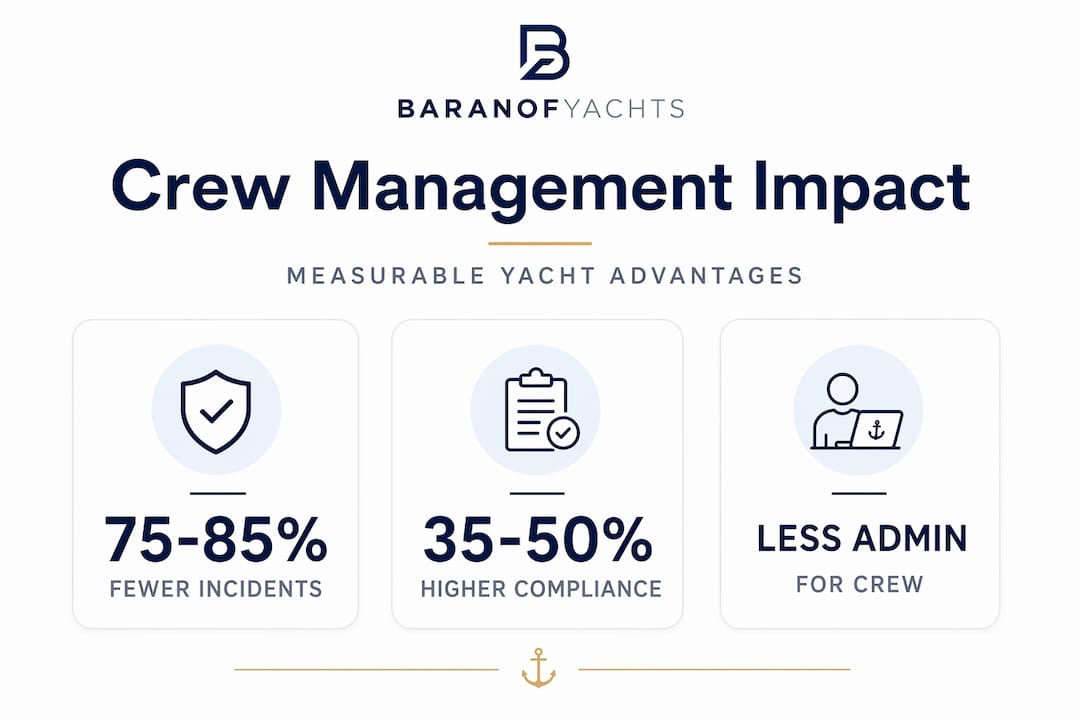
Here is a figure that deserves serious attention: human factors contribute to 75 to 85 percent of maritime incidents. Not mechanical failures. Not weather. People. Fatigue, cognitive overload, unclear procedures, poor situational awareness. These are crew management problems at their root, and they are entirely addressable with the right practices in place.
The connection to safety is well documented. What often goes unrecognized is the connection to guest experience. Operational frictions that affect guests rarely begin with a service moment on deck. They begin upstream: a crew member who has not slept properly because the watch rotation was mismanaged, a steward distracted by an unresolved payroll dispute, a captain burdened with administrative tasks that should have been handled ashore.
| Factor | Without crew management | With crew management |
|---|---|---|
| Fatigue management | Reactive, after incidents occur | Proactive rotation scheduling with documented rest hours |
| Certification currency | Discovered at inspections | Real-time tracking with advance expiry alerts |
| Payroll disputes | Escalate, affecting morale | Resolved before affecting performance |
| Incident rate | Elevated due to human error | Reduced through structured procedures and welfare programs |
Well-designed digitalization improves situational awareness and procedural compliance by 35 to 50 percent. That figure reflects more than software adoption. It reflects what happens when crew are not cognitively overloaded by poorly designed processes and can focus their attention where it belongs: running a safe, guest-ready vessel.
Pro Tip: Review your watch scheduling records quarterly. If rest-hour violations appear in your logs, treat them as a leading indicator of incident risk, not just a compliance gap.
Digital platforms and the importance of crew management systems
The administrative complexity of managing a professional crew would challenge any operation. Across a typical luxury superyacht, you are tracking certifications across multiple flag states, processing payroll in multiple currencies, coordinating crew travel, managing expense approvals, and maintaining audit-ready welfare documentation. The importance of crew management systems becomes obvious when you try to do all of that manually and realize where the gaps are.
Modern platforms address these challenges with a centralized approach:
- Expense and payroll portals: App-based approvals that eliminate paper trails and reduce reconciliation errors dramatically.
- Certification dashboards: Automated alerts for expiring STCW endorsements, medical certificates, and flag state documents.
- Scheduling tools: Rotation planners that account for rest hours, leave entitlements, and crew change logistics.
- Document storage: Flag state declarations, employment contracts, and welfare records stored and retrievable for port state inspections.
The benefit of centralizing these functions extends beyond admin efficiency. Captains and officers freed from administrative processing are able to give their full attention to vessel operations and guest service. That shift in focus is one of the most underappreciated benefits of crew management technology. You can explore how itinerary and operational planning connect to crew readiness for a fuller picture of how these systems reinforce each other.
Evaluating crew management services: what to look for
Selecting a crew management provider requires the same due diligence you would apply to any mission-critical service. A polished brochure and a long client list tell you very little. What you need is evidence of operational capability, and the right questions to surface it.
- What is your crew retention rate, and what is your average time to placement? Retention rates and placement times are the two metrics that reveal whether a provider actually builds long-term relationships with quality crew or simply fills vacancies and moves on.
- How do you verify certifications before placement? Providers should be able to describe a documented verification process, not just confirm that checks are performed.
- How is payroll handled for multi-flag or multi-currency vessels? This question quickly separates providers with genuine maritime payroll expertise from those who handle yacht payroll as an afterthought.
- What welfare standards do you enforce for crew on placement? Providers operating below MLC 2006 minimums expose you to shared liability.
- Can you demonstrate your certificate tracking and welfare compliance tools? If the answer is a spreadsheet, that is a warning sign worth taking seriously.
| Evaluation area | Strong provider | Weak provider |
|---|---|---|
| Retention rate | Above industry average with documented data | Unable to provide figures |
| Certification checks | Documented process with digital audit trail | Verbal confirmation only |
| Payroll expertise | Multi-flag, multi-currency experience | Single-flag domestic payroll background |
Align your provider selection with your vessel type and operational profile. A vessel running commercial charter seasons has different crew management needs than a privately used explorer yacht. The provider who is right for one may not serve the other well. Understanding your owner’s representative role in overseeing these relationships is just as important as the provider you select.
My honest take on crew management as a strategic investment
I have seen yacht owners approach crew management the way they approach insurance: something you maintain because you have to, not because you see the return. That framing costs them more than they realize.
What I have learned from watching well-run luxury operations is that the most visible differentiator between an exceptional guest experience and a merely adequate one is almost always the crew. Not the yacht’s specifications, not the itinerary, and not the catering. The crew. And the crew that delivers that experience consistently is the crew that feels respected, fairly compensated, properly rested, and professionally managed.
The compliance side matters too, but not only for risk avoidance. Operators who invest in genuine welfare programs, transparent payroll, and structured rotations attract better crew. Better crew stay longer. Longer tenure means deeper vessel knowledge, smoother guest interactions, and fewer of the small operational misfires that accumulate into a charter that falls short of expectations.
My take on how to improve crew management in practice: treat the human element with the same rigor you apply to engineering subsystems. If you would not let a critical mechanical system run without maintenance tracking and performance reviews, you should not let your crew management operate that way either. The returns, in safety, compliance, and guest satisfaction, justify the investment many times over.
— Jason
How Baranofyachts helps you get it right
At Baranofyachts, we work with owners from the earliest planning stages through to delivery and active operation, and crew management considerations are part of that conversation from the start. The way a vessel is configured, its crew quarters, its systems, and its operational profile all affect how effectively a crew can be managed once you are underway.
Whether you are configuring a new build with crew welfare and operational efficiency in mind, or working with our team to evaluate how existing systems support your crew management goals, we bring the same meticulous oversight we apply to every aspect of yacht construction and project management. We can also connect you with our broader network of maritime professionals, including the specialists who handle the project management disciplines that keep complex builds and operations running without costly surprises. Reach out to our team to start the conversation.
FAQ
What does crew management actually cover?
Crew management covers the full administrative lifecycle from recruitment and certification verification through payroll, scheduling, welfare, and repatriation. It is far broader than hiring alone.
Why use crew management systems on a luxury yacht?
Digital crew management systems centralize payroll, certification tracking, and compliance documentation, reducing reconciliation errors and freeing captains to focus on safety and guest service rather than administration.
What are yacht owners’ legal obligations under MLC 2006?
Under MLC 2006 Regulation 4.1, medical care at no cost must be provided to all crew members, with a designated officer responsible for onboard medical welfare at all times.
How does crew management affect guest experience?
Operational frictions like unresolved payroll disputes and fatigue from poor scheduling affect crew performance before any guest-facing service issues arise. Well-managed crews are better rested, more focused, and consistently deliver higher-quality guest experiences.
What metrics matter most when evaluating a crew management provider?
Crew retention rates and average time-to-placement are the two most telling indicators of a provider’s real capability, revealing whether they build lasting relationships with quality crew or simply fill vacancies.
Recommended
Sold Listings
Design Your Yacht
"*" indicates required fields
Maximus III - PNW
As you step aboard MAXIMUS III, the first impression is her scale.
At 120 feet with an 8-meter beam and 294 GT of interior volume, this 2025 Crescent Custom tri-deck immediately feels open, balanced, and estate-like. A timeless look while still feeling fresh from the shipyard.
Currently Available


Get your yacht value Estimate
"*" indicates required fields