

Knowing how to optimize yacht itineraries is the difference between a trip that flows effortlessly and one that leaves guests exhausted, rushed, or anchored in the wrong cove at the wrong time. Most planning failures share the same culprits: over-ambitious daily passages, weather ignored until it becomes a problem, and routes designed around maps rather than experience. Whether you are an owner planning your own season, a captain coordinating a charter, or a travel planner building premium voyages for discerning clients, the decisions you make before leaving the dock shape everything that follows. This article walks you through the preparation, structure, and execution that separate good itineraries from exceptional ones.
Table of Contents
- Key takeaways
- How to optimize yacht itineraries: the planning prerequisites
- Designing efficient yacht routes step by step
- Maintaining flexibility when conditions change
- Blending guest experiences into the route
- My take on what actually makes an itinerary work
- How Baranofyachts supports your next optimized voyage
- FAQ
Key takeaways
| Point | Details |
|---|---|
| Plan well in advance | Book and plan 6 to 12 months ahead for peak seasons to secure availability and meet local compliance requirements. |
| Match the yacht to the route | The ideal yacht depends on guest priorities and itinerary fit, not price alone, which directly impacts satisfaction. |
| Limit daily cruising distance | A 28-nautical-mile daily leg balances passage time with time to explore and rest on 7-day charters. |
| Build in contingency time | A 30-minute buffer for marina arrivals reduces stress at busy ports during peak season. |
| Keep itineraries flexible | Pre-identifying backup anchorages within 5 to 8 nautical miles gives captains real options when conditions change. |
How to optimize yacht itineraries: the planning prerequisites
Before you plot a single waypoint, the foundational work you do in planning determines how well everything else holds together. Yacht itinerary planning at the highest level is not about choosing the most scenic route. It is about understanding the constraints and priorities that shape a realistic, enjoyable experience.
The starting point is yacht selection. Matching the yacht’s capabilities to the intended itinerary and the desired atmosphere is more consequential than selecting the largest or newest vessel on the market. A blue-water passage yacht and a harbor-hopping motor cruiser call for entirely different routes and schedules. If you are commissioning a custom build, the itinerary profile you plan to run should inform the vessel’s design from the beginning.
Guest priorities deserve equal attention. Consider these core variables before drafting any route:
- Activity preferences: Do guests prioritize snorkeling and watersports, cultural shore visits, gourmet dining at port, or quiet anchorages for relaxation?
- Physical comfort: Motion sensitivity, age ranges, and fitness levels all influence how long a daily passage should be.
- Social dynamics: Families with children, couples, and corporate groups each have different rhythms and peak-experience windows.
- Onboard equipment: Match the watercraft, dive gear, or fishing equipment carried to the destinations planned.
Regional regulations and seasonal weather patterns are the two variables most commonly underestimated. Different cruising grounds impose distinct rules on anchoring, protected marine areas, and overnight mooring. Ignoring these early creates scheduling collisions mid-trip. On the weather side, planning 6 to 12 months ahead for peak summer seasons and 6 to 9 months for shoulder seasons gives you the time to secure the right yacht and meet all local compliance requirements without scrambling.
Pro Tip: Talk to a local captain or charter agent who has run the route in the past two seasons. Regional knowledge on berth availability, customs processing times, and informal anchoring norms is worth more than any cruising guide.
Designing efficient yacht routes step by step
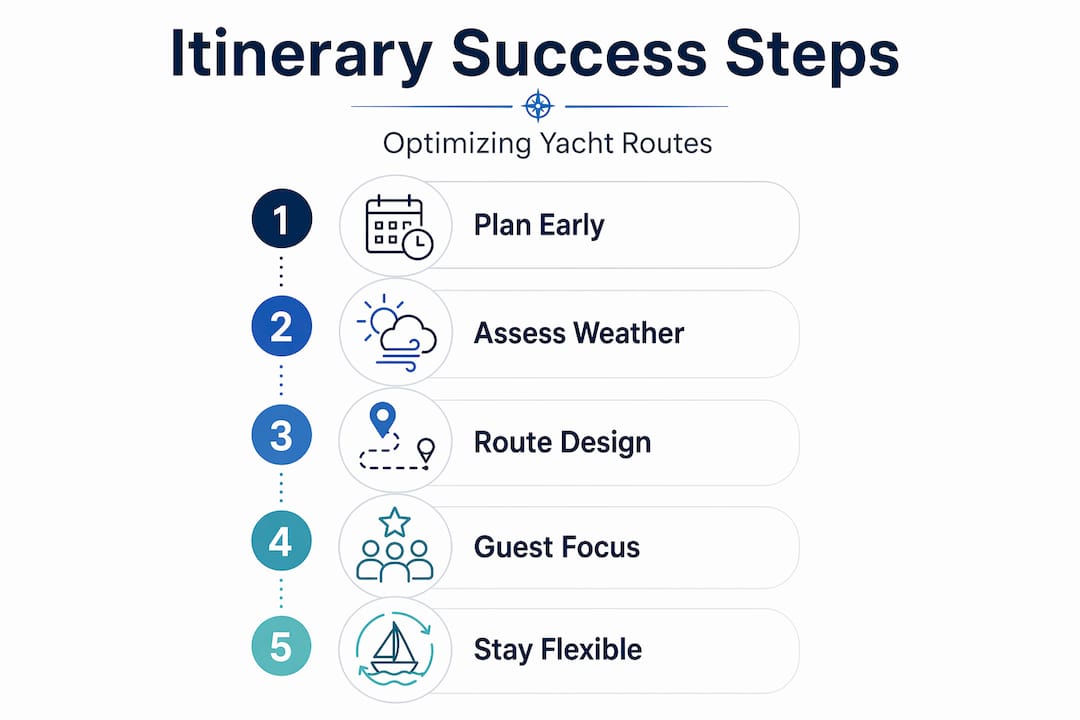
With your prerequisites mapped, the route itself comes next. The most practical method for structuring any itinerary is to identify the furthest destination first, then work backward toward your start point. This forces you to confront realistic daily distances early rather than discovering the problem mid-charter.
Follow this sequence when designing your route:
- Mark the apex destination. Identify the most distant point you intend to reach and calculate the total nautical miles from your departure port.
- Divide into daily legs. For a 7-day charter, a 28-nautical-mile daily leg is a practical limit that preserves time for exploration and rest without over-taxing crew or guests.
- Cluster your destinations. Successful itineraries concentrate stops in dense cruising regions, minimizing long repositioning passages that add mileage without adding experience.
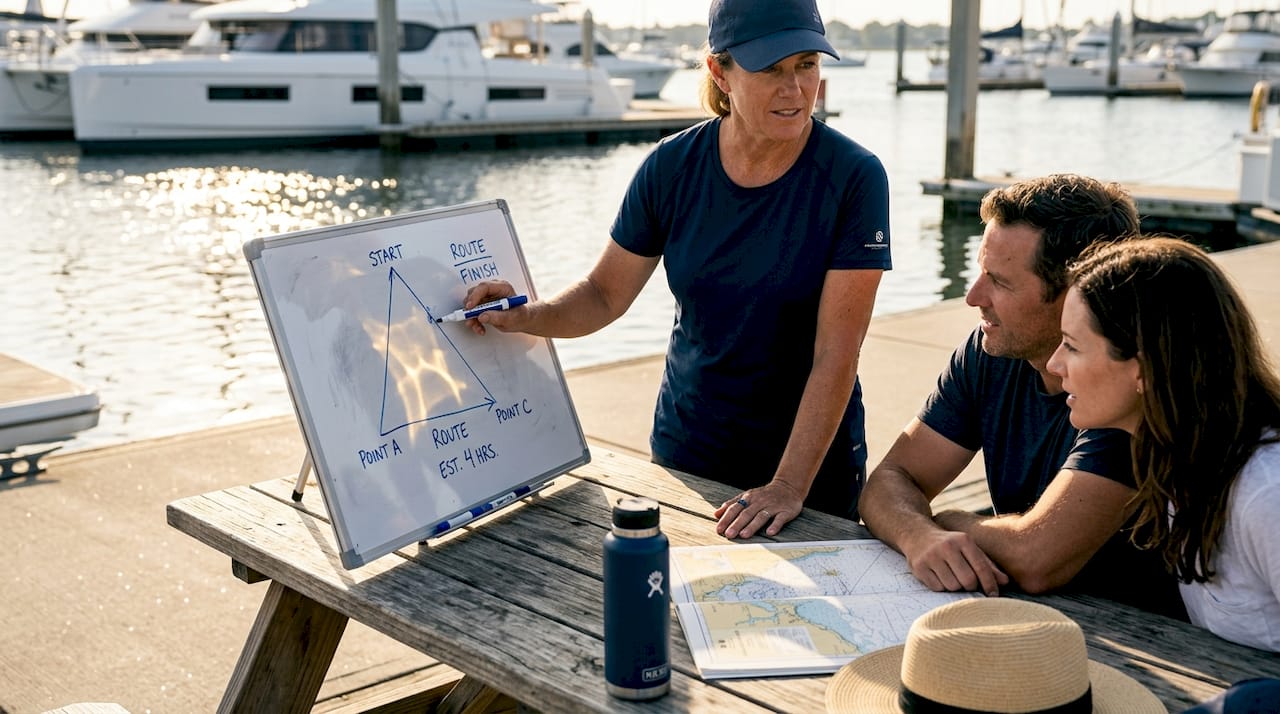
- Apply triangle routing. Rather than sailing point A to B and back again, design the route as a loop or triangle. This maximizes the number of distinct destinations while reducing redundant miles.
- Alternate anchorages and marinas. A healthy mix of open anchorages and marina berths provides variety in atmosphere, access to shoreside amenities, and practical operational needs like provisioning and fueling.
- Insert buffer time. Budget at least 30 minutes of arrival buffer at every marina stop to absorb delays caused by traffic, slow maneuvering in tight harbors, or customs procedures.
The table below illustrates how daily legs translate across common charter durations using the 28-nautical-mile benchmark as a guide:
| Charter duration | Total daily legs | Approximate range covered |
|---|---|---|
| 7 days | 5 to 6 sailing days | 140 to 168 nautical miles |
| 10 days | 7 to 8 sailing days | 196 to 224 nautical miles |
| 14 days | 10 to 11 sailing days | 280 to 308 nautical miles |
Pro Tip: Triangle routing is not just about efficiency. When guests see a new coastline each morning rather than a reverse of yesterday’s view, their perception of the trip’s richness increases substantially. The geographic variety alone lifts the experience.
Maintaining flexibility when conditions change
The most technically perfect itinerary on paper becomes a source of frustration the moment a captain feels locked into it. The best approach to optimize sailing trips is to treat the written itinerary as a strong framework rather than an immovable contract.
Weather is the most frequent disruptor, and it rewards preparation. In the Adriatic, for example, thermal winds like the Maestral build predictably between 11 a.m. and 2 p.m., creating passage discomfort for smaller vessels if the timing is ignored. Planning departures for early morning and reserving afternoons for anchorage activities sidesteps the problem entirely. This kind of tailored trip planning is what separates reactive crews from proactive ones.
Pre-identified alternatives are the operational backbone of a flexible itinerary. Keep these practices built into every plan:
- Backup anchorages within range: Pre-identify at least one alternative anchorage within 5 to 8 nautical miles of every planned stop. If a marina is full or conditions deteriorate, the fallback is already charted and vetted.
- Captain’s authority to adapt: The best charter experiences come from captains who adjust calmly based on weather and guest mood, avoiding drama and keeping comfort as the priority. That authority needs to be explicitly granted in advance, not negotiated underway.
- Weather windows by leg: Review forecasts 48 to 72 hours ahead for each passage, not just at the trip’s outset. Conditions in the Mediterranean or Caribbean can shift within a day.
“Balancing structure with flexibility leads to fewer logistical frustrations and more enjoyable spontaneous moments on yacht trips.” — Searadar Yacht Itinerary Planning
The practical upside of flexibility goes beyond weather management. A guest who discovers a quiet fishing village they were not expecting, or a crew that catches perfect wind and makes an unplanned afternoon sail, walks away with stories. Those stories are what define a trip long after the route is forgotten.
Blending guest experiences into the route
The physical route and the guest experience are two separate design problems. Excellent yachting itinerary strategies address both simultaneously rather than treating the schedule as primary and activities as an afterthought.
Start by understanding what your guests actually want, not what a generic itinerary suggests. A group of divers needs proximity to reef systems. A multigenerational family needs calm anchorages with beach access and low-energy afternoon options. A corporate group often values a prestige port arrival as much as any natural attraction. The route must serve the people aboard, not the other way around.
For shorter trips of three to four days, adopt an anchor plan approach. Focusing on one main activity or destination per trip reduces decision fatigue and keeps the schedule manageable, while leaving other activities loosely organized. On a long weekend, over-programming leaves everyone feeling like they are rushing rather than experiencing.
Consider building the itinerary around a daily rhythm that alternates energy levels:
- Active mornings: Passages, snorkeling excursions, water skiing, or cultural shore visits work best when energy is high and the day is cooler.
- Relaxed afternoons: Spa-style afternoons at anchor, paddleboarding, or simply reading in a secluded cove give guests recovery time without feeling idle.
- Social evenings: Sunset cocktails at anchor or a dinner reservation ashore at a local harbor restaurant create natural social peaks that guests look forward to.
- Rest nights: At least two nights during a week-long charter should be in quiet anchorages rather than busy marina towns, giving guests genuine sleep and stillness.
The onboard upgrades you invest in, whether that is a better tender, watermaker capacity, or climate control in guest cabins, directly expand what your itinerary can offer in remote locations. A yacht that can stay comfortably at anchor for three days without reprovisioning opens up routes that a less equipped vessel simply cannot manage.
My take on what actually makes an itinerary work
I have reviewed and contributed to dozens of yacht itineraries over the years, and the single most consistent mistake I see is conflating ambition with quality. Owners and planners load up a route with impressive destinations, and what they actually deliver is a series of rushed departures, tired guests, and a captain managing logistics instead of the experience.
The best itineraries I have encountered share one quality: they are built around nautical rhythm rather than a destination checklist. The captain knows when to push and when to linger. The schedule breathes. Guests do not feel managed. They feel free.
What I have learned is that matching the skipper’s expertise to the specific cruising ground matters more than any single line item in the vessel’s specification sheet. A brilliant captain on a modest yacht in waters they know intimately will outperform an inexperienced hand on a larger, more luxurious vessel every single time.
I also think the industry undervalues the moment when a plan is abandoned. Some of the most memorable trips I have heard described started when the crew ignored the itinerary entirely and followed an unexpected opportunity. That is only possible when the underlying plan is solid enough that departing from it creates no harm. The structure is what makes spontaneity safe.
Treat itinerary planning as an art form that requires the same discipline as yacht construction. Every element, from the daily distance to the evening anchorage, should be chosen deliberately and connected to a clear purpose.
— Jason
How Baranofyachts supports your next optimized voyage
At Baranofyachts, we understand that the best itinerary begins long before departure. It starts with the right vessel, configured for the routes you intend to run and the guests you intend to impress. Our team works directly with owners, captains, and planners to align yacht specifications with real-world itinerary demands, from hull design and range to onboard equipment and comfort systems. Whether you are exploring a new build, considering an upgrade, or looking for expert guidance on yacht selection, we bring the same precision to trip planning that we apply to every build we manage. Visit our yacht configuration tool to start matching your next vessel to the voyage you have in mind, or explore the full value of working with a professional through our yacht broker guide.
FAQ
What is the best daily distance for a 7-day yacht charter?
A daily leg of approximately 28 nautical miles gives guests time to cruise comfortably while preserving several hours for exploration and relaxation at each stop.
How far in advance should you plan a yacht itinerary?
For peak summer season, plan and book 6 to 12 months ahead. Shoulder season bookings benefit from a 6 to 9-month lead time to secure both the right yacht and required permits.
How do you handle bad weather during a yacht trip?
Pre-identify at least one backup anchorage within 5 to 8 nautical miles of each planned stop and monitor forecasts 48 to 72 hours ahead for each leg. Giving the captain clear authority to adapt eliminates disruption and preserves guest confidence.
What is triangle routing in yacht itinerary planning?
Triangle routing means designing the course as a loop rather than an out-and-back track. This approach exposes guests to more distinct coastlines and destinations while reducing the total miles sailed.
Does yacht size determine itinerary quality?
Not primarily. The match between yacht capabilities and the planned itinerary matters more than size or price. A well-matched, smaller yacht on a thoughtfully designed route will consistently outperform a mismatched larger vessel.
Recommended
Sold Listings
Design Your Yacht
"*" indicates required fields
Maximus III - PNW
As you step aboard MAXIMUS III, the first impression is her scale.
At 120 feet with an 8-meter beam and 294 GT of interior volume, this 2025 Crescent Custom tri-deck immediately feels open, balanced, and estate-like. A timeless look while still feeling fresh from the shipyard.
Currently Available


Get your yacht value Estimate
"*" indicates required fields