

The yachting market is defined as the global commercial and private ecosystem covering the design, manufacture, sale, charter, and maintenance of recreational and luxury yachts. Valued at $9.75 billion in 2026, this industry has grown from $9.41 billion just one year prior. That pace reflects genuine demand, not speculation. Superyachts above 30 meters now anchor an industry with outsized economic reach, drawing in first-time buyers, seasoned collectors, and institutional investors alike. If you are evaluating where and how to enter this market, the data and dynamics below will give you a clear picture of what you are working with.
What is driving growth in the yachting market right now?
The global yacht industry is projected to reach $11.12 billion by 2030, growing at a 3.6% CAGR through 2035. That is a measured, durable growth rate. It signals a market expanding on fundamentals rather than a short-term luxury spending spike.
The superyacht segment carries the most economic weight. A first-of-its-kind global study found the superyacht industry generates €54 billion in total economic impact, with direct industry turnover at €22 billion and indirect effects reaching €32 billion through tourism and supply chains. Every €1 spent in the superyacht sector generates a €2.40 multiplier across connected industries. That figure reframes how you should think about yacht ownership: it is not just a personal asset but a node in a large economic network.
Several forces are shaping the current growth picture:
- Superyacht order books remain full. Demand for vessels above 30 meters has not softened despite broader economic uncertainty.
- Charter and rental markets are expanding. The yacht rental market is pulling in buyers who want to experience ownership economics before committing to a purchase.
- Sustainability is becoming a specification. Hybrid propulsion, solar-assisted systems, and low-emission hull designs are moving from optional upgrades to buyer expectations.
- Geopolitical friction is redirecting, not reducing, demand. Trade tensions have complicated some supply chains, but order volumes at leading yards remain high.
The best yachting destinations continue to attract high-net-worth buyers who want to experience the Mediterranean, Caribbean, and Pacific circuits firsthand before selecting a vessel suited to those waters.
How to buy a yacht: a practical acquisition guide

Buying a luxury yacht is a structured process, not an impulse transaction. The typical acquisition takes 12–24 weeks and involves reviewing 12 to 30 vessels before shortlisting candidates. That range surprises most first-time buyers. The volume of viewings is not inefficiency; it is due diligence.
Here is how a disciplined acquisition unfolds:
- Define your use profile. Decide whether you want a bluewater cruiser, a fast motor yacht, or a displacement vessel suited to extended passages. Your intended waters and crew size drive every specification decision.
- Set a total budget, not just a purchase price. Annual operating costs for a superyacht typically run 10% of the vessel’s value. Factor in crew, insurance, port fees, and maintenance before you commit.
- Engage a qualified broker. A professional yacht broker provides access to both listed and off-market inventory, which matters when the best vessels rarely appear on public platforms.
- Commission an independent survey. This is non-negotiable. The pre-purchase survey must be conducted by a surveyor you hire directly, not one recommended by the selling broker. Objectivity is the entire point.
- Conduct a sea trial. No survey replaces underway performance data. Engine behavior, hull response, and systems function under load reveal what a dockside inspection cannot.
- Review flag state options. Registration jurisdiction affects tax treatment, crew certification requirements, and compliance obligations. The Cayman Islands, Malta, and the Marshall Islands each offer distinct advantages depending on your operating profile.
- Close with legal counsel. Yacht purchase contracts involve VAT exposure, title searches, and lien checks. An experienced maritime attorney protects you at this stage.
Pro Tip: Analyze days-on-market and price-reduction history for any vessel you are considering. Well-priced yachts sell within months, while overpriced inventory can stagnate for 18 months or more. That data tells you exactly how much negotiating room exists.
What are the essential yacht maintenance tips to protect your investment?
Maintenance is where yacht ownership either compounds in value or quietly erodes it. The relationship between routine upkeep and long-term cost is direct and unforgiving.
A single example illustrates the stakes. Neglecting a sacrificial zinc anode that costs $50 can result in up to $5,000 in propeller and shaft corrosion damage. That is a 100-to-1 cost ratio from a single deferred task. Multiply that logic across a vessel’s full systems and the financial argument for disciplined maintenance becomes obvious.
The distinction between preventive and predictive maintenance matters here. Preventive maintenance follows a fixed schedule: engine oil changes, impeller replacements, antifouling paint application, and rigging inspections at set intervals. Predictive maintenance is condition-based: you monitor oil analysis, vibration data, and electrical load patterns to catch failures before they occur. Both approaches are necessary. Neither replaces the other.
Core maintenance priorities every owner should schedule include:
- Engine and generator servicing at manufacturer-specified intervals, typically every 250–500 hours of operation.
- Hull cleaning and antifouling at least annually, more frequently in tropical waters where biofouling accelerates.
- Electrical system inspection, including battery banks, shore power connections, and bilge pump circuits.
- Safety equipment certification: life rafts, EPIRBs, flares, and fire suppression systems all carry expiration dates that flag state regulations enforce.
- Watermaker and HVAC servicing to prevent membrane fouling and refrigerant loss, which are common sources of expensive mid-voyage failures.
Pro Tip: Build a digital maintenance log from day one. When you eventually sell, a complete service record preserves yacht value and gives buyers confidence that accelerates the transaction.
Deferred maintenance does not just cost money. It creates safety exposure. Coast Guard and flag state inspections can result in detentions that ground your vessel until deficiencies are corrected. The reputational and operational cost of a detention far exceeds any short-term savings from skipping scheduled work.
Which regions and builders lead global luxury yacht sales?
Italy is the undisputed center of global superyacht manufacturing. Italy holds 56% of global orders by volume in the 30-meter-and-above segment, with production growing at 5% CAGR from 2023 to 2025. Italian export value approached €4.4 billion in 2025, a figure that held firm despite trade headwinds. Brands like Benetti, Ferretti Group, and Sanlorenzo anchor that dominance.
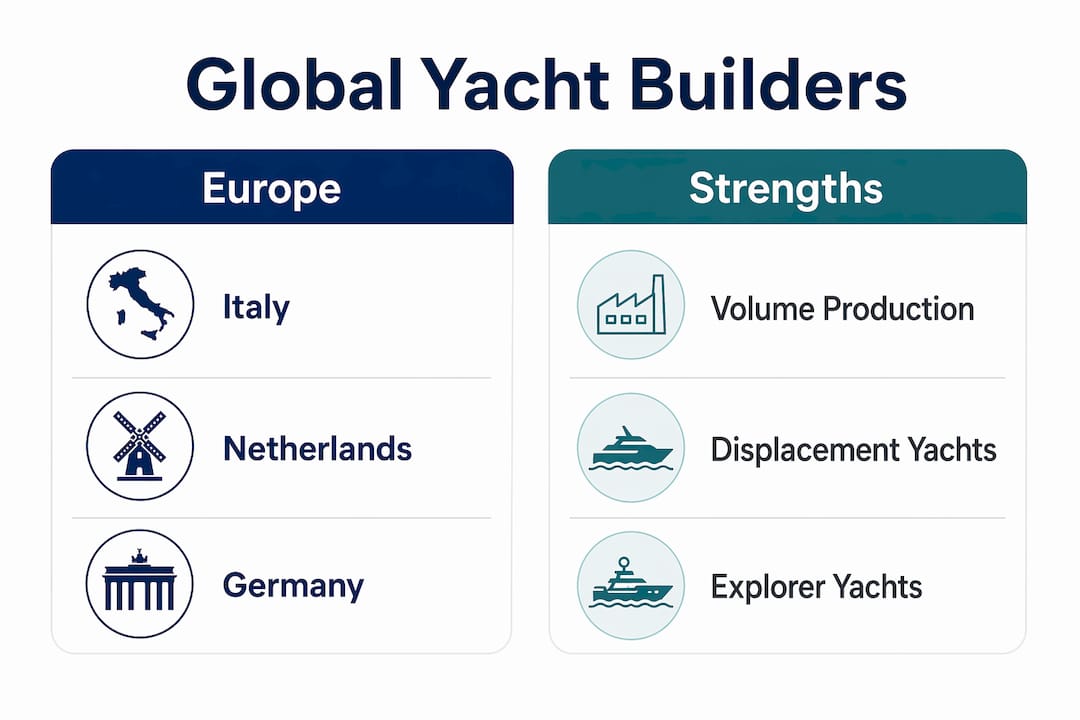
The Netherlands and Germany represent the other major manufacturing centers, particularly for displacement and explorer-style superyachts. Yards like Lurssen and Feadship set the standard for engineering complexity and long-range capability.
| Region | Strength | Notable Builders | Delivery Lead Time |
|---|---|---|---|
| Italy | Volume production, motor yachts | Benetti, Sanlorenzo, Ferretti | 18–36 months |
| Netherlands | Engineering, explorer yachts | Feadship, Heesen | 36–60 months |
| Germany | Structural complexity, large displacement | Lurssen, Abeking & Rasmussen | 48–72 months |
| United States | Sport fishing, custom builds | Viking, Hatteras, custom yards | 12–36 months |
| Turkey | Value-driven builds, gulets | Custom yards | 12–24 months |
Top-tier yards like Lurssen and Feadship carry builder backlogs running through 2027–2029. That capacity constraint is a real market force. Buyers who want a new build from a premier European yard must either commit now or plan for a multi-year wait. Many are turning to the brokerage fleet as a result, which is tightening supply and supporting prices on well-maintained pre-owned vessels.
Understanding superyacht costs and market trends across these regions helps buyers calibrate expectations before they enter negotiations with any yard or broker.
Key takeaways
The global yachting market rewards buyers who combine financial discipline, independent due diligence, and a clear understanding of regional manufacturing capacity before committing to any purchase or build.
| Point | Details |
|---|---|
| Market size and growth | The global yacht market is valued at $9.75 billion in 2026 and projected to reach $11.12 billion by 2030. |
| Acquisition discipline | Budget 12–24 weeks, review 12–30 vessels, and always commission an independent survey and sea trial. |
| Maintenance as investment | Skipping a $50 zinc anode can cost $5,000 in damage; preventive and predictive schedules protect value. |
| Italy leads manufacturing | Italy holds 56% of global superyacht orders above 30 meters, with top yards booked through 2027–2029. |
| Brokerage market pricing | Well-priced vessels sell within months; overpriced inventory stagnates for 18 months or more. |
What i have learned from watching this market closely
The buyers who succeed in this market share one trait: they treat the acquisition process like a capital project, not a lifestyle purchase. They set specifications before they start viewing vessels. They hire their own surveyors. They read days-on-market data the way a real estate investor reads cap rates.
The buyers who struggle are the ones who fall in love with a vessel before the survey comes back. I have watched that pattern play out repeatedly. A beautiful exterior and a persuasive broker can obscure deferred maintenance, structural issues, or systems that are technically functional but operationally unreliable. The survey and sea trial exist precisely to interrupt that emotional momentum with facts.
On the new build side, the backlog situation at premier European yards is not a temporary inconvenience. It reflects genuine demand and constrained skilled labor. If you want a vessel from Feadship or Lurssen, you are making a multi-year commitment from the moment you sign. That is not a reason to avoid new builds. It is a reason to start the process earlier than feels necessary and to work with advisers who have existing relationships at those yards.
The brokerage market, by contrast, offers real opportunity right now. Transparent pricing data, motivated sellers, and a strong inventory of well-maintained vessels from the 2015–2020 build cycle mean disciplined buyers can find genuine value. The key word is disciplined. Overpaying for a poorly maintained vessel because it looks good at the dock is the most common and most expensive mistake in this market.
— Jason
How Baranofyachts helps you move through the market with confidence
Baranofyachts operates at every stage of the luxury yacht acquisition and build process, from initial specification through delivery and post-purchase management. Whether you are evaluating a brokerage purchase or planning a custom yacht build, our team brings the kind of structured oversight that prevents the costly errors this market punishes. We maintain relationships with leading yards, independent surveyors, and flag state specialists so you are never navigating those conversations without experienced support. Our luxury yacht brokerage services give you access to both listed and off-market inventory, with transparent market analysis built into every recommendation. Reach out to start a conversation about your acquisition goals.
FAQ
What is the current size of the global yacht market?
The global yacht market is valued at approximately $9.75 billion in 2026 and is projected to grow to $11.12 billion by 2030 at a 3.6% CAGR.
How long does it take to buy a luxury yacht?
The typical yacht acquisition process takes 12–24 weeks and involves reviewing 12 to 30 vessels before completing a survey, sea trial, and contract review.
Why is an independent survey non-negotiable?
An independent pre-purchase survey verifies the vessel’s actual condition and value without the conflict of interest that exists when a seller’s broker recommends the surveyor.
Which country builds the most superyachts?
Italy leads global superyacht manufacturing with 56% of orders by volume in the 30-meter-and-above segment, driven by builders like Benetti, Sanlorenzo, and Ferretti Group.
How much does deferred maintenance actually cost?
Skipping a $50 sacrificial zinc anode can cause up to $5,000 in propeller and shaft damage. Deferred maintenance across multiple systems compounds those costs exponentially over time.
Recommended
Sold Listings
Design Your Yacht
"*" indicates required fields
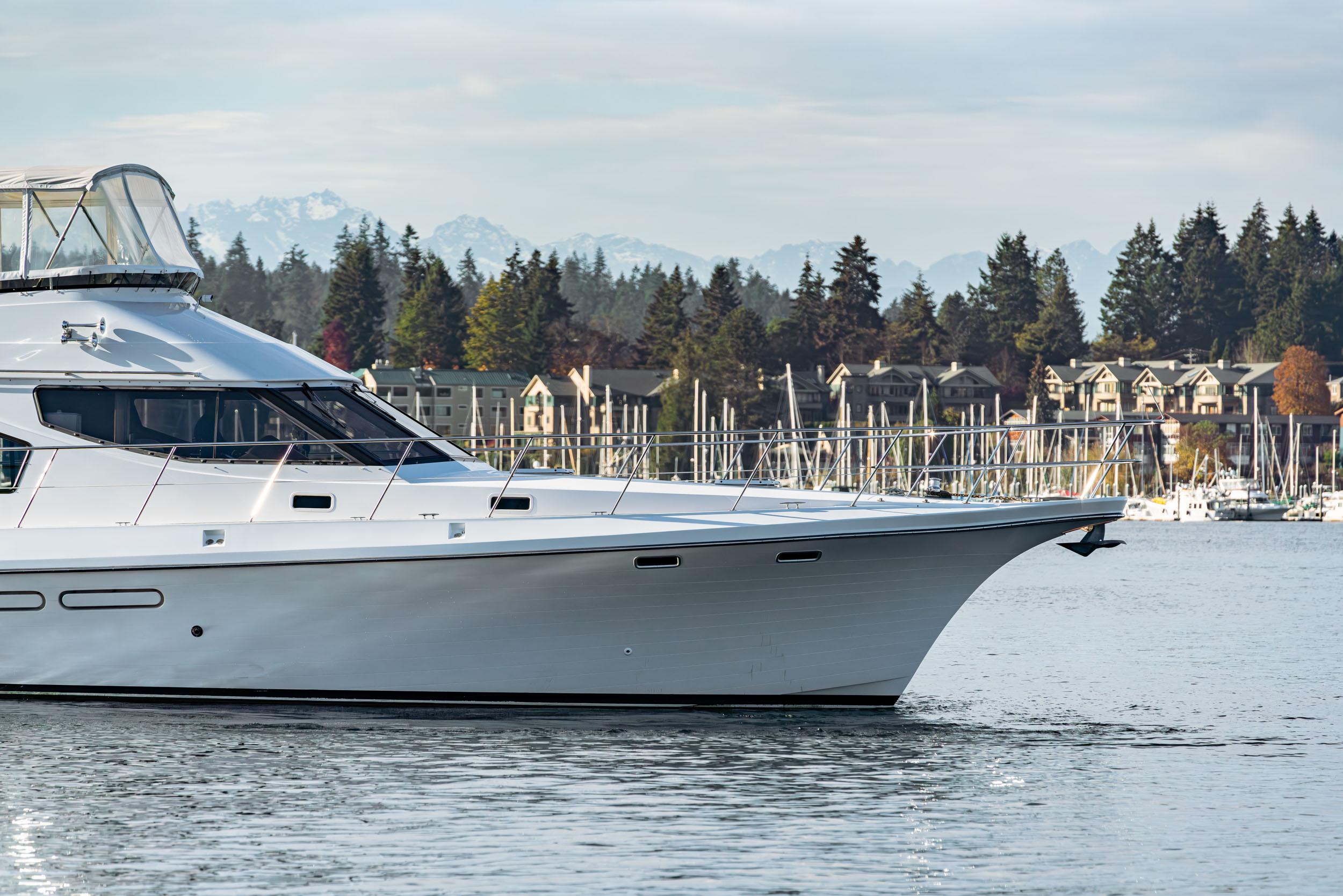
Maximus III - PNW
As you step aboard MAXIMUS III, the first impression is her scale.
At 120 feet with an 8-meter beam and 294 GT of interior volume, this 2025 Crescent Custom tri-deck immediately feels open, balanced, and estate-like. A timeless look while still feeling fresh from the shipyard.
Currently Available


Get your yacht value Estimate
"*" indicates required fields