

A gleaming hull and a reputable builder’s badge can tell you a great deal about a yacht’s origins, but they reveal almost nothing about its current condition, hidden repair history, or actual market value. For affluent buyers and corporate clients entering transactions that can reach well into the millions, relying on appearances alone is not due diligence; it’s a calculated risk taken without the numbers. A professional yacht survey is the mechanism that converts that risk into informed certainty, and understanding exactly how surveys work gives you a decisive edge before any contract is signed.
Table of Contents
- What is a yacht survey?
- The three phases of a yacht survey: What to expect
- Yacht survey costs: What influences the price?
- Special considerations: Superyacht and edge-case surveys
- How to leverage a yacht survey for smart negotiation and peace of mind
- A seasoned perspective on yacht surveys: What most buyers overlook
- Your next step: Expert support for yacht buyers
- Frequently asked questions
Key Takeaways
| Point | Details |
|---|---|
| Three-phase survey process | Every thorough yacht survey includes hull inspection, systems check, and sea trial. |
| Cost varies by size and detail | Expect $18-33 per foot plus extras, with superyachts commanding much higher fees. |
| Critical for smart purchases | Skimping on a survey risks six-figure surprises and missed negotiation leverage. |
| Special steps for superyachts | Large and custom yachts require class, flag checks, and note inaccessible areas. |
| Survey powers better decisions | Well-interpreted survey findings help buyers negotiate, avoid risk, and enjoy true peace of mind. |
What is a yacht survey?
A yacht survey is an independent, expert evaluation of a vessel’s physical condition, structural integrity, mechanical systems, safety equipment, and fair market value. It is commissioned by the buyer, insurer, or sometimes the lender, and it is carried out by a certified marine surveyor who holds no financial stake in the transaction. That independence is the entire point. The surveyor’s job is to give you the unvarnished truth.
Surveys are required or strongly recommended in several key situations:
- Before purchasing any significant vessel, particularly pre-owned yachts
- When applying for marine insurance or renewing an existing policy
- During refinancing or when a lender requires asset verification
- After a grounding, collision, or major weather event to assess damage
- When preparing a yacht for resale and wanting documented proof of condition
The survey covers condition, regulatory compliance, and structural soundness using non-destructive testing methods such as moisture meters, ultrasound, and visual hull inspections. This means surveyors evaluate without cutting into surfaces or dismantling systems, which preserves the vessel’s integrity during the process.
“A yacht survey involves a three-phase process covering hull, systems, and sea trial with non-destructive testing.”
For buyers working with a knowledgeable team, using a yacht broker with survey coordination experience adds another layer of oversight. Brokers who understand the survey process help ensure the right surveyor is selected and that findings are properly interpreted before negotiation begins.
The three phases of a yacht survey: What to expect
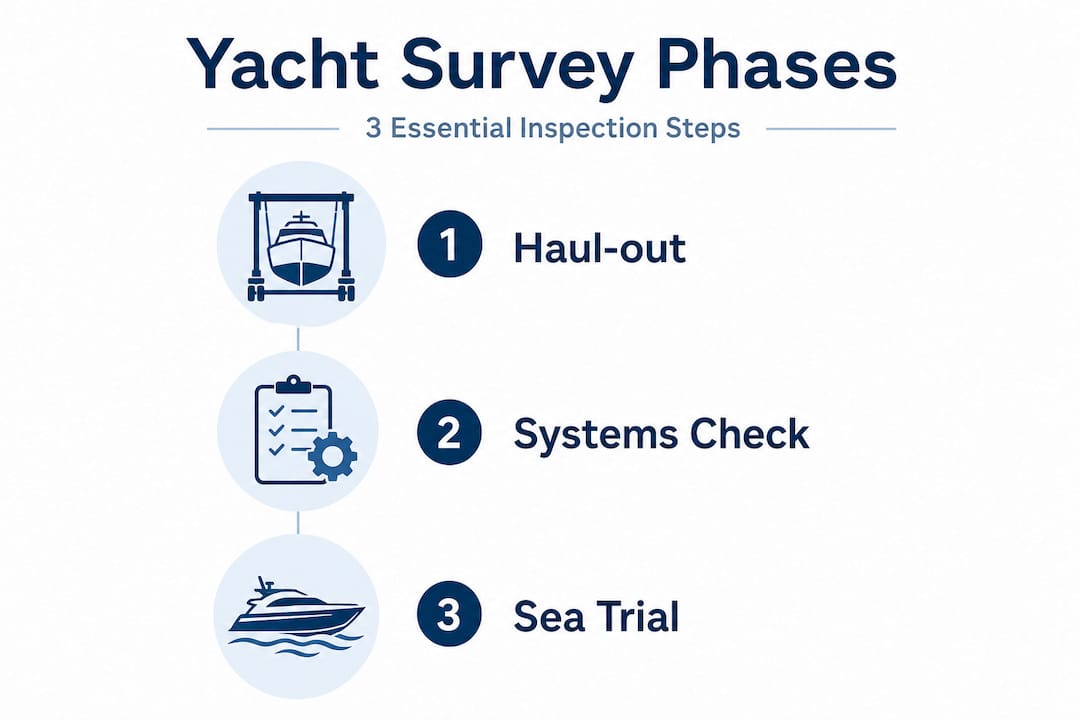
With the importance clear, let’s explore what really happens during a professional yacht survey. Most buyers are surprised to discover that a thorough survey is not a single event but a structured, three-phase process. Each phase targets a different dimension of the yacht’s condition and performance.
-
Phase 1: Haul-out inspection. The vessel is lifted out of the water so the surveyor can examine the hull below the waterline. This is where osmosis blistering, impact damage, antifouling integrity, keel attachment, stern gear alignment, and through-hull fittings are assessed. Moisture readings are taken at multiple points across the hull using calibrated meters. Even a modestly-priced yacht can carry hundreds of thousands of dollars in deferred hull repairs that are invisible when the boat is sitting in a slip.
-
Phase 2: Dockside systems evaluation. Back in the water, the surveyor conducts a systematic inspection of the yacht’s electrical systems, plumbing, fuel systems, navigation electronics, fire suppression, bilge pumps, hatches, and safety gear. This phase also covers structural elements accessible from the interior, including frames, stringers, bulkheads, and engine mounts. Systems aboard modern luxury yachts are layered and interdependent, so a failure in one subsystem often creates knock-on effects elsewhere.
-
Phase 3: Sea trial. The yacht is taken underway, typically with the owner or seller present, so the surveyor can assess performance under load. Engine temperature, vibration patterns, steering response, sail trim behavior (if applicable), and propulsion efficiency are all evaluated. Sea trials reveal load-specific issues that static inspections simply cannot detect, including shaft alignment problems, intermittent electrical faults, and hull flex under power.
Here is a quick comparison of what each phase uncovers versus what it cannot access:
| Survey Phase | Key findings | Limitations |
|---|---|---|
| Haul-out | Hull blistering, keel condition, through-hulls | Interior structural details |
| Dockside systems | Electrical, plumbing, safety gear, electronics | Hidden wiring behind liners |
| Sea trial | Engine performance, vibration, handling | Rare or intermittent faults |

Pro Tip: Always insist on a full sea trial, even for new builds or recently refitted yachts. Commissioning errors and recently installed systems that have never been tested under load can only reveal themselves when the vessel is actually moving.
Aligning survey findings with yacht classification standards gives you a clearer picture of whether the vessel meets the safety and structural benchmarks appropriate for its intended use. For buyers focused on evaluating yacht craftsmanship beyond the cosmetic, the survey is the most reliable lens available.
Yacht survey costs: What influences the price?
Knowing the stages is only part of the equation. Buyers also care about what a thorough survey actually costs, and whether that investment is proportionate to the protection it provides. The short answer: it almost always is.
Survey fees for pre-purchase inspections are generally calculated per foot of vessel length. Standard rates run $18 to $33 per foot for pre-purchase surveys, which means smaller yachts in the 30 to 45 foot range typically cost between $600 and $1,400. Larger yachts over 80 feet often exceed $5,000 for the survey fee alone, not including ancillary costs.
Additional costs that buyers frequently underestimate include:
- Haul-out fees: Lifting the vessel out of the water costs $400 to $800 on average, depending on the marina and the vessel’s size and displacement
- Sea trial costs: Fuel and crew time for the trial phase may be charged separately, especially for large motoryachts
- Specialist consultations: Complex electronics systems, custom mechanical installations, and superyacht-grade materials often require additional specialist input beyond the primary surveyor’s scope
- Travel and mobilization fees: For remote locations or international acquisitions, surveyors may charge travel expenses on top of their standard rate
The cost-to-protection ratio here is straightforward. A survey costing $3,000 on a $1.2 million yacht is 0.25% of the purchase price. The craftsmanship and material details uncovered during that survey can reveal repair or replacement needs that cost ten to fifty times the survey fee. Skipping a survey to save that fraction of a percent is a false economy.
Survey findings also deliver value in ways that extend beyond simple defect detection:
- Validating or challenging the asking price with documented evidence
- Providing insurers with a certified condition report required for full coverage
- Identifying upgrade priorities so you can plan ownership costs from day one
- Creating a baseline record of condition that supports future resale value
- Confirming regulatory compliance for your flag state and cruising area
For buyers at the negotiating yacht price stage, the survey report is often the most powerful tool at the table.
Special considerations: Superyacht and edge-case surveys
With costs in perspective, let’s look at what makes superyacht and unique cases different. Vessels over 24 meters, custom one-off builds, and older classic yachts all introduce variables that a standard survey framework was not designed to handle on its own.
For superyachts operating under a commercial flag or managed under a charter license, parallel surveys involving class and flag state requirements are mandatory in addition to the pre-purchase inspection. Classification societies such as Lloyd’s Register or Bureau Veritas maintain their own survey schedules and standards, and a vessel’s compliance with these bodies carries enormous implications for insurance, port access, and crew certification.
Surveyors working on complex yachts document inaccessible areas explicitly in their reports, noting where non-destructive testing reached its limits. Buyers should treat these notations not as oversights but as areas of elevated risk requiring further investigation. Common edge cases include:
- Custom or one-off builds: Non-standard structural solutions, proprietary systems, or discontinued components that require specialist knowledge to evaluate fairly
- Older classic or vintage yachts: Wooden construction, early composite layups, and legacy electrical systems that fall outside modern assessment benchmarks
- Recently refitted vessels: Refit quality varies enormously. Hidden work behind new liners or freshly painted surfaces can conceal rather than correct underlying problems
- Charter yachts with high operational hours: Accelerated wear across all systems, higher maintenance debt, and documentation that may not fully reflect the vessel’s service history
“Superyachts require parallel class and flag state surveys; surveyors note inaccessible areas due to non-destructive limits.”
Understanding classification in superyacht surveys before you enter a transaction at this level is essential preparation. And for clients who are commissioning custom yacht builds from the ground up rather than purchasing an existing vessel, the survey equivalent is a rigorous series of build inspections and systems sign-offs conducted throughout construction.
How to leverage a yacht survey for smart negotiation and peace of mind
Now that we’ve covered what to expect and the nuances, let’s talk about using this knowledge for smarter decision-making. Survey findings do not simply tell you whether to proceed. They give you a detailed, evidence-backed position from which to negotiate or plan.
Here is how to apply survey results with precision:
-
Categorize findings by severity. A surveyor’s report will typically flag items as requiring immediate action, warranting monitoring, or noting as cosmetic. Focus your negotiating energy on the immediate-action items. These represent the clearest, most defensible basis for a price reduction or seller-funded repair.
-
Get independent repair quotes. Before presenting findings to a seller, obtain written estimates from qualified yards or technicians for the items you intend to raise. Vague objections carry little weight; documented quotes are difficult to dismiss.
-
Calculate total cost of ownership adjustments. Combine your repair estimates with projected maintenance timelines for monitored items. This gives you a realistic picture of first-year ownership costs, which often surprises even experienced buyers.
-
Present findings as a package, not a list of complaints. A well-structured negotiation anchors around the survey report as a neutral, third-party document. Frame your position around the data, not personal preference, and the conversation stays professional and productive.
-
Confirm all agreements in writing. Any price adjustments, seller-funded repairs, or items excluded from the sale as a result of survey findings must be documented formally in amended purchase agreements. Verbal agreements do not hold.
Pro Tip: Insist that all findings and agreed-upon remediation steps are communicated in writing between all parties, including any brokers and lenders involved in the transaction. A clean paper trail protects everyone.
Survey findings can significantly impact both the final price and your projected ownership costs. Buyers who integrate survey data into their negotiation process consistently achieve better outcomes than those who treat the report as a formality. For anyone planning post-purchase improvements, a clear-eyed look at upgrading your yacht starts with knowing exactly what condition you’re upgrading from.
A seasoned perspective on yacht surveys: What most buyers overlook
In our experience overseeing complex luxury yacht acquisitions and builds, one of the most consistent patterns we see is buyers placing excessive confidence in reputation. A well-known builder’s name, a recent refit, or an impeccable service record creates a psychological comfort that can quietly override the need for rigorous independent verification. This is where expensive mistakes are made.
Even new and recently commissioned yachts are not immune. We have seen commissioning oversights, supplier substitutions, and installation errors in vessels delivered directly from respected yards. These are not failures of design; they are the practical realities of complex, multi-contractor builds. A thorough pre-purchase or pre-delivery survey provides an objective check that no amount of trust in a reputation can replicate.
The resale implications are equally significant and often underestimated. A yacht with a documented survey history, clean condition records, and verified systems compliance commands a measurably stronger position in the resale market. Buyers who prepare for resale from the moment of acquisition, treating survey records as long-term assets rather than one-time costs, consistently realize better outcomes when the time comes to sell.
The uncomfortable truth is that a yacht survey is not about distrust. It is about building the factual foundation that makes confident ownership, sound investment decisions, and genuine enjoyment at sea possible. We recommend approaching every survey not as a hurdle but as the most valuable briefing you will receive on the asset you are about to operate.
Your next step: Expert support for yacht buyers
Navigating a yacht purchase at the luxury end of the market calls for more than a good surveyor. It requires a coordinated team who understands how survey findings connect to build standards, negotiation leverage, and long-term ownership planning.

At Baranof Yachts, we bring that full-circle expertise to every client engagement, whether you are acquiring a pre-owned superyacht, evaluating a custom build opportunity, or planning your next significant upgrade. Our team supports you from initial due diligence through to final delivery with the kind of precision and care that protects your investment and ensures every detail serves your vision. Connect with our specialists through our trusted yacht buying support page, explore our pre-build considerations resources, or speak with our yacht experts directly to start building your personalized plan.
Frequently asked questions
How long does a typical yacht survey take?
Most surveys take one to two full days to complete all three phases, with larger or more complex yachts requiring additional time for thorough systems evaluation and extended sea trials.
Is a yacht survey different from a regular marine inspection?
Yes, a yacht survey is considerably more thorough than a general marine inspection, particularly for large or custom vessels, as it is structured around specific purposes such as buying, insuring, or registering the yacht.
Can you buy a yacht without a survey?
You can technically proceed without one, but for affluent and corporate buyers this carries serious risk, as hidden structural, mechanical, or compliance issues may only surface after the purchase is complete.
What if the survey reveals problems after purchase?
If your purchase contract includes a survey contingency, you can renegotiate the price, require seller-funded repairs, or withdraw from the transaction entirely based on the findings.
How much can a survey save me if issues are found?
A well-executed survey can help you avoid or renegotiate away thousands to well over $100,000 in unexpected costs, depending on yacht size and the nature of findings that impact price and future ownership expenses.
Recommended
Sold Listings


Design Your Yacht
"*" indicates required fields
Maximus III - PNW
As you step aboard MAXIMUS III, the first impression is her scale.
At 120 feet with an 8-meter beam and 294 GT of interior volume, this 2025 Crescent Custom tri-deck immediately feels open, balanced, and estate-like. A timeless look while still feeling fresh from the shipyard.
Currently Available


Get your yacht value Estimate
"*" indicates required fields