

A luxury yacht can represent one of the most significant investments you will ever make, yet some of the most damaging flaws remain invisible until months or even years after purchase. A misaligned interior frame, osmotic hull damage, or a poorly sealed fuel system can each trigger costly repairs and undermine your confidence at sea. Understanding how to systematically evaluate yacht craftsmanship before signing is not just a due diligence step; it is the foundation of long-term satisfaction and operational reliability. This guide walks you through every critical layer of that evaluation process, from preparation and hull inspection to mechanical systems, interior joinery, and formal compliance verification.
Table of Contents
- Preparing for a yacht craftsmanship evaluation
- Hull and exterior: Inspection methods and what to look for
- Mechanical systems and onboard utilities
- Interior finish and joinery: Signs of superior craftsmanship
- Verification and classification: Ensuring standards compliance
- Why hidden details and industry gaps matter more than you think
- Next steps: How Baranof Yachts helps you secure lasting quality
- Frequently asked questions
Key Takeaways
| Point | Details |
|---|---|
| Plan with specialists | Qualified owner’s reps and specialist teams catch flaws early in the build or evaluation process. |
| Inspect hull and systems | Thorough hull, mechanical, and utility inspections are essential to avoid hidden issues that impact value. |
| Check interior tolerances | Small gaps and misalignments in joinery signal long-term wear and lost luxury quality. |
| Demand standards compliance | Formal class and flag surveys guarantee lasting value, safety, and easier resale for luxury yachts. |
| Use proven checklists | Structured checklists and advanced testing like oil analysis and NDT uncover hidden defects that visual checks miss. |
Preparing for a yacht craftsmanship evaluation
A thorough evaluation does not start at the dock. It starts weeks before your first visit, with careful planning around the right people, the right documentation, and the right tools. Arriving without preparation is like asking an orchestra to perform without a conductor: the individual parts may be capable, but nothing will come together cleanly.
The first step is assembling your evaluation team. For any substantial vessel, you will want:
- A qualified marine surveyor with superyacht experience and class society familiarity
- Owner’s representatives with specialist knowledge in naval architecture (NV), HVAC, and paint systems
- A paint and coatings specialist for exterior surface verification
- An independent mechanical engineer for engine room and systems inspection
Documentation review is equally important before setting foot on board. Request class and flag survey records, original build specifications, maintenance logs, and any service reports for the last three to five years. Gaps in documentation are themselves a warning sign. We also recommend reviewing pre-build steps for anyone considering a custom commission, since the same records discipline that protects buyers also applies to new builds.
For hands-on inspection, your team should carry moisture meters, ultrasonic thickness gauges, thermal imaging equipment, and structured checklists. According to a leading superyacht survey checklist, you should use detailed checklists for electrical, plumbing, safety gear, and documentation, along with oil analysis and non-destructive testing (NDT) for edge cases involving hidden defects.
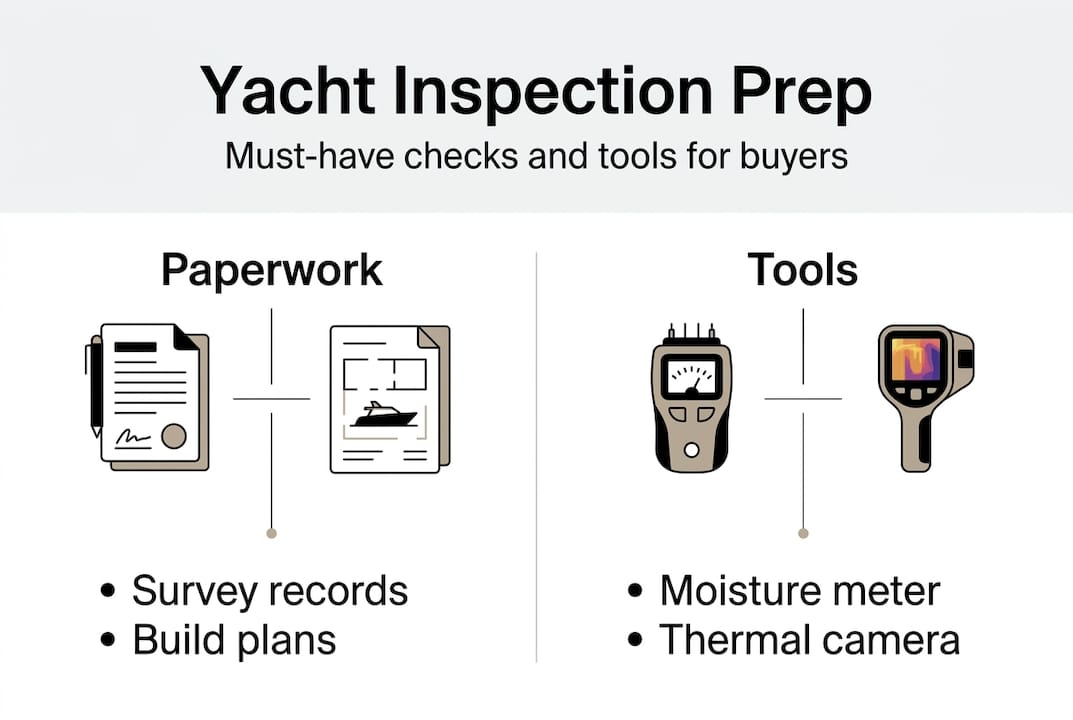
| Preparation element | Why it matters |
|---|---|
| Survey records | Confirms maintenance history and class compliance |
| Specialist team | Catches nuances that generalists miss |
| Inspection tools | Enables objective, measurable data collection |
| Build specifications | Provides baseline for comparing actual vs. intended quality |
Pro Tip: Request a sea trial before any physical inspection. How a vessel handles load, speed, and course changes will surface mechanical and structural symptoms that static inspection alone cannot reveal.
Our project management process applies this same level of preparation discipline to every build we oversee, ensuring nothing is left to chance before or during construction.
Hull and exterior: Inspection methods and what to look for
With your team assembled and documentation reviewed, the hull inspection is your first hands-on test of the yacht’s structural integrity. The hull is the backbone of every performance and safety metric the vessel will ever achieve.
A disciplined haul-out protocol covers these steps in sequence:
- Moisture readings across the entire hull surface, using a calibrated moisture meter to identify water ingress
- Ultrasonic thickness gauging to measure hull plating thickness and detect internal corrosion without cutting into the structure
- Visual delamination check on fiberglass hulls, looking for bubbling, soft spots, or discoloration that signals osmosis
- Corrosion inspection on metal hulls, including welds, through-hulls, and any areas where dissimilar metals contact
- Physical damage survey covering impact areas, repaired sections, and keel attachment points
As a key benchmark, haul-out inspections should cover hull condition including moisture readings, delamination, osmosis, corrosion, and ultrasonic thickness gauging. Missing any of these steps creates blind spots that can cost far more to correct later.
| Hull flaw | Detection method | Risk level |
|---|---|---|
| Osmotic blistering | Visual + moisture meter | High |
| Delamination | Tap test + ultrasonic gauge | Critical |
| Corrosion (metal hulls) | Visual + thickness gauge | High |
| Impact damage | Visual + structural survey | Variable |
“A hull that looks perfect at the waterline can be silently compromised beneath it. The only honest answer comes from the instruments, not the eye.”
Our hull engineering insights illustrate how even subtle structural choices affect long-term performance. For a real-world example of how root causes are identified and resolved, our offshore problem-solving case study shows exactly why thorough hull evaluation protects your investment and your confidence at sea.
For ongoing context on hull maintenance practices, external resources can also provide useful benchmarks for what a well-maintained hull should look like at survey time.
Mechanical systems and onboard utilities
With hull integrity confirmed, your evaluation moves inward to the systems that power and sustain the yacht. Mechanical quality is where most post-purchase regrets originate, because problems here are expensive, disruptive, and often invisible without the right tools.
Engine inspection follows a clear sequence:
- Oil analysis to detect metal particle contamination, indicating internal wear
- Compression testing on each cylinder to confirm engine health and uniformity
- Visual leak inspection covering all fluid systems, including fuel, coolant, and hydraulics
- Alignment check on shaft and coupling, since misalignment accelerates wear on bearings and seals
- Cooling circuit and exhaust integrity review, looking for corrosion, blockages, and heat stress
For generators and auxiliary systems, inspect mechanical systems by checking engines for oil analysis, compression, and leaks, as well as generators, fuel systems, cooling circuits, exhaust, and alignment. These checks apply equally to bow thrusters, stabilizers, and windlass systems.
Your utility system checklist should cover:
- Electrical panels for proper labeling, corrosion-free terminals, and circuit breaker condition
- Plumbing systems for water pressure, valve functionality, and grey or black water routing
- Safety equipment including fire suppression, bilge pumps, and gas detection systems
- HVAC performance under load conditions, not just at rest
The maintenance impact of poorly documented systems compounds over time, turning small oversights into systemic failures. We integrate project oversight for systems into every build we manage to prevent exactly this scenario.
Pro Tip: Non-destructive testing (NDT) methods, including magnetic particle and dye penetrant testing, can reveal cracks and fatigue in critical structural and mechanical components without disassembly. For high-value vessels, this investment is always worth making.
Interior finish and joinery: Signs of superior craftsmanship
After confirming the hull and mechanical systems, the interior evaluation reveals the true standard of bespoke craftsmanship. This is where a genuinely exceptional yacht separates itself from one that merely looks the part.
The checklist for interior inspection includes:
- Door and drawer gap tolerances of 0.5 to 2mm, consistent throughout all cabinetry
- Joinery fit and alignment, checking that panels meet cleanly at corners with no gaps or crowning
- Surface finish quality, including high-gloss varnish uniformity, absence of fish-eyes or brush marks, and UV-resistant coatings on sun-exposed surfaces
- Hardware alignment on all hinges, handles, and latches, with smooth operation under motion
- Absence of rattles at anchor and underway, which indicate tolerance failures in panel or furniture construction
As an industry benchmark, evaluate interior craftsmanship by checking tolerances such as door gaps of 0.5 to 2mm, joinery fit, high-gloss varnish quality, UV resistance, and the absence of rattles or misalignment. These are not minor aesthetic preferences; they are measurable indicators of build quality and long-term value retention.
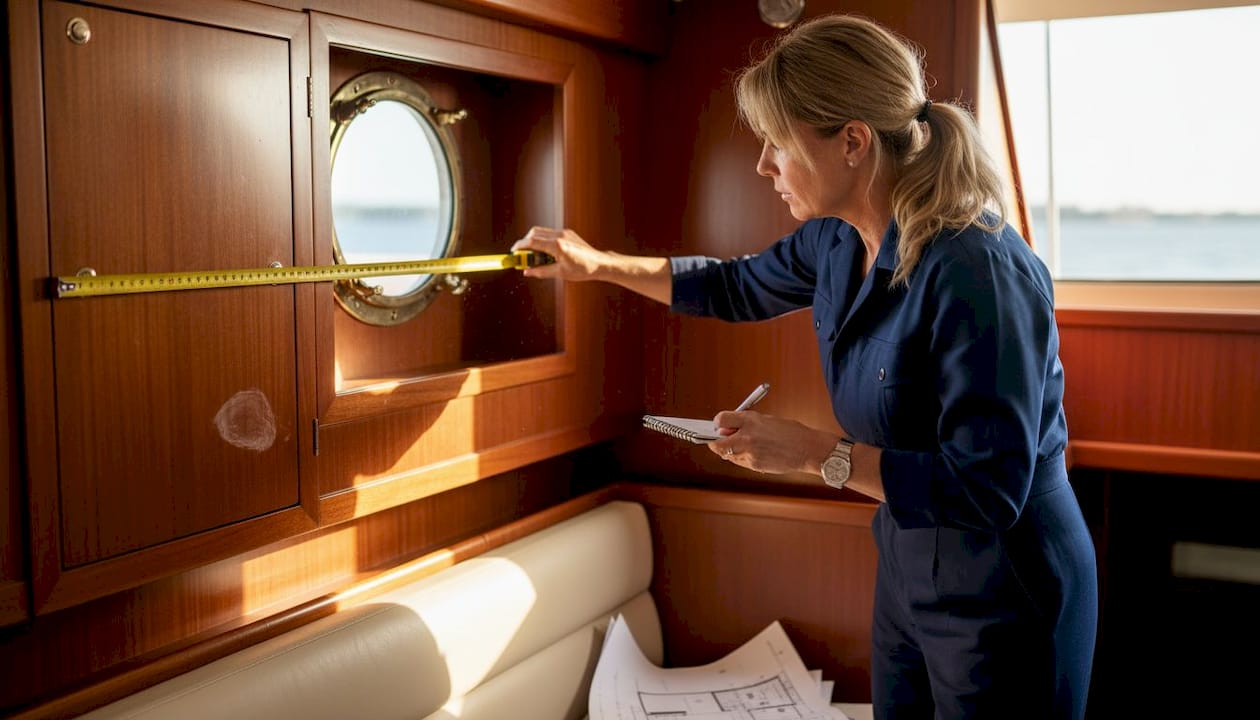
Materials matter as much as construction. Solid hardwood joinery with proper moisture barriers outperforms veneered MDF in marine environments. Metalwork should be passivated or coated to resist salt air. Upholstery stitching and cushion density also signal whether a builder sourced marine-grade materials or made cost-cutting substitutions. For guidance on joinery and finishes at the specification stage, planning ahead avoids these compromises entirely.
Pro Tip: Ask the seller or builder to demonstrate every opening panel, door, and drawer during inspection. A single sticking drawer or squeaking hinge often signals that tolerance control was inconsistent across the entire interior build.
For deeper context on why surface treatments matter, our perspective on UV resistant finishes explains the long-term cost difference between premium and budget-grade interior coatings. Understanding luxury craftsmanship principles from adjacent industries also reinforces why precision in small details drives overall investment value.
Verification and classification: Ensuring standards compliance
Systematic inspection covers what you can observe and measure directly. Formal classification and flag state compliance covers what the broader maritime regulatory framework requires, and what protects your resale value and operational safety over the long term.
The survey types you need to understand are:
- Annual surveys covering safety equipment, life-saving appliances, and fire systems
- Intermediate surveys addressing structural integrity, machinery, and electrical systems, typically at 2.5-year intervals
- Special surveys (also called renewal surveys) for a full structural and systems review every five years
The major classification societies, Lloyd’s Register, ABS (American Bureau of Shipping), and DNV (Det Norske Veritas), each maintain structured documentation and inspection protocols that go well beyond what any private survey covers. Compliance confirms that the vessel was built and maintained to a consistent, verifiable standard.
“Classification is not a box to tick. It is the paper trail that proves a yacht was built right and kept right.”
For vessels over 24 meters, verify compliance with classification society standards such as Lloyd’s, ABS, and DNV, as well as flag state rules including the LY3 and REG Yacht Code, covering annual, intermediate, and special surveys. Failing to confirm these records before purchase transfers all associated liability to you.
| Society/Code | Scope | Key focus |
|---|---|---|
| Lloyd’s Register | Structural + systems | Build quality verification |
| ABS | Structural + machinery | Safety and performance |
| DNV | Full lifecycle | Sustainability + compliance |
| LY3/REG Yacht Code | Flag state (24m+) | Commercial operation rules |
You can also review class compliance options to understand how these requirements factor into custom new builds from the outset. The survey process overview provides additional detail on what each survey type covers in practice.
Why hidden details and industry gaps matter more than you think
Here is what most buyer guides will not tell you: the biggest risk in evaluating yacht craftsmanship is not a gap in your checklist. It is the gap in the industry itself. Unlike class societies and flag state authorities, there is no universally enforced standard for independent surveyors or project managers. The lack of industry standards for independent surveyors and project managers creates real risks, which is why relying on class and flag surveys alongside qualified specialist teams is the only consistent approach to quality assurance.
We have seen firsthand how a beautifully presented vessel can carry structural and systems issues that a generalist surveyor simply does not have the specialist knowledge to identify. Interior joinery that looks magazine-ready can hide moisture ingress behind panels. A clean engine room can conceal alignment issues that only emerge under load at sea.
Our recommendation is direct: insist on owner’s representatives with documented specialist experience, engage independent surveyors with class society familiarity, and require written specifications before any build commitment. The project management perspective we apply to every project is built on exactly this discipline. The yachts that hold their value, perform reliably, and satisfy their owners for decades are the ones where every detail was evaluated and documented before the first line was signed.
Next steps: How Baranof Yachts helps you secure lasting quality
Every point in this guide comes down to one principle: the quality you get is the quality you verify before committing. At Baranof Yachts, we bring that conductor’s eye to every step of the process, from early specification through final delivery.

Whether you are evaluating an existing vessel or commissioning a new build, our build consultation process ensures that your specifications are documented, enforced, and delivered. Our project management services place specialist oversight at every critical decision point, so nothing is left to assumption. If you are ready to explore what a properly specified, professionally managed yacht looks like, configure your yacht and schedule a consultation with our team today.
Frequently asked questions
What are the most common hidden flaws in yacht craftsmanship?
Hidden flaws include poor hull integrity, misaligned interior joinery, subpar varnish, and poorly maintained mechanical systems. Haul-out inspections covering moisture readings, delamination, osmosis, corrosion, and ultrasonic thickness gauging are essential to uncovering these issues before purchase.
How should corporate clients and captains ensure unbiased craftsmanship evaluation?
They should hire owner’s representatives with specialist teams and rely on class and flag surveys for consistent quality verification. Industry standards confirm that prioritizing NV, HVAC, and paint specialists during the build or evaluation process significantly reduces the risk of missed defects.
Why is compliance with class society and flag state standards so important?
Formal compliance ensures safety, protects resale value, and reduces operational risk for luxury yachts. Classification compliance with Lloyd’s, ABS, DNV, and the LY3/REG Yacht Code provides a verifiable record that the vessel was built and maintained to a recognized standard.
What are the key measurements for evaluating interior joinery and finish?
Door gap tolerances, surface gloss quality, UV resistance, and hardware alignment are the critical metrics for interior evaluation. Tolerance benchmarks such as door gaps of 0.5 to 2mm are used by leading builders as a baseline for precision craftsmanship.
How do oil analysis and NDT inspections help find hidden defects?
Oil analysis detects engine wear through metal particle contamination, while NDT methods reveal invisible flaws in mechanical and structural components without disassembly. Oil analysis and NDT are especially valuable for high-hours vessels where surface condition may not reflect internal wear accurately.
Recommended
Sold Listings

Design Your Yacht
"*" indicates required fields
Maximus III - PNW
As you step aboard MAXIMUS III, the first impression is her scale.
At 120 feet with an 8-meter beam and 294 GT of interior volume, this 2025 Crescent Custom tri-deck immediately feels open, balanced, and estate-like. A timeless look while still feeling fresh from the shipyard.
Currently Available


Get your yacht value Estimate
"*" indicates required fields