

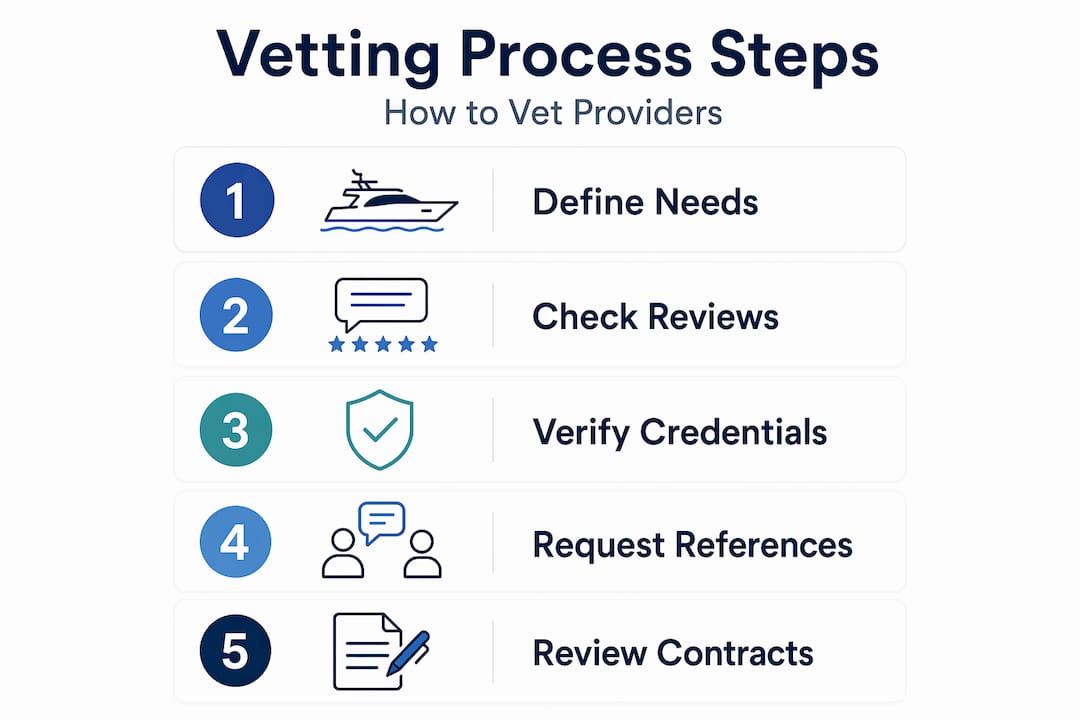
Choosing the wrong yacht service provider can cost you far more than money. Poor workmanship on critical systems, vague contracts that bury unexpected charges, and unresponsive crews mid-charter are all consequences of skipping a proper vetting process. Knowing how to vet yacht service providers before you sign anything protects your vessel, your investment, and the experience you’ve worked to build. This guide covers the full sequence: initial research, reputation analysis, reference checks, credential verification, and contractual scrutiny, with practical inside knowledge that goes well beyond the standard checklist.
Table of Contents
- Key Takeaways
- How to vet yacht service providers before you start
- Reading online reputation with precision
- Requesting references and verifying credentials
- Contractual clarity and what it reveals about a provider
- My honest take on vetting in the real world
- How Baranofyachts makes vetting easier for discerning owners
- FAQ
Key Takeaways
| Point | Details |
|---|---|
| Start with industry bodies | Verify membership in MYBA, IYBA, or MRAA before anything else to confirm baseline accountability. |
| Read review patterns, not scores | Look for recurring complaints across platforms in the last 24 months, not isolated one-star reviews. |
| Request references that match your vessel | Ask for at least two recent references from clients with similar yacht size and service complexity. |
| Demand itemized written proposals | Vague estimates are the leading cause of post-service disputes; written breakdowns protect you. |
| Accountability outweighs price | Providers who resolve problems quietly before they reach you are worth paying more for. |
How to vet yacht service providers before you start
Before you contact a single provider, you need to define exactly what you’re hiring for. Yacht services span a wide spectrum: routine maintenance, full refit and renovation, brokerage, charter management, crew placement, and technical systems repair. Each category carries its own compliance standards, credential requirements, and relevant industry affiliations. Conflating them is the first mistake most owners make.
Once you know what you need, start your screening with industry membership. Verified membership in bodies like MYBA, IYBA, MRAA, or LYBRA signals that a provider has agreed to codes of ethics, client fund protections, and dispute resolution mechanisms. These aren’t decorative memberships. A charter company holding MYBA affiliation, for example, is bound by standardized escrow arrangements that protect advance payments. That single factor eliminates an entire category of financial risk.
Start your initial research using these sources:
- Marine association directories (MYBA, IYBA, NMMA) that list verified member companies by region and specialty
- Marina bulletin boards and dockmaster referrals, which surface providers with proven track records in a specific port
- Yacht club networks, where captains and owners speak candidly about contractors they trust and ones they’ve stopped calling
- Online forums and owner communities such as The Hull Truth, Cruisers Forum, and superyacht-specific groups on social platforms
Pro Tip: Your best referral often comes from a dockmaster or marina manager who has watched multiple service providers work on boats over years. They see the results, they hear the complaints, and they have no financial incentive to mislead you.
This stage is about narrowing a long list to a short one. Take your time here. The providers who survive this initial screen have earned the right to a deeper evaluation.
Reading online reputation with precision
Most owners glance at a star rating and move on. That’s not vetting. That’s a coin toss. What actually matters when reviewing online reputation for yacht service providers is review patterns across 12 to 24 months, not aggregate scores inflated by older reviews from a different ownership or management era.

Platforms worth checking include Google Reviews, Yelp, the Better Business Bureau, and niche marine directories. For charter operators and brokers specifically, also check consumer protection agency records and any regulatory complaint filings in the relevant flag state jurisdiction.
The red flags to watch for aren’t dramatic. They’re repetitive. A pattern of complaints about:
- Slow or evasive responses after deposit payment
- Work completed to a lower standard than quoted
- Extra charges appearing without prior written authorization
- Crew or technicians who don’t match the qualifications advertised
These patterns, appearing across multiple reviews from different customers within the same 18-month window, tell you something structural about how the company operates. One bad review can be a difficult client. Five similar reviews is a business model.
Small operators present a specific challenge here. A sole-proprietor marine mechanic or a boutique charter manager may have minimal online presence but an outstanding local reputation. In those cases, direct community outreach matters more than digital profiles. Cross-reference any limited online footprint with physical business registration, proof of insurance, and verifiable industry affiliations before discounting them. You can also review how yacht craftsmanship gets evaluated to develop a sharper eye for quality claims versus actual delivered results.
Pro Tip: Search the provider’s business name alongside the words “complaint,” “dispute,” and “lawsuit” in your search engine. Most owners skip this. It takes ninety seconds and occasionally surfaces information that no review platform would show you.
Requesting references and verifying credentials
Here’s where the real signal separates from the noise. Any provider can assemble a polished website and a curated list of testimonials. What you want are direct, unscripted conversations with people who hired them for work similar to yours.
Request at least two client references from the past year and specify that the vessels should be comparable in size and operational complexity to your own. A glowing reference from the owner of a 35-foot sailing sloop is largely irrelevant if you’re commissioning maintenance work on a 90-foot motor yacht with integrated AV systems, watermakers, and stabilizers.
When you speak to references, ask these questions in sequence:
- Was the scope of work delivered on time and within the quoted budget?
- Were there any surprises, and how did the provider communicate them before acting?
- How did the provider handle the first problem or complication that arose?
- Would you hire them again for a larger or more critical project?
- Is there anything they told you that you wish you had known before signing?
On credentials, the specifics depend on the service category. For technical maintenance and repair, verify certifications from programs like ABYC, NMEA, or factory-authorized qualifications. Warranty work on major propulsion or navigation systems typically requires factory-certified technicians, and using non-certified contractors may void coverage. For charter and crew services, confirm compliance with ISM, LY3 standards, and that crew certificates are current under STCW.
True professionals welcome rigorous questions about insurance and compliance. They see it as evidence that you’re a serious, informed client. Evasiveness, deflection, or vague reassurances in response to direct credential questions are among the clearest signals that a provider cannot deliver the standard they’re advertising. You can read more about why working with a qualified yacht broker simplifies much of this credential verification process.
Pro Tip: Ask providers to describe a specific situation where something went wrong during a project and explain exactly what they did to resolve it. Providers with genuine experience can answer this immediately. Those without it will give you a generic non-answer.
Contractual clarity and what it reveals about a provider
The quality of a provider’s contract tells you almost everything about how they operate. Before price, before portfolio, and before personality, the written proposal is the clearest window into a company’s professionalism.
For charter and brokerage, look for agreements built on recognized frameworks like MYBA or CYBA standard contracts. These templates exist precisely because decades of disputes have shaped them into fair, enforceable documents. A provider who won’t use standardized agreements or insists on custom paperwork that omits key protections should prompt serious questions.
Detailed written proposals must itemize APA, VAT, fuel surcharges, and cancellation terms before you sign anything. The Advance Provisioning Allowance alone is a common source of disputes when not clearly defined. Payment escrow arrangements for large prepayments are standard practice among reputable operators and should be expected, not negotiated.
Watch for these specific warning signs in any contract or proposal:
- Lump-sum pricing without line-item breakdown
- Cancellation terms that favor only the provider
- No mention of dispute resolution or escalation procedures
- Payment going directly to the company rather than a protected escrow account
- Missing or vague insurance coverage details
Accountability and support after problems arise ultimately determine whether your experience at sea meets expectations. A slightly higher investment with a provider who resolves complications quietly and efficiently is almost always the better long-term decision. The aftercare essentials for luxury yachts article offers useful context on what ongoing service relationships should look like after the initial vetting is complete.
Pro Tip: Ask the provider directly: “Give me an example of a last-minute emergency or client request your team handled successfully.” Providers with strong operational competence answer with specifics. Anyone who answers in vague, general terms about being “client-focused” is telling you, indirectly, that they haven’t been tested.
My honest take on vetting in the real world
I’ve watched owners spend months researching paint specifications and then sign service contracts in twenty minutes because the provider sounded confident. That’s the pattern. And it’s where the regret almost always comes from.
The certification question is worth addressing directly. Credentials matter, but they don’t tell you how a provider behaves when something goes sideways on a Friday afternoon in a foreign port. What really separates top-tier providers is their operational network behind the scenes, the informal relationships with port agents, technical partners, and local contractors that mean problems get solved before you even know they occurred.
Online reviews are useful for filtering obvious failures. They are terrible at identifying excellence. The best providers I’ve encountered often have modest online profiles and enormous reputations among people who never write reviews because they’re too busy running vessels. Direct conversations, within trusted owner and captain networks, surface the information that public ratings never will.
My strongest piece of advice: treat evasiveness as an absolute disqualifier. When you ask direct questions about insurance, compliance, or how the team handles problems, a provider’s response tells you more about their character than their brochure ever could. Cost matters, but peace of mind at sea is not a line item you can negotiate down.
— Jason
How Baranofyachts makes vetting easier for discerning owners
At Baranofyachts, we understand that the vetting process for yacht service providers is as meticulous as the vessels themselves. Our brokerage and custom build expertise comes with direct access to a carefully maintained network of vetted technical partners, refit specialists, and maritime professionals, so you are never starting from zero. Whether you are exploring your next custom build or want to understand the real value of working with a broker, our team brings the conductor’s eye to every step of the process. You focus on the experience at sea. We handle the orchestration behind it.
FAQ
What industry memberships should yacht service providers hold?
Reputable providers should hold membership in recognized bodies such as MYBA, IYBA, MRAA, or LYBRA, which require adherence to ethical standards and often mandate escrow fund protections for client payments.
How many references should I request when vetting yacht repair services?
Request at least two recent references from clients with vessels similar in size and complexity to yours. References from the past 12 months are most reliable for assessing current service standards.
What are the biggest red flags in a yacht service provider checklist?
Key red flags include vague or unitemized proposals, evasiveness about credentials and insurance, complaint patterns across multiple review platforms within the last 24 months, and contracts lacking defined cancellation or dispute resolution terms.
Do certifications like ABYC or NMEA guarantee quality service?
Certifications confirm technical training and eligibility for warranty work, but they don’t guarantee operational reliability. Combine credential verification with direct reference calls and specific questions about how the provider handles real-world problems.
Why do standardized contracts matter when choosing yacht services?
Standard frameworks like MYBA or CYBA agreements incorporate protections developed through years of industry disputes, covering escrow arrangements, cancellation policies, and VAT treatment. Providers unwilling to use them introduce unnecessary contractual risk.
Recommended
Sold Listings
Design Your Yacht
"*" indicates required fields
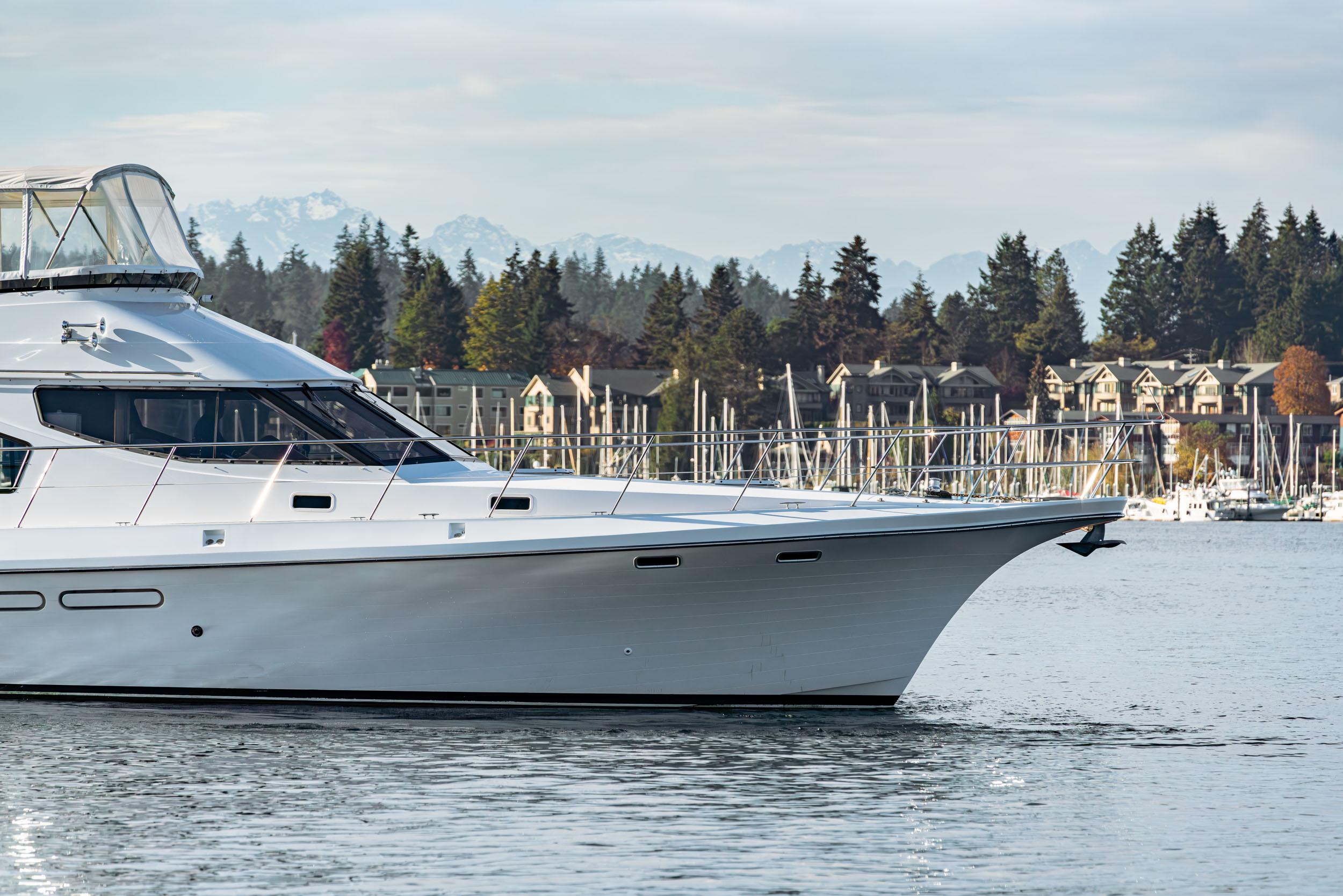
Maximus III - PNW
As you step aboard MAXIMUS III, the first impression is her scale.
At 120 feet with an 8-meter beam and 294 GT of interior volume, this 2025 Crescent Custom tri-deck immediately feels open, balanced, and estate-like. A timeless look while still feeling fresh from the shipyard.
Currently Available


Get your yacht value Estimate
"*" indicates required fields