

Commissioning or purchasing a luxury yacht is one of the most significant financial and technical decisions you will ever make, yet most buyers approach it as though they are selecting a piece of bespoke furniture. That assumption is costly. Understanding what is a yacht feasibility study changes the entire picture. It reveals that before a single plate is cut or keel laid, a disciplined process must assess whether your vision is technically sound, financially realistic, and legally compliant. This guide walks you through every dimension of that process, so you arrive at your build or purchase decision with clarity, not costly surprises.
Table of Contents
- What is a yacht feasibility study and why does it matter?
- Key components of yacht feasibility studies
- Real-world impact: feasibility studies in luxury yacht projects
- Expert insights and industry nuances in yacht feasibility
- The unique truth about yacht feasibility studies few discuss
- How Baranof Yachts simplifies and elevates your yacht feasibility journey
- Frequently asked questions
Key Takeaways
| Point | Details |
|---|---|
| Comprehensive planning | Yacht feasibility studies integrate technical, financial, and compliance assessments to reduce risks. |
| Classification matters | Class society approval is a fundamental feasibility constraint affecting design and construction. |
| Data-driven design | Advanced hydrodynamic modeling guides early sizing and propulsion decisions for optimal performance. |
| Schedule control | Early identification of long-lead items and parallel workflows helps prevent costly delays. |
| Informed decisions | Well-executed feasibility studies enhance confidence and value for affluent yacht buyers. |
What is a yacht feasibility study and why does it matter?
A yacht feasibility study is a structured, pre-commitment assessment that examines whether a proposed yacht project, whether a new custom build or a major refit, can be executed within your technical, financial, and regulatory boundaries. It is not a design document. It is the foundational analysis that determines whether your design can become reality on budget, on schedule, and in compliance with governing rules.
Think of it as the conductor raising a baton before the orchestra plays. Every instrument must be tuned and positioned correctly before the first note. Without that preparation, even the most gifted musicians produce noise, not music. A yacht feasibility study performs that same orchestrating function for your project.
A well-executed study covers the following areas:
- Technical viability: Hull geometry, propulsion systems, weight distribution, and structural integrity against performance targets
- Classification compliance: Meeting the standards of the governing classification society for your intended operational profile
- Hydrodynamic performance: Computational analysis of resistance, seakeeping behavior, and maneuvering in real sea conditions
- Financial feasibility: Capital expenditure forecasts, operating cost projections, and contingency planning
- Schedule risk: Identification of long-lead procurement items and parallel workstream opportunities
- Regulatory compliance: Environmental standards, safety certification, and insurance requirements
A classification society is an independent organization that establishes and enforces standards, known as class rules, for design, construction, and maintenance, with ongoing surveys required to maintain class status. These rules are not optional. They shape your feasibility parameters before any creative decisions are finalized.
Without this study, the risks multiply quickly. Budget overruns, design modifications forced by late-stage classification rejections, and procurement delays that stretch timelines by months are all predictable consequences of skipping the process. For clients exploring bespoke yacht building, where complexity and customization are inherently higher, the study is not a formality. It is the foundation everything else rests on.
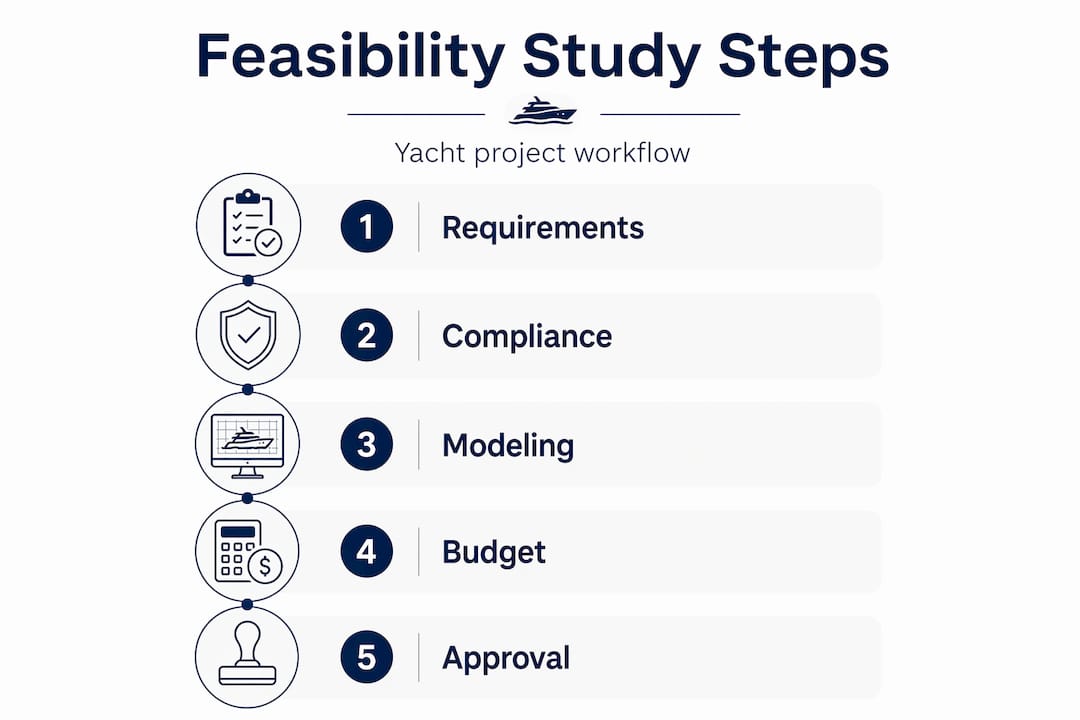
Key components of yacht feasibility studies
A thorough feasibility study for yachts is built from several distinct but deeply interconnected disciplines. Each one informs the others, and weaknesses in one area inevitably create knock-on effects across the whole project.
Classification and compliance planning
Classification societies require full submission of plans and documentation before construction begins. Your feasibility study must map exactly which drawings need approval, when they must be submitted, and how classification surveys will be scheduled through the build. Understanding yacht classification early in the process is not just about safety — it directly determines what your designer can and cannot do.
Hydrodynamic and performance feasibility
This is where physics asserts itself over aesthetics. Hydrodynamic feasibility uses computational modeling for resistance, seakeeping, and maneuvering to optimize yacht dimensions per ISO 22834:2022 standards. In practical terms, this means your hull’s length, breadth, and draft are not chosen because they look elegant in a rendering. They are sized to deliver the range, speed, and motion comfort you need in the sea states where you intend to cruise.

Financial and project feasibility
Yacht investment analysis at the feasibility stage covers capital expenditures, fit-out costs, and operating cost modeling. Critically, it also identifies long-lead items — components like custom propulsion systems, stabilizers, or specialized deck equipment — that have procurement lead times of six months or more. Identifying these early allows procurement to begin in parallel with design, avoiding the sequential delays that derail most troubled projects. Your choice of hull materials also feeds directly into cost modeling at this stage.
Here is a comparison of the three core feasibility dimensions and their primary focus:
| Feasibility dimension | Primary focus | Key outputs |
|---|---|---|
| Classification requirements | Regulatory and safety compliance | Approved drawings, survey schedule |
| Hydrodynamic modeling | Performance and dimensional optimization | Hull geometry, propulsion selection |
| Financial feasibility | Budget control and schedule management | Cost plan, procurement timeline |
Top five common pitfalls in yacht feasibility:
- Treating classification requirements as a final step rather than an initial design constraint
- Relying on designer intuition alone for hull sizing without computational hydrodynamic validation
- Underestimating long-lead item procurement timelines and their effect on overall schedule
- Failing to budget for periodic re-surveys and ongoing compliance costs post-delivery
- Overlooking the relationship between propulsion choices and flag state operational restrictions
Pro Tip: Integrate classification constraints into your feasibility study from day one. Addressing them after the design is substantially complete often means expensive revisions, wasted time, and renegotiated contracts with your shipyard.
Real-world impact: feasibility studies in luxury yacht projects
Theory is useful. Numbers are convincing. A 55m yacht refit completed in 90 days with only a 3.2% budget overrun demonstrates what feasibility-driven project management achieves in practice. The discipline that produced that result was advance procurement of long-lead items and the deliberate scheduling of parallel workstreams rather than sequential ones.
“The feasibility study did not just protect the budget — it protected the timeline. By knowing what we needed to order before the yard period began, we eliminated the waiting time that typically inflates refit durations by weeks.”
This is the real power of how to conduct yacht feasibility properly. Rather than reacting to problems as they surface, you have already mapped the critical path and positioned your resources accordingly. The specific advantages this delivers include:
- Component availability: Main engine parts, custom joinery, and specialized electronics are ordered weeks or months before they are needed on the build
- Parallel discipline execution: Naval architecture, engineering design, and classification submissions proceed simultaneously rather than sequentially
- Survey scheduling: Classification surveyors are booked at the right build milestones rather than scrambling to arrange inspections mid-project
- Budget confidence: Contingency reserves are calculated from real risk data rather than arbitrary percentages
For clients considering how to upgrade a luxury yacht, the same feasibility logic applies to refits as it does to new builds. The scale of commitment differs; the discipline does not.
Pro Tip: Ask your project manager to show you the critical path analysis from the feasibility study before signing a build or refit contract. If they cannot produce one, that is a significant warning sign about how the project will be managed.
Expert insights and industry nuances in yacht feasibility
Practitioners who work inside these projects know details that rarely surface in client-facing conversations. Understanding them gives you leverage in discussions with shipyards, designers, and project managers.
Classification feasibility.pdf) requires submission of plans and documentation upfront, and schedule feasibility revolves around early procurement of long-lead items for risk mitigation. What this means in practice is that your project timeline is effectively set during the feasibility study, not during the build itself.
Why performance modeling matters even when you trust your designer’s experience:
- Designer experience is pattern recognition from past projects. Your specific combination of intended range, speed, sea area, guest complement, and regulatory flag may be genuinely novel.
- Computational fluid dynamics catches hull form inefficiencies that tank range estimates by 15 to 20 percent before a model has ever touched water.
- Propulsion system selection based on modeling rather than convention can reduce fuel consumption meaningfully over the yacht’s operational life, which affects both running costs and resale value.
- ISO 22834:2022 compliance for motor yacht hydrodynamics is increasingly referenced by classification societies, making documented modeling a practical necessity rather than a nice-to-have.
The insights you gain before building your yacht are often worth more than any single design decision made during the build. The feasibility stage is where those insights are captured and put to work.
What yacht financial feasibility must also cover that many studies omit:
- Flag state restrictions that limit operational geography based on propulsion or emissions class
- The insurance implications of classification choices, particularly for vessels operating outside classed trade limits
- Resale value impacts of non-standard or poorly documented technical choices made early in design
Yacht market feasibility is another underutilized dimension. If your corporate client intends to charter the vessel commercially, demand modeling for your target charter market should be part of the study. Build specifications that do not match charter market preferences create an immediate valuation penalty at delivery.
The unique truth about yacht feasibility studies few discuss
Here is the view we have developed through years of working with affluent clients and complex custom builds: the typical feasibility study is too narrow, and most owners do not realize it until something goes wrong.
The standard approach covers cost, schedule, and classification. That covers perhaps 70 percent of the real risk landscape. The remaining 30 percent sits in areas that feel less urgent during the planning phase but surface forcefully once the vessel is in service.
Consider ongoing classification compliance. Most buyers understand that a classification society approves the build. Fewer understand that maintaining class status requires periodic surveys, and that modifications made during ownership, even seemingly minor ones, must be approved to avoid class suspension. A vessel with lapsed classification status is, in practical terms, uninsurable and unmarketable. That is not a theoretical risk. It is a consequence we have seen affect resale transactions directly.
What most owners miss when reviewing feasibility studies:
- Legal risks from flag state non-compliance: The flag you choose affects crew certification requirements, operational area restrictions, and the applicable safety regime. A feasibility study should model this, not assume a flag.
- Global operational access: Draft, air draft, and emissions certification determine where your yacht can realistically go. A vessel designed without reference to Panama Canal or specific marina clearance constraints may be locked out of itineraries its owner intends to use.
- Resale value impacts: Technical choices made at the feasibility stage, propulsion type, classification society, build yard reputation, material specifications, become the permanent fingerprint of the vessel and are legible to any competent surveyor at resale.
The contrarian truth is that feasibility is not a phase you complete. It is a discipline you maintain. Buyers who evaluate craftsmanship and long-term value with the same rigor they apply to financial planning protect both their investment and their enjoyment of the vessel far more effectively than those who treat feasibility as a box to check before the fun begins.
How Baranof Yachts simplifies and elevates your yacht feasibility journey
Navigating the complexity of a yacht feasibility study requires partners who have done it before, understand where the risks hide, and know how to align every workstream before the first decision is locked in.

At Baranof Yachts, we integrate rigorous feasibility analysis into every custom build and project management engagement from the first conversation. Our naval architects bring classification requirements and hydrodynamic modeling into the design process before creative concepts are finalized, not after. We coordinate long-lead procurement planning to protect your schedule, and we maintain transparent communication at every milestone so you always know where your project stands.
Here is how to begin your feasibility and build journey with us:
- Start with a consultation: Share your vision, intended use, and operational profile. We assess feasibility dimensions relevant to your specific project.
- Review our build expertise: Explore what goes into a project before building your yacht to align expectations from day one.
- Configure your vision: Use our yacht configuration tool to begin translating your preferences into a build brief.
- Understand the broker advantage: Learn why a yacht broker with deep build expertise protects your interests throughout the feasibility and delivery process.
Frequently asked questions
What documents are typically included in a yacht feasibility study?
A yacht feasibility study generally includes classification plans, computational hydrodynamic modeling reports, cost estimates, schedule risk assessments, and regulatory compliance evaluations covering safety, environmental, and flag state requirements.
Why is classification society approval critical in yacht feasibility?
Classification societies approve design drawings and inspect construction to maintain compliance, making their requirements a primary design constraint that must be addressed at the feasibility stage rather than retrofitted later.
How does hydrodynamic modeling influence yacht design feasibility?
Hydrodynamic modeling per ISO 22834:2022 quantifies resistance, seakeeping, and maneuvering performance, helping optimize hull dimensions and propulsion choices early in design to avoid expensive revisions once construction is underway.
How do feasibility studies help prevent schedule overruns?
Advance procurement of long-lead items and deliberate parallel workstream scheduling, both core outputs of a sound feasibility study, are the primary tools that keep luxury yacht projects on time and within budget contingency targets.
Can a yacht be built without a feasibility study?
Technically yes, but omitting a feasibility study significantly increases the likelihood of classification non-compliance, cost overruns, schedule delays, and performance shortfalls — risks that are particularly consequential for custom luxury builds where every specification is unique.
Recommended
Sold Listings


Design Your Yacht
"*" indicates required fields
Maximus III - PNW
As you step aboard MAXIMUS III, the first impression is her scale.
At 120 feet with an 8-meter beam and 294 GT of interior volume, this 2025 Crescent Custom tri-deck immediately feels open, balanced, and estate-like. A timeless look while still feeling fresh from the shipyard.
Currently Available


Get your yacht value Estimate
"*" indicates required fields