

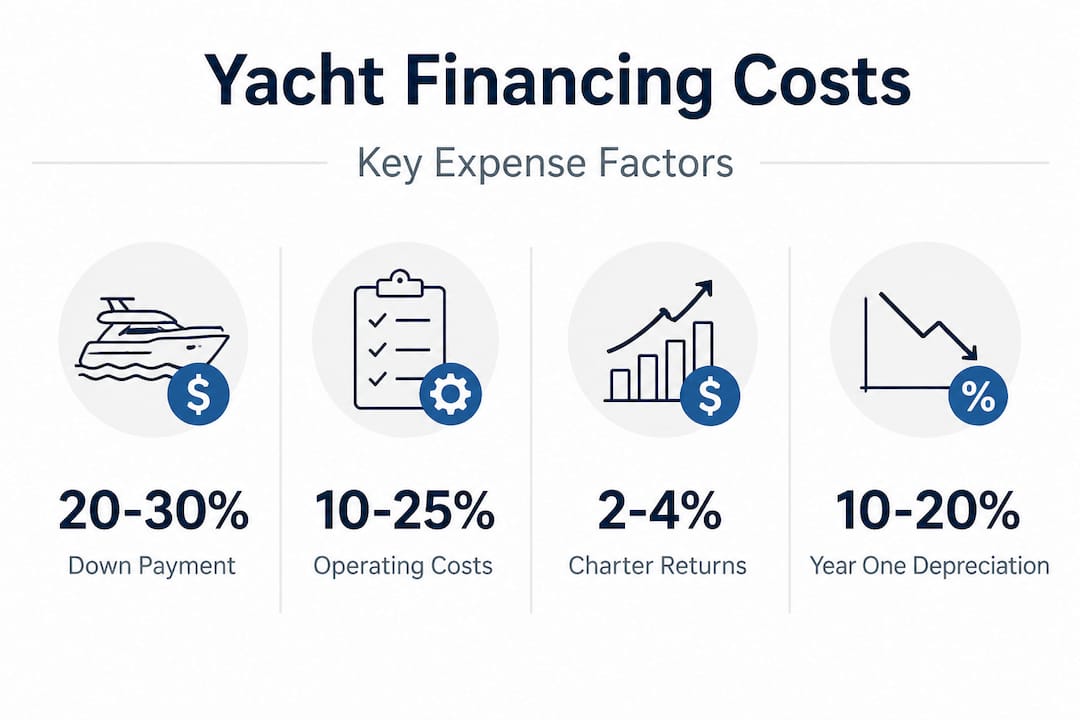
Most people entering the luxury yacht market assume that chartering their vessel will significantly reduce the financial burden of ownership. The reality is far more sobering. Charter revenue rarely offsets costs, with owners typically netting just 2-4% after expenses, making private yacht ownership essentially a lifestyle commitment unless you’re using the vessel more than six to eight weeks per year. Understanding this from the outset changes everything about how you approach the financing conversation, which methods you choose, and what you prioritize in negotiations. This guide walks you through the financing landscape with the clarity and precision you need to make decisions you’ll be confident in for years to come.
Table of Contents
- Understanding yacht financing: Common methods and industry terms
- Costs beyond purchase: Operating expenses, depreciation, and hidden risk
- Calculating the true return: Chartering, resale, and the lifestyle equation
- Making yacht financing work: Smart strategies for buyers and managers
- A seasoned perspective: The real difference between asset and lifestyle financing
- Ready to make confident yacht financing decisions?
- Frequently asked questions
Key Takeaways
| Point | Details |
|---|---|
| Charter covers little | Chartering rarely offsets ownership costs, making yachts a lifestyle purchase. |
| Ongoing costs matter | Annual expenses run 10-25% of yacht value and must be planned alongside financing. |
| Depreciation impacts financing | Yacht values drop steeply at first and yearly, influencing loan terms and resale timing. |
| Smart strategies maximize value | Negotiating loans, prepping for resale, and managing upgrades are crucial for long-term success. |
| Financing is personal | Every owner’s best approach depends on usage and priorities—investment vs lifestyle. |
Understanding yacht financing: Common methods and industry terms
Having set the context for yacht ownership realities, let’s detail how these vessels are typically financed. The three primary paths are direct purchase with cash, secured marine loans, and leasing arrangements. Each carries a different risk profile, tax treatment, and effect on your operational flexibility.
Cash purchase remains the most straightforward route for ultra-high-net-worth buyers. It eliminates interest costs and simplifies ownership structure, but it ties up significant capital that could be deployed elsewhere. For a $10 million yacht, a cash purchase might feel clean and uncomplicated, but it requires you to carry the full weight of annual operating costs that run between 10-25% of the vessel’s value every single year, with no leverage to offset that figure.
Marine loans function similarly to commercial real estate loans. Lenders typically require 20-30% down, and interest rates for high-value yachts generally range from 5-9% depending on creditworthiness, vessel age, and loan term. Repayment terms span 10-20 years, and the yacht itself serves as collateral. One important distinction: lenders treat new builds and production yachts differently. A custom yacht financing arrangement involves a phased payment structure tied to construction milestones, which requires a lender familiar with build timelines and the variables that can shift delivery dates.
Leasing structures, including operating leases and finance leases, offer tax efficiency in certain jurisdictions and can preserve capital. Operating leases allow you to use the vessel without ownership on your balance sheet, while finance leases transfer most ownership risks and rewards to you. Both require careful legal structuring, particularly if you intend to flag the vessel internationally.
Here is a clear comparison of the three primary financing methods:
| Method | Typical down payment | Interest/cost impact | Best suited for |
|---|---|---|---|
| Cash purchase | 100% | No interest, full capital deployed | Capital-rich buyers prioritizing simplicity |
| Marine loan | 20-30% | 5-9% annual interest | Buyers optimizing leverage and liquidity |
| Operating lease | Varies | Rental payments, off-balance sheet | Corporate clients seeking tax efficiency |
| Finance lease | 10-20% | Capitalized, on-balance sheet | Buyers wanting ownership benefits with structure |
Key industry terms you’ll encounter throughout this process include:
- Residual value: The projected market value of the yacht at the end of a loan or lease term, which directly affects your monthly payments and exit options.
- Depreciation: The annual reduction in a yacht’s market value over time, factored into both tax planning and resale strategy.
- Operating expenses (OpEx): Ongoing costs including crew salaries, fuel, insurance, dockage, maintenance, and compliance.
- Loan-to-value (LTV) ratio: The loan amount expressed as a percentage of the appraised vessel value, typically capped at 70-80% by lenders.
Exploring your yacht ownership options in detail before approaching a lender gives you a significant advantage in structuring a deal that actually serves your long-term goals. And if you’re considering a refit alongside a purchase, understanding yacht upgrade financing as a separate line item is essential, since lenders treat vessel improvements differently from primary acquisition costs.
Pro Tip: Custom builds require a lender who understands construction-phase disbursements. Standard marine lenders often do not have the workflows for milestone-based drawdowns. Work with a specialist from the outset to avoid costly delays.
Costs beyond purchase: Operating expenses, depreciation, and hidden risk
Once you understand the upfront financing process, the next critical factor is ongoing costs. These are the numbers that surprise most buyers, not because they’re hidden, but because the magnitude rarely registers until you’re already in the water.
Annual operating costs run 10-25% of a yacht’s value. On a $5 million vessel, that’s $500,000 to $1.25 million per year before any financing costs are considered. These figures include:
- Crew salaries and benefits: A professional crew for a 100-foot yacht typically costs $400,000-$700,000 annually including captain, first mate, chef, and deckhands.
- Fuel: Depending on usage, fuel costs for a large motoryacht can reach $200,000-$500,000 per year.
- Insurance: Marine insurance for high-value yachts generally runs 1-2% of hull value annually.
- Dockage and marina fees: Prime berths in Monaco, the Balearics, or the Caribbean can run $100,000-$300,000 per season.
- Maintenance and repairs: Routine maintenance, haul-outs, and system servicing easily consume another 5-10% of vessel value annually.
Depreciation compounds the picture further. The first-year depreciation runs 10-20% of purchase value, then settles into a 5-10% annual decline. For a $10 million yacht, that means you could lose $1-2 million in value in the first 12 months alone, before factoring in your operating costs or financing charges.
| Expense category | Typical annual range | Notes |
|---|---|---|
| Crew | $400,000-$700,000 | Scales with crew size and vessel length |
| Fuel | $200,000-$500,000 | Dependent on usage and vessel type |
| Insurance | 1-2% of hull value | Varies by coverage, flag, and operating area |
| Dockage | $100,000-$300,000 | Highly location-dependent |
| Maintenance | 5-10% of vessel value | Includes haul-outs and system overhauls |
| Depreciation (year 1) | 10-20% of purchase value | Steepest in first 24 months |
“Charter revenue rarely fully offsets costs, with owners netting just 2-4% after expenses. Private yacht ownership functions as a lifestyle expense unless you’re chartering more than six to eight weeks per year.” This is the financial truth that separates informed buyers from those who come into ownership with unrealistic expectations.
Our superyacht costs guide breaks down these numbers in greater detail for vessels in the 40-meter-plus range, where costs escalate considerably and operational complexity increases with every additional foot of length.

Calculating the true return: Chartering, resale, and the lifestyle equation
Considering operational expenses, it’s time to evaluate return strategies and the real-world math. Most buyers arrive at the financing conversation asking whether they can “make the yacht pay for itself.” In most cases, the honest answer is no, and trying to force that equation often results in poor decisions.
Let’s examine chartering versus personal use:
| Scenario | Gross charter revenue | Net after expenses (2-4%) | Personal use trade-off |
|---|---|---|---|
| 10 weeks charter, $50K/week | $500,000 | $10,000-$20,000 | Significant restrictions on personal access |
| 6 weeks charter, $50K/week | $300,000 | $6,000-$12,000 | Moderate personal use retained |
| Personal use only | $0 | N/A | Full flexibility, pure lifestyle asset |
The chartering cost reality is stark: even heavy charter programs rarely net more than $10,000-$20,000 on vessels with $500,000+ annual operating costs. The economics simply do not pencil out as a return strategy unless you’re operating a commercial charter fleet with professional management from day one.
Resale value, however, is a more controllable variable. There are specific, practical steps that directly protect your yacht’s residual value and improve your position when financing or refinancing:
- Commission a pre-purchase survey from an independent marine surveyor before acquisition to establish baseline condition and avoid inheriting undisclosed issues.
- Maintain meticulous service records for all mechanical, electrical, and structural systems. Buyers and lenders both scrutinize documentation rigorously.
- Schedule regular haul-outs and antifouling according to manufacturer recommendations. Deferred maintenance accelerates depreciation well beyond the standard 5-10% annual rate.
- Invest in timely refits rather than waiting for systems to fail. A proactive refit signals to future buyers that the vessel has been cared for, not just used.
- Work with specialists who understand yacht resale strategies to time your exit, position the vessel correctly in the market, and present it with accurate, compelling documentation.
A thorough resale preparation guide will walk you through the staging and documentation process in detail, but the foundational principle is simple: the care you invest throughout ownership directly determines your negotiating power at the point of sale.
Pro Tip: If you plan to use your yacht personally for more than 10 weeks per year, the cost-per-day equation actually becomes more favorable than intermittent chartering with restricted personal access. Run the real numbers against your actual usage patterns before structuring your financing around charter income you may never see.
Making yacht financing work: Smart strategies for buyers and managers
With the larger financial landscape in mind, let’s look at what you can do to optimize the process. Whether you’re an individual buyer or a project manager overseeing a corporate acquisition, the principles that separate a well-structured deal from a costly one are consistent.
Key steps for successful yacht financing:
- Engage a marine finance specialist early. General commercial lenders often lack the expertise to assess vessel-specific collateral, construction timelines, or international flagging implications.
- Get a professional appraisal before you negotiate. Knowing precise market value gives you leverage in price negotiations and ensures you’re financing a realistic figure.
- Structure loan terms around your actual projected usage, not optimistic charter projections. A longer loan term with lower payments may provide more flexibility than an aggressive payoff schedule that strains operational liquidity.
- Separate refit financing from acquisition financing. Bundling upgrades into your primary loan can complicate collateral assessment and may attract less favorable terms than a standalone refit facility.
- Understand your jurisdiction’s tax treatment of yacht loans, leases, and charter income before you commit to a structure. The difference between an operating lease and a finance lease can have significant tax implications depending on where you’re flagged and where you operate.
- Review the yacht classification guide to understand how class ratings affect your insurability, resale value, and lender appetite.
When it comes to negotiations, knowing how to approach negotiating yacht price effectively is as important as securing favorable loan terms. Sellers and brokers are sophisticated, and the same precision you apply to financing should carry through into every aspect of the acquisition conversation.
If you’re in the planning phase for a new build, reviewing what’s involved before building your yacht will prepare you for the financial commitments that come well before the keel is laid, including design fees, class approvals, and initial yard deposits that typically fall outside standard financing structures.
Because operating costs run 10-25% of vessel value annually, building a realistic OpEx budget into your financing plan from day one is not optional. It is the foundation of a sustainable ownership experience.
Pro Tip: Many buyers overlook refit financing entirely, assuming refits are cash expenses. In fact, structured refit financing can preserve liquidity, improve vessel value during the loan period, and position the yacht for a stronger resale at the end of the ownership cycle.
A seasoned perspective: The real difference between asset and lifestyle financing
Here is something we observe consistently across the clients and projects we work with: buyers arrive at the financing table thinking like asset managers and leave as lifestyle investors. The shift is not a failure of analysis. It reflects the reality of what luxury yacht ownership actually is.
Most buyers initially approach the decision with a spreadsheet logic, projecting charter income, modeling depreciation curves, and calculating break-even points. That rigor is valuable, and we encourage it. But the moment a vessel is delivered and the first season is underway, the conversation invariably changes. The question stops being “what is my return?” and becomes “how do I make this experience as extraordinary as possible?”
This is not a warning to avoid financial discipline. It is a call to structure your financing with honesty about your true priorities from the outset. If you are acquiring a yacht for genuine lifestyle enrichment, a 20-year loan that keeps monthly costs manageable and preserves your liquidity for OpEx is often smarter than a compressed payoff schedule that strains both your finances and your enjoyment.
Exclusive custom builds occupy a distinct position in this equation. When a vessel is designed and constructed to your precise specifications, it holds appeal with a very specific buyer at resale, and it creates an ownership experience that production vessels simply cannot replicate. The ownership exclusivity that comes with a bespoke build changes the financial calculus because you are not competing in a commoditized market at the point of resale.
We also want to be direct about the charter revenue reality: a net return of 2-4% against annual operating costs means chartering is a way to defray expenses, not eliminate them. Structuring your financing decisions around the assumption of full charter coverage is the single most common financial mistake we see, and it creates pressure on the ownership experience that erodes the very lifestyle value you acquired the vessel to enjoy.
The right financing strategy is one that aligns with how you actually intend to use the yacht, not how you hope to rationalize the cost.
Ready to make confident yacht financing decisions?
Navigating luxury yacht financing well requires the kind of structured guidance that only comes from direct experience across acquisition, construction, and project management. We work alongside buyers and captains at every stage of this process, from the early conversations about ownership structure to final delivery and beyond.
Our team at Baranof Yachts brings that same conductor’s eye to your financing decisions that we apply to every aspect of yacht design and project management. Whether you’re exploring project management for new builds, working through the yacht resale process, or ready to configure your ideal yacht, we provide the clarity and expertise to move forward with confidence. Reach out to our team for a consultation that starts with your goals and ends with a plan you can trust.
Frequently asked questions
What is the minimum down payment for yacht financing?
Most lenders require a minimum down payment of 20-30% for luxury yachts, though cash purchases and lease structures vary considerably by lender and vessel type.
How much do annual operating costs typically run?
Annual operating costs generally total 10-25% of your yacht’s value, covering crew salaries, fuel, maintenance, insurance, and dockage fees.
Can chartering cover my yacht financing and ownership costs?
Charter revenue rarely covers all expenses, with owners typically netting just 2-4% after costs, making full financial coverage the rare exception rather than the rule.
Is depreciation a major factor in yacht financing?
Depreciation is significant: expect a 10-20% value loss in year one and 5-10% annually thereafter, directly influencing your loan-to-value ratio and resale positioning.
What’s the best way to improve yacht resale value?
Timely refits, meticulous maintenance records, and professional resale preparation, including survey-ready condition and accurate documentation, are the most effective strategies for maximizing resale value.
Recommended
Sold Listings
Design Your Yacht
"*" indicates required fields
Maximus III - PNW
As you step aboard MAXIMUS III, the first impression is her scale.
At 120 feet with an 8-meter beam and 294 GT of interior volume, this 2025 Crescent Custom tri-deck immediately feels open, balanced, and estate-like. A timeless look while still feeling fresh from the shipyard.
Currently Available


Get your yacht value Estimate
"*" indicates required fields