

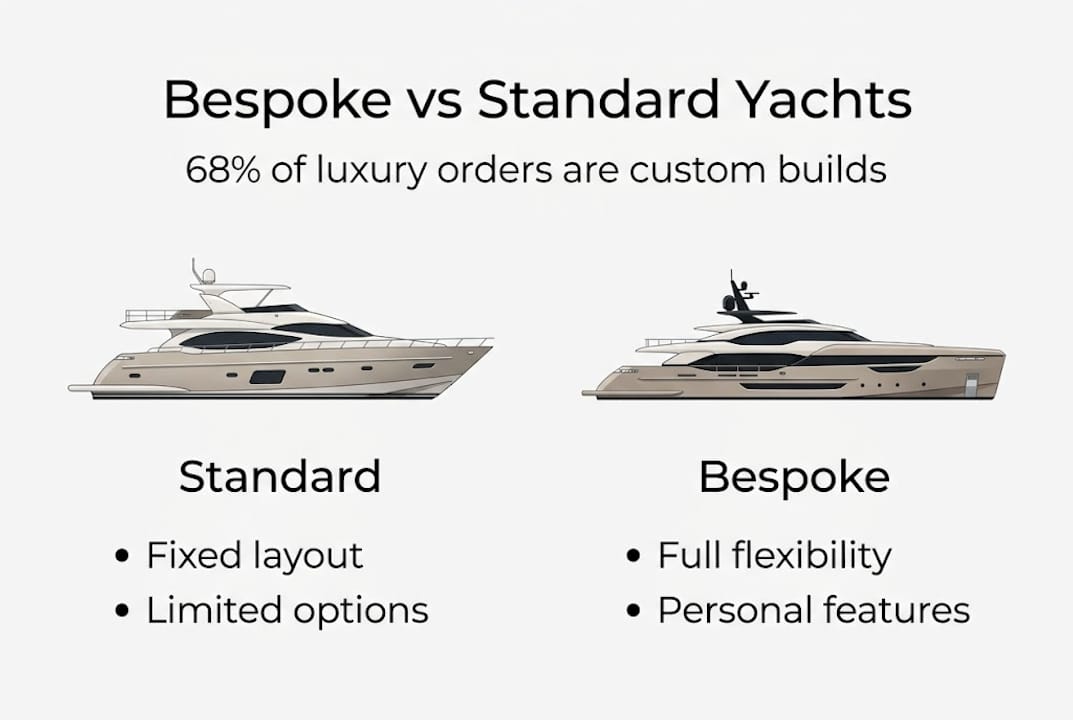
Custom yacht builds now account for 68% of new luxury orders, yet most clients approaching their first bespoke commission still carry the same misconception: that going custom is purely about extravagance. The reality is far more purposeful. A bespoke yacht is, at its core, a precision instrument designed around your life, your operations, and your long-term maritime goals. In the sections ahead, we walk through why personalization has moved well beyond aesthetics, how bespoke builds generate measurable financial and operational advantages, and what the build process actually looks like from vision to launch.
Table of Contents
- The rise of bespoke yacht building
- Personalization: Crafting your ideal maritime experience
- Financial and operational advantages
- Navigating the bespoke build process
- A fresh perspective: The real reason to build bespoke
- Ready to realize your bespoke yacht vision?
- Frequently asked questions
Key Takeaways
| Point | Details |
|---|---|
| Bespoke builds dominate | Custom yacht orders now represent 68% of the luxury market, reshaping industry priorities. |
| Personalization yields value | Building bespoke aligns aesthetics and functionality for your lifestyle or business needs. |
| Financial benefits beyond cost | While bespoke is pricier upfront, it delivers higher margins and resale potential long term. |
| Success requires planning | Navigating the custom build process demands expert guidance and careful project management. |
The rise of bespoke yacht building
The numbers tell a clear story. Custom builds dominate new luxury orders, reshaping shipyard strategies and redefining client expectations across the entire industry. Shipyards that once built primarily from fixed catalogs are now investing heavily in design departments, engineering consultants, and flexible production workflows to meet demand. This is not a niche trend. It is the new standard.
The financial scale behind this shift is significant. The luxury yacht market is valued between USD 10 and 11 billion in 2025 and 2026, growing at a 6% compound annual growth rate. Within that market, custom builds command higher margins for shipyards and deliver greater value to owners, though they also carry more complex execution risks. Understanding both sides of that equation is essential before committing to a project.
So why are clients choosing bespoke at such high rates? Several converging factors are driving the shift:
- Rising expectations: Affluent clients no longer accept the compromises that come with a production vessel. They want a yacht that reflects their operational rhythm.
- Expanding corporate use: Corporations are commissioning yachts for client entertainment, executive transport, and brand representation, each requiring unique interior and technical configurations.
- Technological evolution: Advanced materials, hybrid propulsion systems, and smart ship management software have made bespoke construction more viable and more compelling than ever before.
- Charter market dynamics: Custom yachts are increasingly attractive in the charter market because distinctive design and tailored amenities command premium charter rates.
The data on building custom yachts confirms that this surge in demand is not slowing. Shipyards with strong bespoke capabilities are booking out years in advance, and new build trends show that clients are increasingly arriving with detailed briefs rather than browsing catalogs.
| Metric | Standard build | Bespoke build |
|---|---|---|
| Configuration flexibility | Limited | Full |
| Lead time | 6-12 months | 12-24 months |
| Resale value premium | Moderate | High |
| Charter rate potential | Standard | Premium |
| Client satisfaction index | Variable | Consistently high |
These numbers reflect a market that has made its choice. Bespoke is not an upgrade. It is, for the majority of serious buyers, the only logical starting point.
Personalization: Crafting your ideal maritime experience
Personalization in a bespoke yacht is not simply a matter of choosing upholstery colors or wood finishes. It reaches into every subsystem of the vessel, from propulsion layout and fuel tank placement to galley workflow and entertainment integration. The result is a yacht that does not just look like you. It works like you.

This utilitarian dimension is often underestimated. As bespoke design increasingly demonstrates, the true advantage is fitting your lifestyle within the constraints of naval architecture, not fighting against them. A family-focused owner prioritizes safe deck layouts, flexible sleeping configurations, and shallow draft for coastal anchoring. A corporate client needs secure communications infrastructure, formal dining capacity, and a tender garage that doubles as a working launch platform.
Here is how a bespoke vessel compares to a standard production model across key personalization dimensions:
| Feature | Standard model | Bespoke build |
|---|---|---|
| Interior layout | Fixed | Fully configurable |
| Propulsion system | Pre-selected | Owner-specified |
| Technology integration | Basic package | Custom suite |
| Deck use zones | Standard | Activity-specific design |
| Material selection | Catalog options | Unlimited sourcing |
The practical benefits go further still. Configuring your yacht around specific activities, whether that means a dedicated dive platform, a helipad, a cinema room, or a hybrid workspace, means you are never retrofitting an existing vessel to fit a new purpose. Everything is built to spec from day one.
Some of the most impactful personalization decisions include:
- Hull form: Optimized for your primary cruising region, whether open ocean passagemaking or sheltered coastal waters.
- Below-decks layout: Crew quarters, owner suite placement, and guest cabin count designed around your typical group size.
- Entertainment systems: Audio-visual integration, outdoor cinema, and smart lighting that fits your entertainment style.
- Safety and navigation technology: Radar, sonar, and redundant communication systems specified for your intended range.
Explore customization ideas to see how past clients have turned functional briefs into remarkable vessels. And for deeper insight into how naval architecture guidance shapes these decisions, we walk you through the full design conversation.
Pro Tip: Think beyond your immediate needs. When writing your brief, consider where your life or business may be in five to ten years. A well-designed bespoke yacht should accommodate the next chapter, not just the current one.
Financial and operational advantages
Bespoke yacht ownership carries a reputation for high upfront cost, and that reputation is not entirely wrong. But framing the conversation purely around purchase price misses the bigger financial picture. When built with precision and managed correctly, a custom yacht is a high-performing asset.
Here is a structured view of the key financial and operational advantages:
- Higher resale value: Custom yachts with distinctive design credentials and premium specifications hold their value more effectively than production vessels, particularly when the original build documentation and material provenance are well maintained.
- Premium charter earnings: A thoughtfully designed bespoke vessel commands significantly higher charter rates than a comparable standard model. Unique features, superior comfort, and tailored amenities are exactly what the charter market rewards.
- Reduced retrofit costs: Because every system is designed to specification from the outset, owners avoid the expensive retrofitting that often plagues production vessel owners who later try to adapt their boats to new uses.
- Operational efficiency: Propulsion systems, fuel capacity, and range are matched to your actual cruising patterns, reducing fuel consumption and maintenance costs over time.
- Tax and depreciation considerations: For corporate clients, a properly structured yacht acquisition can offer meaningful tax advantages depending on jurisdiction and intended use.
The luxury yacht market data confirms that custom builds drive higher margins across the supply chain, but execution risks are real. Cost overruns, timeline slippage, and subsystem conflicts are the most common financial hazards in a bespoke build. This is precisely where experienced yacht project management becomes the difference between a well-run project and a costly one.
Pro Tip: Review a detailed case study before finalizing your budget. Real-world project data reveals cost patterns that no brochure will show you.
When we manage a build, we apply a conductor’s eye to every phase, coordinating shipyard, suppliers, classification surveyors, and technical consultants as a well-rehearsed symphony. That orchestration is what keeps financial exposure in check and operational outcomes on target.
Navigating the bespoke build process
Knowing that bespoke is the right choice is one thing. Knowing how to navigate the build process without costly missteps is another. Here is a clear sequence of the key stages:
- Vision and brief development: Define your intended use, cruising territory, guest and crew capacity, and aesthetic direction. The more specific this brief, the fewer expensive changes arise downstream.
- Naval architecture and design: Your brief is translated into preliminary hull lines, deck layouts, and interior arrangements by a naval architect working within class society requirements.
- Shipyard selection: Match the build to a yard with proven capability in your vessel category. Not every shipyard excels at every type.
- Material and systems specification: Select hull materials, propulsion technology, electrical architecture, and interior fit-out materials. Each decision carries knock-on effects for weight distribution, maintenance cycles, and long-term performance.
- Construction and survey milestones: Independent surveys at key stages, keel laying, framing, systems installation, and pre-launch, protect your interests and verify quality.
- Sea trials and delivery: Comprehensive sea trials validate every system before you take delivery.
Common pitfalls we consistently see include:
- Underspecifying the brief, which leads to change orders that inflate both cost and timeline
- Choosing a shipyard based on price alone rather than track record in the relevant vessel category
- Neglecting wash-down drainage systems and clearances until late in the build, which then require expensive structural rework
- Failing to budget for independent survey representation throughout construction
As the luxury yacht market analysis notes, execution risks are higher in bespoke builds, but careful planning yields substantial rewards. The pre-build essentials we recommend addressing before signing a shipyard contract are often the most protective steps a client can take.
“The difference between a successful bespoke build and a troubled one almost always comes down to decisions made in the first thirty days of the project, not the last.”
Experienced project management expertise keeps each stage sequenced correctly, anticipates conflicts before they become problems, and ensures that the vessel delivered matches the vision agreed upon at the outset.
A fresh perspective: The real reason to build bespoke
Here is something the industry rarely says clearly: most clients who choose bespoke do so for the wrong reason initially, and the best ones figure out the right reason along the way.
The conventional assumption is that bespoke equals excess. More volume, more gadgets, more visible luxury. But the clients who get the most from a custom build are those who treat it as a precision fit problem. They are not asking “what can I add?” They are asking “what does this vessel need to do, and how do I make it do that better than anything else afloat?”
As bespoke design principles show, the future of luxury is utilitarian. Clients who build for life-fit, rather than status, end up with vessels they use more, maintain more willingly, and ultimately value more. The hard-learned lesson from projects we have managed is simple: a yacht that matches your life is always more satisfying than a yacht that impresses people who are not aboard.
Our planning advice consistently emphasizes this point. Choose bespoke not because you can, but because it genuinely fits your vision of the sea.
Ready to realize your bespoke yacht vision?
Every insight in this guide points toward one practical truth: the more clearly you define your vision, the better your bespoke build will perform across every dimension, financial, operational, and personal.
At Baranof Yachts, we translate that vision into a managed, expertly coordinated build process from first brief to sea trials. Whether you are ready to start your configuration today or want to understand the full scope of our project management details, we are here to guide you with precision and purpose. Take the next step and consult with naval architects who understand exactly what it takes to bring a bespoke yacht to life.
Frequently asked questions
How does building a bespoke yacht improve operational performance?
A custom yacht is engineered around your intended use, so propulsion, layout, and technology work together from day one rather than being adapted after the fact. Bespoke utility means fewer compromises, lower long-term operating costs, and a vessel that performs exactly where and how you need it.
Are bespoke yachts more expensive than standard models?
The upfront cost is higher, but custom builds deliver stronger resale value, premium charter earnings, and tailored utility that production models simply cannot match over the life of ownership.
What is the average timeline for a bespoke yacht build?
Most custom yacht builds take 12 to 24 months depending on vessel complexity and shipyard capacity. Given that 68% of luxury orders are now custom, leading shipyards book well in advance, so early engagement is critical.
Can smaller yachts also be bespoke?
Absolutely. Bespoke demand is rising steadily across smaller size categories, not just superyachts, making custom design accessible to a broader range of serious yacht owners.
Recommended
Sold Listings
Design Your Yacht
"*" indicates required fields
Maximus III - PNW
As you step aboard MAXIMUS III, the first impression is her scale.
At 120 feet with an 8-meter beam and 294 GT of interior volume, this 2025 Crescent Custom tri-deck immediately feels open, balanced, and estate-like. A timeless look while still feeling fresh from the shipyard.
Currently Available


Get your yacht value Estimate
"*" indicates required fields