

Only 12,000 individuals globally own superyachts. That figure alone tells you something remarkable: even among the ultra-wealthy, true yacht ownership remains extraordinarily rare. But what most people miss is that the real differentiator is not the purchase price. It is how you structure ownership, how deeply you shape the vessel’s design, and how meaningfully you use it. This guide breaks down the primary ownership models, the financial realities behind them, and the legal and experiential factors that determine whether your yacht truly reflects your vision or simply represents a very expensive line item on a balance sheet.
Table of Contents
- What exclusivity means in yacht ownership
- Ownership structures: sole, fractional, and club models
- The real costs of exclusive yacht ownership
- Legal, tax, and succession nuances of ownership
- Trends: From traditional ownership to experience-first models
- Why true exclusivity means more than just ownership
- Ready to shape your own exclusive yacht experience?
- Frequently asked questions
Key Takeaways
| Point | Details |
|---|---|
| Exclusivity defined | True exclusivity blends rarity, privacy, and the ability to create personalized experiences on the water. |
| Ownership options | Sole, fractional, and club models each offer different balances of control, cost, and access. |
| Costs are significant | Operating a superyacht costs 10–20% of its value annually, making expense management critical. |
| Structure impacts legacy | Legal and tax frameworks shape privacy, inheritance, and long-term control of your yacht. |
| Experience-first trends | New ownership and access models are redefining marine luxury for a new generation. |
What exclusivity means in yacht ownership
To demystify the appeal of yacht ownership, let us clarify what exclusivity really means. Most people assume it is purely about cost. A nine-figure price tag, a helipad, a custom hull. Those things matter, but they are surface-level signals. True exclusivity in the maritime world involves four interconnected qualities: rarity, privacy, full operational control, and the ability to create experiences that cannot be replicated anywhere else on earth.
Owning a yacht is not simply holding a title. It means you influence the design from the keel up, determining everything from the layout of the master suite to the access in yacht design decisions that affect how crew and guests move through the vessel. It means your itinerary is yours alone. No shared calendars, no compromises, no strangers in your saloon. It also means the vessel can carry your legacy forward, passed to family or preserved as a statement of your values and aesthetic.
Consider who actually occupies this space. 45 to 60 percent of superyacht owners are American, with an average net worth of $450 million and an average age of 58. These are individuals who have spent decades making high-stakes decisions. They are not buying yachts impulsively. They are making deliberate choices about how they want to spend their time, protect their privacy, and express their identity.
Here is what genuinely sets exclusive ownership apart from access-based models:
- Full design influence: You work directly with naval architects and outfitters to specify every system and finish, including custom yacht features that reflect your exact preferences.
- Unrestricted itinerary: No booking windows, no availability calendars, no shared usage agreements.
- Privacy at every level: Guest manifests, crew selection, and route planning remain entirely within your control.
- Legacy potential: The vessel can be structured for generational transfer, becoming a family asset rather than a depreciating transaction.
“Exclusivity is not about keeping others out. It is about creating a space where everything in, on, and around the vessel is an expression of your vision.”
Club memberships and fractional programs can offer beautiful experiences, but they are fundamentally access products. Ownership is something categorically different.
Ownership structures: sole, fractional, and club models
With the meaning of exclusivity clarified, it is vital to examine the different ways you can own a yacht. The structure you choose shapes your costs, your flexibility, your privacy, and ultimately how much of that genuine exclusivity you actually experience.
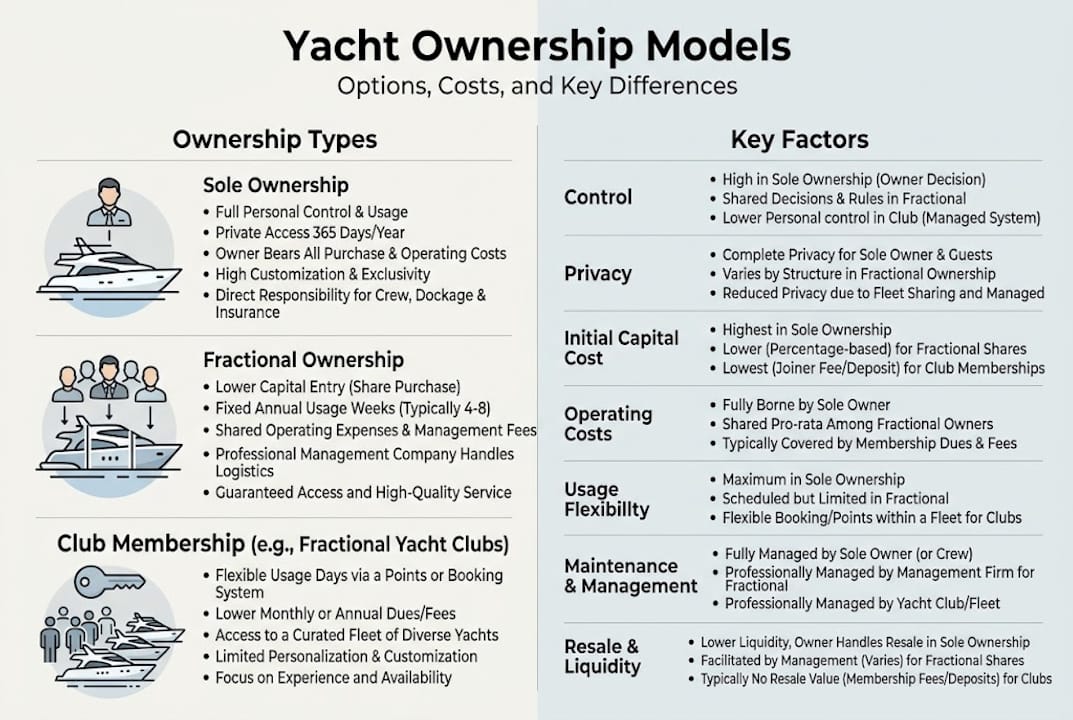
Sole ownership is the most straightforward model. You own the vessel outright. Every decision, from crew hiring to refit scheduling, is yours. The tradeoff is that you also bear every cost. Sole ownership maximizes exclusivity but comes with the full financial burden, which for a superyacht can run into tens of millions annually.
Fractional ownership distributes both cost and usage across a small group of co-owners, typically two to five parties. You pay a fraction of the purchase price and share operating costs proportionally. Access is scheduled in advance, and while you retain more flexibility than a club model, you do give up some spontaneity and absolute privacy.
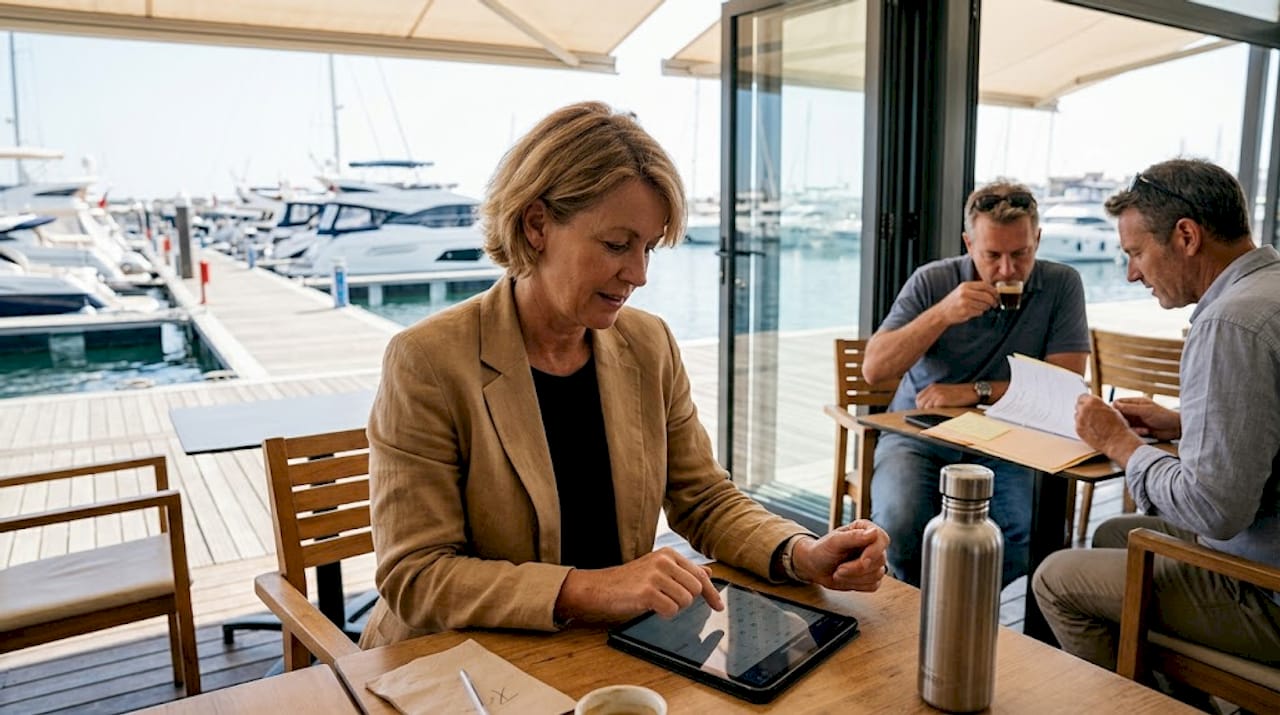
Club programs and syndicates take this further. Models like the Maybach Ocean Club involve up to 300 co-owners, each receiving roughly four weeks of use per year. The financial entry point is dramatically lower, but so is the sense of personal ownership. These programs appeal strongly to experience-first buyers who prioritize time on the water over the prestige of a title.
| Structure | Control | Privacy | Annual cost | Best for |
|---|---|---|---|---|
| Sole ownership | Full | Maximum | Highest | Legacy, design, full use |
| Fractional | Shared | Moderate | Proportional | Cost-conscious buyers |
| Club/syndicate | Minimal | Limited | Lowest | Experience-first clients |
Younger ultra-high-net-worth individuals (UHNWIs) are increasingly drawn to fractional and club models, valuing flexibility and global access over singular possession. Before committing to any structure, reviewing pre-purchase tips can help you align your choice with your lifestyle and long-term goals.
Pro Tip: If you are considering fractional ownership, negotiate for guaranteed peak-season weeks in writing before signing. Availability during prime cruising windows is the most common friction point among co-owners.
The real costs of exclusive yacht ownership
Choosing your ownership model is just part of the equation; understanding the real costs reveals the whole picture. Many buyers focus on the purchase price and underestimate what follows. The ongoing financial commitment is substantial and predictable, which means it can be planned for carefully.
Annual operating costs for superyachts typically consume 10 to 20 percent of the vessel’s purchase price. On a $75 million yacht, that translates to $6 to $9 million per year. Sole owners absorb this entirely; fractional owners pay their proportional share.
Here is a breakdown of where those costs go:
- Crew salaries and benefits: For a large superyacht, a professional crew of 15 to 20 can cost $2 to $3 million annually, including salaries, training, and benefits.
- Maintenance and refit: Regular maintenance, antifouling, and periodic refits account for a significant portion of the annual budget. Lessons from ongoing maintenance decisions show that deferred work always costs more.
- Insurance: Comprehensive marine insurance for a superyacht typically runs 0.5 to 1.5 percent of hull value per year.
- Mooring and marina fees: Berthing in premium destinations like Monaco, Ibiza, or the Maldives adds up quickly, often reaching six figures annually.
- Fuel and provisioning: Extended voyages consume enormous quantities of fuel; provisioning for guests adds further variable costs.
| Cost category | Approximate annual range |
|---|---|
| Crew | $2M to $3M |
| Maintenance and refit | $1M to $2.5M |
| Insurance | $375K to $1.1M |
| Mooring and marina | $200K to $600K |
| Fuel and provisioning | $500K to $1.5M |
Charter income is often cited as an offset, but the reality is more measured. Net charter yields rarely exceed 2 to 4 percent of the vessel’s value annually after fees, crew costs, and wear. Treat your yacht as a passion asset, not a financial instrument.
Pro Tip: Build a dedicated operating reserve of at least 18 months of projected running costs before taking delivery. Unexpected refit requirements and regulatory compliance upgrades are the two most common budget surprises.
Legal, tax, and succession nuances of ownership
Financial costs are just one side; legal structures dramatically affect the kind of exclusivity and legacy you can preserve. How you hold title to your yacht has consequences that reach far beyond the initial transaction.
The three primary holding structures are personal ownership, LLC (limited liability company), and trust. Each carries distinct implications:
- Personal ownership: Simple and direct, but exposes the owner to personal liability and offers limited privacy.
- LLC structure: Provides liability protection, can optimize tax treatment, and creates a layer of privacy between the owner and the vessel. Hybrid structures like LLCs combined with charter arrangements can further optimize taxes and privacy.
- Trust: Particularly valuable for succession planning, allowing the vessel to pass to heirs without probate and with clear governance rules.
Cross-border purchases introduce additional complexity. Flag state regulations, VAT obligations in European waters, and customs requirements in the United States all require careful navigation. Purchasing a vessel registered in the Cayman Islands for use in Mediterranean waters, for example, involves compliance layers that demand specialist legal counsel.
Several complications arise more often than buyers expect:
- Marital disputes: Divorce proceedings can freeze or force the sale of a vessel if ownership is not properly structured in advance.
- Liens: Outstanding liens survive a sale and transfer to the new owner unless cleared at closing.
- International compliance: Crew employment law, safety certification, and environmental regulations vary by flag state and cruising territory.
“Proper structuring is not just about tax efficiency. It is about ensuring that the vessel you worked to create remains under the control of the people you intend, for as long as you intend.”
Engaging a maritime attorney early in the process, ideally before signing a purchase agreement, is one of the most valuable steps any serious buyer can take.
Trends: From traditional ownership to experience-first models
With foundational elements covered, it is clear that the definition of exclusivity is evolving. Let us review these new trends reshaping how sophisticated clients engage with luxury yachting.
The rise of experience-focused models reflects a broader shift in how ultra-high-net-worth individuals think about assets. Younger UHNWIs increasingly prefer experience-focused models over asset accumulation. For this cohort, the quality of time spent on the water matters more than the legal formality of ownership.
Club models have evolved significantly. Programs now offer members access to multiple vessels across different cruising regions, curated itineraries, exclusive onboard events, and even input into vessel specifications. The emerging yacht models coming out of leading yards reflect this demand, with modular interiors and flexible configuration options designed for shared-use programs.
Key trends reshaping luxury yacht access in 2026:
- Multi-vessel club memberships giving access to different hull types and cruising regions
- Customization rights within club programs, allowing members to specify finishes and layouts for their allocated weeks
- Exclusive event programming tied to membership, including regattas, culinary voyages, and private destination access
- Digital booking and concierge platforms that make scheduling and provisioning seamless across ownership models
- Sustainability-focused builds attracting a new generation of environmentally conscious UHNWI clients
These trends do not diminish sole ownership. They expand the ecosystem, creating more pathways for more clients to find a model that genuinely fits their life.
Why true exclusivity means more than just ownership
Looking at these trends and complexities, our perspective is that true exclusivity is ultimately about something deeper than paperwork or price.
We have worked with clients across the full spectrum of ownership models, and the ones who report the greatest satisfaction are not always the sole owners of the largest vessels. They are the ones whose yacht reflects a genuine vision: a specific hull form they fought for, a saloon layout that perfectly accommodates their family, a color palette that means something to them personally. That kind of intentionality creates real prestige.
What typically gets overlooked is the owner’s role as a creative collaborator. The most memorable vessels we have been involved with were shaped by clients who engaged deeply in the design process, who asked hard questions about subsystems and long-term stewardship, and who thought about how the vessel would serve their family over decades, not just seasons. Our project management insights reflect this philosophy directly.
Our practical wisdom is this: align your ownership structure and your yacht’s design with your actual lifestyle, not with a status signal. The most exclusive thing you can do is build something that is irreplaceably yours.
Ready to shape your own exclusive yacht experience?
If redefining exclusivity matters as much to you as it does to us, here is how to get started.
At Baranof Yachts, we specialize in guiding clients through every stage of bespoke yacht ownership, from initial concept and ownership structure decisions through to delivery and beyond. Whether you are drawn to sole ownership of a fully custom build or exploring how a fractional model might fit your life, our team brings the expertise to make the process clear and the outcome exceptional.
You can begin by exploring how to configure your ideal yacht or read about how we make custom builds simple and smart for clients at every stage. When you are ready to talk, our team is here to help you move from vision to voyage.
Frequently asked questions
What does exclusive yacht ownership actually offer compared to charters?
Sole ownership gives you full authority over design, itinerary, crew, and legacy decisions, whereas charters and club models only provide temporary, scheduled access with no lasting control.
How much does it cost to maintain a superyacht annually?
Operating costs for superyachts typically run 10 to 20 percent of the purchase price each year, which means a $75 million vessel can cost $6 to $9 million annually to operate.
Can yacht ownership be structured to reduce tax or limit liability?
Yes. Hybrid structures combining LLCs with charter arrangements can provide meaningful tax advantages, liability protection, and additional privacy, particularly when integrated with estate planning.
Is buying a yacht a good investment?
Yachts depreciate and should be treated as passion assets rather than financial instruments, as charter offsets rarely exceed 2 to 4 percent net yield annually after fees and operating costs.
Recommended
Sold Listings
Design Your Yacht
"*" indicates required fields
Maximus III - PNW
As you step aboard MAXIMUS III, the first impression is her scale.
At 120 feet with an 8-meter beam and 294 GT of interior volume, this 2025 Crescent Custom tri-deck immediately feels open, balanced, and estate-like. A timeless look while still feeling fresh from the shipyard.
Currently Available


Get your yacht value Estimate
"*" indicates required fields