
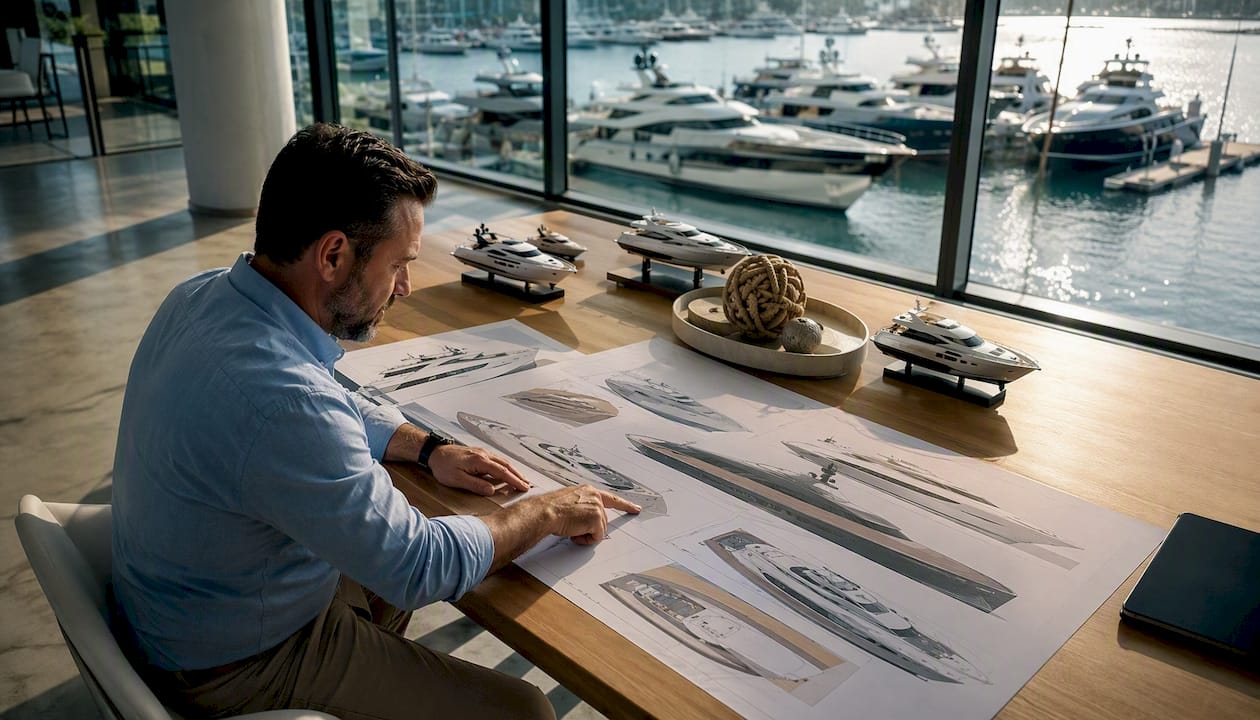
The most practical way to categorize boats is by propulsion and mission: powerboats, sailboats and multihulls, human-powered craft, personal watercraft (PWC), and specialty or commercial vessels. Choose by matching your primary activity to the environment where you’ll use it most, then let budget confirm the shortlist.
A few trusted signals worth knowing before you go further:
- ISO/CE seaworthiness categories (A through D) define where a boat can safely operate, from open-ocean Category A vessels down to sheltered-water Category D craft. We cover the full breakdown in the design fundamentals section below.
- USCG and state registration requirements are tied to vessel length and class. U.S. regulatory safety requirements for life jackets, fire extinguishers, and distress signals vary by vessel class, so confirming both federal and state rules before purchase is non-negotiable.
- Hull form determines performance ceiling. Planing hulls favor speed; displacement hulls favor range and fuel efficiency. That single distinction shapes every other ownership decision.
Use the quick-reference table in the next section to match your mission to a boat type, then read the relevant category section for the detail you need to make a confident decision.
Table of Contents
- At a Glance: 8 Common Boat Types Compared
- Powerboats: What the Major Subtypes Actually Do
- Sailboats and Multihulls: Which Hull Form Fits Your Plans?
- Specialty Recreational Boats: Pontoons, Trawlers, Wake Boats, and More
- Small and Human-Powered Boats: What You Need to Know Before Buying
- Hull Forms, Propulsion, Materials, and ISO/CE Categories Explained
- How to Choose the Right Boat: Criteria, Costs, and a Buying Timeline
- Safety, Registration, and U.S. Legal Basics Every Buyer Must Know
- Key Takeaways
- What the Boat Selection Process Gets Wrong Most Often
- Baranofyachts: Expert Guidance for Serious Yacht Buyers
- Authoritative Sources and Further Reading
At a Glance: 8 Common Boat Types Compared
| Boat Type | Best For | Typical Length / Capacity | Propulsion | Purchase Cost Range | Annual Ownership Est. | Maintenance Difficulty | Best Environment |
|---|---|---|---|---|---|---|---|
| Bowrider / Deck Boat | Family day use, watersports | 17–22 ft / 4–8 passengers | Outboard or sterndrive | $15,000–$30,000 | $300–$3,000+ | Low–Moderate | Lake, river, nearshore |
| Center Console | Fishing, coastal cruising | 18–35 ft / 4–10 passengers | Outboard (single or twin) | — | $15,000–$30,000 | Moderate | Nearshore, offshore |
| Pontoon | Social/family, calm water | 16–30 ft / 12–23 passengers | Outboard | — | $3,000–$7,000 | Low | Lake, river, bay |
| Cabin Cruiser / Cuddy | Overnight cruising, day trips | 22–45 ft / 4–8 passengers | Sterndrive or inboard | — | — | Moderate–High | Coastal, nearshore |
| Bass / Bay Boat | Freshwater/inshore fishing | — | Outboard | $15,000–$30,000 | $300–$3,000+ | Low–Moderate | Lake, river, bay |
| Trawler / Motor Yacht | Long-range cruising, liveaboard | 26–100+ ft / 4–10 passengers | Inboard diesel | — | — | High | Coastal, offshore |
| Sailboat / Monohull | Coastal cruising, racing, liveaboard | 20–60+ ft / 2–8 passengers | Sail + auxiliary inboard | — | $5,000–$40,000 | Moderate–High | Coastal, offshore |
| Kayak / Canoe / PWC | Recreation, fishing, watersports | 8–14 ft / 1–3 persons | Human-powered or jet | $300–$15,000 | — | Low | Lake, river, nearshore |
Quick selection tips:
- If your primary activity is fishing offshore, a center console with twin outboards gives you the best combination of fishability and rough-water capability.
- For calm-water family days with a large group, a pontoon’s stability and capacity are hard to beat at its price point.
Statistic callout: ISO/CE Category A vessels are rated for waves over 13 feet and winds above 40 knots; Category D is limited to waves up to 18 inches and winds of 16 knots. Most recreational boats sold in the U.S. fall into Categories C or D.
Powerboats: What the Major Subtypes Actually Do
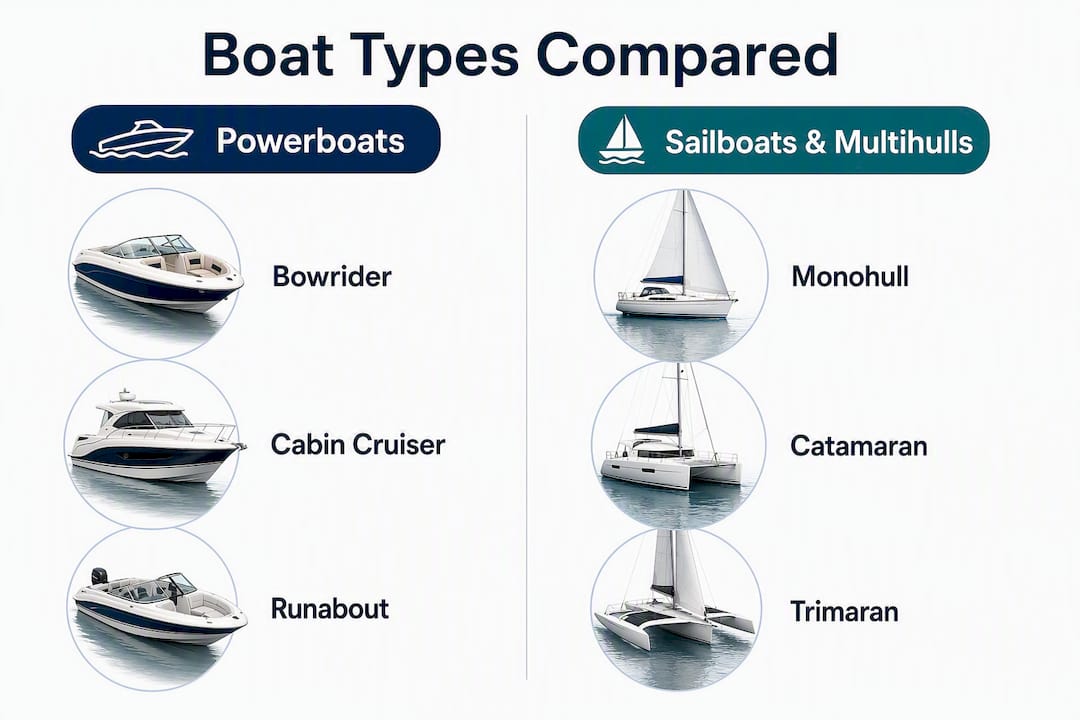
“Powerboat” covers any motorized vessel where an internal-combustion or electric engine provides primary propulsion. The category spans everything from a 17-foot runabout to a 60-foot express cruiser, and the propulsion configuration you choose shapes both performance and long-term costs more than almost any other decision.
Propulsion options at a glance:
- Outboard motors mount externally on the transom, are easy to service, and dominate boats under 35 feet. Replacement is straightforward, which keeps long-term costs predictable.
- Sterndrive (inboard/outboard) systems place the engine inside the hull with a drive unit through the transom. They offer a cleaner deck layout and better weight distribution but require more involved maintenance.
- Inboard gasoline or diesel engines sit fully inside the hull, common on larger cruisers and performance boats. Diesel inboards are the standard for vessels intended for extended offshore passages.
- Jet drives replace a propeller with an impeller, making them safer in shallow water and popular on jet boats and PWCs.
Common powerboat subtypes
Bowrider and deck boats are the workhorses of recreational boating. Open bow seating, a swim platform, and a layout optimized for socializing make them the default choice for family day use and watersports on lakes and nearshore coastal waters. Most run on a single outboard or sterndrive and trailer easily.
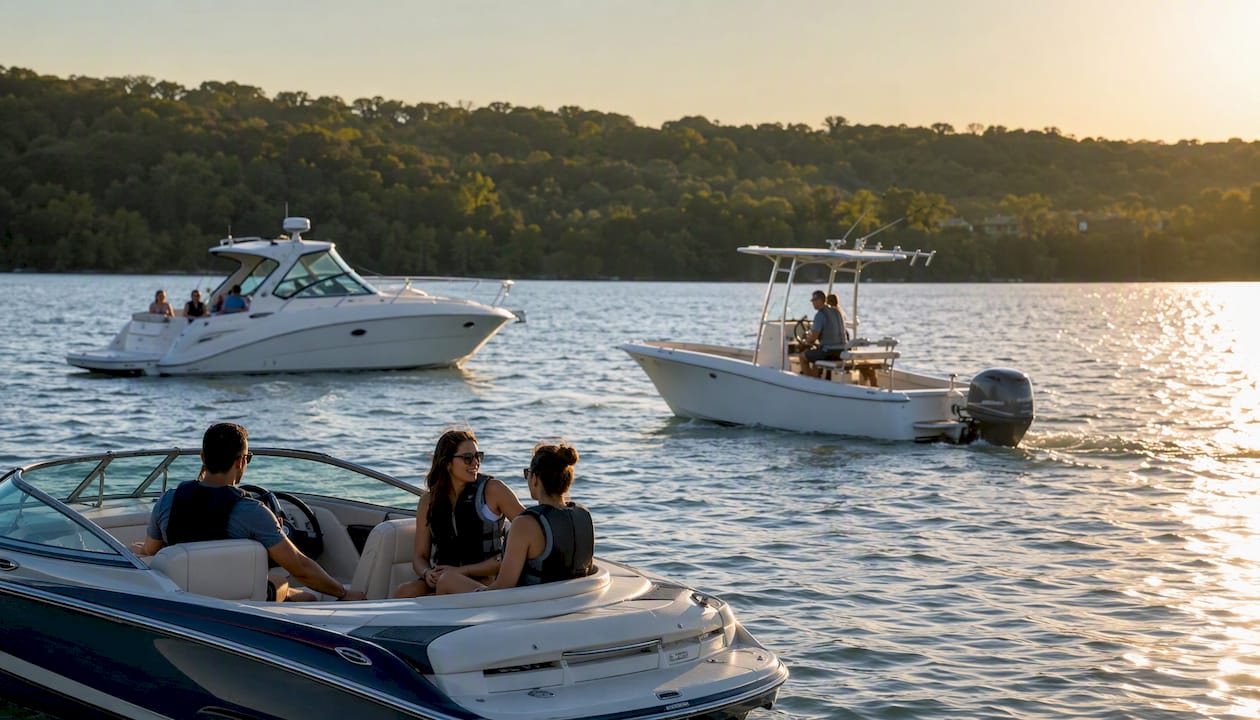
Center consoles are built around a single console in the middle of the boat, leaving the entire deck perimeter open for fishing. Their open layout sheds water quickly, and twin-outboard configurations on larger models give offshore capability that few other recreational designs match. A 25-foot center console with twin 150-horsepower outboards is a common setup for nearshore Gulf Coast fishing.
Cabin cruisers and cuddy cabins add enclosed sleeping and galley space. A cuddy cabin offers a small forward berth and basic shelter; a full cabin cruiser extends that to a proper overnight setup with a head and sometimes a full galley. These are the entry point for extended coastal cruising without moving to a full trawler.
Runabouts are compact, fast, and purpose-built for speed and watersports. They typically run 17–22 feet, carry 4–8 passengers, and favor sterndrive or outboard power.
| Subtype | Typical Length | Passengers | Engine Type | Trailerable |
|---|---|---|---|---|
| Bowrider | 17–22 ft | 8–12 | Outboard / sterndrive | Yes |
| Center Console | 18–35 ft | 4–10 | Outboard (single/twin) | Yes (under 28 ft) |
| Cabin Cruiser | 22–45 ft | 4–8 | Sterndrive / inboard | Rarely above 30 ft |
| Runabout | 17–22 ft | 4–8 | Outboard / sterndrive | Yes |
Pros of powerboats as a category:
- Speed and versatility across a wide range of activities
- Large dealer and service network across the U.S.
- Strong resale market for well-maintained outboard-powered models
Cons to plan for:
- Fuel costs are significant, especially at planing speeds with larger engines
- Engine maintenance intervals are non-negotiable; deferred service compounds quickly
- Larger inboard-powered boats require a slip rather than a trailer, adding annual storage costs
Practical ownership note: a 25-foot outboard-powered boat kept on a trailer costs considerably less annually than the same boat kept in a marina slip. Factor in slip fees, winterization, and engine service when building your total cost of ownership.
Sailboats and Multihulls: Which Hull Form Fits Your Plans?
Sailboats use wind as primary propulsion, with an auxiliary engine for maneuvering in harbors and motoring through calms. The ownership profile is fundamentally different from a powerboat: fuel costs drop sharply, but rigging, sails, and standing rigging require regular inspection and periodic replacement.
Core distinctions:
A monohull sailboat has a single hull and relies on ballast in the keel for stability. It heels (leans) in wind, which some sailors find exhilarating and others find uncomfortable. A catamaran uses two parallel hulls connected by a bridgedeck, offering a level sailing platform, more interior volume, and shallower draft. Trimarans add a third hull for even greater stability and speed, though they are less common in the cruising market.
Common sailboat subtypes and their missions:
- Day sailors (typically 14–22 feet): simple rigs, minimal equipment, ideal for learning and afternoon sails on protected water.
- Coastal cruisers (22–40 feet): the most common category for weekend sailors. Sloops with a single mast and a furling headsail are the standard configuration.
- Bluewater cruisers (38–60+ feet): built for offshore passagemaking with reinforced hulls, larger fuel and water tankage, and redundant systems. These are the boats that cross oceans.
- Performance racers: optimized for speed over comfort, with carbon fiber spars, fractional rigs, and minimal accommodation.
- Liveaboard catamarans: the fastest-growing segment of the cruising market. Wide beams, large saloons, and separate hulls for cabins make them practical floating homes.
Ownership considerations:
Rigging inspection every season is standard practice. Standing rigging (the wire or rod that supports the mast) typically needs replacement every 10–15 years on a cruising boat, and the cost is proportional to mast height. Sails wear faster than most new owners expect; a full suit of cruising sails on a 40-foot boat can run $15,000–$30,000.
Docking costs are another variable. Catamarans require a wide berth, and many marinas charge a premium for beam over a certain width. That cost can offset the interior-space advantage on a tight annual budget.
Pro Tip: If you’re considering a trailerable sailboat under 25 feet, confirm the beam before you buy. Many modern performance designs exceed standard trailer width limits, which means an oversize permit for every road trip to a new sailing area.
Specialty Recreational Boats: Pontoons, Trawlers, Wake Boats, and More
Some boats are so purpose-built that their design makes the mission obvious. Understanding the practical differences between these categories prevents the common mistake of buying a general-purpose powerboat when a specialty design would serve you far better.
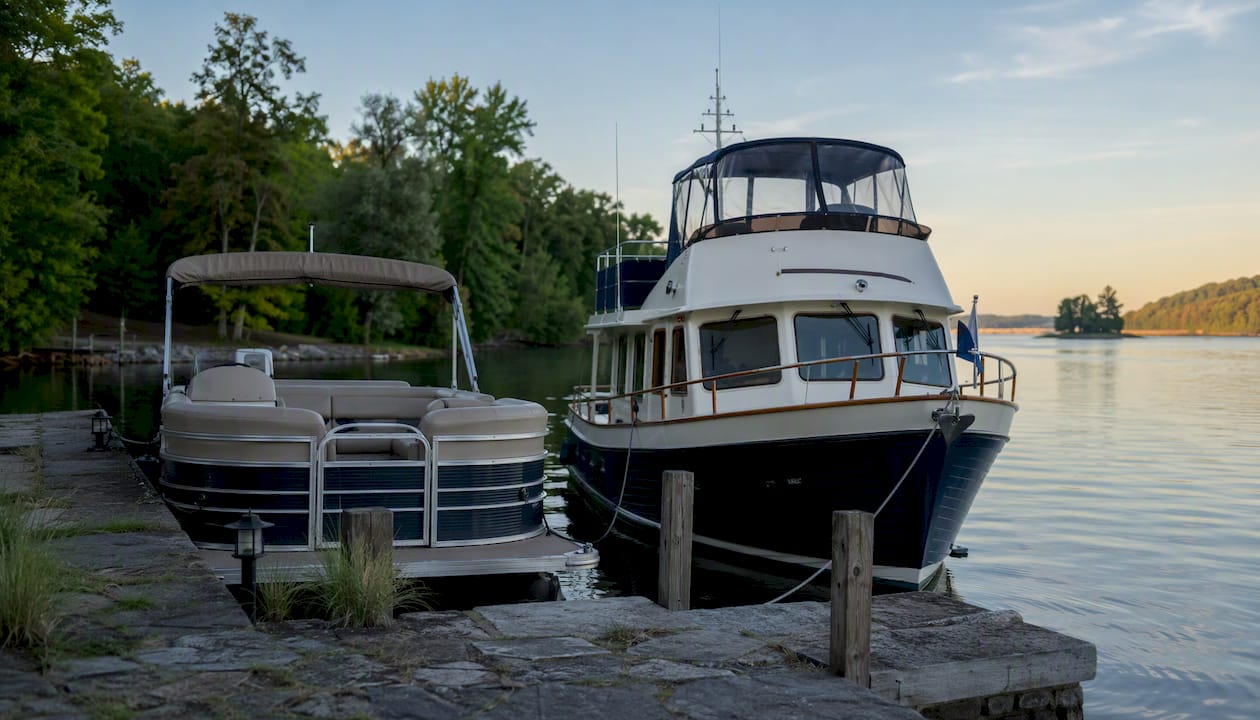
Pontoon boats are supported by two or three aluminum tubes (pontoons) beneath a flat deck platform. Pontoons range from roughly 16 to 30 feet and can carry 12–23 passengers depending on model and layout, making them the most social platform in recreational boating. Modern performance pontoons with triple-tube designs and high-horsepower outboards can reach surprising speeds, but their natural element remains calm lakes and protected bays. They are among the fastest-growing vessel categories in the U.S. recreational market.
Trawlers and displacement-hull motor yachts are built for range, not speed. Trawlers range from 26 feet to over 100 feet and favor diesel power and displacement hulls for stability and fuel efficiency on long passages. The ownership profile is closer to a small ship than a recreational powerboat: professional maintenance, marina slips, and sometimes paid crew are part of the picture above 50 feet.
Wake boats and ski boats carry ballast systems and towers specifically to create a large, clean wake for wakeboarding and wakesurfing. The ballast tanks add weight and complexity; fuel consumption at wakeboarding speeds is higher than most buyers anticipate. These are lake boats, full stop.
Bass boats feature large, open casting decks, livewells for keeping fish alive, and a low-profile hull optimized for shallow freshwater lakes and rivers. They are fast, purpose-built, and genuinely poor choices for anything other than their intended mission.
Offshore sportfishing boats are the heavy end of the fishing category: deep-V hulls, tower-mounted fighting chairs, large fish boxes, and twin or triple outboards or inboard diesel power. They are built to handle open-ocean conditions and are sized accordingly, typically 30–60 feet.
Houseboats are the liveaboard option for protected inland waters. Wide, flat-bottomed, and slow, they prioritize living space over any performance metric. Many are permanently moored or move only seasonally.
Choosing specialty vs. general-purpose:
A general-purpose powerboat like a bowrider handles a wide range of activities adequately. A specialty boat handles one activity exceptionally well and others poorly. If 80% of your time on the water will be spent doing one thing, the specialty design almost always wins on both performance and long-term satisfaction.
Small and Human-Powered Boats: What You Need to Know Before Buying
The smallest and least expensive category covers more ground than most buyers realize, from a $300 recreational kayak to a $15,000 inflatable tender for a larger yacht. These craft have low barriers to entry, but a few practical and regulatory details are worth understanding before you buy.
-
Kayaks and canoes are the most accessible entry point to boating. No registration is required in most U.S. states for non-motorized kayaks and canoes, though rules vary. Purchase prices range from $300 for a basic recreational kayak to $3,000+ for a touring or fishing-specific model. Storage is simple: a garage wall or a roof rack.
-
Rowboats and jon boats are flat-bottomed, stable, and practical for calm freshwater. Jon boats with a small outboard are common on bass lakes and rivers. Most states require registration once a motor is added, regardless of vessel size.
-
Inflatable boats and RIBs (rigid inflatable boats) range from simple pool toys to serious offshore tenders. A quality RIB with a 25-horsepower outboard is a capable tender for a larger yacht and can handle moderate coastal conditions. Purchase prices run $1,500–$20,000 depending on construction quality and size.
-
Personal watercraft (PWC) such as Jet Ski and Sea-Doo models use a jet drive and are classified as Class A vessels (under 16 feet) under USCG length-based classification. All U.S. states require registration for PWCs, and most require a boater education certificate for operators under a certain age. Purchase prices run $7,000–$18,000 new.
-
Small outboard tenders (8–14 feet with a 5–25 horsepower outboard) are the standard utility boat for larger yacht owners. They are trailerable, storable on a yacht’s davits, and inexpensive to maintain.
State check note: Before purchasing any small motorized craft, confirm your state’s registration requirements, minimum safety equipment rules, and any age or education requirements for operators. Rules vary significantly by state. The BoatUS Foundation and your state’s boating agency are the most reliable starting points.
Dry storage ashore is the most cost-effective option for small craft. A kayak or small jon boat stored at home costs almost nothing annually beyond basic maintenance; a PWC stored at a marina adds $500–$2,000 per season depending on location.
Hull Forms, Propulsion, Materials, and ISO/CE Categories Explained
Understanding why hull design matters is the difference between a boat that performs as expected and one that disappoints the moment conditions change.
Planing vs. displacement hulls
Planing hulls ride on top of the water at speed, while displacement hulls move through it at all times. A planing hull needs sufficient power to climb onto plane; below that threshold, it is actually less efficient than a displacement hull. A displacement hull has a theoretical maximum speed governed by its waterline length.
Statistic callout: The hull-speed formula for displacement hulls is approximately 1.34 × √(waterline length in feet), measured in knots. A 36-foot waterline yields a theoretical hull speed of roughly 8 knots. Pushing beyond that speed dramatically increases fuel consumption with little gain.
For a deeper look at displacement hull design and its practical benefits, the trade-offs between hull forms become especially clear when evaluating trawlers and long-range motor yachts.
Multihull vs. monohull
Multihulls (catamarans and trimarans) offer more initial stability, greater deck space, and shallower draft than monohulls of comparable length. The trade-off is beam: a 45-foot catamaran may occupy a berth wide enough for a 60-foot monohull, with corresponding marina fees. Monohulls have a deeper, more predictable motion in offshore conditions that many experienced bluewater sailors prefer.
Propulsion types and typical use-cases
- Outboard: dominant under 35 feet; easy to service; best for trailerable boats and fishing applications
- Sterndrive: common on 20–35-foot cruisers; cleaner deck layout; more maintenance-intensive than outboard
- Inboard gasoline: found on older cruisers and ski boats; being replaced by outboard and sterndrive in most new builds
- Inboard diesel: standard for trawlers, motor yachts, and sailboat auxiliaries above 35 feet; superior fuel efficiency and longevity
- Jet drive: propeller-free; ideal for shallow water and PWCs; less efficient at low speeds
Hull materials
Hull material selection directly affects durability, maintenance burden, and long-term value:
- Fiberglass/GRP: the dominant material for production recreational boats; low maintenance, good resale value, widely repairable
- Aluminum: lightweight, corrosion-resistant in freshwater, common on jon boats and fishing boats; requires anodizing or paint in saltwater
- Composite (carbon fiber, Kevlar): used in performance and luxury builds for weight savings; expensive to repair
- Steel: used on large commercial vessels and some bluewater cruisers; heavy but extremely strong; requires diligent corrosion management
- Wood: traditional, beautiful, and high-maintenance; mostly found in classic and heritage vessels
ISO/CE categories A–D
| Category | Wave Height | Wind Speed | Practical Use |
|---|---|---|---|
| A (Ocean) | Over 13 ft | Over 40 knots | Offshore bluewater passages |
| B (Offshore) | Up to 13 ft | Up to 40 knots | Coastal and offshore day/overnight |
| C (Inshore) | Up to 7 ft | Up to 27 knots | Large bays, lakes, nearshore |
| D (Sheltered) | Up to 18 inches | Up to 16 knots | Calm inland waters only |
Most production recreational boats sold in the U.S. are rated Category C or D. If you plan to operate offshore, confirm the vessel’s category before purchase.
How to Choose the Right Boat: Criteria, Costs, and a Buying Timeline
Start with mission, then environment, then budget. That order matters because a boat optimized for the wrong mission will frustrate you regardless of price, and a boat rated for the wrong environment is a safety issue.
Step-by-step selection process:
- Define your primary mission. Fishing, watersports, coastal cruising, liveaboard, or social day use? Be specific. “A little of everything” is the most expensive answer.
- Identify your primary operating environment. Lake, river, nearshore coastal, or offshore? Cross-reference with ISO/CE categories to confirm the vessel class you need.
- Set a realistic total cost of ownership (TCO) budget. Purchase price is typically 40–60% of your first-year cost. Annual ownership expenses include:
- Insurance: $500–$5,000+ depending on vessel value and coverage
- Slip or dry storage: $1,500–$15,000+ per year depending on location and vessel size
- Fuel: highly variable; a 25-foot outboard boat running 100 hours per season at 10 gallons per hour costs roughly $3,500–$5,000 in fuel alone
- Maintenance and winterization: budget 1.5–2% of vessel value annually as a baseline
- Choose hull form and propulsion based on mission and environment. Offshore fishing demands a deep-V planing hull and reliable outboard or diesel power. Long-range cruising demands a displacement hull and diesel.
- Decide trailer vs. slip. Trailerable boats (generally under 28–30 feet) cost significantly less to store and give you flexibility to launch at different locations. Larger boats require a slip, which adds a fixed annual cost.
- Shortlist two or three specific models within your budget. Use the quick-reference table above as a starting filter, then research model-specific owner forums and survey reports.
- Schedule a sea trial. No boat should be purchased without one. Test at cruising speed, at low speed, and in the conditions you’ll actually use it in.
- Commission a pre-purchase survey. A certified marine surveyor will inspect the hull, systems, and engine. For any boat over $20,000, a survey is money well spent. For larger yachts, professional project oversight and brokerage services protect your investment from the first conversation through delivery.
- Arrange financing and insurance before closing. Marine lenders typically require 10–20% down on recreational boats. Insurance quotes should be in hand before you finalize the purchase price.
- Complete registration and titling. Most states require registration within 30–60 days of purchase. Title and registration fees vary by state and vessel value.
Realistic purchase price bands:
- Entry-level recreational boats (kayaks to 22-foot outboards): $300–$40,000
- Mid-range powerboats and sailboats (22–40 feet): $40,000–$300,000
- Large yachts and custom builds (40 feet and above): $300,000 to well above $2 million
Typical buying timeline: 4–12 weeks from initial research to registration for a production boat purchase; 12–36 months for a custom build or major refit. For larger vessels, working with a broker from the start compresses the timeline and reduces the risk of costly mistakes. Understanding the current yachting market helps buyers time their purchase and negotiate from an informed position.
Buyer checklist before closing:
- Sea trial completed in representative conditions
- Pre-purchase survey by a certified marine surveyor
- Engine hours and full maintenance records reviewed
- Title search and lien check completed
- Insurance quote confirmed and coverage bound
- State registration requirements confirmed
- Financing terms finalized
For buyers considering a luxury yacht charter before committing to ownership, chartering first is one of the most reliable ways to validate a mission and a vessel type before signing a purchase agreement.
Safety, Registration, and U.S. Legal Basics Every Buyer Must Know
Every U.S. boat buyer must complete four actions before the first time they operate a vessel: confirm state registration and titling requirements, assemble the required safety equipment for their vessel class, complete boater education where required, and verify any state-specific rules for their operating area.
Minimum USCG-recommended safety equipment by vessel class:
- Life jackets (PFDs): one USCG-approved Type I, II, III, or V PFD for every person on board; throwable Type IV device required on boats 16 feet and over
- Fire extinguisher: required on all motorized boats; quantity and type depend on vessel length and whether the boat has enclosed spaces
- Visual distress signals: required on coastal waters; flares, electronic signals, or approved alternatives
- Sound-producing device: horn or whistle required on all vessels
- Navigation lights: required for operating between sunset and sunrise
- Backfire flame arrestor: required on all gasoline inboard engines
- Ventilation: required for enclosed engine and fuel compartments
Safety equipment requirements are tied to vessel length and class; manufacturers’ marketing claims do not substitute for federal and state compliance. Always verify requirements with both the USCG and your state boating agency.
Vessel length measurement note: In the U.S., regulatory vessel length is measured along the centerline from the outside of the bow to the outside of the stern. Permanent attachments such as swim platforms and wake towers are excluded from this measurement, which can affect which regulatory class a boat falls into and what equipment is required.
State check: Registration requirements, boater education mandates, and age restrictions for PWC operators vary significantly by state. The BoatUS Foundation and your state’s Department of Motor Vehicles or boating agency are the authoritative sources. The NMMA also publishes state-by-state compliance guidance.
Boater education: Many states now require a boater education certificate for all operators, not just those under 18. Even where it is not legally required, completing a course through the BoatUS Foundation or the U.S. Coast Guard Auxiliary is one of the most effective ways to reduce on-water risk.
This article provides general information about U.S. boating regulations and is not a substitute for professional legal or regulatory advice. Confirm current requirements with the USCG, your state boating agency, or a qualified marine attorney before operating any vessel.
Key Takeaways
Choosing the right boat comes down to three decisions made in the right order: define your primary mission, match it to the correct hull form and operating environment, then build a realistic total cost of ownership budget before you ever look at a purchase price.
| Point | Details |
|---|---|
| Mission drives the decision | Define your primary activity first; a boat optimized for the wrong mission will underperform regardless of price. |
| Hull form sets the performance ceiling | Planing hulls favor speed; displacement hulls favor range and efficiency, with hull speed governed by the 1.34 × √(waterline length) formula. |
| ISO/CE categories define safe operating range | Category A handles ocean conditions; Category D is limited to sheltered waters with waves up to 18 inches. |
| Total cost of ownership exceeds purchase price | Budget for insurance, slip or storage, fuel, and maintenance at roughly 1.5–2% of vessel value annually, beyond the purchase price. |
| Baranofyachts for larger vessel purchases | For yachts above 40 feet, custom builds, or refit projects, Baranofyachts provides brokerage, project management, and build oversight to protect your investment. |
What the Boat Selection Process Gets Wrong Most Often
The conventional wisdom says to start with your budget. We’d argue that’s the second-worst place to start, right after starting with aesthetics.
The buyers who end up most satisfied with their vessels are the ones who spent time on the water before they spent money on a boat. Renting, chartering, and crewing on other people’s boats for a full season before purchasing is not a delay tactic. It’s the most efficient path to the right decision. The mission you think you want at a boat show in January often looks very different after a summer of actually doing it.
There’s also a persistent tendency to undervalue hull capability and overvalue fit and finish. A beautifully appointed cabin cruiser with a hull rated for inshore use will not keep you safe offshore, no matter how well it’s built. Experienced owners prioritize mission-fit and resale value over aesthetics, and the data on buyer satisfaction bears that out consistently.
The other underappreciated variable is the ownership infrastructure around the boat. A 45-foot trawler is not just a larger version of a 25-foot powerboat. It requires a slip, likely a professional captain for offshore passages, a maintenance budget that scales with complexity, and a management plan for when you’re not aboard. Yacht management for larger vessels is a discipline in its own right, and buyers who treat it as an afterthought tend to sell within three years.
For buyers moving into the 40-foot-and-above category, the single most valuable thing you can do is engage a broker or project manager before you start looking at specific boats. Not after you’ve fallen in love with a listing. Before. The difference in outcome, both in purchase price and in long-term satisfaction, is substantial.
Baranofyachts: Expert Guidance for Serious Yacht Buyers
When the boat you’re considering moves beyond a production runabout into the territory of a 40-foot-plus motor yacht, a custom bluewater sailboat, or a bespoke build, the complexity of the purchase scales faster than most buyers expect.

Baranofyachts works with buyers at exactly that inflection point, where the right vessel requires more than a dealer transaction. We provide full brokerage services, custom build project management, and refit consulting for clients who want a yacht built or acquired to precise specifications, not just the closest available listing. Our team manages the full process from initial brief through sea trial, survey, and delivery, with the kind of conductor’s-eye oversight that keeps timelines, budgets, and build quality aligned.
For buyers ready to move from research to a real conversation about a specific vessel or build project, the boat brokerage services at Baranofyachts are the right starting point. If you’re earlier in the process and want to understand what a custom build actually involves, our step-by-step planning guide walks through every stage from concept to delivery. Reach out to schedule a consultation and let’s define exactly what the right vessel looks like for your plans.
Authoritative Sources and Further Reading
The claims in this guide draw on the following authoritative sources. We recommend each as a starting point for deeper research on specific topics.
- BoatUS Foundation: Boat Types & Uses — The most accessible U.S.-focused primer on hull types, propulsion, and safety equipment requirements. Used for hull-speed formula, planing vs. displacement explanations, and safety equipment guidance throughout this article.
- BoaterExam: Boat Size Classifications — Explains U.S. regulatory vessel length measurement methodology, including the exclusion of swim platforms and wake towers. Used for the vessel length measurement note in the safety section.
- NMMA Standard Codes: Boat Category Content Types — Industry-standard definitions for powerboats, sailboats, PWCs, and small boats used by manufacturers and dealers. Reference for propulsion and hull category definitions.
- Baranofyachts: Displacement Hull Design and Benefits — Technical explanation of displacement hull characteristics, trade-offs, and applications for buyers evaluating trawlers and long-range motor yachts.
- Baranofyachts: Hull Material Selection Guide — Full guide to fiberglass, aluminum, composite, steel, and wood hull materials with durability and maintenance trade-offs.
- Baranofyachts: Before Building Your Yacht — Practical planning resource for buyers considering a custom build, covering the decisions that must be made before a shipyard contract is signed.
- Sphynx BCN: Sustainable Yacht Travel Tips — Partner resource covering eco-conscious operation, propulsion choices, and sustainable ownership practices for higher-end buyers.
Recommended
Sold Listings


Design Your Yacht
"*" indicates required fields
Maximus III - PNW
As you step aboard MAXIMUS III, the first impression is her scale.
At 120 feet with an 8-meter beam and 294 GT of interior volume, this 2025 Crescent Custom tri-deck immediately feels open, balanced, and estate-like. A timeless look while still feeling fresh from the shipyard.
Currently Available


Get your yacht value Estimate
"*" indicates required fields