
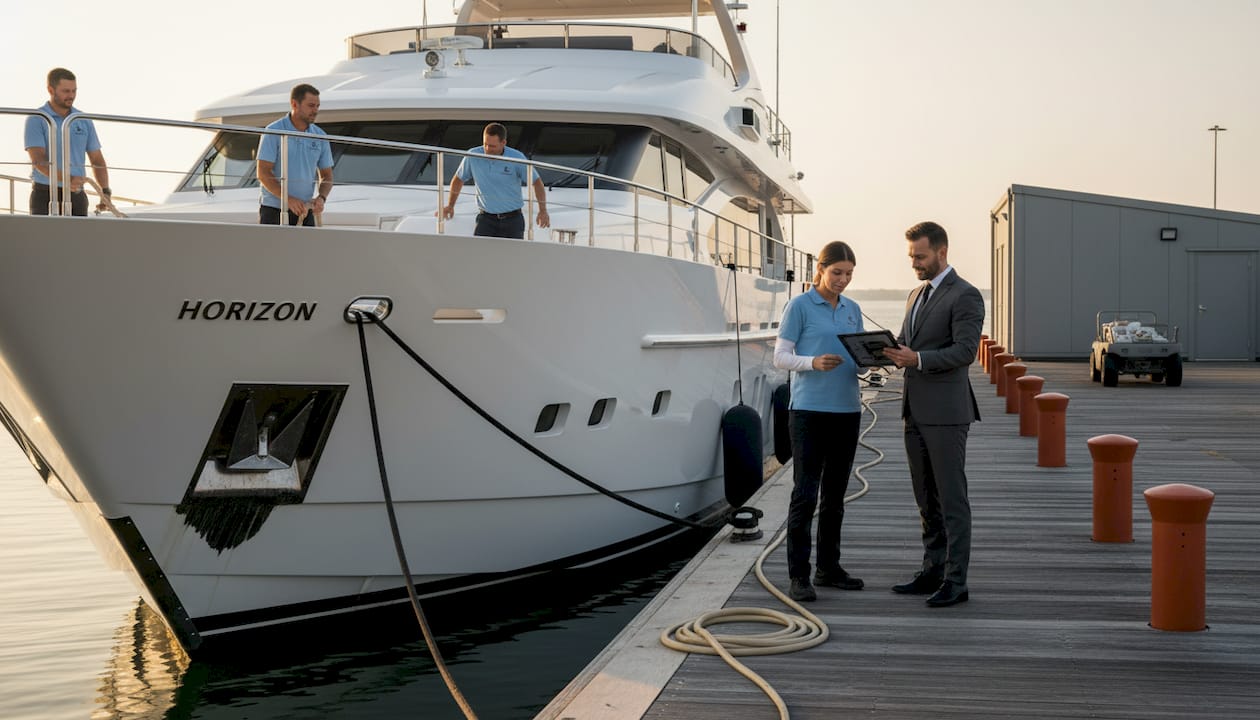
Most people assume that any impressively large yacht qualifies as a superyacht. That assumption misses the mark by a significant distance. The superyacht category is defined by a precise combination of size thresholds, professional crewing standards, regulatory compliance codes, and operational infrastructure that separates these vessels entirely from the world of large private yachts. Whether you are weighing your first acquisition or deepening your knowledge before a significant investment, understanding these distinctions protects your decision-making and sharpens your expectations. This guide walks you through the real definition, the financial architecture of ownership, the customization landscape, and the market forces shaping the industry right now.
Table of Contents
- What truly defines a superyacht?
- Inside the numbers: Costs, ownership, and operations
- Customization, innovation, and lifestyle on board
- Market dynamics: Superyacht industry growth and global trends
- Why most buyers underestimate the complexity—and opportunity—of superyachts
- Ready to define your superyacht experience?
- Frequently asked questions
Key Takeaways
| Point | Details |
|---|---|
| Strict definition standards | Superyachts are defined by size, crew, and regulatory requirements, not just length. |
| Substantial operating costs | Annual ownership expenses often reach millions and surpass the 10% rule in practice. |
| Customization leads the market | Most new superyachts are uniquely built with bespoke features and amenities. |
| Industry is rapidly growing | The superyacht market is set to double by 2032, driven by global demand and innovation. |
What truly defines a superyacht?
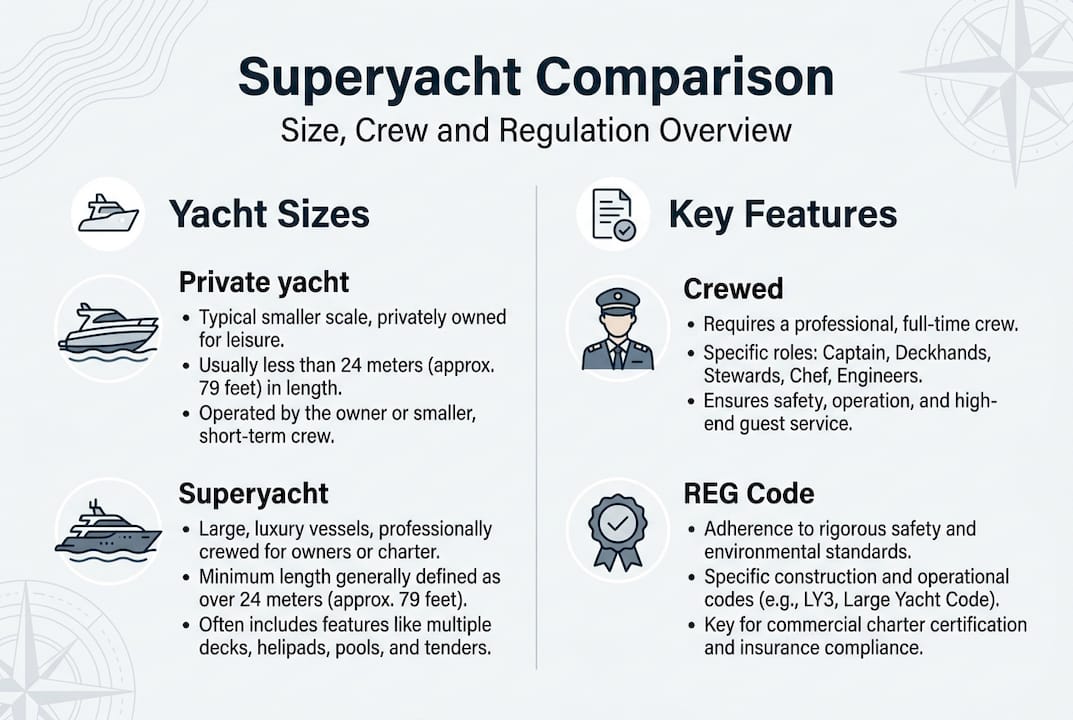
The word “superyacht” gets applied loosely in popular media, but the maritime industry uses it with precision. A superyacht is generally any motorized or sailing vessel measuring 24 meters (approximately 79 feet) or longer, operated by a professional paid crew and built or certified to recognized commercial or large yacht standards. Beyond that baseline length, two additional layers of definition apply: gross tonnage and regulatory code compliance.
Gross tonnage (GT) is a volumetric measure of a vessel’s enclosed spaces, not its weight. This number directly determines which regulatory framework governs the yacht. Vessels below 500 GT face comparatively lighter regulatory demands, while those above 500 GT must satisfy a more rigorous tier of safety, equipment, and certification requirements. Many owners building in the 40 to 60 meter range deliberately manage design choices to stay sub-500 GT, which reduces operational compliance costs without sacrificing interior volume.
The most important regulatory framework for privately chartered superyachts is the REG Yacht Code Part A (formerly known as LY3). This code applies to yachts 24 meters and above carrying no more than 12 passengers. Professional crew requirements, typically five or more paid specialists including captain, engineers, and deckhands, combined with strict code compliance, are what formally separate a superyacht from a large private yacht owned by an individual who operates it personally.
Here is a quick comparison of how the categories stack up:
| Vessel Category | Typical Length | Crew Requirement | Regulatory Code |
|---|---|---|---|
| Large private yacht | 15m to 24m | Optional, minimal | Minimal/flag state only |
| Superyacht | 24m to 60m | 5+ professional crew | REG Yacht Code Part A |
| Megayacht | 60m to 90m | 15+ professional crew | MCA/flag state commercial |
| Gigayacht | 90m+ | 30+ professional crew | Full commercial + IMO |
Beyond the technical classifications, the superyacht category carries a global fleet footprint. The registered superyacht fleet has grown steadily over the past decade, with more than 6,000 vessels currently documented worldwide. The distinction between “superyacht” and “megayacht” is primarily one of scale and complexity, not a fundamentally different category. Understanding where your vessel sits within this spectrum influences everything from the yacht craftsmanship standards you should demand during construction to the crewing certifications you will need to maintain.
Key characteristics that define a superyacht at any size tier include:
- Certified professional crew with STCW (Standards of Training, Certification, and Watchkeeping) qualifications
- Flag state registration with a recognized maritime authority (Marshall Islands, Cayman Islands, Malta, and others)
- Classification society certification from bodies such as Lloyd’s Register, Bureau Veritas, or DNV
- Safety management systems including life-saving appliances and fire suppression rated for guest occupancy
- Annual surveys and dry-docking on a scheduled cycle, typically every five years for out-of-water inspection
If you are considering a new build, understanding these layers of compliance before building your yacht is essential. Getting the regulatory framework right at the design stage prevents costly modifications later and ensures your vessel is insurable, charterable, and resalable from day one.
Inside the numbers: Costs, ownership, and operations
Once you have the technical picture, the financial reality comes next. Superyacht ownership is rarely a simple asset acquisition. It is an ongoing operational commitment that demands careful budgeting, professional management, and long-term financial planning.

The most widely cited rule in the industry is the 10% rule: expect to spend roughly 10 to 20% of your vessel’s purchase price annually on operating costs. Annual operating costs for a 60-foot yacht valued at approximately $6 million run between $1.2 million and $1.6 million per year. For a 150-foot vessel at $40 million, that figure climbs to $6.5 million to $8.5 million annually, with crew salaries alone accounting for 30 to 45% of total operating expenses.
A typical annual cost breakdown for a mid-range superyacht looks like this:
| Expense Category | Approximate Share of Annual Budget |
|---|---|
| Crew salaries and benefits | 30 to 45% |
| Fuel and voyage costs | 15 to 25% |
| Insurance | 5 to 10% |
| Maintenance and repairs | 15 to 20% |
| Marina fees and port costs | 5 to 10% |
| Provisions and supplies | 5 to 8% |
| Administration and management | 3 to 7% |
In practice, operating costs exceed the 10% rule more often than they meet it. Three converging pressures are driving costs higher across the fleet. First, crew shortages in key specialist roles (engineers trained on hybrid propulsion systems, for example) are pushing salaries up sharply. Second, yachts incorporating advanced hybrid or zero-emission technology require specialized maintenance expertise that commands a premium. Third, evolving tax frameworks in major cruising jurisdictions including the European Union and the United States add layers of compliance overhead that owners frequently underestimate.
- Define your usage profile first. A yacht that spends 200 days at sea per year has a fundamentally different fuel and maintenance budget than one used for 30 days of family cruising.
- Budget for contingencies. Mechanical failures, unexpected dry-docking, and regulatory changes can add 15 to 25% to any annual budget in a difficult year.
- Understand charter economics honestly. Many owners use charter income to offset costs, but chartering offsets roughly 60% of annual operating expenses at best and rarely generates net profit once management fees, downtime, and wear are accounted for.
- Plan your management structure early. A professional yacht management company adds cost but typically reduces inefficiency, unauthorized expenditure, and crew turnover.
- Assess resale value at purchase. Hull form, builder reputation, and classification society all directly impact resale value, so the purchase decision and the exit strategy are intertwined from day one.
Pro Tip: Work with a qualified superyacht accountant alongside your maritime lawyer before signing any build contract or purchase agreement. The tax treatment of a yacht used partly for charter, partly for private use, varies significantly by flag state and your country of residence. Getting this structure right at the outset can save hundreds of thousands of dollars annually.
Exploring ownership options and costs in depth before committing to a specific vessel size gives you the clearest picture of your true financial exposure and the strategic choices available to you.
Customization, innovation, and lifestyle on board
The financial framework matters enormously, but it is the customization and lifestyle dimension that most often drives the actual purchase decision. Modern superyachts are not simply large watercraft. They are bespoke floating environments engineered around their owner’s specific life.
The superyacht market is increasingly driven by ultra-high-net-worth individuals seeking highly personalized experiences, with sustainability and wellness amenities rising sharply as purchasing priorities. The Asia-Pacific region is currently the fastest-growing market segment, with new ownership demographics in Singapore, China, and Australia reshaping what builders design by default.
“The most satisfying superyacht builds we oversee are not the largest or the most expensive. They are the ones where the owner’s daily life at sea has been thought through in granular detail from the first concept sketch.”
Custom builds now account for 68% of luxury yacht orders, a figure that reflects how deeply personal this category of purchase has become. Owners are not selecting from a catalog. They are directing a design process that touches every system, surface, and experiential element of the vessel.
The most frequently requested features in current new build projects include:
- Beach clubs and swim platforms that transform the stern into a fully equipped water-sports hub
- Wellness spaces including spas, infrared saunas, yoga studios, and onboard fitness facilities with professional-grade equipment
- Hybrid and electric propulsion systems that reduce fuel consumption in low-speed cruising and allow near-silent anchoring
- Dedicated crew quarters designed to retain high-quality staff through comfortable, well-separated accommodations
- Cinema and entertainment decks with satellite connectivity systems capable of streaming and video conferencing from any anchorage globally
- Sustainable interior materials including recycled teak, bio-composite panels, and low-VOC coatings
Hybrid propulsion deserves particular attention. Systems pairing traditional diesel engines with electric drive motors and battery banks have moved from novelty to near-standard specification on vessels above 45 meters. The operational benefit is meaningful: a vessel running on battery power alone at anchor generates no engine noise and no exhaust emissions, and the fuel savings on short coastal passages add up materially across a full season.
Pro Tip: When specifying your yacht’s systems, build in adaptability from the outset. Technology cycles in propulsion, entertainment, and connectivity are moving faster than the typical superyacht’s 20 to 30-year service life. Designing accessible engine rooms, modular AV systems, and standardized electrical interfaces ensures you can upgrade without major structural intervention five or ten years from now.
Market dynamics: Superyacht industry growth and global trends
The superyacht market is not a niche curiosity. It is a measurable, growing industry with clear structural drivers and a compelling forward trajectory for both buyers and sellers.
The market reached approximately $10 to 12 billion in total value in 2024 and 2025, with projections pointing to $25.7 billion by 2032 at a compound annual growth rate of approximately 9.8%. More than 180 new builds exceeding 40 meters were launched in 2023 alone, and the global fleet is on track to reach 6,500 registered vessels by 2030.
| Market Metric | 2024 to 2025 Value | 2032 Projection |
|---|---|---|
| Global market size | $10 to 12 billion | $25.7 billion |
| New builds above 40m (annual) | 180+ | Projected 250+ |
| Registered fleet size | ~6,000 vessels | ~6,500 vessels |
| Compound annual growth rate | 9.8% | Consistent through 2032 |
Several structural forces are driving this expansion:
- Wealth concentration at the ultra-high-net-worth tier continues to accelerate globally, expanding the addressable buyer pool
- Experiential luxury is replacing material acquisition as the dominant spending preference among high-net-worth individuals, and superyachts represent the ultimate experiential asset
- Asia-Pacific demand is growing faster than any other region, with first-generation buyers entering the market in Singapore, Hong Kong, and coastal Australian cities
- Sustainability regulations are accelerating new build activity as owners replace older diesel-only vessels with modern hybrid or hydrogen-capable platforms before mandatory emissions rules take effect in major cruising jurisdictions
- Charter market expansion is lowering the barrier to entry for prospective owners who want operational familiarity before committing to a purchase
For buyers, this market trajectory has two important implications. First, well-specified new builds from reputable builders hold value more effectively than speculative purchases made on the secondary market without survey. Second, timing matters. Lead times at leading European and Asian shipyards are currently running 24 to 48 months for vessels above 40 meters, which means a buying decision made today determines delivery well into 2027 or 2028. Following market analysis posts and working with specialists who monitor builder capacity and order books directly provides a meaningful advantage when negotiating build slots and pricing. Understanding yacht resale strategies from the moment of purchase shapes every specification decision that follows.
Why most buyers underestimate the complexity—and opportunity—of superyachts
We see a consistent pattern across the buyers we work with: the financial complexity surprises even experienced investors, while the strategic opportunity is almost always underused.
Most buyers enter the process with a clear emotional vision and an incomplete operational model. The vessel feels like a lifestyle purchase first and a logistical system second. In reality, it is both simultaneously, and the buyers who thrive long-term are those who treat the operational architecture with the same rigor they apply to the design brief.
The overlooked opportunity is adaptability. Owners who invest in flexible layouts, future-ready propulsion infrastructure, and modular interior systems enjoy dramatically better resale outcomes and lower mid-life refit costs. Those who lock in highly personalized, hard-to-reverse design choices often find their vessel’s appeal narrowed on the secondary market.
Our practical advice: assemble your advisory team before you fall in love with a specific hull. A qualified project manager, a maritime lawyer, a superyacht accountant, and an experienced broker working together from the concept stage create far better outcomes than any single expert engaged after a purchase decision has been made. And when you are ready to think ahead, preparing your yacht for resale from the very beginning of ownership is the single most underrated value-creation strategy in this market.
Ready to define your superyacht experience?
The knowledge in this guide is a foundation, not a finish line. Every superyacht project we manage at Baranof Yachts starts with a conversation about exactly what you need the vessel to do, for whom, and for how long. Those answers shape every specification decision, budget allocation, and builder selection that follows.

If you are ready to move from understanding to action, we invite you to configure your ideal yacht and explore what a fully personalized build looks like in practice. For those drawn to the bespoke process, our guide to bespoke yacht building shows how the 68% custom build majority approaches design from first principles. When you are ready to take the first step, start your custom project with our team and move from concept to voyage with clarity and confidence.
Frequently asked questions
How large does a yacht have to be to qualify as a superyacht?
Superyachts are typically defined as vessels 24 meters or longer, operated with a professional crew of five or more and meeting specific regulatory standards such as the REG Yacht Code Part A for yachts carrying up to 12 passengers.
What is the average annual cost to operate a superyacht?
Annual operating costs typically range from 10 to 20% of the purchase price, meaning a $40 million, 150-foot vessel will require $6.5 million to $8.5 million per year to operate, with crew salaries representing the largest single cost category.
Can I profit by chartering my superyacht?
Most owners use charter income to offset operating costs, but chartering offsets roughly 60% of annual expenses at best and rarely generates genuine profit once management fees, wear, and downtime are factored in.
What are the most popular features or trends in modern superyachts?
Hybrid propulsion, wellness amenities, and highly personalized bespoke interiors are the dominant trends, with sustainability and experiential design leading the priorities of ultra-high-net-worth buyers globally.
Recommended
Sold Listings


Design Your Yacht
"*" indicates required fields
Maximus III - PNW
As you step aboard MAXIMUS III, the first impression is her scale.
At 120 feet with an 8-meter beam and 294 GT of interior volume, this 2025 Crescent Custom tri-deck immediately feels open, balanced, and estate-like. A timeless look while still feeling fresh from the shipyard.
Currently Available


Get your yacht value Estimate
"*" indicates required fields