

The U.S. superyacht resale market in 2026 is disciplined, data-transparent, and rewarding for those who price with precision. Well-priced inventory moves in months, while overpriced listings accumulate stigma and can sit for extended periods. U.S. buyers account for a significant share of global transactions, driven by favorable tax structures and concentrated wealth creation. Understanding superyacht resale market dynamics today means reading two signals simultaneously: a new-build order book that has contracted for the second consecutive year while average vessel size has grown, and a brokerage pool where asking-to-transaction discounts range from 5–15% on well-maintained hulls to 15–25% on older or poorly maintained vessels.
What this means for you right now:
- Buyers: Brokerage hulls offer genuine value against a constrained new-build pipeline; use public days-on-market data to identify motivated sellers before making an offer.
- Sellers: Pricing discipline is non-negotiable. Overpriced listings now carry a visible, public track record that buyers use as a negotiation lever.
- Investors: The 50–70 meter length band offers some of the strongest liquidity, and a targeted pre-listing refit focused on mechanical and classification issues can materially improve net proceeds.
Table of Contents
- What does the 2026 U.S. superyacht resale market look like?
- What moves resale price: the valuation drivers investors must model
- How do U.S. superyacht resale transactions actually work?
- How do broker selection and marketing change your sale outcome?
- What should buyers and sellers do right now?
- How are superyacht valuations actually constructed?
- The Baranofyachts resale optimization framework
- Key Takeaways
- A broker’s honest read on where value hides in this market
- Baranofyachts: when to engage a specialist for your resale
- Where to find hard data and further research
What does the 2026 U.S. superyacht resale market look like?
The supply picture is tighter than it appears on the surface. The 2026 BOAT International Global Order Book lists 1,093 yachts of 24 meters and above on order, a unit count that has contracted for the second consecutive year even as average length and gross tonnage have risen. Fewer hulls are entering the fleet annually, which concentrates demand on existing brokerage inventory, particularly in the 40–80 meter range where U.S. buyers are most active.
Asking prices have held relatively firm at the top of the market, but the gap between asking and transaction price has widened for vessels that carry deferred maintenance or outdated classification status. Well-maintained hulls typically sell at a 5–15% discount to asking price, while older or poorly maintained vessels often see discounts of 15–25%. Florida remains the dominant U.S. delivery hub, with Fort Lauderdale serving as the primary staging point for Atlantic crossings and Caribbean deployments. Pacific-based buyers increasingly transact through West Coast brokers, though the Fort Lauderdale International Boat Show continues to set the annual pricing benchmark for the broader U.S. market.
Demand composition in the U.S. splits roughly between private owners and charter operators, with charter-fleet buyers often willing to pay a modest premium for vessels with existing USCG or MCA certification, since that documentation eliminates a costly and time-consuming compliance step. The U.S. tax code has included bonus depreciation provisions that have incentivized charter-use acquisitions in the past, though buyers should confirm current applicability with a qualified tax advisor.
Key supply and demand signals for 2026:
- New-build unit count contracting; average vessel size increasing, concentrating scarcity in larger brokerage hulls.
- Charter demand remains strong globally; Europe leads charter weeks while Asia Pacific growth accelerates.
- U.S. buyers represent approximately 45–50% of global transaction volume, the highest share on record.
- Florida and the Northeast U.S. corridor account for the majority of domestic delivery logistics.
- Days-on-market divergence is widening: well-priced inventory trades in months; overpriced inventory can sit for lengthy periods.
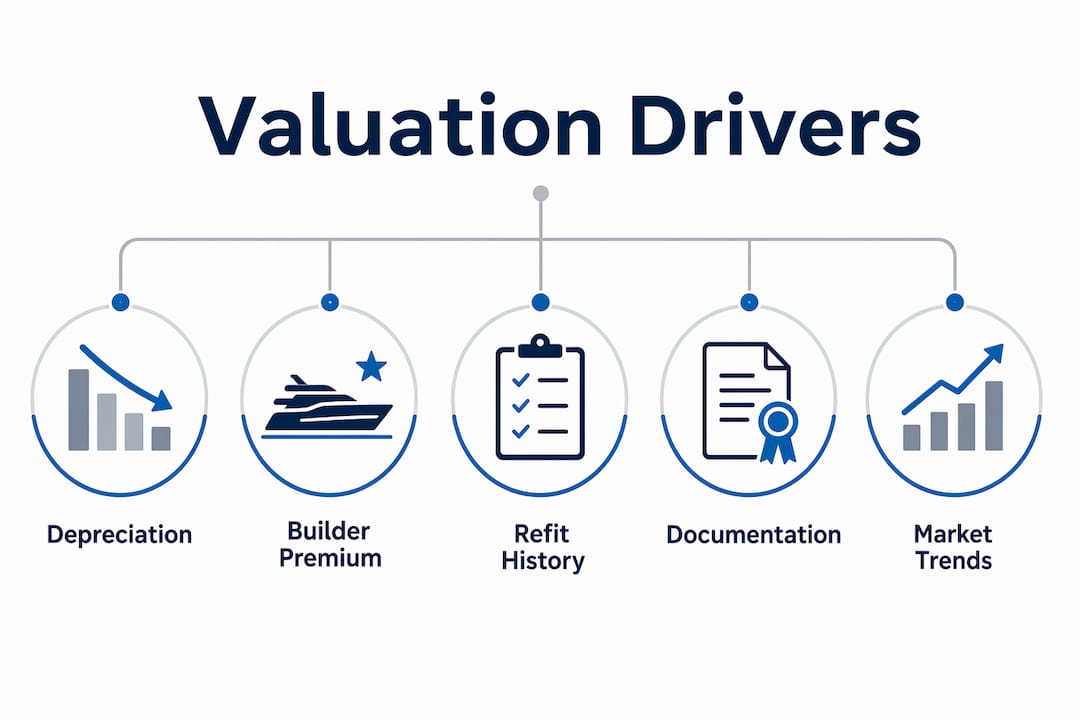
What moves resale price: the valuation drivers investors must model
Resale value in the superyacht segment is not a single curve. It is the product of several interacting variables, and getting even one of them wrong can cost a seller millions or cause a buyer to overpay significantly.

Depreciation and the builder premium
A reliable hedonic model shows superyachts depreciate approximately 7.1% annually from new, with the rate decelerating as the vessel ages. A ten-year-old yacht does not lose value at the same pace as a two-year-old one. Builder tier does not alter this underlying curve. Instead, it acts as a sale-price multiplier: a Lürssen or Feadship hull commands a higher absolute price at every point on the depreciation curve compared with a lesser-known yard, but both follow similar trajectories. Buyers who conflate builder prestige with slower depreciation are modeling incorrectly.
Refit history: mechanical vs. cosmetic
A targeted pre-listing refit that addresses mechanical systems and classification requirements consistently delivers better return on investment than purely cosmetic work. New upholstery and fresh paint improve photography; a recently overhauled main engine and a current Lloyd’s or DNV class certificate remove buyer objections that would otherwise trigger a price reduction at survey. The two categories are not interchangeable in their effect on net proceeds.
Documentation and classification
Flag state and classification status affect perceived transaction risk as much as physical condition. A vessel with current class, a clean MCA or USCG compliance history, and organized engine-room logs closes faster and at a narrower discount than one with lapsed class or missing records. For U.S. buyers specifically, USCG documentation simplifies financing and title transfer.
Size and the liquidity sweet spot
- Vessels in the 50–70 meter range attract the broadest pool of qualified buyers globally, giving sellers the most negotiating leverage.
- Below 40 meters, the market is more liquid but price-per-meter is lower and competition from production builders is higher.
- Above 80 meters, the buyer pool narrows sharply; marketing timelines lengthen and pricing becomes highly bespoke.
- LOA elasticity in motor yacht valuation models is notably large, meaning incremental length increases can produce outsized pricing effects compared with other features.
Pro Tip: Before listing, commission a pre-sale survey specifically to identify classification deficiencies. Addressing them before buyer due diligence removes the single most common source of post-survey price renegotiation.
How do U.S. superyacht resale transactions actually work?
A well-run U.S. superyacht resale transaction from listing to closing typically spans four to six months for a well-priced, well-documented vessel in the current market. Overpriced or under-documented listings routinely stretch to twelve months or beyond, accumulating the kind of public price-reduction history that signals distress to sophisticated buyers.
The transaction stages
- Pre-listing preparation (2–6 weeks): Survey, documentation assembly, professional photography, and video production. This stage sets the asking price and determines the quality of the marketing package.
- Active marketing (4–12 weeks): Broker outreach to qualified buyer networks, show appearances, digital campaigns, and targeted direct contact with known buyers in the target size band.
- Offer and negotiation (1–3 weeks): Letter of intent, deposit into escrow (typically 10% of asking price), and agreement on survey scope and timing.
- Survey and sea trial (1–2 weeks): Independent marine survey, engine-room inspection, and sea trial. Survey findings drive the final price negotiation.
- Closing and delivery (2–4 weeks): Title transfer, flag registration, USCG documentation (for U.S.-flagged vessels), and physical delivery at agreed port.
Typical transaction costs
- Broker commission: 10% of the sale price, typically split 5% to the listing broker and 5% to the buyer’s broker, though structures vary.
- Survey and haulout: $15,000–$50,000+ depending on vessel size and location; generally paid by the buyer.
- U.S. import duty: applicable if the vessel was built outside the U.S. and has not previously been formally imported; consult a customs broker for the current rate and any applicable exemptions.
- Flag registration and USCG documentation: modest fees, but the process requires a clean title chain and can surface historical liens.
- Delivery crew and repositioning: variable; factor $20,000–$100,000+ for transatlantic or transpacific deliveries.
Timing and seasonality
- Fort Lauderdale International Boat Show (October/November) generates the highest concentration of qualified buyer traffic in the U.S. calendar; listing in September to be show-ready is a proven strategy.
- Summer listings in the Northeast U.S. and New England corridor attract buyers actively using the water, which shortens decision timelines.
- Avoid listing in January/February unless the vessel is in a warm-water location; cold-weather surveys deter buyers and extend timelines.
How do broker selection and marketing change your sale outcome?

The choice of broker is not a formality. In a market where days-on-market and price-reduction history are increasingly public, the broker’s pricing discipline and marketing reach directly affect the final transaction price and the seller’s negotiating position.
What to look for in a broker
- Demonstrated experience in your vessel’s specific size band, not just the broader luxury market.
- Access to a qualified buyer database with documented transaction history in the target segment.
- Transparent reporting on days-on-market, comparable listings, and price-reduction patterns for similar vessels.
- Professional asset production capability: high-resolution photography, drone footage, and virtual walkthroughs are now baseline expectations for serious buyers.
Marketing tactics that move high-end inventory
A well-marketed listing does three things simultaneously: it reaches the right buyers, it builds confidence through transparency, and it removes friction from the due diligence process. Turnkey listings that include recent survey reports, organized maintenance logs, and a clear refit history convert faster because they reduce the buyer’s perceived risk. Listings that withhold this information signal problems even when none exist.
Pre-listing preparation through Baranofyachts’s resale preparation guide covers exactly this sequence: survey first, then prioritized refit, then documentation assembly, then professional asset production. The order matters because each step informs the next.
The difference between a prepared and an unprepared listing is not just cosmetic. A vessel that enters the market with a current survey, organized records, and professional photography typically attracts offers within the first 60 days of active marketing. An unprepared listing, even at a lower asking price, often sits for six months or more as buyers discount for the uncertainty they cannot quantify. The cost of that delay, in carrying costs alone, frequently exceeds the cost of the preparation work that would have prevented it.
Baranofyachts’s yacht marketing strategies outline the specific asset mix that performs best for luxury listings, including targeted outreach to known buyers in the relevant size band, show-floor presence, and digital campaign structures calibrated to the typical decision timeline for a $5M+ purchase.
What should buyers and sellers do right now?
The current market rewards preparation and punishes hesitation on both sides of the transaction. Buyers who arrive with financing pre-arranged and a clear survey mandate close faster and at better prices. Sellers who have done the preparation work before listing avoid the post-survey price renegotiation that erodes net proceeds.
Buyer checklist
- Verify the vessel’s classification status with the issuing society (Lloyd’s, DNV, Bureau Veritas) directly, not just through the seller’s documentation.
- Commission an independent marine survey from a surveyor with specific experience in the vessel’s size class and construction type.
- Review engine-room logs, service records, and refit invoices for the past five years minimum; gaps in records are a pricing lever, not just a due diligence concern.
- Confirm USCG documentation status and check for any historical liens through a maritime title search.
- Obtain a professional valuation using a hedonic model calibrated to current comparable sales, not asking prices.
- Structure the letter of intent to include a survey contingency and a clearly defined escrow release mechanism.
Seller checklist
- Commission a pre-sale survey before listing; address all class-critical deficiencies before the vessel goes to market.
- Assemble a complete documentation pack: builder’s certificate, class certificates, flag registration, engine logs, and refit invoices.
- Prioritize mechanical and classification refits over cosmetic work; the return on investment is higher and the impact on buyer confidence is greater.
- Set the asking price using current comparable sold data, not asking-price indexes; the gap between the two is where negotiations begin.
- Brief your broker on the vessel’s full history, including any survey findings that were addressed and how; transparency builds trust and narrows discounting.
Timing strategy
The decision between listing now versus waiting for a new-build slot is more nuanced than it appears. With the new-build order book contracted and delivery timelines extending to three years or more for many yards, brokerage hulls carry a genuine time-value advantage for buyers who want to be on the water within twelve months. Sellers who understand this dynamic can price accordingly, particularly in the 50–70 meter band where new-build alternatives are most constrained.
Pro Tip: If a post-survey finding threatens to derail a deal, get a contractor’s quote for the repair before the renegotiation conversation. A specific, documented cost is always a smaller negotiating concession than an undefined “risk” that a buyer will price conservatively.
How are superyacht valuations actually constructed?
A credible superyacht valuation is built from a hedonic regression model that weights the primary price drivers against a database of comparable sold transactions. Asking prices are a starting point, not a benchmark; the asking-to-transaction gap in the current market means that a valuation built on listed prices will consistently overstate fair market value.
Core valuation inputs
| Input | Description | Typical Weight/Effect |
|---|---|---|
| LOA (length overall) | Primary size metric; motor LOA elasticity high | Largest single price driver |
| Year built | Drives the depreciation calculation (~7.1% annually, decelerating) | High; modified by refit recency |
| Builder tier | Applied as a sale-price multiplier, not a curve modifier | Significant at point of sale |
| Class status | Lloyd’s, DNV, Bureau Veritas; current vs. lapsed | Affects perceived risk and financing |
| Refit recency | Major mechanical overhaul within past 3 years | Moderate to high |
| Unique features | Explorer configuration, hybrid propulsion, beach club | Bespoke; case-by-case |
Williams Yacht Intelligence publishes a valuation calculator and index calibrated to hundreds of listings, with model inputs covering LOA, year built, and builder tier. Hedonic regression models calibrated against professional broker listings can achieve explanatory power with R² near 0.93 in some motor yacht samples, making them genuinely useful for investor-grade price estimates when professional data sources are available.
Where to find comparable data
- Sold-price networks: Professional broker networks maintain sold-price databases that are not publicly available; a qualified broker can pull genuine transaction comps for your size band and builder tier.
- Williams Yacht Intelligence: Published index and valuation calculator; best for asking-price benchmarking and LOA/builder-tier sensitivity analysis.
- Superyacht Guide Intelligence: Fleet counts by length band and estimated fleet-value signals, useful for market-scale context.
- Trade press: BOAT International and Superyacht Times publish transaction reports and market analyses that provide directional pricing signals.
The most common valuation error we see is conflating asking-price indexes with transaction-price benchmarks. The two diverge by 5–15% for well-maintained hulls, while older or poorly maintained vessels may transact at discounts of 15–25%, and that gap is precisely where investment returns are made or lost.
The Baranofyachts resale optimization framework
We have developed a structured resale optimization process that works through four sequential stages, each designed to build on the last and to narrow the gap between asking price and final transaction price.
Our four-stage framework
- Pre-listing survey and condition assessment: We commission or review an independent survey before the vessel goes to market. This step identifies class-critical deficiencies, deferred maintenance items, and documentation gaps that would otherwise surface during buyer due diligence and trigger post-survey price renegotiation.
- Prioritized refit planning: Not every deficiency warrants repair before listing. We triage findings by their likely impact on buyer psychology and transaction price, focusing resources on mechanical and classification issues first, then structural items, and finally cosmetic work where budget allows.
- Documentation pack assembly: We compile the complete documentation package, including builder’s certificate, class certificates, flag registration, engine-room logs, refit invoices, and crew records. A complete pack signals professionalism and reduces the buyer’s perceived risk.
- Targeted marketing campaign: We deploy a campaign calibrated to the vessel’s specific size band and buyer profile, combining direct outreach to qualified buyers, show-floor presence, professional photography and video, and digital distribution through channels that reach the U.S. buyer base.
Expert resale preparation applied through this framework can improve resale outcomes by up to 20% compared with an unprepared listing, according to Baranofyachts’s own analysis of client transactions.
The vessels that close fastest and at the narrowest discount are never the newest or the most expensive. They are the best-prepared. A thorough pre-listing process, a complete documentation pack, and a broker who understands the buyer’s decision timeline consistently outperform listings that rely on the vessel’s pedigree alone to carry the transaction.
Our process is designed to give sellers the information and positioning they need to enter the market from a position of strength, and to give buyers the confidence to move quickly when the right vessel appears.
Key Takeaways
The U.S. superyacht resale market in 2026 rewards pricing discipline, thorough preparation, and broker expertise above all other factors.
| Point | Details |
|---|---|
| Pricing discipline is public | Days-on-market and price-reduction history are visible to buyers; overpriced listings accumulate stigma quickly. |
| Depreciation runs at an estimated annual rate around 7% | The rate decelerates with age; builder tier acts as a sale-price multiplier, not a curve modifier. |
| Asking-to-transaction gap | Well-maintained vessels tend to sell 5–15% below asking price; older or poorly maintained hulls typically transact at 15–25% discounts. |
| Preparation drives outcomes | A pre-listing survey and prioritized mechanical refit consistently narrow post-survey renegotiation and reduce days-on-market. |
| Baranofyachts resale framework | Baranofyachts’s four-stage resale optimization process can materially improve transaction outcomes compared with an unprepared listing. |
A broker’s honest read on where value hides in this market
The U.S. superyacht market in 2026 is more legible than it has ever been, and that legibility cuts both ways. Buyers arrive better informed than they did five years ago. They have seen the days-on-market data. They know when a listing has been sitting. They know the asking-to-transaction spread for their target size band. That is not a problem for sellers who have done the work; it is a significant problem for those who have not.
What we are seeing on the ground is a bifurcated market. Vessels that enter with a current survey, a complete documentation pack, and a realistic asking price based on genuine sold comps are attracting multiple qualified inquiries within the first 60 days. Vessels that enter without that preparation are sitting, accumulating price reductions, and ultimately transacting at a larger discount than the cost of the preparation work would have been.
The most instructive pattern we encounter is the slot-versus-brokerage decision. A buyer who wants a 60-meter motor yacht and is considering a new-build slot faces a three-year wait and a construction-cost environment that has not softened. A comparable brokerage hull, properly prepared and priced, can be on the water within six months. When we walk buyers through that comparison with actual cost-of-carry figures, the brokerage case is compelling for most of them.
The risk that buyers underestimate is documentation. A vessel with a gap in its engine-room logs or a lapsed class certificate is not just a negotiating inconvenience; it is a financing obstacle and, for charter-use buyers, a compliance liability. We have seen transactions fall apart at closing over documentation issues that a pre-listing review would have caught in an afternoon.
*— Jason
Baranofyachts: when to engage a specialist for your resale
Sellers who engage Baranofyachts before listing, rather than after a failed first attempt, consistently achieve better outcomes. The difference is not just the marketing reach; it is the structured preparation process that happens before the vessel ever appears in a buyer’s search results.

We work with owners at every stage of the resale process: pre-listing valuation and condition assessment, prioritized refit planning, documentation pack assembly, and full-service brokerage through to closing. For buyers, we provide access to off-market inventory, independent valuation support, and transaction management from letter of intent through delivery. Our brokerage services cover the full transaction lifecycle, and our market knowledge of the U.S. buyer base means your vessel reaches the right audience at the right time.
The right moment to engage us is before you set an asking price, not after the first price reduction. If you are preparing to list, recovering from a post-survey surprise, or trying to time a sale against the new-build backlog, we can help you build a strategy grounded in current market data. Explore our full 2026 market briefing and reach out to the Baranofyachts team to schedule a consultation.
Where to find hard data and further research
The quality of your market intelligence directly determines the quality of your pricing and timing decisions. These are the sources we rely on and recommend:
- Williams Yacht Intelligence: Best for valuation modeling, LOA and builder-tier elasticity analysis, and asking-price index benchmarking. The published calculator is the most accessible professional-grade tool for investor-level price estimates.
- First Owner’s Reference: Covers market legibility, days-on-market trends, and order-book context. Useful for understanding the macro supply picture and pricing discipline signals.
- Superyacht Guide Intelligence Report 2026: Fleet counts by length band and fleet-value signals; best for understanding market scale and service-market context.
- BOAT International: Annual order-book data and transaction reports; the primary source for new-build pipeline figures and global fleet statistics.
- Lumenautica Global Superyacht Trends 2026: Regional charter demand analysis and Asia Pacific growth signals; useful for charter-fleet buyers assessing deployment economics.
- Baranofyachts resources: Our superyacht market overview and resale preparation guides provide U.S.-focused context alongside the broader industry data above.
This article is general market information, not legal, tax, or financial advice. Confirm current tax provisions, import duties, and regulatory requirements with a qualified professional for your specific situation.
Recommended
Sold Listings


Design Your Yacht
"*" indicates required fields
Maximus III - PNW
As you step aboard MAXIMUS III, the first impression is her scale.
At 120 feet with an 8-meter beam and 294 GT of interior volume, this 2025 Crescent Custom tri-deck immediately feels open, balanced, and estate-like. A timeless look while still feeling fresh from the shipyard.
Currently Available


Get your yacht value Estimate
"*" indicates required fields