

Luxury yacht marketing is not a glossy brochure exercise. Too many sellers in the high-end maritime space assume that beautiful photography and a prestigious listing price are enough to attract serious buyers. They are not. Today’s affluent buyers and corporate charter clients are sophisticated, research-driven, and remarkably attuned to authenticity. The strategies that move the needle in this industry combine precision targeting, emotionally resonant storytelling, and measurable data signals, all working together like a well-rehearsed symphony. This article shows you exactly how to orchestrate that performance.
Table of Contents
- Understanding today’s yacht buyer: Affluent and corporate segments
- Crafting irresistible luxury yacht marketing messages
- Channel selection: Where luxury yacht buyers engage
- Data-driven strategies: Trust signals and adaptive marketing
- What most yacht marketing guides miss: Human insight beats automation
- Bring your yacht marketing vision to life
- Frequently asked questions
Key Takeaways
| Point | Details |
|---|---|
| Know your audience | Differentiate marketing for high-net-worth individuals and corporate clients to maximize appeal and conversions. |
| Focus on experiences | Message tone should inspire, educate, and evoke exclusivity, not just sell features. |
| Leverage intent-aligned channels | Use search and retargeting to connect with buyers exactly when they’re researching or considering. |
| Prove measurable value | Showcase engagement data and deliver operational proof to build trust, especially for corporate clients. |
| Balance tech with human luxury | AI supports marketing adaptiveness but true brand impact relies on authentic, human-centered relationships. |
Understanding today’s yacht buyer: Affluent and corporate segments
We cannot build a high-performance marketing strategy without first understanding precisely who we are speaking to. In the luxury maritime world, two primary client profiles shape almost every campaign decision: the high-net-worth individual (HNWI) seeking a deeply personal acquisition, and the corporate client pursuing charter or fleet services for entertainment, incentive travel, or executive retreats.

These two audiences look similar on the surface. Both have substantial budgets. Both expect exceptional service. But their decision drivers are fundamentally different, and conflating them is one of the most costly mistakes a yacht marketer can make.
Private buyers versus corporate charter clients
| Factor | Private luxury buyer | Corporate charter client |
|---|---|---|
| Primary motivation | Lifestyle, legacy, personal status | ROI, employee/client experience, brand prestige |
| Decision timeline | Months to years | Weeks to months |
| Key influencers | Personal advisors, family, brokers | C-suite, procurement, event planners |
| Content preferences | Experiential, bespoke narratives | Case studies, capacity specs, flexible options |
| Channel sensitivity | Exclusive events, referral networks | LinkedIn, targeted Meta campaigns, trade shows |
For corporate clients, LinkedIn and Meta targeting by company size and industry is a fundamentally different strategic logic than leisure marketing. A campaign aimed at incentive travel buyers for a global pharmaceutical company requires precise firmographic targeting, not lifestyle imagery alone.
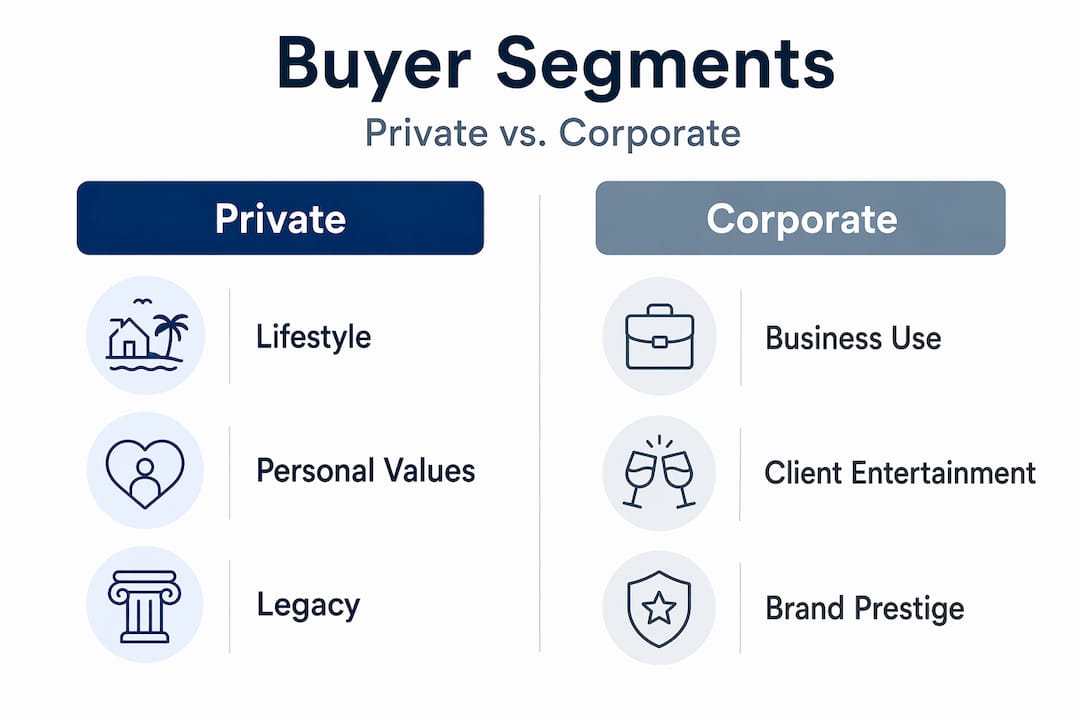
Private buyers, by contrast, respond to content that is cultural, personal, and calm rather than assertive or transactional. The experience must feel bespoke and emotionally resonant before the prospect will even initiate a conversation.
Key decision drivers to always keep in mind:
- Exclusivity: HNWI buyers want to feel they are accessing something unavailable to the general market.
- ROI and operational value: Corporate clients want hard evidence that the investment justifies the spend.
- Experience design: Both segments expect a seamlessly curated journey, from first touchpoint to delivery.
- Personalization: Neither segment responds to mass messaging. Tailored communication is the price of entry.
A new generational layer is also reshaping both segments. Younger affluent buyers entering the market bring expectations around authenticity, sustainability, and social responsibility that did not feature so prominently a decade ago. Our approach to bespoke yacht building already reflects these priorities by centering customization and long-term satisfaction, which positions us well to serve both established and emerging buyer profiles.
“The key to luxury marketing is not volume. It is resonance. When every message feels crafted specifically for its recipient, conversion rates and relationship depth improve dramatically.”
Crafting irresistible luxury yacht marketing messages
Once you recognize the major audience segments, the next step is crafting messages that command attention and drive action. This is where many marketers stumble. They default to price-led language or generic superlatives, neither of which creates genuine connection with a prospect who has already seen the best the world offers.
Effective luxury yacht messaging operates on three levels simultaneously: intellectual credibility, emotional resonance, and social distinction. Your message must prove that you understand the buyer’s world, make them feel something meaningful, and affirm that choosing your offering places them among a discerning few.
Building a message architecture that converts
Start by asking what story the buyer is telling themselves about this purchase. A private buyer acquiring a custom build is often narrating a story about achievement, freedom, or legacy. A corporate buyer organizing a charter retreat is narrating a story about leadership, reward, and competitive advantage. Your messaging must step into those narratives rather than interrupting them with a sales pitch.
Practical principles for high-converting luxury messaging:
- Lead with vision, not specifications: Open with the experience, then support it with technical proof. “Imagine three days off the Amalfi Coast with nothing but open water and precision-engineered comfort” is more compelling than “67-foot beam with twin 1,800 HP engines” as an opener.
- Use measured, authoritative language: Calm and confident outperforms urgent and promotional every time with affluent audiences. Avoid words like “limited time” or “exclusive offer.”
- Incorporate storytelling and dialogue: Messaging should feel like a conversation between equals, not a pitch from a vendor.
- Align with social responsibility where authentic: Younger superyacht buyers show measurably higher responsiveness to authentic storytelling and social responsibility messaging, which means that content addressing sustainability, craftsmanship ethics, or community impact can meaningfully increase engagement with that demographic.
Pro Tip: A/B test your opening lines across two versions. One that leads with an experiential image and one that leads with a credibility statement. Measure scroll depth and time on page, not just clicks. Affluent buyers read thoroughly before they act.
The most sophisticated luxury messaging educates while it inspires. When your personalized yacht content explains the decision-making process around hull design, navigation systems, or interior material sourcing, it simultaneously builds trust and positions your team as a true expert partner rather than a transactional seller. This shift from pitch to counsel is what separates elite yacht marketers from average ones.
Channel selection: Where luxury yacht buyers engage
With messaging in place, it is essential to match message with medium by choosing channels that align with buyer intent and lifestyle. The wrong channel can undermine even the most precisely crafted message.
Luxury yacht buyers do not move through a simple, linear funnel. They research extensively, revisit your brand multiple times, and consult with advisors before making contact. This means your channel strategy must account for both the discovery phase and the extended consideration phase.
Ranked channel priorities for luxury yacht marketing
| Channel | Best use | Audience fit |
|---|---|---|
| Search and intent-aligned landing pages | Active research phase | Both HNWI and corporate |
| Retargeting campaigns | Nurture and re-engagement | Warm prospects |
| Corporate targeting by industry/size | Corporate charter clients | |
| Meta (Instagram/Facebook) | Visual lifestyle and aspirational content | HNWI, Gen Y buyers |
| Exclusive events and boat shows | Relationship building, experiential validation | Both segments |
| Email and direct outreach | Personalized follow-up, inventory updates | Existing prospects |
-
Prioritize search and landing pages first. Search-aligned landing pages capture buyers at the exact moment they are actively researching destinations, specifications, or builder capabilities. This intent-aligned traffic converts at significantly higher rates than interruption-based advertising.
-
Build a robust retargeting infrastructure. Yacht buyers rarely convert on first contact. A retargeting system that serves relevant inventory updates, testimonials, and brand reinforcement content over weeks and months is not optional; it is essential for closing high-value prospects.
-
Use LinkedIn for corporate penetration. Target by company size, industry vertical, and seniority level to reach the decision-makers who authorize corporate charter contracts and executive retreat budgets.
-
Leverage Meta for lifestyle and visual storytelling. Instagram, in particular, performs strongly for aspirational content aimed at younger affluent buyers. Short-form video and high-quality photography of the on-water experience drive significant engagement and top-of-funnel awareness.
-
Never underestimate offline channels. Industry events, private previews, and broker-led introductions remain highly influential at the final decision stage. Digital channels create awareness and nurture intent; human connection closes the sale.
Pro Tip: Map your channel investment to the buyer’s stage, not your budget preferences. Spending heavily on awareness channels while neglecting retargeting is like filling a harbor with beautiful boats and then removing all the dock lines. The interest is there; the structure to hold it is missing.
Explore how digital strategies for selling yachts and a well-structured yacht marketing plan can coordinate these channels into a coherent system rather than isolated tactics.
Data-driven strategies: Trust signals and adaptive marketing
With the right channels selected, the next essential move is demonstrating proof and refining your campaigns through measurable signals. Data-driven marketing in the luxury yacht space is not about reducing the experience to numbers. It is about building the kind of operational confidence that sophisticated buyers require before committing to a seven or eight-figure investment.
Trust signals work differently in luxury markets than in mass-market environments. Your audience is not looking for the lowest price or the fastest delivery promise. They are looking for evidence that you have delivered complex, high-value projects with precision and care, and that you have the metrics to prove it.
What trust signals actually move luxury buyers
- Demonstrable project outcomes: Specific data points about past builds, charter bookings, or client satisfaction rates carry far more weight than general testimonials.
- Platform engagement metrics: Operational proof and measurable engagement matter to corporate clients and sophisticated owners who want confidence signals, not only aspirational imagery. Citing reach, engagement, and tangible campaign results has become increasingly standard in broker communications.
- Case-specific portfolio evidence: Detailed project galleries with technical specifications, timeline adherence records, and client outcome descriptions establish authority in ways that general brand statements cannot.
- Third-party validation: Industry awards, certifications, and press coverage from recognized maritime publications add independent credibility that self-promotion cannot replicate.
On the technology side, artificial intelligence is beginning to reshape how campaigns are managed in real time. AI-enhanced campaign tools can adjust targeting parameters, bid strategies, and content delivery dynamically based on performance signals. However, they must be positioned and managed as a support infrastructure, not as a replacement for the human voice and cultural sensitivity that luxury brand communication demands.
“Automation optimizes reach and efficiency. Human judgment preserves the emotional intelligence that turns a prospect into a client. In luxury yacht marketing, you need both, and you need to know exactly when to use each.”
The risk of over-automating is real. A message generated entirely by algorithm, however well optimized, rarely carries the weight of a message that reflects genuine understanding of the buyer’s aspirations. We see this balance as fundamental to how we approach every trial digital marketing strategy we develop, ensuring that technology amplifies rather than replaces the personal connection at the heart of every successful yacht sale.
What most yacht marketing guides miss: Human insight beats automation
We have read a great deal of marketing guidance in this industry, and much of it defaults to the same playbook: optimize your ads, post consistently on social media, collect leads with a contact form, and follow up with an email sequence. That framework is not wrong. But it is profoundly incomplete for a market where the average transaction value often exceeds what most people earn in a lifetime.
The truth that most guides gloss over is this: affluent buyers are not persuaded by funnels. They are persuaded by people they trust. The most powerful marketing asset in luxury yacht sales is not your advertising budget or your retargeting pixel. It is the credibility of the human being on the other end of the relationship.
We have seen firsthand that the broker-guided yacht buying experience is often the deciding factor, not the campaign that brought the prospect in. A highly qualified buyer who felt genuinely understood by a knowledgeable advisor will overlook minor gaps in your digital presence. But the most technically perfect digital campaign cannot compensate for a disconnected or transactional human interaction at the critical moment.
This means that marketing investment must extend into relationship training, advisor expertise, and the quality of in-person or video consultation experiences. Your campaign brings people to the door. Your people determine whether they walk through it.
There is also a subtler point about cultural and emotional intelligence that automation cannot replicate. Luxury buyers in different regions, age groups, and industries respond to completely different emotional registers. A buyer in Southeast Asia may prioritize family legacy and discretion. A Gen Y entrepreneur in North America may prioritize sustainability credentials and experiential novelty. No algorithm currently reads these distinctions with the nuance a skilled, well-briefed advisor applies instinctively.
Our perspective is straightforward: invest in technology to maximize reach and precision, but invest equally in the human layer that converts interest into commitment. The brands that win in luxury yacht sales over the next decade will be those that use data to get in front of the right people and use genuine human insight to earn their trust.
Bring your yacht marketing vision to life
Understanding these strategies is the critical first step. Putting them to work in a coordinated, brand-consistent way is where lasting results are built. Whether you are looking to attract high-net-worth individual buyers, position your fleet for corporate charter clients, or establish your brand as the definitive choice in custom builds, the path forward requires a partner who understands both the marketing discipline and the maritime world with equal depth.
At Baranof Yachts, we bring that dual expertise to every client engagement. From helping you configure your ideal yacht with precision and purpose, to guiding your positioning through every stage of the sales process, our team operates with the same conductor’s eye we bring to complex build projects. If you are ready to elevate your approach and see what a truly tailored strategy looks like in practice, explore our bespoke yacht design capabilities and reach out to begin a conversation.
Frequently asked questions
What marketing channels are most effective for selling luxury yachts?
Search-aligned landing pages are the most intent-driven digital channel, capturing buyers who are actively researching, with retargeting campaigns serving as the essential follow-up layer to re-engage warm prospects over time.
How should messaging differ for corporate yacht charters?
Corporate charter campaigns require targeting by company size and industry vertical, with messaging that highlights demonstrable ROI, curated group experiences, and flexible charter structures rather than personal lifestyle aspiration.
Do luxury yacht buyers respond to social responsibility in marketing?
Younger superyacht buyers show measurably higher responsiveness to authentic communication and social responsibility messaging, making sustainability and craftsmanship ethics increasingly important content pillars for brands targeting that demographic.
How does AI fit into yacht marketing today?
AI tools enhance campaign adaptiveness by optimizing targeting and delivery in real time, but the messaging itself must remain human, culturally calibrated, and brand-consistent to preserve the luxury voice that affluent buyers expect.
What trust signals matter most to corporate yacht clients?
Operational proof and measurable engagement such as platform metrics, documented project outcomes, and tangible campaign results carry significantly more weight with corporate clients than aspirational brand statements alone.
Recommended
Sold Listings
Design Your Yacht
"*" indicates required fields
Maximus III - PNW
As you step aboard MAXIMUS III, the first impression is her scale.
At 120 feet with an 8-meter beam and 294 GT of interior volume, this 2025 Crescent Custom tri-deck immediately feels open, balanced, and estate-like. A timeless look while still feeling fresh from the shipyard.
Currently Available


Get your yacht value Estimate
"*" indicates required fields