
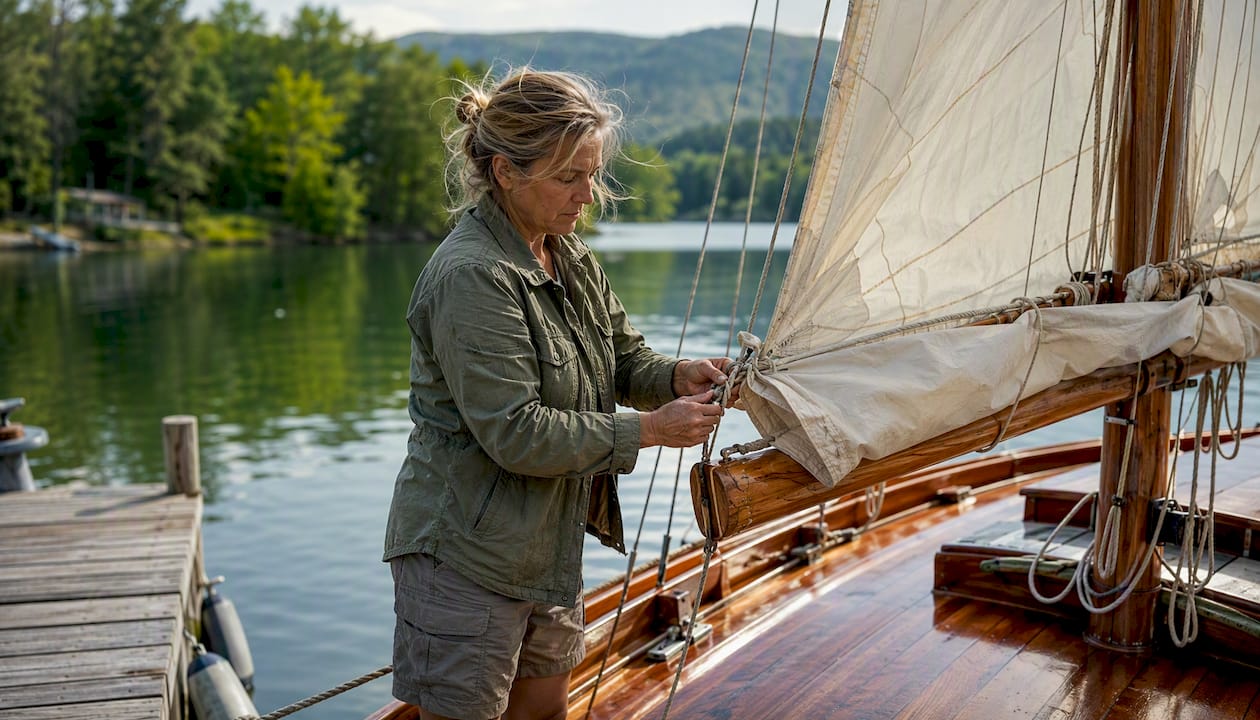
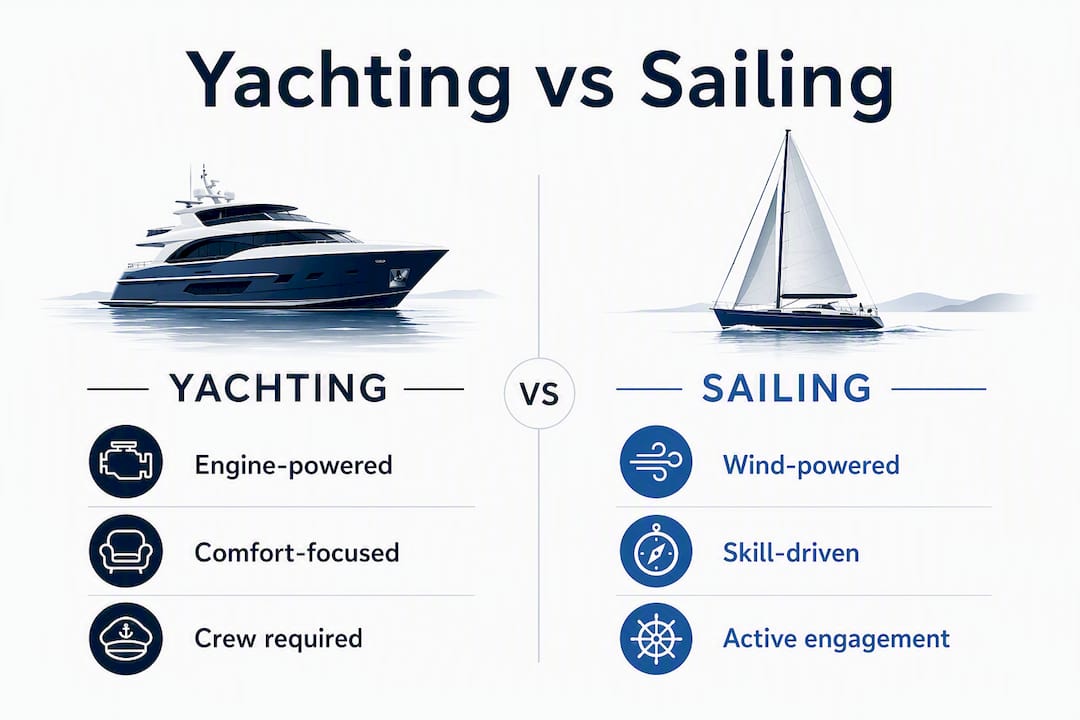
Sailing is wind-powered, hands-on, and skill-driven; yachting centers on comfort, social leisure, and larger, more capable vessels — and the distinction between the two shapes every decision you’ll make about training, budget, and vessel choice.
TL;DR — find your path in 30 seconds:
- Want an active, skill-based pursuit? Start with a US Sailing Basic Keelboat course, join a club, and progress through coastal cruising certifications. Sailing rewards patience and technique.
- Want comfort, social hosting, and extended cruising? A cruising or motor yacht, managed with professional crew support, delivers the lifestyle most people picture when they say “yachting.”
- Weighing competitive racing? World Sailing-recognized racing classes and club regattas offer structured competition at every level, from dinghy fleets to offshore circuits.
- Ready to own? The National Marine Manufacturers Association (NMMA) tracks the U.S. recreational marine market and is the best starting point for understanding what the industry looks like at scale before you commit to a vessel category.
Table of Contents
- How yachting and sailing compare at a glance
- How propulsion shapes everything about your time on the water
- What “yacht” actually means for size and interior comfort
- What ownership actually costs: purchase price and ongoing expenses
- Crew needs and the real learning curve
- Speed, handling, and the racing-versus-cruising tradeoff
- Where each vessel type is most practical in U.S. waters
- How hull materials and construction standards differ
- Environmental impact: sailing versus motor yachting
- A guide to vessel categories: from dinghies to superyachts
- How to get started in the U.S.: lessons, clubs, and your first charter
- Recreational sailing versus competitive racing: what to expect
- Charter, fractional ownership, or full ownership: which model fits?
- Which path is right for you? A practical decision checklist
- How luxury yacht acquisition and project management actually work
- Key Takeaways
- Why education and brokerage belong together
- Baranofyachts: from first question to first season
- Useful sources and where to learn more
How yachting and sailing compare at a glance
The fastest way to understand the two disciplines is side by side. The table below maps the dimensions that actually drive your decision.
| Dimension | Small sailboats | Cruising sailboats | Motor yachts | Superyachts |
|---|---|---|---|---|
| Propulsion | Wind (sail only) | Wind + auxiliary diesel | Diesel engines (primary) | Diesel, hybrid, or gas turbine |
| Typical size | Under 25 ft | 30–60 ft | 40–130 ft | 100 ft+ |
| Primary use | Day sailing, racing | Coastal/offshore cruising | Leisure, entertaining | Luxury extended voyaging |
| Crew requirement | 1–2 people | 2–4 people | 2–6 people | Professional crew required |
| Comfort & amenities | Minimal | Full galley, 1–3 cabins | Full interior, HVAC, multiple staterooms | Hotel-grade systems throughout |
| Cost (purchase) | $5K–$50K | $50K–$500K+ | $200K–$5M+ | $5M–$500M+ |
| Performance | High upwind efficiency | Balanced speed/comfort | High speed, fuel-dependent | Speed varies by hull type |
| Range | Coastal/day trips | Offshore passages | Fuel-range limited | Unlimited with provisioning |
| Environmental impact | Very low | Low (under sail) | Moderate to high | High; hybrid options emerging |
Three differences that tend to surprise people:
- A 45-foot cruising sailboat and a 45-foot motor yacht share almost nothing in terms of systems complexity, fuel cost, or crew workload — the label “yacht” covers an enormous range.
- Motor yachts can cover ground faster but require fuel logistics that fundamentally change passage planning, especially for U.S. coastal runs of 200+ miles.
- Sailing under canvas produces near-zero emissions; a large motor yacht burning diesel at cruise speed generates a carbon footprint that has no equivalent in the sail world.
How propulsion shapes everything about your time on the water
Sailing technique is built around apparent wind, points of sail, and sail trim — concepts that take a season to internalize and a lifetime to refine. When you’re sailing, propulsion is never passive. Tacking upwind, easing sheets on a broad reach, and reading pressure shifts in the rig are active, continuous decisions. That engagement is exactly what draws many people to the sport, and exactly what others find exhausting.
Motor propulsion flips the equation. A diesel-powered yacht delivers predictable speed, a fixed range based on fuel capacity, and a helm experience closer to a large powerboat than a sailing vessel. The tradeoffs are real: fuel costs, engine maintenance, noise underway, and the logistics of finding fuel docks on longer passages. Hybrid systems are gaining ground in the 60–100-foot range, pairing diesel generators with electric drives to reduce noise and fuel burn at low speeds.
Key propulsion considerations:
- Pure sail: lowest operating cost underway, highest skill demand, weather-dependent scheduling
- Diesel motor yacht: speed and schedule predictability, significant fuel and maintenance overhead
- Motorsailer or hybrid: a genuine middle path for owners who want sail capability without sacrificing range or schedule flexibility
- Auxiliary diesel on a cruising sailboat: standard for most 30-foot-plus cruisers; used for maneuvering, calms, and charging ship’s systems
Pro Tip: If you plan to use a vessel for both extended coastal cruising and occasional offshore passages, a motorsailer or a well-found cruising sailboat with a reliable auxiliary diesel gives you the flexibility of both worlds without the fuel overhead of a full motor yacht.
What “yacht” actually means for size and interior comfort
The word “yacht” is doing a lot of work. A 28-foot day sailor technically qualifies in some definitions; so does a 200-foot superyacht. What matters practically is the size band and what it delivers in terms of livability.

| Size band | Typical layout | Best for |
|---|---|---|
| Under 25 ft | Open cockpit, no cabin or basic V-berth | Day sailing, racing, learning |
| 30–40 ft | 1–2 cabins, compact galley, single head | Weekend cruising, couples |
| 40–60 ft | 2–4 staterooms, full galley, 2 heads | Extended cruising, small groups |
| 60–100 ft | Multiple staterooms, HVAC, crew quarters | Charter, private luxury cruising |
| 100 ft+ | Hotel-grade systems, tender garage, full crew | Superyacht ownership or charter |
Two quick profiles illustrate the gap:
A 42-foot cruising sailboat typically offers two private cabins, a nav station, a full galley with refrigeration, a single head with shower, and enough tankage for a week offshore. It’s manageable by a couple with solid sailing skills and costs a fraction of a comparable motor yacht to run.
A 65-foot motor yacht at the same length delivers a master stateroom with en suite, two guest cabins, a salon with full entertainment systems, a flybridge, and a crew cabin. It also demands a berth with shore power, generates significant fuel costs underway, and usually benefits from at least a part-time captain.
Marina implications follow directly from size. Vessels over 50 feet need dedicated slips at full-service marinas, and berth costs in premium U.S. markets — Newport, Miami, San Diego — scale sharply with length.
What ownership actually costs: purchase price and ongoing expenses
Purchase price is the number people focus on; ongoing costs are the ones that determine whether ownership stays enjoyable. Industry guidance consistently points to annual operating costs running roughly 8–12% of a vessel’s value, with some practitioners recommending budgeting 10–20% depending on usage intensity and crew requirements.
Typical purchase ranges by category:
- Small sailboats (under 25 ft): $5,000–$50,000
- Mid-range cruising sailboats (30–50 ft): $50,000–$350,000
- Cruising motor yachts (40–80 ft): $200,000–$2M+
- Large motor yachts (80–130 ft): $2M–$15M
- Superyachts (100 ft+): $15M–$500M+
| Cost driver | Sailing vessel | Motor yacht |
|---|---|---|
| Dockage / slip fees | Moderate | High (larger berths) |
| Fuel | Low (under sail) | High (primary propulsion) |
| Insurance | Moderate | High |
| Crew (if any) | Optional for smaller vessels | Often required at 60 ft+ |
| Annual maintenance reserve | 2–5% of value | 3–8% of value |
| Haul-out / bottom paint | Annual | Annual |
Hidden costs that first-time buyers consistently underestimate:
- Pre-purchase survey: typically $25–$50 per foot of vessel length — a necessary due-diligence expense that also shapes your negotiating position
- Sea trial costs and travel to inspect the vessel
- Delivery fees if the vessel is not in your home port
- Winterization in northern U.S. markets
- Electronics and safety gear upgrades on older vessels
- Registration, documentation, and flag costs for larger yachts
For yacht insurance planning, coverage needs scale with vessel value, cruising range, and whether you carry guests — all of which affect premium calculations significantly.
Crew needs and the real learning curve
Sailing a dinghy solo and managing a 70-foot motor yacht with a paid crew are separated by years of experience and entirely different skill sets. The good news is that the U.S. has well-structured pathways for both.
US Sailing’s learning path moves from smallboat courses through Basic Keelboat certification — which prepares students to safely operate simple day-sailing vessels and typically takes a few days to several weekends — and then into coastal cruising and offshore endorsements. The American Sailing Association (ASA) offers a parallel track with its own certification ladder, and the two systems are broadly compatible in terms of what employers and charter companies recognize.
Skill levels and what they unlock:
- Beginner (smallboat/dinghy): Tacking, jibing, basic sail trim — the foundation for everything else
- Basic keelboat: Day sailing a 20–30-foot vessel in familiar waters with a small crew
- Coastal cruising: Overnight passages, navigation, anchoring, basic diesel systems
- Offshore/bluewater: Watch-keeping, celestial or advanced electronic navigation, heavy-weather tactics
- Professional crew: STCW certification, MCA or USCG licensing depending on vessel size and flag
Realistic timeline for a committed learner:
- Smallboat basics: 1–2 weekends
- Basic keelboat certification: 3–5 days of instruction
- Coastal cruising competency: 1–2 seasons of active sailing
- Offshore readiness: 3–5 years, including logged sea miles
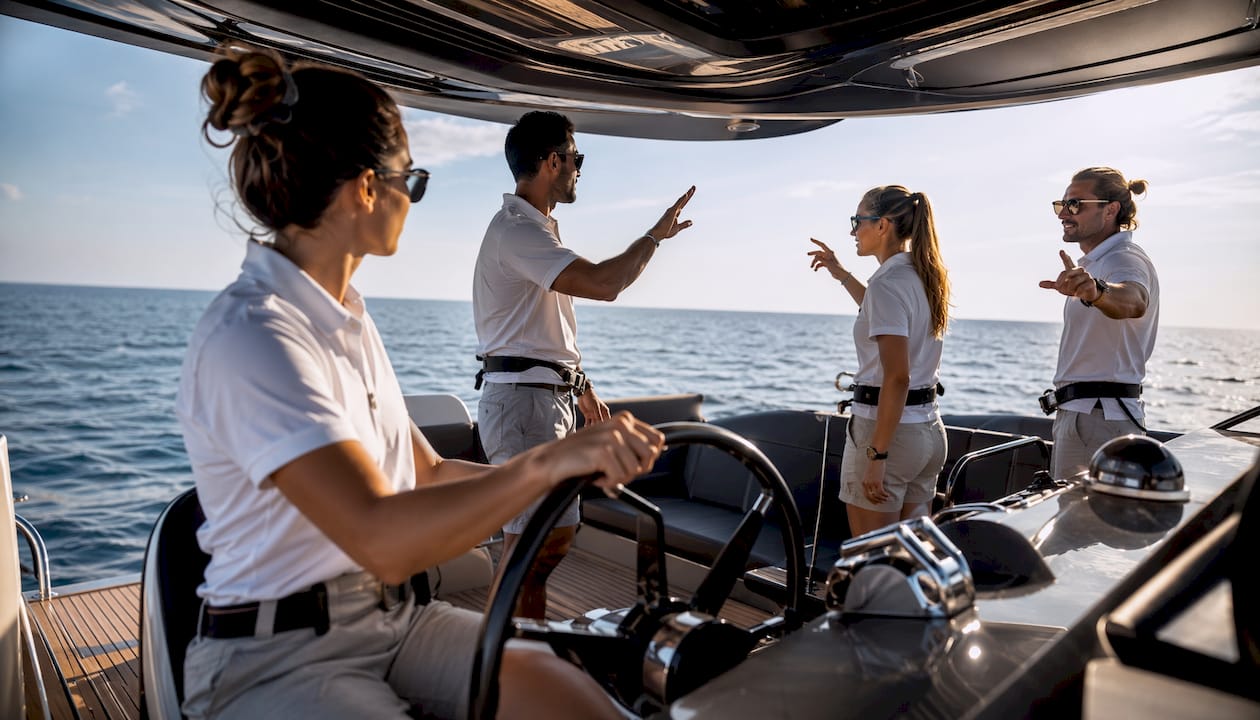
For motor yachts above 50 feet, professional crew management becomes less optional and more a structural necessity. A captain handles vessel operation; a mate or engineer handles systems; a steward manages the interior. The owner’s role shifts from operator to decision-maker and host.
Speed, handling, and the racing-versus-cruising tradeoff
Racing yachts trade luxury for speed — stripped of comfort to maximize aerodynamic and hydrodynamic performance — while cruising yachts prioritize sea-kindliness and liveaboard systems. That design philosophy difference runs through every structural and systems decision.
A racing monohull is built light, with a deep fin keel, a fractional rig, and minimal interior furniture. It points high upwind and accelerates quickly in a puff, but it’s uncomfortable in a seaway and demands an active, coordinated crew. A cruising sailboat of the same length carries more displacement, a full keel or modified fin, a masthead rig for easy sail handling, and a cockpit designed for long watches rather than tactical maneuvers.
Motor yachts occupy a different performance envelope entirely. Planing hulls deliver speeds of 25–35 knots but burn fuel at rates that make long passages expensive. Displacement motor yachts cruise at 8–12 knots with far better fuel economy and range. Semi-displacement designs split the difference.
Key handling tradeoffs:
- Multihulls (catamarans, trimarans) offer speed, stability, and shallow draft — ideal for island-hopping and anchorages inaccessible to deep-keeled monohulls
- Monohulls heel under sail, which some find exhilarating and others find uncomfortable; catamarans sail flat
- In tight marinas, a motor yacht’s twin screws give precise maneuvering; a sailboat’s single prop and fixed keel demand more skill and planning
- Heavy-weather performance favors well-found cruising designs with sea-kindly hulls over either racing boats or high-speed motor yachts
Where each vessel type is most practical in U.S. waters
The U.S. coastline offers an extraordinary range of sailing and cruising environments, and vessel choice should follow the waters you actually plan to use.
Mission profiles by region:
- Chesapeake Bay: Ideal for cruising sailboats and smaller motor yachts. Shallow draft is an advantage; the Bay’s protected waters suit 30–50-foot vessels perfectly.
- Florida and the Bahamas: Catamarans and shallow-draft sailboats dominate. The Bahamas’ banks require drafts under 5 feet in many areas; motor yachts need careful route planning.
- Pacific Northwest (Puget Sound, San Juan Islands): Strong currents, cold water, and variable weather favor well-found cruising sailboats and displacement motor yachts with good range.
- Great Lakes: Underrated sailing territory. Lake Michigan and Lake Superior offer offshore-quality conditions; the Great Lakes sailing community is active and well-organized.
- New England (Maine, Cape Cod, Nantucket): Classic cruising grounds for both sail and power, with excellent anchorages and full-service marinas.
Pro Tip: Before committing to a vessel, charter in the specific waters you plan to cruise. A week in the Bahamas on a 45-foot catamaran versus a 50-foot motor yacht will tell you more about your preferences than any amount of research.
For detailed yacht itinerary planning across U.S. cruising grounds, routing and provisioning decisions vary significantly by region and season.
How hull materials and construction standards differ
Hull material is one of the most consequential decisions in yacht construction, affecting weight, maintenance, longevity, and repairability across the vessel’s entire life.
| Material | Typical use | Advantages | Considerations |
|---|---|---|---|
| Fiberglass (GRP) | Most production sailboats and motor yachts | Low maintenance, good strength-to-weight | Osmotic blistering over time; harder to repair structurally |
| Aluminum | Offshore cruisers, expedition yachts | Excellent strength, repairable, long-lived | Requires anodic protection; higher build cost |
| Steel | Long-range cruising, commercial-grade builds | Very strong, repairable anywhere | Heavy; requires diligent corrosion management |
| Carbon fiber | Racing yachts, performance cruisers | Exceptional stiffness and light weight | Expensive; specialist repair required |
Sailing vessels carry structural loads that motor yachts don’t: keel attachment points, chainplate loads from standing rigging, and mast compression all require engineering that a motor yacht hull simply doesn’t need. Conversely, a motor yacht’s structure must accommodate engine beds, large fuel tanks, and machinery access — priorities that shape the entire interior layout.
Classification and flag standards add another layer. Vessels operating commercially or in certain international waters must meet classification society requirements (Lloyd’s Register, Bureau Veritas, DNV) that go well beyond recreational standards. For private recreational use in U.S. waters, ABYC (American Boat and Yacht Council) standards govern most construction and systems requirements. Understanding which standard applies to your intended use is part of the pre-purchase process, not an afterthought.
For a deeper look at how build types and materials affect long-term ownership, the choices made at the construction stage echo through every refit and maintenance cycle.
Environmental impact: sailing versus motor yachting
Sailing under canvas is among the lowest-impact ways to travel on water. When the engine is off and the sails are drawing, fuel consumption drops to near zero and emissions follow. That’s a genuine advantage over any motor-driven alternative, and it’s one reason the sailing community has historically been more attuned to environmental stewardship.
Motor yachts present a more complex picture. Fuel consumption at cruise speed varies enormously by hull type and speed, but a 60-foot motor yacht running at 20 knots burns fuel at a rate that adds up quickly on a week-long passage. Waste management is a separate concern: U.S. federal law prohibits overboard discharge of untreated sewage within three miles of shore, and many states have no-discharge zones that extend further. Holding tanks, Type I/II/III marine sanitation devices, and pump-out stations are the compliance infrastructure every owner must understand.
Practical steps to reduce environmental footprint:
- Sail more, motor less — even on a cruising sailboat, defaulting to sail in favorable conditions cuts fuel use dramatically
- Install solar panels and wind generators to reduce generator runtime at anchor
- Use electric tenders instead of outboard-powered dinghies for short runs ashore
- Specify low-antifouling bottom paints or copper-free alternatives where regulations require them
- For motor yachts, hybrid propulsion systems reduce fuel burn and noise at low speeds
Pro Tip: The single highest-impact upgrade for a motor yacht owner is a hybrid propulsion system or a high-efficiency generator paired with a large battery bank. At anchor or in harbor — where yachts spend a significant portion of their time — electric hotel loads can run silently without burning diesel.
A guide to vessel categories: from dinghies to superyachts
| Category | Size range | Best for |
|---|---|---|
| Dinghy | Under 15 ft | Learning, racing, day sailing |
| Day sailor / keelboat | 15–25 ft | Club racing, family day trips |
| Cruising sailboat | 30–50 ft | Coastal and offshore cruising |
| Racing yacht | 30–80 ft | Performance racing, regattas |
| Catamaran (cruising) | 35–60 ft | Island-hopping, charter, liveaboard |
| Motor yacht (express/flybridge) | 40–80 ft | Coastal entertaining, weekend cruising |
| Large motor yacht | 80–130 ft | Extended private cruising, charter |
| Superyacht | 100 ft+ | Full-service luxury voyaging |
A few distinctions worth noting:
Catamarans have reshaped the cruising market. Their wide beam delivers living space that a monohull of the same length can’t match, their shallow draft opens anchorages that deeper vessels can’t reach, and their stability at anchor makes them the preferred platform for charter fleets in the Caribbean and Pacific. In racing, multihulls operate in a separate performance class — speeds that would be impossible on a conventional monohull.
Superyachts sit in a category where the word “yacht” barely captures the reality. At 150 feet and above, these vessels carry full professional crews, multiple tenders and water toys, stabilization systems, and onboard amenities that rival boutique hotels. The ownership model at this level almost always involves a management company and a professional captain.
How to get started in the U.S.: lessons, clubs, and your first charter
Three practical paths lead into yachting and sailing, and the right one depends on where you are right now.
-
Take a structured sailing course. US Sailing’s beginner pathway starts with smallboat instruction and moves through Basic Keelboat certification, which prepares you to safely operate a day-sailing vessel. The ASA offers a parallel certification ladder. Both are widely recognized by charter companies and yacht clubs across the U.S. A Basic Keelboat course typically takes a few days to several weekends.
-
Join a yacht club or community sailing program. US Sailing-affiliated clubs and community sailing programs operate across coastal and inland U.S. waters. Club membership gives you access to boats, racing programs, and experienced sailors willing to take newcomers out. Crewing on someone else’s boat is one of the fastest ways to accumulate sea miles and practical skills without the overhead of ownership.
-
Charter before you buy. A bareboat charter — where you skipper the vessel yourself — requires certification and experience, but a crewed charter requires nothing except a budget. Spending a week on a 50-foot sailing catamaran or a 65-foot motor yacht in the British Virgin Islands, the Bahamas, or the Pacific Northwest tells you more about your preferences than any amount of research. Charter costs vary widely by vessel size and destination, but the investment is trivial compared to the cost of buying the wrong type of vessel.
Suggested milestones for a committed beginner:
- Month 1–3: Complete a smallboat or Basic Keelboat course
- Month 3–12: Join a club, crew on races, log coastal miles
- Year 1–2: Complete a coastal cruising certification; take a first bareboat charter
- Year 2–5: Offshore endorsement, diesel systems course, first-aid/safety training
- Year 3+: Evaluate ownership options with a clear sense of your preferred vessel type
For crew training and handover planning on a new vessel, the onboarding process is as important as the purchase itself.
Recreational sailing versus competitive racing: what to expect
Recreational cruising and competitive racing share the same water but almost nothing else. Understanding the difference before you commit time and money to either path saves considerable frustration.
Recreational cruising is self-directed. You choose the destination, the pace, and the crew. A weekend sail from Annapolis to the Eastern Shore, a two-week passage from Florida to the Bahamas, or a summer circumnavigation of Lake Superior — the itinerary is yours. The social structure is relaxed, the schedule is flexible, and the primary measure of success is whether everyone had a good time.
Competitive racing operates on a fixed calendar with defined rules, handicap systems, and crew roles. Club-level racing uses handicap systems like PHRF (Performance Handicap Racing Fleet) to level the playing field across different vessel types, making it possible for a 35-foot cruiser-racer to compete meaningfully against a purpose-built racing yacht. At the club level, the time commitment is typically one evening race per week during the season plus occasional weekend regattas.
Key distinctions between racing levels:
- Club racing: Accessible, social, low-cost entry; PHRF or one-design class racing; crew of 4–8 depending on vessel size
- Coastal and offshore racing: Longer races (overnight to multi-day), stricter safety requirements, more demanding crew skill levels
- High-performance circuits: Professional or semi-professional crews, purpose-built racing yachts, significant sponsorship and logistics overhead
- Ocean racing: Events like the Newport Bermuda Race or the Pacific Cup require offshore certification, safety equipment audits, and experienced crew — not a beginner’s starting point
World Sailing governs international racing rules and class structures, providing the framework that makes competition consistent from club level to Olympic sailing.
Charter, fractional ownership, or full ownership: which model fits?
The commitment model matters as much as the vessel type. Most people who eventually buy a yacht should have chartered first — not because ownership is a bad idea, but because the experience of living aboard for a week reveals preferences that no amount of research can surface.
Charter delivers maximum flexibility at the lowest financial commitment. You pay for the time you use, the vessel is maintained by the charter company, and you can try different types and sizes before settling on a preference. The downside is that you have no control over the vessel’s condition between charters, and availability in peak season requires booking months ahead.
Fractional ownership and co-ownership models divide the costs and usage of a single vessel among multiple owners. These arrangements work well when all parties have compatible schedules and similar usage patterns, but they require clear legal agreements and a shared maintenance philosophy.
Full ownership gives you complete control — over the vessel’s condition, its schedule, its customization, and its crew. It also gives you complete responsibility for all costs, maintenance decisions, and operational planning. For owners who use a vessel more than 4–6 weeks per year and want a specific vessel configured to their preferences, ownership typically makes more sense than long-term chartering.
Pro Tip: Before signing a purchase offer, decide whether you intend to use the vessel privately, put it into a charter program to offset costs, or run it as a charter-led investment. That single decision drives vessel specification, flag choice, crew structure, and tax treatment — and it’s far harder to change after closing than before.
For owners considering a yacht sale-leaseback arrangement or a managed charter program, the structure needs to be established before the purchase closes, not after.
Which path is right for you? A practical decision checklist
Work through these questions in order. Your answers will point clearly toward sailing, yachting, or a hybrid approach.
-
What is your primary purpose? Active sport and skill development points toward sailing. Social entertaining, comfort, and extended cruising points toward a motor or cruising yacht.
-
How often will you use the vessel? Under 4 weeks per year: charter first. Over 6 weeks: ownership economics start to make sense.
-
How large is your typical group? Couples and small families fit well on 35–45-foot sailing vessels. Groups of 6–10 need 55 feet or more, which usually means a motor yacht or large catamaran.
-
How much are you willing to invest in training? Sailing requires ongoing skill development. Motor yachts above 50 feet require a professional captain if you’re not licensed. Be honest about your appetite for both.
-
What is your realistic annual operating budget? Budget 10–20% of vessel value per year for operating costs. A $500,000 vessel costs $50,000–$100,000 per year to operate properly.
-
How much systems complexity can you manage? A simple cruising sailboat is far more owner-maintainable than a 70-foot motor yacht with HVAC, watermakers, stabilizers, and multiple diesel systems.
-
Where do you want to go? Shallow anchorages and island-hopping favor catamarans and shallow-draft sailboats. Speed and schedule predictability favor motor yachts.
-
Are you interested in racing? If yes, a one-design or PHRF-rated sailboat and a club membership is the most direct path.
When to contact a broker: Once you’ve answered these questions and have a vessel category, size range, and budget in mind, a broker conversation becomes productive. Have your intended use, home port, crew plan, and annual budget ready before the first call. Decide your intended use early — use-case drives vessel specification, flag choices, and crew structure in ways that are difficult to reverse after purchase.
How luxury yacht acquisition and project management actually work
For buyers in the luxury segment, the purchase process is more structured than most first-timers expect. For vessels in the $5M–$25M range, the typical buy cycle runs 3–6 months from initial specification to delivery; new builds and custom projects follow much longer cadences and require early decisions about flagging, classification, and ownership structures.
The high-level acquisition workflow for a luxury yacht looks like this:
- Specification: Define intended use, size range, preferred builder or brokerage market, and ownership structure before viewing vessels.
- Broker selection: A specialist broker with experience in your target segment and vessel type is not optional at this level — the broker’s network, market knowledge, and negotiating experience directly affect the outcome.
- Survey and sea trial: A professional marine survey at $25–$50 per foot of vessel length is non-negotiable. The survey report is your primary negotiating tool and your first line of defense against post-closing surprises.
- Ownership and tax structuring: Set the ownership entity, flag, and tax structure before signing the offer. Changing these after closing is expensive and sometimes impossible.
- Delivery and first-season support: Delivery logistics, crew onboarding, and systems commissioning require as much planning as the purchase itself.
Pro Tip: For a custom build, the design brief is the single most important document you’ll produce. It defines the vessel’s purpose, layout priorities, systems philosophy, and aesthetic direction — and it becomes the reference point for every decision the shipyard and project manager make over the build cycle. Getting it right at the start saves months of revision and significant cost.
At Baranofyachts, we work with clients from the first specification conversation through delivery and first-season commissioning. Our role is to act as the conductor’s eye across the entire process — coordinating naval architects, shipyards, classification surveyors, flag registries, and crew training so that every subsystem is aligned before the vessel leaves the yard. For clients considering a custom build, we recommend starting with a formal yacht design brief as the foundation for every subsequent decision.
Understanding maritime regulations and compliance for flagging and international operations is a parallel process that should begin at the same time as vessel specification, not after the purchase closes.
Key Takeaways
Sailing and yachting serve fundamentally different purposes: sailing rewards active skill and wind-first engagement, while yachting prioritizes comfort, social use, and larger, professionally managed vessels.
| Point | Details |
|---|---|
| Core distinction | Sailing is wind-powered and skill-driven; yachting centers on comfort, size, and social leisure. |
| Annual operating costs | Budget 8–12% of vessel value per year for operating costs (some practitioners recommend 10–20% depending on usage and crew needs). |
| Training pathway | US Sailing and ASA offer modular U.S. certification tracks from beginner to offshore-ready skipper. |
| Pre-purchase survey | A professional survey costs $25–$50 per foot and is the most important due-diligence step before any offer. |
| Baranofyachts role | Baranofyachts guides luxury buyers through specification, brokerage, custom builds, and delivery for the full acquisition cycle. |
Why education and brokerage belong together
The practical checklists and cost benchmarks in this guide reflect what we see consistently across luxury yacht transactions and custom build projects at Baranofyachts. Buyers who arrive at their first broker conversation with a clear sense of intended use, realistic operating budgets, and an understanding of the training or crew requirements they’re taking on make better decisions — and end up with vessels that actually fit their lives.
The gap between what people imagine yacht ownership looks like and what it requires operationally is where most first-time buyers run into difficulty. Our experience across brokerage mandates and new-build projects has shaped the practical guidance here, particularly around cost benchmarks, crew planning, and the importance of pre-purchase structuring. We’ve preserved space in our client onboarding process for proof points and select client perspectives that we’ll add as projects reach completion.
Baranofyachts: from first question to first season
The difference between a yacht that fits your life and one that becomes a burden usually comes down to the decisions made before the purchase, not after. Baranofyachts works with buyers at every stage of the luxury acquisition process — from initial specification and market search through survey, closing, and first-season commissioning. For clients considering a custom build, our project management team coordinates every element of the build cycle so that delivery is a celebration, not a correction process.

Whether you’re weighing your first luxury purchase, planning a custom build, or exploring how bespoke yacht construction can be tailored to your exact requirements, the right starting point is a conversation. Contact Baranofyachts to schedule a consultation and bring your specification, budget, and intended use — we’ll take it from there.
Useful sources and where to learn more
- US Sailing — The national governing body for sailing in the U.S.; start here for certification pathways, club directories, and beginner course information.
- World Sailing — The international federation governing racing rules, class structures, and Olympic sailing; essential for anyone interested in competitive sailing.
- NMMA (National Marine Manufacturers Association) — The primary U.S. industry body for recreational marine data, market statistics, and manufacturer standards.
- PassageMaker Magazine — Practical guidance on buying and operating cruising motor yachts; the buying guide cited in this article is a strong starting point for first-time buyers.
- Vessel Flag — Yacht Delivery Logistics — U.S.-focused resource on delivery logistics and transport considerations for owners taking possession of a vessel in a remote location.
- Baranofyachts — Luxury yacht brokerage, custom builds, and project management; contact for consultation on acquisition, specification, and delivery planning.
Recommended
Sold Listings


Design Your Yacht
"*" indicates required fields
Maximus III - PNW
As you step aboard MAXIMUS III, the first impression is her scale.
At 120 feet with an 8-meter beam and 294 GT of interior volume, this 2025 Crescent Custom tri-deck immediately feels open, balanced, and estate-like. A timeless look while still feeling fresh from the shipyard.
Currently Available


Get your yacht value Estimate
"*" indicates required fields