
Yachts hold value over time because of a combination of premium craftsmanship, heritage brand reputation, disciplined maintenance, and constrained market supply that sustains demand and resale pricing across ownership cycles. Unlike most depreciating assets, a well-chosen yacht from a builder like Feadship or Lürssen can stabilize in value after the initial ownership period and, in some cases, command prices that rival the original purchase. Understanding yacht value retention requires looking beyond the sticker price to the full picture: depreciation curves, builder pedigree, upkeep discipline, and market timing. The investors who approach yacht ownership with that level of clarity consistently achieve better financial outcomes than those who treat it as a pure lifestyle purchase.
Why yachts hold value over time: the depreciation curve explained
Yacht depreciation follows a predictable curve, and knowing where you sit on that curve determines your financial exposure. New builds lose 15–20% of value on the day of delivery. This is the “new-build cliff,” and it is the single largest value event in a yacht’s life.
From there, cumulative losses accelerate. By year five, total depreciation reaches 40–50% of the original purchase price. That pace then slows considerably, settling into a 2–5% annual loss after the ten-year mark. The implication is clear: the first owner absorbs the steepest financial hit, while subsequent owners benefit from a far more stable pricing floor.

| Ownership period | Approximate annual depreciation |
|---|---|
| Year 1 (delivery) | 15–20% loss |
| Years 1–5 | Cumulative 40–50% loss |
| Years 5–10 | 5–7% annually |
| Years 10 and beyond | 2–5% annually |
Depreciation rates also vary by yacht category. Superyachts above 40 meters from heritage shipyards flatten out faster than production motor yachts in the 20–30 meter range. Sailing yachts with classic lines tend to hold value more consistently than contemporary motor yachts with trend-driven styling that dates quickly.
Pro Tip: The 5–10 year used yacht window is the acquisition sweet spot for investors. The steepest depreciation has already occurred, maintenance history is verifiable, and annual value loss has slowed to a manageable rate.
What role do brand and build quality play in maintaining yacht value?
Builder reputation is the single most durable driver of long-term resale strength. Premium shipyards like Feadship, Lürssen, and Royal Huisman show single-digit annual depreciation after the initial five years, compared to significantly steeper losses for standard production models. That gap compounds over a ten-year holding period into a material difference in residual value.
The reasons are structural, not cosmetic. Heritage builders use superior hull construction methods, proprietary subsystems, and design philosophies built for longevity rather than short production cycles. Their vessels age gracefully because the engineering tolerances and material specifications were set to outlast trends.
- Hull construction: Aluminum and steel hulls from top-tier yards resist fatigue and corrosion far longer than fiberglass production builds.
- Design timelessness: Classic proportions and restrained styling avoid the rapid visual aging that hits trend-driven designs within a decade.
- Component quality: Proprietary mechanical and electrical subsystems from established marine suppliers reduce knock-on maintenance failures.
- Resale market recognition: Brokers and buyers in the yacht resale market actively seek heritage brands, creating consistent buyer pools.
The scarcity dynamic reinforces this. Feadship produces a limited number of hulls per year. That constraint creates pricing power that mirrors fine art markets, where limited supply and long waitlists support resale values for iconic models. Brand prestige in luxury assets operates the same way whether the asset is a Patek Philippe or a Feadship motor yacht.
“The most durable investment in a yacht is made before the keel is laid. Choosing a builder with a proven resale record is the decision that protects value for every subsequent owner.”
Pro Tip: Choosing a classic design with enduring proportions over a trend-forward aesthetic reduces depreciation risk by at least one full ownership cycle. Timeless styling does not go out of fashion in the yacht resale market.
How does disciplined maintenance affect long-term value retention?
Maintenance is not a cost center. It is a value preservation mechanism, and the difference between a well-maintained yacht and a neglected one shows up immediately in buyer pricing. Documented maintenance records reduce the buyer’s perceived risk, which directly compresses the discount they demand at negotiation.
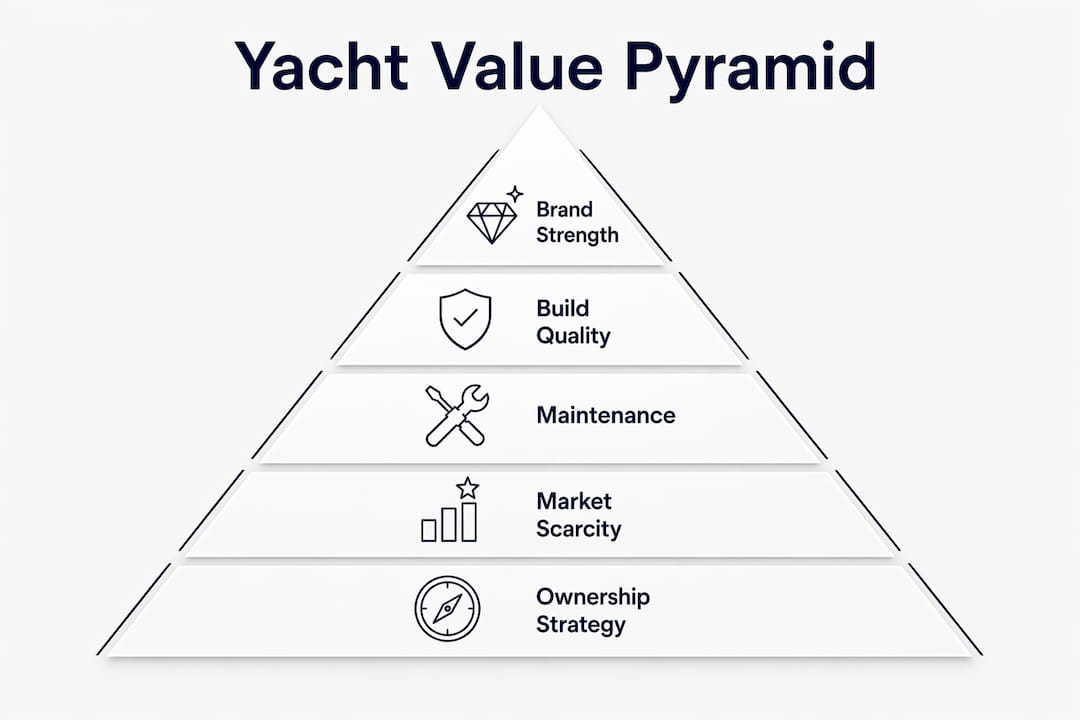
The challenge most owners underestimate is maintenance velocity. Realistic operating costs run 30–50% higher than initial buyer estimates, driven primarily by refit cycles and system upkeep rather than fuel alone. Deferred maintenance does not save money. It transfers cost to the next owner in the form of a lower sale price, and the discount is almost always larger than the maintenance bill would have been.
A structured maintenance approach follows a clear sequence:
- Annual surveys and class renewals: Keep the vessel in class and flag-compliant. Lapses create legal liability and kill buyer confidence instantly.
- Scheduled refit cycles: Plan major refits every five years. Cosmetic and mechanical refits that restore condition maintain value. Refits that add obsolete technology or personal taste items rarely generate returns.
- Documented service records: Every engine hour, system service, and repair should be logged. Buyers pay a premium for transparency.
- Crew stability: Stable captain and crew management correlates directly with vessel condition. High crew turnover leads to inconsistent upkeep and accelerated wear on systems.
- Proactive system monitoring: Address subsystem failures before they cascade. A failed watermaker that damages cabinetry costs ten times more than the original repair.
Pro Tip: Budget 10–15% of the yacht’s annual value for operating costs before you commit to purchase. Owners who plan for yacht aftercare essentials from day one avoid the financial shock that forces distressed sales.
What market dynamics and ownership strategies influence yacht value over time?
Scarcity is the market force that separates yachts from most other depreciating assets. Limited annual production from premium shipyards, combined with long build waitlists, creates a supply constraint that supports resale pricing for iconic models. This dynamic is most pronounced for vessels above 40 meters from builders with established order books.
Charter operations offer a direct mechanism to offset ownership costs. A 55–60 meter charter yacht can gross $800,000 to $1.5 million annually, offsetting approximately 20–30% of yearly running costs after expenses. That is not a profit model. It is a cost mitigation model, and owners who treat it as the former consistently overextend.
Effective charter operation requires more than listing the vessel. Maximizing charter weeks demands integrated vessel design for charter use, correct flag registration, and fully certified crew. Vessels not built with charter in mind often require expensive retrofits to meet commercial certification standards.
| Ownership model | Value retention profile | Best suited for |
|---|---|---|
| New build, private use | Steepest initial depreciation | Long-term holders, 15+ years |
| Pre-owned (5–10 years), private | Stabilized depreciation, lower entry cost | Investors, medium-term holders |
| Charter-operated superyacht | Partial cost offset, higher operational complexity | Commercial operators, UHNW portfolios |
| Heritage brand, classic design | Strongest long-term resale floor | Value-focused buyers |
Market timing also matters. Selling during periods of low inventory and high demand produces materially better outcomes than distressed sales driven by ownership fatigue or unplanned costs. Owners who plan their exit from the point of acquisition consistently achieve higher net returns than those who sell reactively.
- Monitor 2026 yachting market trends for inventory signals before listing.
- Avoid selling during high-supply periods when competing listings compress pricing.
- Engage a specialist broker 12–18 months before your target sale date to position the vessel correctly.
How can buyers and investors optimize yacht ownership for maximum value retention?
The investment value of yachts is not accidental. It is the product of deliberate decisions made at acquisition, during ownership, and at exit. Owners who treat yacht ownership like a commercial asset consistently outperform those who manage it as a lifestyle expense.
The core principles that protect value are consistent across vessel types and ownership models:
- Buy in the 5–10 year window. The acquisition sweet spot balances stabilized depreciation with manageable maintenance burden and verifiable service history.
- Select heritage builders. Feadship, Lürssen, and Royal Huisman carry resale premiums that production builders cannot match. The choice of building materials and construction method directly affects the vessel’s longevity and market appeal.
- Prioritize timeless design. Trend-driven styling accelerates visual aging. Classic proportions hold buyer appeal across multiple market cycles.
- Engage professional management. Treating ownership like a commercial business with disciplined chartering, professional crew management, and planned refit cycles is the defining factor between owners who preserve value and those who don’t.
- Plan the exit before you buy. Define your target holding period, acceptable depreciation rate, and exit conditions at acquisition. Reactive sales almost always produce worse outcomes.
Pro Tip: Commission a pre-purchase survey from an independent marine surveyor before any acquisition. A thorough survey on a pre-owned vessel reveals deferred maintenance and hidden system failures that will cost far more than the survey fee if left undiscovered.
Key Takeaways
Yachts hold value over time when owners combine heritage builder selection, disciplined maintenance, and a planned exit strategy from the point of acquisition.
| Point | Details |
|---|---|
| Buy in the 5–10 year window | Stabilized depreciation and verifiable history make pre-owned yachts the strongest value entry point. |
| Heritage builders outperform | Feadship, Lürssen, and Royal Huisman show single-digit annual depreciation after year five. |
| Maintenance is value preservation | Documented upkeep reduces buyer risk discount and directly supports resale price. |
| Charter offsets costs, not losses | A 55–60 meter yacht can gross $800,000–$1.5 million annually, covering 20–30% of running costs. |
| Plan the exit at acquisition | Owners with a defined holding period and exit strategy consistently achieve better net returns. |
What I’ve learned about yacht value that most buyers find out too late
The conversation about the long-term yacht investment almost always focuses on the wrong variable. Buyers obsess over the purchase price and the builder’s name. What actually determines your financial outcome is the discipline of ownership in the years between acquisition and sale.
I’ve seen vessels from top-tier yards sell at a significant discount because the maintenance records were incomplete and the crew had turned over three times in five years. The buyer’s surveyor found deferred work across multiple subsystems, and the seller had no documentation to counter the risk discount. The brand name did not save them. The lack of operational discipline cost them.
The other myth worth addressing directly: charter income is not a path to profit. It is a cost offset tool. Owners who enter charter operations expecting to generate net returns almost always end up frustrated. The commercial certification requirements, crew costs, and booking management overhead consume more than most first-time charter operators anticipate. Treat charter income as a mechanism to reduce your annual carrying cost, not as a revenue stream.
The emotional return on yacht ownership is real and should not be dismissed. The experiences, the relationships built aboard, and the quality of time at sea are genuine returns that do not appear on a balance sheet. The owners who find the most satisfaction are those who plan the financial side with the same rigor they apply to the lifestyle side. When the numbers are managed well, the experience is unencumbered.
Within a UHNW portfolio, a well-chosen yacht occupies a unique position. It is a physical asset with genuine scarcity characteristics, a lifestyle utility that other asset classes cannot replicate, and a vehicle for disciplined cost management through charter. It is not a stock. It is not real estate. Treat it as its own asset class with its own rules, and it rewards that respect.
— Jason
Baranofyachts: expert guidance for owners who want to protect their investment
Protecting the investment value of yachts starts with the decisions made before the purchase contract is signed. At Baranofyachts, we work with buyers and investors from the earliest planning stages through delivery and beyond, ensuring every decision from builder selection to hull specification supports long-term value retention.

Whether you are evaluating a pre-owned acquisition, planning a custom yacht build, or structuring an ownership model that includes charter operations, our team brings the project management discipline and market knowledge to guide you through each stage. We also offer yacht management strategies designed to preserve vessel condition and maximize resale readiness throughout your ownership period. Connect with Baranofyachts to build an ownership plan that protects your asset from day one.
FAQ
What causes the biggest drop in yacht value?
The steepest depreciation occurs at delivery, when new yachts lose 15–20% immediately. Cumulative losses reach 40–50% by year five, making the first owner’s period the most financially exposed phase of ownership.
Do premium yacht builders like Feadship really hold value better?
Yes. Feadship, Lürssen, and Royal Huisman show single-digit annual depreciation after the initial five years, compared to steeper ongoing losses for standard production yachts. Builder reputation is a direct and measurable driver of resale strength.
Can charter income offset yacht ownership costs?
A 55–60 meter charter yacht can gross $800,000 to $1.5 million annually, offsetting 20–30% of running costs. Charter income is a cost mitigation tool, not a profit mechanism, and requires professional management to execute effectively.
What is the best age to buy a pre-owned yacht for value?
The 5–10 year used yacht is the recognized sweet spot for acquisition. The steepest depreciation has already occurred, maintenance history is available for review, and annual value loss has slowed to 2–5%.
How much should I budget for annual yacht operating costs?
Realistic operating costs run 30–50% higher than most buyers initially estimate, driven by refit cycles and system maintenance rather than fuel. Planning for this from the outset prevents the financial pressure that leads to distressed sales.
Recommended
Sold Listings


Design Your Yacht
"*" indicates required fields
Maximus III - PNW
As you step aboard MAXIMUS III, the first impression is her scale.
At 120 feet with an 8-meter beam and 294 GT of interior volume, this 2025 Crescent Custom tri-deck immediately feels open, balanced, and estate-like. A timeless look while still feeling fresh from the shipyard.
Currently Available


Get your yacht value Estimate
"*" indicates required fields