
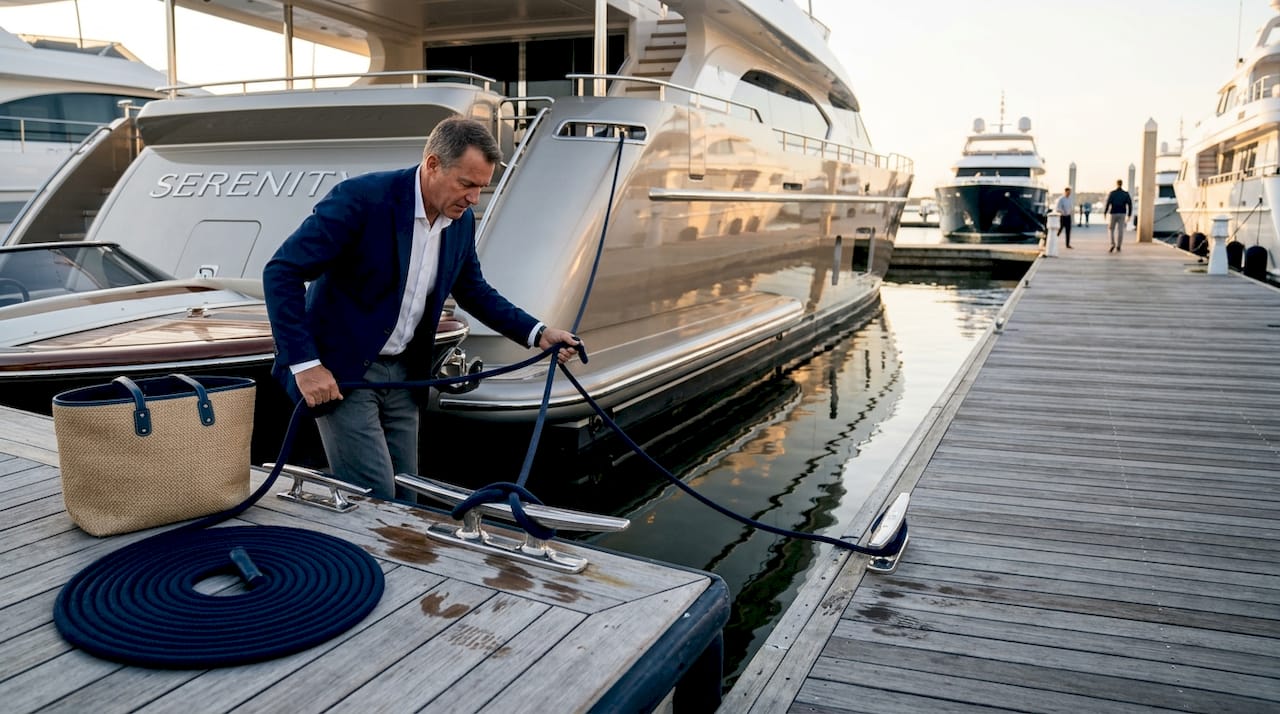
Most yacht owners focus intensely on the mothership, pouring attention into hull design, interior finishes, and propulsion systems, while the tender gets treated as a footnote. That’s a costly mistake. A yacht tender is far more than a small boat tied to the stern. It’s the operational heartbeat of your time at anchor, the platform for water sports, the lifeline for provisioning runs, and often the first impression guests receive of your entire yachting program. This guide covers everything you need to know to choose, configure, and maintain the ideal tender for your vessel and lifestyle.
Table of Contents
- What is a yacht tender?
- Key uses and benefits of yacht tenders
- Types of yacht tenders compared
- How to select and maintain the ideal yacht tender
- Our perspective: What most yacht buyers overlook about tenders
- Ready to customize your yachting experience?
- Frequently asked questions
Key Takeaways
| Point | Details |
|---|---|
| Tenders defined | A yacht tender is a versatile vessel for support, transport, and entertainment tied to a main luxury yacht. |
| Enhance experience | Choosing the right tender transforms shore access and water activities for owners and guests. |
| Diverse options | Tenders range from basic utility craft to high-performance, custom luxury boats. |
| Selection strategy | Match tender type and features to your yacht size, guest needs, and planned activities. |
What is a yacht tender?
The simplest definition comes straight from the maritime record: a yacht tender is “a smaller support and entertainment vessel carried or associated with a private (super)yacht to service the yacht’s needs and provide transport when the mothership cannot berth dockside.” That last phrase carries real weight. Most luxury anchorages, remote coves, and shallow-draft destinations simply cannot accommodate a 100-foot or 150-foot vessel at a dock. The tender solves that problem instantly.
But the definition undersells the role. Think of the tender as a satellite vessel, one that extends your yacht’s operational radius in every direction. It carries guests ashore for dinner. It tows a wakeboarder through glassy morning water. It runs ahead to a provisioning dock while the main vessel holds position. It serves as a dive platform, a fishing skiff, a chase boat, and in certain configurations, a certified safety and rescue craft.
Core functions at a glance:
- Shore transport for guests and crew
- Provisioning and logistics runs
- Water sports platform (wakeboarding, tubing, skiing)
- Dive and snorkel support
- Exploration of shallow or restricted anchorages
- Emergency and safety backup
Tender types span an enormous range. At the utilitarian end, you have oar-powered dinghies and basic outboard runabouts. At the pinnacle, you find custom yacht tender design options featuring inboard diesel or water-jet propulsion, climate-controlled cabins, custom upholstery matched to the mothership’s interior palette, and integrated audio-visual systems. The gap between those two poles is vast, and where your tender lands on that spectrum shapes the entire character of your time on the water.
“The tender is not a support vessel. It is an extension of the yacht’s identity, and owners who treat it that way consistently report a richer, more layered experience at anchor.”
For most modern luxury yachts above 80 feet, carrying at least one tender is a practical necessity. Many superyachts carry two or three, each purpose-built for a different role, from a high-speed limousine tender for VIP transfers to a rugged utility boat for crew operations.
Key uses and benefits of yacht tenders
With their critical role established, let’s explore how tenders directly impact your experience at sea. The support and entertainment role of a tender touches nearly every hour you spend at anchor, and understanding the full spectrum of that role helps you make smarter decisions when speccing out your vessel.
Here are the primary functions in order of operational priority:
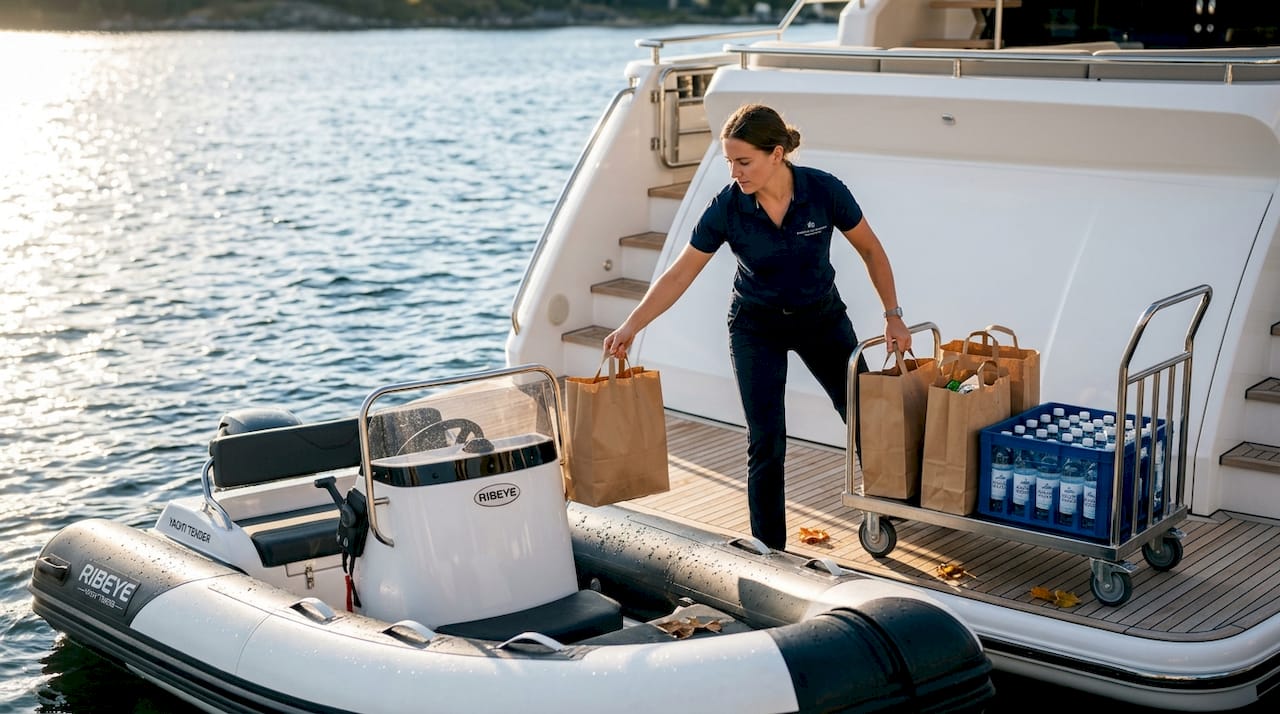
- Shore transport. When your yacht anchors off a picturesque village or a private beach, the tender is the bridge between vessel and land. A well-designed tender makes that transit smooth, dry, and dignified, especially for guests in formal attire heading to a shoreside dinner.
- Crew operations and provisioning. Captains rely on tenders for fuel runs, grocery and supply pickups, and coordination with port agents. A utility-grade tender dedicated to crew operations keeps the guest-facing tender clean and presentation-ready.
- Water sports and leisure. Tenders configured as sports platforms can tow wakeboards, water skis, inflatable tubes, and even parasail equipment. Some owners fit their tenders with dive compressors and tank storage for dedicated dive operations.
- Exploration. A shallow-draft tender opens anchorages that the mothership can never reach, mangrove channels, sea caves, tidal flats, and remote beaches accessible only by small craft.
- Safety and emergency response. Many classification societies recognize properly equipped tenders as part of a yacht’s safety plan. A tender with sufficient capacity and range can serve as a rescue vessel in man-overboard scenarios or emergency evacuations. Understanding your yacht safety classification requirements will clarify what specifications your tender must meet.
- Guest entertainment. Beyond water sports, tenders serve as cocktail platforms, sunset cruise vessels, and fishing boats. The versatility here is limited only by your imagination and your tender’s configuration.
“Owners who invest in the right tender configuration before their first season consistently avoid the operational friction that undermines the luxury experience.”
Pro Tip: Before finalizing your tender selection, map out a typical week’s itinerary for your yacht. Count how many shore runs you’ll make, what water sports your guests prefer, and whether you’ll anchor in shallow or deep-water locations. That use profile will tell you more about the right tender than any spec sheet. Also factor in tender maintenance best practices early, because a tender that’s difficult to service will create operational headaches that ripple through every aspect of your program.
The safety dimension deserves special emphasis. A tender that’s properly sized, equipped with navigation lights, a VHF radio, flares, and life-saving equipment transforms from a convenience into a genuine safety asset. Owners who treat tender specification as a safety exercise, not just a luxury exercise, build programs that are both more enjoyable and more resilient.
Types of yacht tenders compared
Choosing among tender types can be challenging, so here’s how they compare across the dimensions that matter most to luxury owners.
Yacht tenders range from utilitarian craft powered by oars or small outboards all the way to high-performance superyacht tenders with inboard engines or water-jet propulsion systems capable of 40-plus knots. The five primary categories you’ll encounter are:
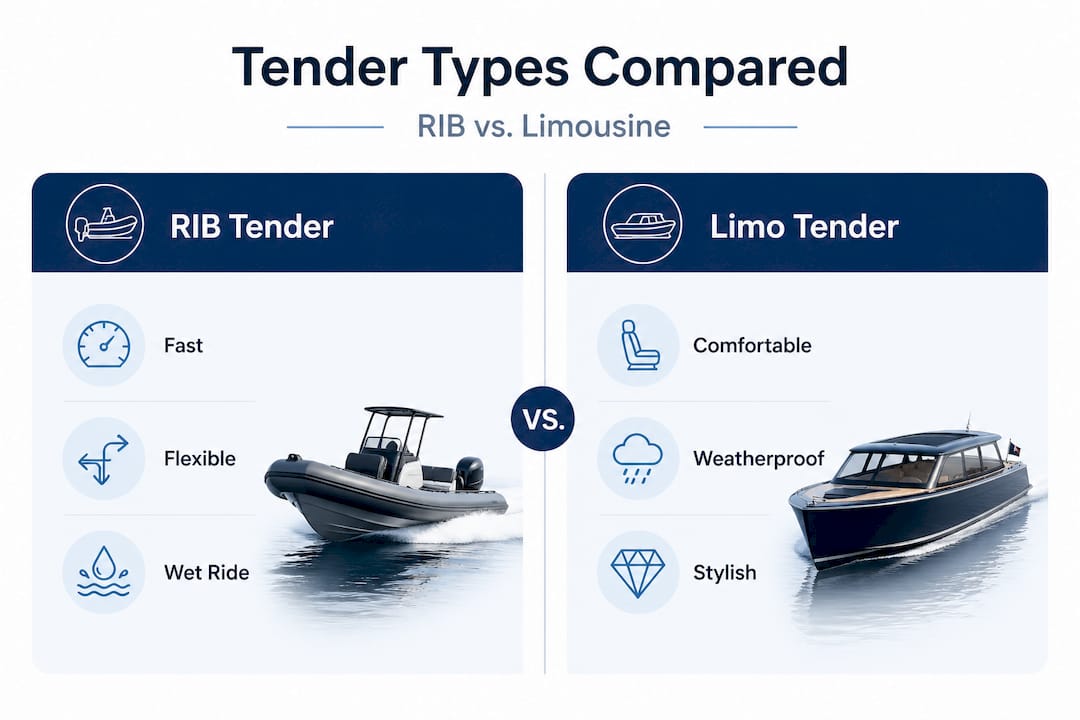
- Rigid inflatable boats (RIBs). The workhorse of the tender world. RIBs combine a solid fiberglass or aluminum hull with inflatable sponsons (the buoyancy tubes along the sides), delivering excellent stability, load capacity, and sea-keeping ability. They handle rough water well and are relatively easy to maintain.
- Open runabouts. Fiberglass or composite open boats, typically outboard-powered, offering simplicity and versatility. Good for water sports and casual shore runs, though they offer less weather protection than enclosed options.
- Limousine tenders. The prestige option. These enclosed, often inboard-powered vessels are designed for VIP transfers, featuring leather seating, climate control, sound systems, and exterior styling matched to the mothership. Speed is secondary to comfort and presentation.
- High-speed performance tenders. Water-jet or inboard-powered craft optimized for speed and agility. Popular with owners who want a chase boat capable of keeping up with fast-moving water sports or covering long distances quickly.
- Utility/crew tenders. Basic, durable, and purpose-built for operational tasks. Often a simple RIB or aluminum boat with a reliable outboard, kept separate from the guest-facing tender fleet.
| Tender type | Typical speed | Passenger capacity | Weather protection | Best use case |
|---|---|---|---|---|
| RIB | 25-35 knots | 6-12 | Low to moderate | All-around utility and water sports |
| Open runabout | 20-30 knots | 4-8 | Low | Casual transport, water sports |
| Limousine tender | 20-28 knots | 6-10 | High | VIP transfers, formal occasions |
| High-speed performance | 35-50+ knots | 4-6 | Low to moderate | Chase boat, fast transfers |
| Utility/crew | 15-25 knots | 4-6 | Low | Provisioning, crew operations |
Industry data suggests that the majority of new superyacht orders above 40 meters now include at least one custom-specified tender as part of the build package, reflecting how central the tender has become to the overall yachting program. Exploring your yacht configuration options early in the build process ensures your tender garage, crane system, and deck layout are all designed around your chosen tender type rather than retrofitted later.
We also recommend involving your project management team in tender selection from the earliest design stages. The knock-on effects of tender size on garage dimensions, crane capacity, and freeboard clearances are significant, and catching those interdependencies early saves considerable cost and redesign effort downstream.
How to select and maintain the ideal yacht tender
Once you’ve compared types, the next step is ensuring your tender perfectly complements your yacht and lifestyle. Selection is not just about picking the most impressive-looking boat. It’s about matching a working subsystem to the specific operational profile of your program.
Follow these steps to make a well-informed decision:
- Define your primary use case. Will the tender primarily transport guests to shore, support water sports, or serve dual roles? Single-purpose tenders can be optimized more aggressively. Multi-role tenders need more balanced specifications.
- Measure your storage constraints first. The tender must fit in your garage or on your deck with adequate clearance for launching and retrieval. Work backward from those dimensions, not forward from a wish list. Many owners fall in love with a tender that physically cannot be stored aboard their vessel.
- Match the tender’s aesthetic to the mothership. Color palette, material choices, upholstery, and hardware finishes should feel like a deliberate extension of the main yacht’s design language, not an afterthought. Custom-built tenders aligned to yacht requirements and owner preferences are increasingly the standard at the luxury end of the market.
- Specify for your guest profile. A yacht used primarily for family charters with children needs different tender features than one hosting corporate clients. Safety rails, boarding ladders, seating configurations, and sun protection all vary significantly between use cases.
- Plan for maintenance from day one. Engine access, hull material, and mechanical complexity all affect how much time and cost your crew will spend keeping the tender operational. Review evaluating yacht craftsmanship principles when assessing tender build quality, because the same standards that apply to the mothership apply here.
Maintenance essentials and frequency:
- Engine service (outboard or inboard): every 100 hours or annually, whichever comes first
- Inflatable sponson inspection and pressure check: monthly and before every season
- Hull cleaning and antifouling: seasonally or as usage demands
- Electrical system check (navigation lights, bilge pump, radio): before every extended deployment
- Upholstery and interior detailing: after every use in salt water
Pro Tip: One of the most common mistakes we see luxury buyers make is specifying a tender that’s too large for their typical crew to launch and retrieve single-handedly. A tender that requires three crew members to deploy safely is a tender that won’t get used as often as it should. Size for operational ease, not just maximum capacity. Real-world maintenance insights consistently show that the vessels used most frequently are those designed with crew workflow in mind.
Our perspective: What most yacht buyers overlook about tenders
Here is the industry truth that rarely gets said plainly: most first-time luxury yacht buyers treat the tender as a line item, something to check off after the main vessel is specified. Experienced owners know better. The tender is often the vessel your guests interact with most during a typical charter week. It’s the first thing they board when they arrive by water taxi, the platform they’re standing on when they put on a wakeboard for the first time, and the boat that carries them back to the mothership after a long evening ashore. It shapes the emotional memory of the trip more than almost any other element.
We’ve worked with clients who invested extraordinary care in their main yacht’s interior design, then selected a generic RIB as an afterthought. The disconnect was jarring. Guests noticed. The experience felt inconsistent in a way that was hard to articulate but impossible to ignore.
The contrarian truth is this: the tender is not a support vessel. It is a guest experience vessel that happens to also perform support functions. When you approach tender selection with that framing, every decision changes. You ask different questions about seating comfort, boarding ease, noise levels underway, and aesthetic coherence. You invest in bespoke yacht building insights that carry through from the mothership to the tender, creating a program that feels unified rather than assembled from parts.
Owners who engage with tender design early, who treat it as a creative and strategic exercise rather than a procurement task, consistently report fewer operational headaches and more layered enjoyment across every season. That’s not coincidence. It’s the result of treating every vessel in your fleet with the same conductor’s eye you bring to the main yacht.
Ready to customize your yachting experience?
If you’re ready to make your yachting life extraordinary, here’s how to begin. At Baranof Yachts, we bring the same meticulous, client-centered approach to tender specification that we apply to every aspect of a custom build. Whether you’re starting from a blank page or refining an existing program, we work with you to ensure every vessel in your fleet performs in harmony.

Our team can help you configure your new yacht with tender storage, launch systems, and deck layouts designed around your specific tender choice from the very first design session. If you’re exploring bespoke yacht solutions for a new build or a significant refit, we’ll ensure your tender program receives the same creative attention as your main vessel. Connect with our yacht consultation experts to begin a conversation about your vision, your itinerary, and the fleet that will bring it all to life.
Frequently asked questions
What is the main purpose of a yacht tender?
A yacht tender provides transport, support, and entertainment for the main yacht when it cannot berth dockside, serving as the operational link between the mothership and shore or shallow-water destinations.
Are yacht tenders required for all luxury yachts?
While not legally required for all vessels, most luxury yachts rely on tenders for convenience, safety, and enhanced on-water activities, since tenders service a yacht’s needs across transport, provisioning, and guest entertainment functions.
What types of yacht tenders are most popular?
Rigid inflatables, limousine tenders, and high-speed performance craft are the most popular choices with luxury owners, reflecting the range from utilitarian outboard-powered craft to high-performance inboard and water-jet vessels.
How do you choose the right yacht tender?
Select a tender by first defining your primary use case, then measuring your storage constraints, matching the aesthetic to your mothership, and specifying for your guest profile, since custom-built tenders aligned to yacht requirements and owner preferences deliver the most cohesive and satisfying results.
Recommended
Sold Listings


Design Your Yacht
"*" indicates required fields
Maximus III - PNW
As you step aboard MAXIMUS III, the first impression is her scale.
At 120 feet with an 8-meter beam and 294 GT of interior volume, this 2025 Crescent Custom tri-deck immediately feels open, balanced, and estate-like. A timeless look while still feeling fresh from the shipyard.
Currently Available


Get your yacht value Estimate
"*" indicates required fields