

A yacht design brief is a foundational project document that defines the owner’s intent, the vessel’s purpose, and the boundaries within which every design and build decision must operate. Without one, shipyards quote against assumptions, designers guess at priorities, and costs spiral before a single frame is cut. The brief is the control center of the entire yacht design process, translating your vision into a structured set of requirements that every stakeholder can act on. Understanding what goes into a strong brief is the first step toward a yacht that performs exactly as you intended.
What is a yacht design brief, and why does it matter?
A yacht design brief is defined as an early project document that clarifies objectives, affected areas, constraints, priorities, and handover expectations to align all parties before contracts and pricing begin. Think of it as the conductor’s score before the orchestra plays. Every section of the build, from hull engineering to interior layout, takes its cue from what the brief establishes upfront.
The brief matters because ambiguity is expensive. A loose or incomplete brief forces shipyards to pad their quotes with contingencies, inflating your initial budget before the project even starts. A precise brief, by contrast, enables a rigorous scope review that reduces unforeseen costs and keeps commercial proposals accurate. The difference between a well-written brief and a vague one can represent hundreds of thousands of dollars in cost variance on a large build.

The industry term you will encounter most often alongside “design brief” is the project brief or owner’s brief, used interchangeably across naval architecture firms and shipyards worldwide. Whether you are commissioning a new build or managing a refit, the document serves the same function: it maps the outcome, priorities, assumptions, and decision authority before any work begins.
What are the key components of a yacht design brief?
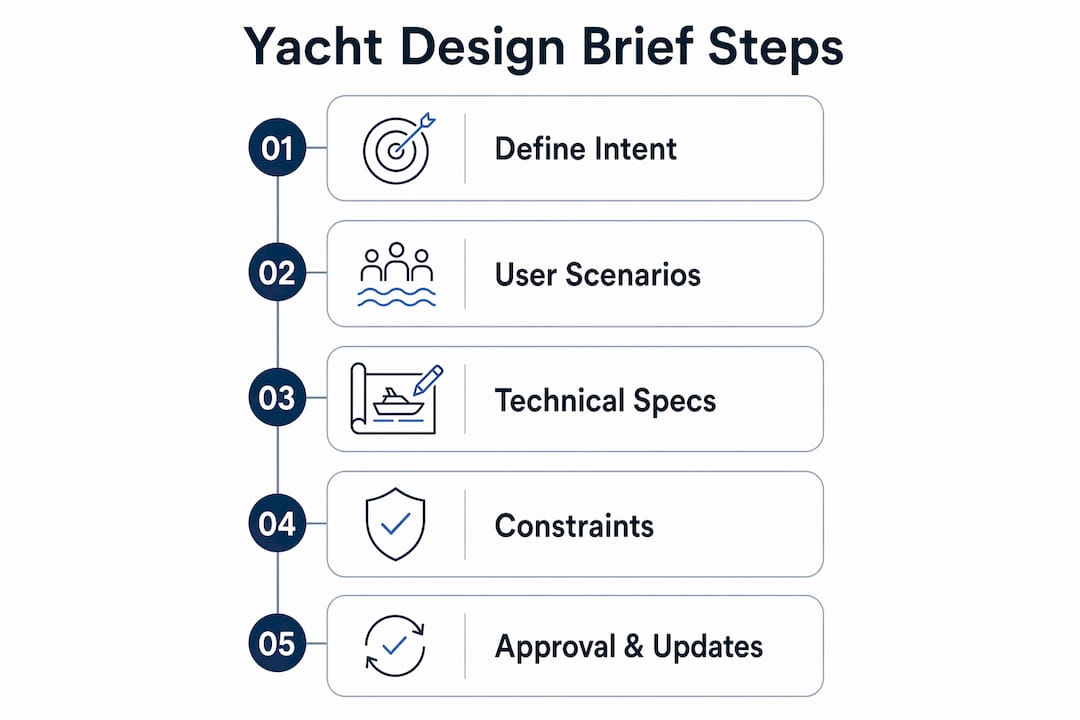
An effective brief covers six core areas. Each one removes a category of ambiguity from the project.
- Project objectives and intended use. State the primary purpose of the vessel. Is this a long-range bluewater cruiser, a charter platform, a racing yacht, or a corporate hospitality vessel? The yacht design process relies on a defined purpose to guide every downstream decision, from hull form to propulsion.
- User profiles and use scenarios. Describe who will be aboard and how they will use the vessel. A family of five with young children has different safety, layout, and storage requirements than a professional charter crew hosting rotating guests.
- Technical specifications. Define size range, preferred building materials, propulsion type, onboard systems, and performance targets. Yacht design balances hydrodynamics and weight distribution with comfort and aesthetics. Your brief must communicate where your priorities sit on that spectrum.
- Constraints. Budget ceiling, delivery timeline, flag state regulations, and port or marina restrictions all belong here. These are non-negotiable boundaries that prevent scope from expanding unchecked.
- Expected handover condition. Defining the expected handover condition upfront prevents disputes at project closeout. Specify what “complete” means: sea trials passed, classification society sign-off, full crew training, or all three.
- Decision authority and communication protocols. Name who approves changes, who receives progress reports, and how variations are documented. This single element prevents the most common cause of project delay: unclear ownership of decisions.
Pro Tip: Write the user profile section as a series of short scenarios. “Owner and four guests depart Palma for a two-week Mediterranean cruise” is more useful to a designer than “family cruising use.”
How does a yacht design brief influence the design and build process?
A well-prepared brief does not just inform the design. It governs the entire build from concept through delivery. Here is how that plays out in practice:
- It sets the pricing baseline. Shipyards and naval architects price against the brief. A clear and precise brief produces accurate, comparable quotes. Vague briefs produce wide price ranges that make vendor selection nearly impossible.
- It enables efficient procurement planning. When materials, systems, and performance targets are defined early, procurement teams can source long-lead items, such as custom joinery, propulsion systems, or specialized electronics, without delaying the build schedule.
- It controls scope creep. Every project faces change requests. The brief is the reference point against which every proposed change is measured. If a new request falls outside the original objectives or constraints, the team can evaluate its true cost and schedule impact before approving it.
- It aligns the full project team. Owners, naval architects, interior designers, and shipyard project managers all read from the same document. Misalignment between these parties is the leading cause of rework, and rework is the leading cause of cost overruns.
- It supports a clean handover. When the brief defines the expected delivery condition precisely, the final inspection and sea trial process becomes a checklist rather than a negotiation.
“The design brief sets the project intention and decision frame before pricing and planning, creating a map showing outcome, priorities, assumptions, constraints, and decision authority.” — KRM Yacht
We at Baranofyachts have seen firsthand how a thorough brief compresses the back-and-forth between owner and yard from months to weeks. The brief does not slow the project down. It accelerates it by removing the need for repeated clarification at every stage.
Design brief vs. scope of work vs. project specifications
These three documents are related but serve distinct functions. Confusing them is a common mistake that creates gaps in project governance.
| Document | Primary purpose | Stage of use | Level of detail |
|---|---|---|---|
| Yacht design brief | Defines owner intent, objectives, and constraints | Pre-design, before pricing | High-level, strategic |
| Scope of work | Translates the brief into specific tasks and deliverables | Contract and planning phase | Mid-level, task-oriented |
| Project specifications | Defines materials, standards, tolerances, and methods | Construction and procurement | Granular, technical |
The design brief is the parent document. The scope of work breaks the brief into contracted deliverables, assigning responsibility to specific parties. The project specifications then define exactly how each deliverable must be built, referencing classification society rules, ISO standards, or flag state requirements as applicable.
A yacht build without all three documents in place is a build without a governance structure. The brief alone is not enough. But without the brief, the scope of work has no foundation, and the specifications have no context. All three must trace back to the same owner intent.
Practical tips for creating an effective yacht design brief
Creating a strong brief is a skill. Most owners do it once. Naval architects and project managers do it repeatedly, which is why engaging experienced professionals early pays dividends.
- Bring in your naval architect before you write a single line. The yacht design process blends aesthetics, functionality, and engineering in ways that are not always intuitive. A naval architect will ask questions you have not considered, particularly around stability, regulatory compliance, and long-term operational costs.
- Prioritize function over decoration. Designer Patrick Knowles draws a clear distinction between decoration and design, noting that a brief must foster long-term coherence rather than immediate visual impact. A vessel built around a coherent functional framework will remain relevant and satisfying for decades. One built around a current aesthetic trend will feel dated within five years.
- Treat the brief as a living document. Industry practice confirms that the design brief evolves throughout the project and serves as the primary tool against scope creep. Review it formally at each project milestone and update it to reflect approved decisions. An outdated brief is as dangerous as no brief at all.
- Be specific about constraints. Vague budget guidance, such as “we want to keep costs reasonable,” gives the design team nothing to work with. State a firm budget ceiling and a delivery date. These constraints are not limitations. They are the parameters that make creative problem-solving possible.
- Structure the document clearly. Use numbered sections, clear headings, and a version control log. Tools like Microsoft Word with tracked changes or project management platforms like Notion or Asana work well for collaborative brief management. The goal is a document that any new team member can read and immediately understand.
Pro Tip: Review how to organize owner briefings before your first meeting with a naval architect. Arriving with a structured agenda shortens the briefing process significantly.
Key Takeaways
A yacht design brief is the single most important document in any build or refit project, because it defines intent, controls cost, and governs every decision from concept through delivery.
| Point | Details |
|---|---|
| Define intent upfront | The brief must state objectives, use scenarios, and constraints before any pricing or design work begins. |
| Precision reduces cost | Precise briefs produce accurate shipyard quotes; vague briefs produce contingency-laden estimates that inflate budgets. |
| Treat it as a living document | Update the brief at each milestone to reflect approved decisions and prevent scope creep. |
| Know the document hierarchy | The brief is the parent document; the scope of work and project specifications both trace back to it. |
| Function before decoration | A brief built around long-term functional coherence produces a vessel that remains relevant for decades. |
My honest read on why most briefs fail
I have reviewed a lot of project briefs over the years, and the pattern is consistent. Owners who struggle most during builds are not the ones who lacked vision. They are the ones who had vision but never translated it into a structured document that the shipyard could actually use.
The most expensive mistake I see is treating the brief as a formality, something to hand over at the first meeting and then forget. The brief is not a formality. It is the project’s immune system. Every time a change request arrives, every time a supplier substitution is proposed, every time a schedule slips, the brief is what you return to. It tells you whether the change is consistent with your original intent or whether it is scope creep dressed up as progress.
The second mistake is confusing decoration with design. Owners spend hours selecting fabrics and finishes, then spend five minutes on propulsion requirements or fuel range. Those priorities are inverted. The structural and systems decisions made in the brief stage will affect every day you spend aboard. The upholstery can be changed. The hull form cannot.
My advice: spend as much time on your brief as you would on any major contract negotiation. Because that is exactly what it is. You can read more about managing the full build process once your brief is in place.
— Jason
Ready to put your brief into action?

At Baranofyachts, we work with owners from the first line of the brief through to sea trials and delivery. A well-written brief is only as valuable as the team that can execute against it. Our naval architects and project managers have guided custom yacht builds across a wide range of vessel types, and we bring that experience to every owner engagement. Whether you are starting from a blank page or refining an existing concept, you can configure your ideal yacht with our team and see how your brief translates into a real vessel specification. Contact us to schedule a consultation and take the first structured step toward your build.
FAQ
What is the difference between a design brief and a scope of work?
A design brief defines owner intent, objectives, and constraints at a strategic level before pricing begins. A scope of work translates that brief into specific contracted tasks and deliverables assigned to project parties.
How long should a yacht design brief be?
There is no fixed length, but an effective brief covers objectives, user profiles, technical specifications, constraints, handover conditions, and decision authority. For a large custom build, that typically runs 10–20 pages.
Can a yacht design brief change during the project?
Yes. The brief is a living document that should be updated at each project milestone to reflect approved decisions. Keeping it current is the primary defense against scope creep.
Who should write the yacht design brief?
The owner defines the intent, but a naval architect or experienced project manager should structure and review the document. Their input ensures the brief is technically complete and commercially usable by shipyards.
Does a design brief apply to refits as well as new builds?
A refit brief follows the same principles as a new build brief, defining objectives, affected areas, constraints, and expected handover condition. The document is equally critical for refit projects, where scope creep is especially common.
Recommended
Sold Listings


Design Your Yacht
"*" indicates required fields
Maximus III - PNW
As you step aboard MAXIMUS III, the first impression is her scale.
At 120 feet with an 8-meter beam and 294 GT of interior volume, this 2025 Crescent Custom tri-deck immediately feels open, balanced, and estate-like. A timeless look while still feeling fresh from the shipyard.
Currently Available


Get your yacht value Estimate
"*" indicates required fields