
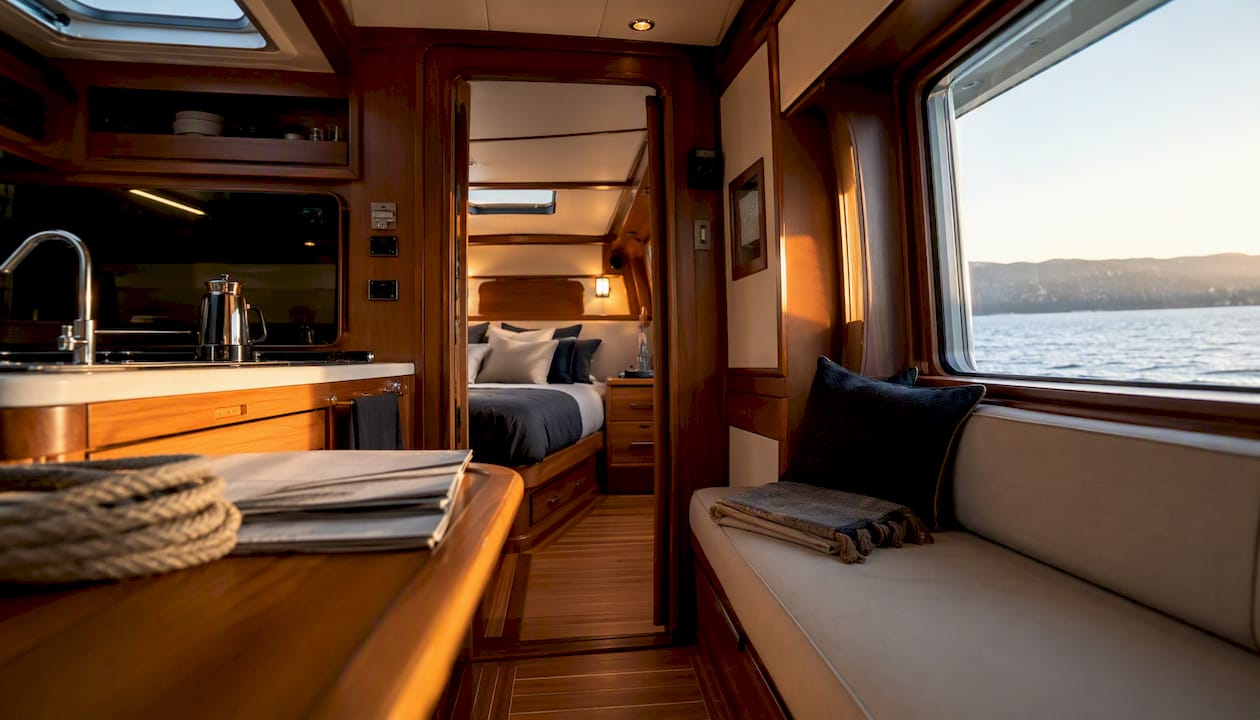
For most U.S. buyers who want year-round comfort and manageable running costs, trawlers and pilothouse motor yachts are the strongest starting point among liveaboard boats. They combine fuel economy, mechanical simplicity, and the kind of interior volume that makes daily life aboard genuinely comfortable rather than a constant exercise in compromise. Power catamarans are the right call if deck space and at-anchor stability matter more than range efficiency. Monohull sailboats suit buyers who prioritize offshore passage-making under sail and can tolerate a narrower interior.
Your immediate next moves:
- Shortlist your platform based on cruising range, daily comfort priorities, and marina footprint (multihulls often pay higher slip fees).
- Set a total budget that includes purchase price, survey, refit contingency, first-year slip fees, and insurance — not just the listing price.
- Schedule sea trials and an independent marine survey before any offer becomes binding.
- Contact a broker with liveaboard-specific inventory and U.S. market knowledge to get curated listings matched to your criteria.
Pro Tip: Before committing to any platform, spend at least one weekend aboard that boat type — anchored out, not just dockside. Motion tolerance and noise at anchor reveal more about long-term livability than any spec sheet.
Key Takeaways
Trawlers and pilothouse motor yachts are the strongest starting point for most U.S. liveaboard buyers, offering the best balance of fuel economy, interior volume, and mechanical simplicity at realistic purchase prices.
| Point | Details |
|---|---|
| Platform match first | Choose your vessel type based on actual weekly use — marina comfort vs. offshore range — before evaluating any listing. |
| Budget beyond the purchase price | Year-one costs including slip, insurance, survey, and refit contingency can add $28,000–$55,000 above the purchase price depending on platform. |
| Verify berthing before closing | Liveaboard-permitted slips carry waitlists in many U.S. markets; confirm slip availability and marina policy before signing a purchase agreement. |
| Independent survey is non-negotiable | Hire your own ABYC- or SAMS-affiliated surveyor; a seller-provided survey does not protect your interests. |
| Baranofyachts for the full process | Baranofyachts provides curated liveaboard listings, survey coordination, refit oversight, and post-sale owner support through one integrated team. |
Table of Contents
- What are the best liveaboard boat platforms for daily life?
- How do you choose the right liveaboard vessel?
- What does it really cost to buy and live on a boat?
- Where can you legally live aboard a boat in the U.S.?
- What is the step-by-step process for buying a liveaboard?
- Where do you find liveaboard listings in the U.S.?
- How Baranofyachts supports liveaboard buyers from search to move-in
- What buyers consistently get wrong about liveaboard purchases
- Ready to find your liveaboard vessel with Baranofyachts?
- Sources
What are the best liveaboard boat platforms for daily life?
The term “liveaboard” covers a wide range of vessel types, and the right platform depends almost entirely on how you plan to use it. Liveaboard aggregates thousands of liveaboard-style trips, which illustrates how the word spans both travel-oriented dive cruises and full-time residential living aboard. For buyers focused on full-time U.S. residence, the platform decision comes down to five main families.
Trawlers and pilothouse motor yachts (40–60 feet)
Trawlers are the workhorse of the liveaboard world for good reason. Their displacement or semi-displacement hulls prioritize fuel economy over speed, typically cruising at 7–10 knots on a single engine. That mechanical simplicity translates directly to lower service costs and fewer systems failures over time. Interior volume in a 45-foot trawler often rivals a 55-foot planing cruiser because the hull form allows full standing headroom throughout, a proper galley, and a dedicated master stateroom. Kadey-Krogen is the benchmark name in long-range trawler design, with hulls engineered specifically for extended offshore passages. Hatteras builds pilothouse motor yachts that lean toward higher performance while retaining the enclosed helm and interior comfort liveaboard buyers need.
Best for: Long-range passagemaking, coastal cruising, buyers who want one engine and predictable fuel bills.
Watch for: Older trawlers can carry deferred maintenance; always budget for a haul-out and systems audit.
Power catamarans (40–55 feet)
Power cats deliver the widest salon and cockpit footprint of any platform at equivalent length, and their twin-hull design produces minimal roll at anchor. BoatTEST’s analysis of trawlers versus power catamarans confirms that cats win on deck space and at-anchor stability, though they typically carry a higher purchase price and often incur multihull slip surcharges at U.S. marinas. Sunseeker produces power cats with strong fit and finish that appeal to buyers who want resort-style living aboard.
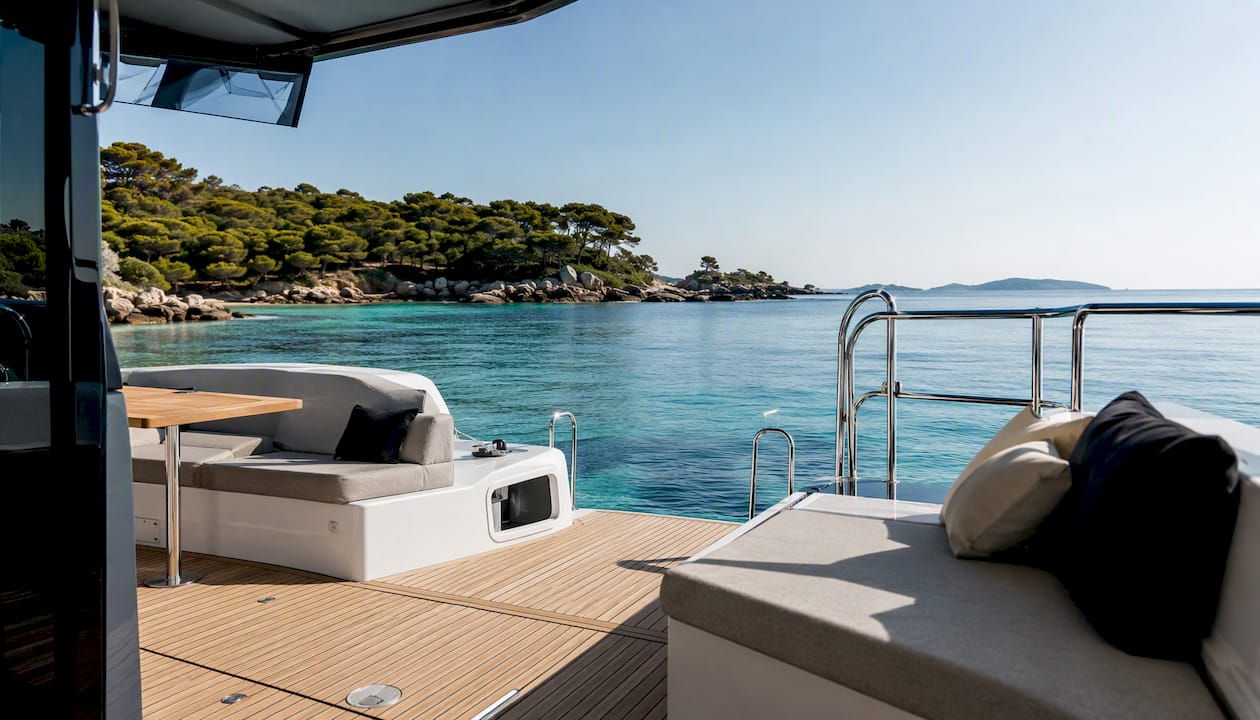
Best for: Buyers who entertain, families with children, or anyone who spends more time at anchor than underway.
Watch for: Beam width limits marina access; always confirm slip availability before purchase.
Monohull sailboats (38–55 feet)
A well-found monohull sailboat offers the lowest fuel costs of any platform and genuine offshore capability under sail. The trade-off is interior beam: a 45-foot monohull typically has a narrower salon than a trawler of the same length. Tiara builds performance-oriented monohulls that balance sailing ability with livable interiors. For buyers who plan extended coastal or bluewater passages and want to minimize fuel dependency, a monohull remains the most proven offshore platform.
Best for: Offshore passage-making, budget-conscious buyers, sailors who want to keep sailing skills sharp.
Watch for: Heeling underway takes adjustment; at-anchor motion in a swell is more pronounced than on a cat.
Expedition and pilothouse motor yachts (50–70 feet)
Viking and Sea Ray both produce pilothouse and express motor yachts in the 50-foot-plus range that offer serious seakeeping ability alongside hotel-grade interiors. These vessels carry larger fuel tanks, more storage, and more sophisticated systems than entry-level trawlers, which suits buyers who want extended range without sacrificing comfort. The systems complexity is higher, and so is the maintenance budget.
Best for: Buyers with larger budgets who want long-range capability and premium interior appointments.
Watch for: Systems sophistication means higher service costs; factor in annual electronics and HVAC maintenance.
Smaller and alternative liveaboard options
Tug conversions and converted commercial hulls in the 35–45-foot range offer affordable entry points for buyers willing to invest sweat equity. These platforms often have excellent stability and tankage but require careful survey work to assess structural condition and systems age.
Pro Tip: Match the platform to your actual weekly routine, not your aspirational cruising plan. BoatTEST’s platform comparison frames this trade-off clearly.
How do you choose the right liveaboard vessel?
A disciplined checklist applied consistently across every listing saves you from the most expensive mistake in liveaboard buying: falling in love with a boat before you’ve verified its condition. Work through these decision variables and inspection points in order.
Core decision variables to establish before you view any listing:
- Intended cruising range — coastal weekender, coastal cruiser, or bluewater passage-maker? This single variable narrows the platform list faster than any other.
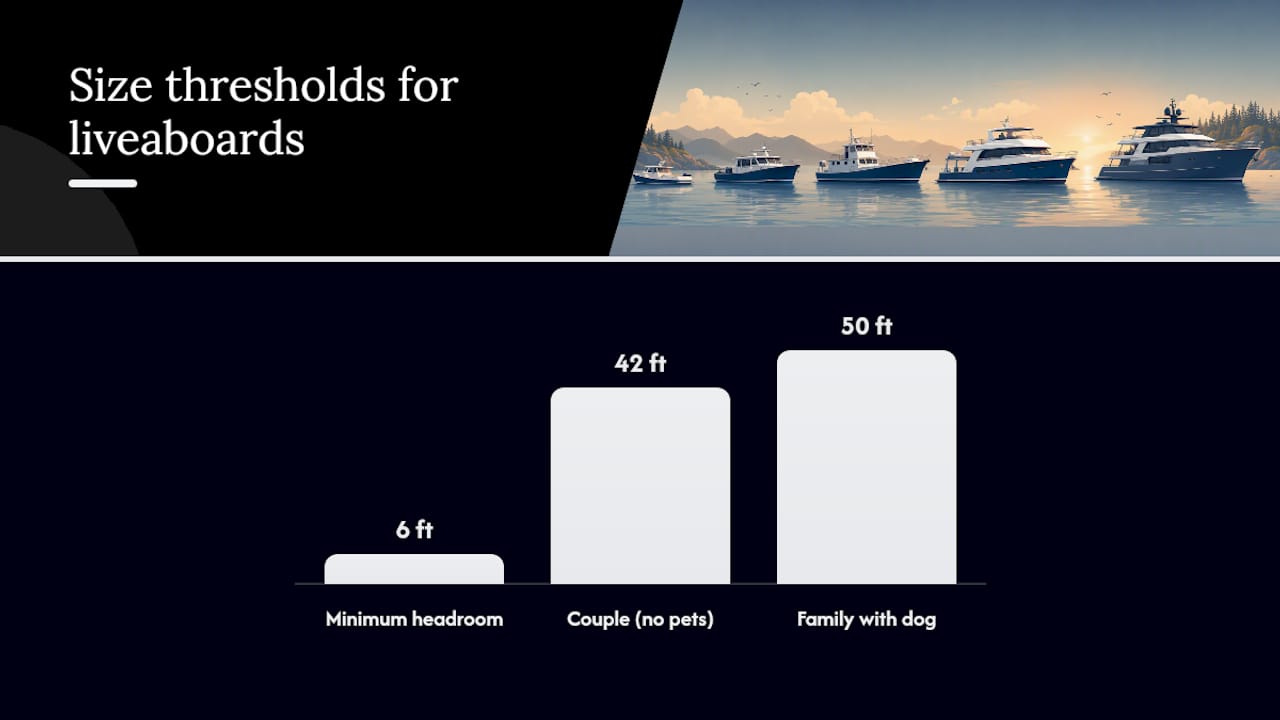
- Liveaboard comforts — minimum headroom (6 feet throughout is the practical floor), number of berths, galley size, and climate control requirements for your home region.
- Budget envelope — total budget including purchase, survey ($1,500–$3,000 for a thorough independent survey), refit, first-year slip, and insurance. Not just the asking price.
- Crew size and pets — a couple without pets can live comfortably on a 42-foot trawler; a family of four with a dog needs 50 feet minimum.
- Marina vs. cruising lifestyle — if you plan to stay in one slip most of the year, beam and amenities matter more than range.
Listing inspection checklist:
- Engine hours and service intervals documented in a physical or digital log.
- Survey history and any refit records (what was done, when, by whom).
- House battery bank capacity and age (lithium or AGM, and when last replaced).
- Freshwater tankage and watermaker condition.
- Refrigeration, heating, and air conditioning systems — age, brand, and service history.
- Hull condition below the waterline (osmotic blistering, keel attachment on sailboats, through-hull fittings).
- Safety gear inventory: life raft certification date, EPIRB registration, flares, fire suppression.
Questions to ask the seller or broker:
- What were the sea trial results on the last survey?
- Are there any known soft spots in the deck or hull?
- Has the vessel ever had an insurance claim? What for?
- What is the current slip type — liveaboard-permitted or standard?
- Does USCG documentation match the vessel’s current condition and any modifications?
Red flags that warrant walking away or a significant price reduction:
- Missing or inconsistent engine hour logs.
- Seller resistance to an independent sea trial or survey.
- Evidence of water intrusion behind headliner panels or under sole boards.
- Mismatched paperwork between registration, documented condition, and visible modifications.
- Engines with hour discrepancies between port and starboard logs on a twin-engine vessel.
Trust signals to look for on brokered listings: full specs with photos, a recent independent marine survey report, documented sea trial results, comprehensive maintenance logs, current USCG documentation or state registration, and an insurance quote or underwriter note confirming liveaboard classification.
What does it really cost to buy and live on a boat?
The purchase price is the number that gets attention, but the annual operating budget is what determines whether liveaboard life is sustainable. Both deserve equal scrutiny.
Purchase price ranges by platform
Used liveaboard-ready trawlers in the 40–50-foot range commonly trade within a broad range depending on age, condition, and builder reputation. Power catamarans of equivalent length typically sit higher, with prices often above those of trawlers from established builders. Monohull sailboats in the 40–50-foot range vary widely in price depending on age and equipment, from more affordable older production boats to higher-priced newer or blue-water-equipped examples. These are market ranges, not guaranteed prices; condition and refit history move individual boats significantly within or outside these bands.
Annual ownership cost categories
Lower-budget scenario: A 1998 45-foot single-engine trawler purchased for $175,000 with a $12,000 refit budget, $8,400 annual slip, $3,500 insurance, and $4,000 in maintenance runs roughly $28,000 in year-one costs beyond the purchase price.
Mid-range scenario: A 2010 48-foot power catamaran at $420,000 with a $20,000 refit, $18,000 annual slip (multihull rate), $6,500 insurance, and $7,500 in twin-engine maintenance puts year-one costs closer to $55,000 above purchase.
Pro Tip: The “double-everything rule” is real for twin-engine and multihull vessels. Two engines mean two service intervals, two sets of impellers and belts, two transmissions, and twice the starter batteries and alternators. BoatTEST’s platform analysis highlights how this compounds over time — factor it into your five-year ownership budget, not just year one.
Where can you legally live aboard a boat in the U.S.?
Living aboard is legal in many U.S. locations, but the rules are set at the marina, municipal, and state level rather than federally. What is permitted at one marina may be prohibited at the next slip over, and what a municipality allows can change with a zoning amendment. Verify every layer before you sign a purchase agreement.
- Marina liveaboard policies vary enormously. Some marinas designate a fixed percentage of slips as liveaboard-permitted and maintain waitlists for those berths. The Port of Seattle’s small-boat marina customer handbook is a clear example of how port authorities document slip rules, liveaboard permissions, and operational requirements. Review the equivalent document for any marina you are considering.
- Municipal codes in some cities restrict or prohibit full-time liveaboards in certain anchorage zones or require permits. Check with the local harbor master and review the municipal code for the specific waterway.
- Anchoring fields and anchorage zones offer an alternative to marina slips in many coastal areas, but anchoring rules vary by state and municipality. Some areas impose time limits; others require a permit for stays beyond a defined period.
- USCG documentation vs. state registration affects how your vessel is classified and where it can legally operate. A federally documented vessel carries a Certificate of Documentation; state-registered vessels display a state registration number. Both are valid for liveaboard use, but insurance underwriters and some marinas have preferences. Our yacht registration guide covers the documentation decision in detail.
- Insurance classification matters: a standard recreational policy typically does not cover full-time liveaboard use. You need a liveaboard rider or a dedicated liveaboard policy, and some underwriters restrict cruising range or require annual haul-out documentation.
- Multihull berthing adds a layer of complexity. Many marinas charge a beam-based surcharge for catamarans, and some older marinas cannot accommodate the beam width of a 45-foot power cat at all.
Legal callout: Living aboard is legal in many U.S. marinas and anchorages, but always subject to local marina policy, municipal code, and insurance underwriter requirements. Confirm documentation, lease terms, and insurance classification before you close on any vessel.
What is the step-by-step process for buying a liveaboard?
The sequence from first search to moving aboard typically runs 3–6 months for a straightforward purchase, longer if a significant refit is involved. Here is the practical order of operations.
- Define needs and budget (1–2 weeks). Establish your platform preference, minimum liveaboard requirements, total budget including contingency, and target marina or cruising region. Confirm liveaboard slip availability in your target location before you go further.
- Shortlist platforms and listings (2–4 weeks). Search brokered inventory for vessels that match your criteria. Prioritize listings with full specs, photos, and documented maintenance history. BetterBoat’s liveaboard trawler guide recommends testing a platform with short stays or rentals before committing — a weekend charter on a trawler or power cat costs far less than a re-sale loss.
- Broker contact and viewings (1–3 weeks). Work with a broker who has liveaboard-specific inventory and can pre-screen listings against your criteria. Schedule in-person viewings; photos do not reveal soft decks, odors, or systems condition.
- Sea trial (1 day, scheduled within the offer process). Insist on a sea trial at cruising speed. Monitor engine temperature, oil pressure, exhaust smoke, steering response, and electrical load under house battery draw. Any seller who resists a sea trial is a red flag.
- Independent marine survey (1–2 weeks to schedule and complete). Hire your own ABYC- or SAMS-affiliated surveyor, not one recommended by the seller. The survey covers hull condition, structural integrity, systems, safety equipment, and compliance. Budget $1,500–$3,000. A thorough survey on a used trawler often surfaces $5,000–$20,000 in deferred maintenance items that become negotiating leverage.
- Negotiate and close (1–3 weeks). Use survey findings to negotiate price or require repairs before closing. Closing documents include the bill of sale, title or USCG documentation transfer, and any existing survey and maintenance records.
- Register and insure (1–2 weeks). File for USCG documentation or state registration. Secure a liveaboard-classified insurance policy before moving aboard.
- Refit and upgrades (2 weeks to 3 months, depending on scope). Address survey items, upgrade house battery bank if needed, install or service climate control, and confirm safety gear is current. Our trawler refit case study walks through how addressing root-cause issues on a 50-foot trawler transformed its offshore reliability.
- Move aboard. Confirm your liveaboard slip agreement is signed, mail forwarding is set up, and your insurance policy is active before the first night.
Where do you find liveaboard listings in the U.S.?
The U.S. market for liveaboard-capable vessels is geographically segmented, and where you search shapes what you find. Regional inventory patterns matter as much as the listing platform itself.
Regional market snapshot:
- Pacific Northwest carries a strong inventory of older displacement trawlers, many with full liveaboard histories and established marina relationships. Prices tend to be competitive, but survey carefully for osmotic blistering and systems age in the wet climate.
- Southeast and Florida offer the highest volume of liveaboard-capable sailboats, trawlers, and power cats in the country. The year-round boating season means more active listings and more competition. Kadey-Krogen, Hatteras, and Sunseeker inventory appears regularly in Florida brokerage.
- Northeast operates on a seasonal market. Winter listings can offer value, but liveaboard slip availability is limited in cold-weather months, and winterization costs add to the first-year budget.
- Gulf Coast provides a mid-range market with good trawler and motor yacht inventory, lower slip costs than Florida’s east coast, and access to the Great Loop route for buyers who want extended cruising options.
Where to search:
- Brokered inventory (through firms like Baranofyachts) provides the most complete listings: full specs, photos, survey availability, and a broker who has pre-screened the vessel. Viking, Sea Ray, and Tiara inventory appears most consistently through established brokerage networks.
- Classified platforms offer volume but require more due diligence; listings vary widely in completeness and accuracy.
- Manufacturer dealer inventory covers newer models and certified pre-owned programs from builders like Hatteras and Sunseeker.
- Specialized liveaboard marketplaces aggregate listings by use type and can filter for liveaboard-permitted slip included.
Reading a listing effectively:
Check engine hours against the vessel’s age (a 20-year-old trawler with 1,200 hours is very different from one with 4,500 hours). Confirm the slip type is liveaboard-permitted, not standard. Look for survey availability and whether the listing includes maintenance logs. A listing without photos of the engine room, bilge, and electrical panel is missing the most important real estate on the boat.
How Baranofyachts supports liveaboard buyers from search to move-in
Baranofyachts brings brokerage expertise, custom build project management, and refit consulting together under one roof, which shortens the path from research to moving aboard considerably. For liveaboard buyers, that integration matters because the purchase is rarely the end of the process — it is the beginning of a refit and systems audit that determines how quickly and comfortably you actually move aboard.
Core services for liveaboard buyers:
- Brokered listings with full specifications: Baranofyachts curates inventory against liveaboard criteria, so you are not sorting through listings that cannot accommodate full-time residence.
- Survey and sea trial coordination: We connect buyers with qualified independent surveyors and manage the logistics of sea trials, so the inspection process runs on a timeline that protects your offer.
- Refit and upgrade consulting: Post-survey, our team identifies which findings are safety-critical, which are negotiating points, and which can be deferred — then coordinates vetted craftsmen and shipyards to execute the work.
- Custom build and project management: For buyers who want a vessel built to their exact liveaboard specifications, Baranofyachts manages the design, build, and delivery process with the precision of a conductor overseeing every subsystem before launch.
- Post-sale owner support: From yacht management strategies to ongoing maintenance oversight, we stay engaged after the sale to protect your investment and your daily comfort aboard.
The practical result: buyers who work with Baranofyachts typically arrive at their move-in date with a vessel that has been surveyed, refitted to a documented standard, and insured correctly — rather than discovering deferred maintenance items six months after moving aboard.
What buyers consistently get wrong about liveaboard purchases
The most expensive mistake we see is treating the purchase price as the budget. Buyers who close on a $200,000 trawler without a refit contingency, a confirmed liveaboard slip, and a liveaboard insurance rider often spend the first year solving problems that a thorough pre-purchase process would have surfaced.
The second mistake is skipping the independent survey or accepting a seller-provided survey as sufficient. A survey commissioned by the seller is not independent. It may be accurate, but it was not written to protect your interests. Hire your own surveyor, attend the haul-out, and read the full report before you negotiate — not after you close.
Berthing is the constraint most buyers underestimate. The Wayward Home’s first-person trawler account describes the reality of slip waitlists and post-purchase refit surprises that are common in popular liveaboard markets. In cities like Seattle, San Francisco, and Annapolis, liveaboard-permitted slips carry waitlists measured in months or years. Confirm your slip before you close on the boat, not after.
Two behaviors that change outcomes immediately: insist on documented maintenance logs as a condition of viewing (not just of purchase), and include a haul-out inspection in your survey contingency. A boat that looks perfect above the waterline can carry osmotic blistering, failed through-hulls, or a compromised keel attachment below it. The haul-out is the $500 insurance policy against a $50,000 surprise.
Ready to find your liveaboard vessel with Baranofyachts?
Baranofyachts is the direct path from liveaboard research to a vessel that is ready to live on — not just ready to list. Where a standard brokerage hands you a listing and a purchase agreement, we bring coordinated survey management, refit oversight, and post-sale owner support to every transaction. That means you move aboard with documented confidence in your vessel’s condition, not a stack of deferred maintenance items and an insurance policy that may not cover your actual use.

Whether you are evaluating your first trawler, considering a custom pilothouse build, or comparing power catamaran options in the Southeast market, our team is ready to build a curated search around your criteria. Explore our boat brokerage services or schedule a yacht tour to see current inventory in person. Contact Baranofyachts today for a no-obligation buyer consultation and a tailored listing alert matched to your liveaboard requirements.
Sources
- Trawler or Power Catamaran: Don’t Make the Wrong Liveaboard Call | BoatTEST
- Port of Seattle small-boat marina customer handbook
- Forget Sailboats. Here’s Why We Chose a Trawler for Full-Time Boat Life. – The Wayward Home
- Liveaboard
- The Liveaboard Trawler | Better Boat
This article is general information, not a substitute for advice from a qualified lawyer. Consult a qualified legal professional about your own circumstances before acting on anything here.
Recommended
Sold Listings


Design Your Yacht
"*" indicates required fields
Maximus III - PNW
As you step aboard MAXIMUS III, the first impression is her scale.
At 120 feet with an 8-meter beam and 294 GT of interior volume, this 2025 Crescent Custom tri-deck immediately feels open, balanced, and estate-like. A timeless look while still feeling fresh from the shipyard.
Currently Available


Get your yacht value Estimate
"*" indicates required fields