
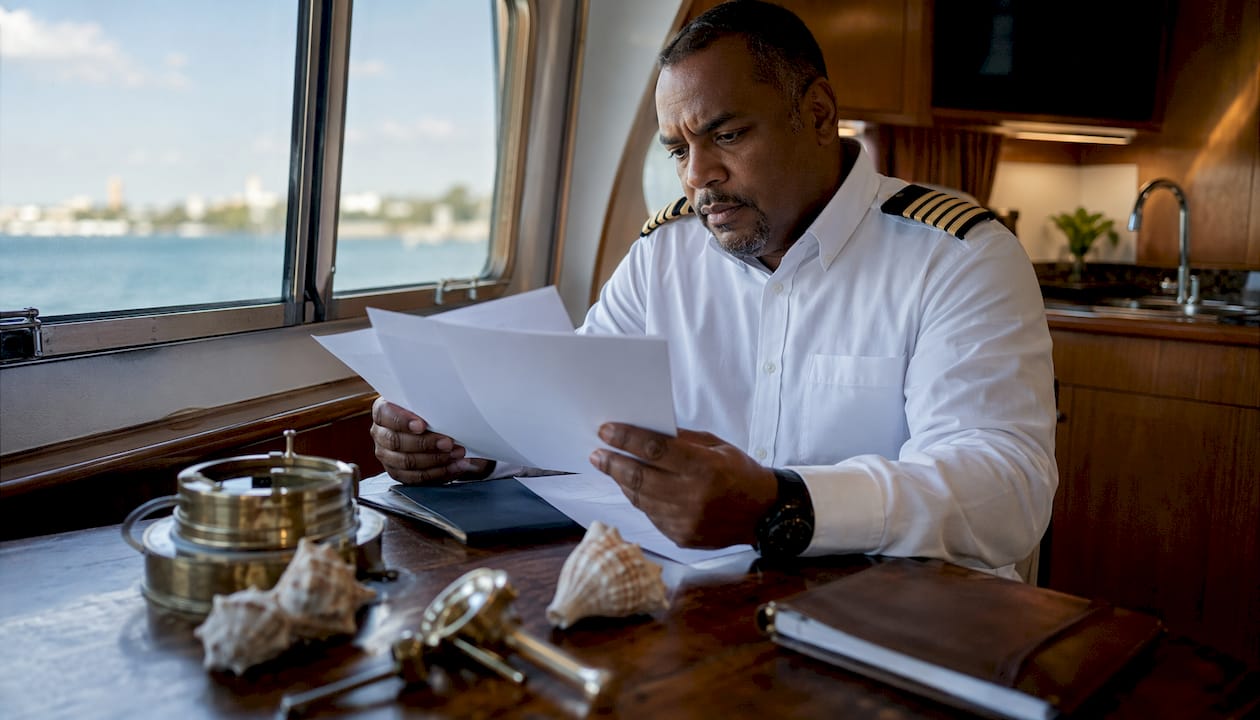
“Commercial yacht license” is not a single credential you apply for and receive. In the U.S., it refers to two parallel requirements that must both be in place before a yacht earns revenue: the operator’s federal credential (the USCG Merchant Mariner Credential, or MMC, with the appropriate endorsements) and the vessel’s commercial status (commercial registration, applicable inspections, certifications, and insurance). Miss either one, and you face policy invalidation, fines, and potential criminal charges before a single charter guest steps aboard.
Table of Contents
- What does “commercial yacht license” actually mean legally?
- What operator credentials does a U.S. captain need?
- What must a vessel have to operate commercially in the U.S.?
- How do you convert a private yacht to commercial charter service?
- What ongoing obligations come with commercial operation?
- Who issues approvals and enforces the rules?
- How Baranofyachts supports owners from concept to commercial readiness
- Key Takeaways
- The cost of treating compliance as an afterthought
- Baranofyachts: your partner for commercial-capable builds and conversions
- Authoritative sources and further reading
What does “commercial yacht license” actually mean legally?
The phrase bundles two legally distinct things that operate on separate tracks: the operator’s MMC follows a person, and the vessel’s commercial certification follows the hull. A captain can hold every endorsement the USCG issues and still be operating illegally if the yacht itself has not been commercially registered, surveyed, and coded to the applicable standard.
The vessel-side requirements vary by flag state, size, trading area, and whether the yacht carries more than 12 passengers. For U.S.-flagged yachts operating domestically, the USCG sets the inspection and certification framework. Yachts operating internationally or under certain foreign flags may also trigger the ISM Code and Maritime Labour Convention (MLC), which add a safety management system and crew welfare obligations on top of the domestic baseline.
A common pitfall: owners who offer “cost-shared” trips assume they fall outside commercial rules. U.S. regulators and insurers look at the substance of the arrangement, not the label. Revenue-bearing activity without proper certification carries the same enforcement risk as an openly advertised charter.
- The operator’s MMC and endorsements are a personal credential issued by the USCG National Maritime Center.
- The vessel’s commercial status depends on registration, surveys, inspections, and applicable codes (ISM, MLC, USCG Certificate of Inspection).
- Both must be current and aligned before any paid operation begins.
- Flag-state choice drives which survey standard and crew rules apply; this decision belongs at the design or pre-purchase stage, not after launch.
Pro Tip: If you are commissioning a new build or planning a refit, write commercial-use intent into the design brief from day one. Retrofitting structural fire divisions, stability calculations, or safety systems after construction can cost multiples of what early planning would have required.
What operator credentials does a U.S. captain need?
The USCG issues several credential tiers based on tonnage, route, and passenger limits. Here is how the main endorsements compare:
| Credential | Tonnage / Scope | Passengers | Vessel Type |
|---|---|---|---|
| OUPV (6-pack) | Up to 100 GRT, Near Coastal or Inland | Up to 6 for hire | Uninspected only |
| — | — | More than 6 on inspected vessel | Inspected vessels |
| — | — | More than 6 on inspected vessel | Inspected vessels |
| Master 100 Ton | Up to 100 GRT, Near Coastal or Inland | More than 6 on inspected vessel | Inspected vessels |
| — | — | More than 6 on inspected vessel | Inspected vessels |
The OUPV requires 360 days of sea service, with each qualifying day defined as at least 4 hours underway, documented on Form CG-719S. Master 100 Ton Near Coastal demands more sea time and stricter route evidence. The full credentialing process, from sea-time accumulation through medical exam, TWIC card, classroom training, and USCG application processing, typically takes 9–18 months, with sea time being the main variable.
When verifying a hired captain’s credential, check: MMC number and expiration date, specific endorsements (tonnage, route, passenger authority), drug-testing enrollment and random-testing compliance, TWIC card validity, and current medical certificate.
Pro Tip: Recreational sea time aboard your own yacht can count toward MMC endorsements if properly documented. Keep a personal logbook with dates, hours underway, and vessel details, then have entries certified on Form CG-719S. Waiting until the credentialing application to reconstruct this history is one of the most common and costly delays we see.
What must a vessel have to operate commercially in the U.S.?
Commercial vessel status is a sequence, not a single event. Owners typically work through these steps:
- Choose flag state and registration category. U.S. flagging subjects the vessel to USCG oversight; foreign flagging may offer different survey standards, tax treatment, and crew rules. This choice shapes every subsequent requirement, so it belongs at the earliest planning stage. Our guide on flag-state selection covers the trade-offs in detail.
- Commission a commercial survey. A qualified marine surveyor assesses the hull, systems, stability, and safety equipment against the applicable commercial standard.
- Obtain USCG inspection or Certificate of Inspection (COI) if applicable. Vessels carrying more than 6 passengers for hire on U.S. navigable waters typically require a COI, which triggers specific structural, fire-suppression, life-saving, and navigation equipment requirements.
- Code to ISM/MLC when required. Yachts operating internationally or under flags that mandate it must implement a documented Safety Management System (ISM) and meet MLC crew welfare standards.
- Secure commercial hull and liability insurance. A private recreational policy does not cover revenue-generating activity. Charter-specific hull and Protection & Indemnity (P&I) coverage is required, and premiums reflect the higher operational exposure. Our yacht insurance planning guide outlines what owners should budget.
- Address tax and financial registration. Charter revenue may trigger sales tax, use tax, or other obligations depending on the operating jurisdiction.
Operating commercially on a privately coded vessel does not just risk a fine. It voids the hull policy, exposes the owner to unlimited personal liability, and can result in criminal charges.
Pro Tip: Flag-state selection is not just a paperwork decision. It determines which classification society standards apply, how crew must be documented under MLC, and what tax treatment charter revenue receives. Owners who treat it as an afterthought routinely face expensive reclassification work.
How do you convert a private yacht to commercial charter service?
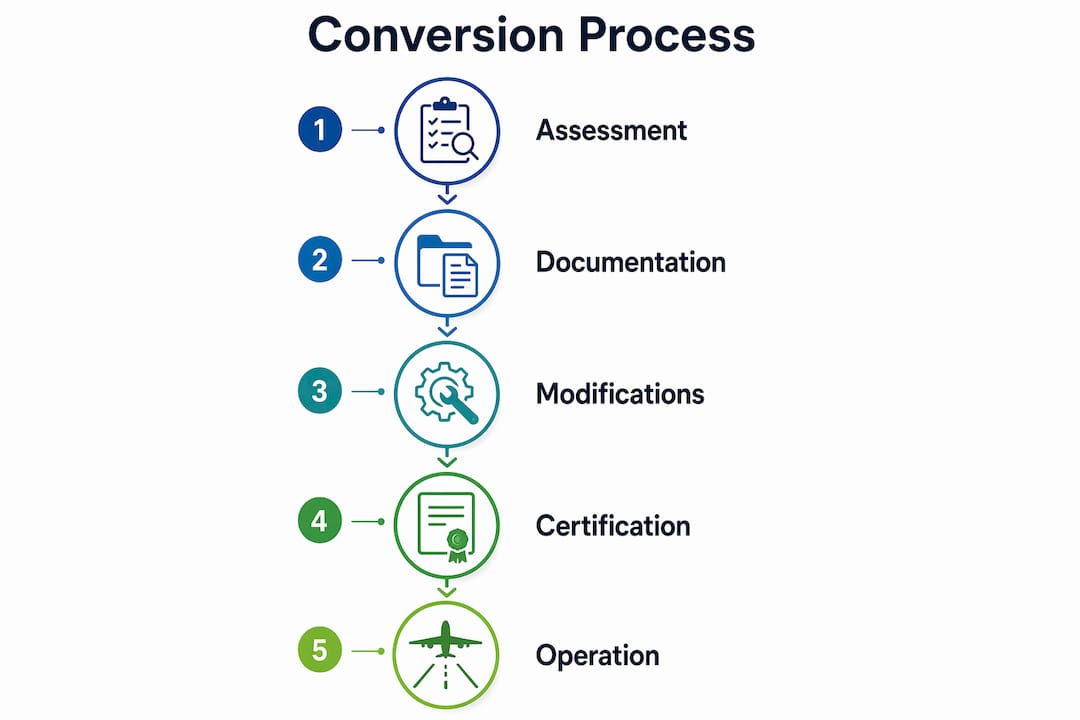
The conversion sequence has five phases, each with its own cost drivers and specialists.

| Phase | Key Activities | Typical Duration |
|---|---|---|
| Assessment | Commercial survey, gap analysis, flag-state selection | 4 weeks |
| Design and refit | Naval architecture changes, structural upgrades, safety systems, stability book update | 3–12 months |
| Survey and inspection | USCG inspection or COI application, classification society review if applicable | 4–12 weeks |
| Certification | ISM SMS documentation, MLC crew records, insurance re-rating | 4 weeks |
| Commercial readiness | Crew credentialing, payroll and MLC compliance setup, inaugural safety drills | 2–4 weeks |
Cost drivers vary significantly by vessel age, size, and original build standard. Major buckets include naval architecture and structural modifications, safety and fire-suppression equipment upgrades, survey and certification fees, and crewing and payroll system setup. Owners who plan for commercial use during the design phase avoid the most expensive structural rework.
Pro Tip: The hidden costs owners most often miss are documentation and compliance administration: stability book amendments, ISM SMS drafting, MLC crew record systems, and tax registration. Budget for these explicitly, because they add weeks and real expense if treated as an afterthought.
What ongoing obligations come with commercial operation?
Commercial status is not a one-time certification. It creates a recurring compliance calendar that owners must fund and manage:
- Scheduled surveys and inspections: Annual, intermediate, and five-year surveys depending on flag state and classification society requirements.
- Safety Management System maintenance: ISM requires documented procedures, drills, incident reporting, and internal audits. Letting the SMS lapse is a flag-state deficiency.
- Crew certification and MLC compliance: All crew must hold current STCW certificates, medical certificates, and drug-test records. MLC mandates written employment agreements, rest-hour logs, and welfare provisions.
- Logbooks and voyage records: USCG and flag-state rules require accurate deck logs, engine logs, and crew records. These are the first documents an inspector requests.
- Drug and medical testing: U.S. commercial operations require a USCG-compliant drug-testing program for all credentialed crew.
Lapses in any of these areas can void insurance mid-voyage, trigger port-state detention, and expose the owner to personal liability. Engaging a professional yacht manager or project manager to maintain the compliance calendar is the most reliable way to protect the investment.
Who issues approvals and enforces the rules?
The U.S. Coast Guard is the primary authority for both operator credentials and vessel inspections on U.S.-flagged or U.S.-operating commercial yachts. The USCG National Maritime Center issues MMCs and endorsements; USCG Marine Safety Offices conduct vessel inspections and issue Certificates of Inspection.
Classification societies such as ABS (American Bureau of Shipping) and Lloyd’s Register enter the process when a vessel seeks commercial coding under a standard that requires third-party structural and systems certification. They certify that the hull, machinery, and safety systems meet the applicable class rules, and their involvement is often a flag-state or insurer requirement for larger yachts.
“The operator’s credential and the vessel’s commercial certification are separate legal instruments. A captain with a Master 100 Ton endorsement cannot make an uncertified vessel legal for charter — and a commercially coded vessel cannot operate safely without a captain whose endorsements match the tonnage and route.” — USCG National Maritime Center guidance on charter boat operations.
Flag states beyond the U.S. (Cayman Islands, Marshall Islands, and others) have their own registries and recognized organizations that conduct surveys on their behalf. The RYA’s commercial endorsement framework illustrates how flag-state rules drive manning and certification tables in other jurisdictions, a useful reference point when evaluating foreign-flag options for a U.S.-based owner.
How Baranofyachts supports owners from concept to commercial readiness
We work with owners and corporate clients at every stage of the compliance journey: early feasibility review, naval architecture and refit oversight, survey coordination, crew sourcing and credential verification, insurance and registration support, and management handover. The conductor’s-eye view we bring to project management means that structural, regulatory, and operational requirements are sequenced together, not discovered in conflict after the fact.
When interviewing project managers, naval architects, or surveyors for a commercial-capable build or conversion, ask:
- Have you managed a USCG COI application or ISM SMS implementation for a vessel of this size and flag?
- How do you sequence the commercial survey relative to refit milestones to avoid rework?
- What is your process for crew credential verification and MLC compliance setup?
Pro Tip: Engage a project manager before the design contract is signed on a new build, and before the shipyard contract is signed on a refit. The cost of early involvement is a fraction of the cost of redesigning a fire zone or re-engineering a stability calculation after steel has been cut.
Key Takeaways
A commercial yacht license in the U.S. requires both a correctly endorsed USCG Merchant Mariner Credential for the operator and full commercial certification for the vessel, and neither alone is sufficient.
| Point | Details |
|---|---|
| Two separate requirements | The operator’s MMC and the vessel’s commercial certification must both be current before any paid operation. |
| Sea-time documentation | OUPV requires 360 days of sea service at 4 hours minimum per day, documented on Form CG-719S. |
| Credentialing timeline | The full MMC process typically takes 9–18 months; sea time is the primary variable. |
| Vessel conversion sequence | Assessment, refit, survey, certification, and commercial readiness each require dedicated specialists and budget. |
| Baranofyachts project management | Baranofyachts coordinates compliance planning, refit oversight, and crew credentialing from concept through commercial launch. |
The cost of treating compliance as an afterthought
The most consistent mistake we see is owners who assume that private ownership of a well-equipped yacht is most of the way to charter readiness. It is not. The gap between a privately coded superyacht and a commercially certified one can involve structural fire divisions, revised stability calculations, a full ISM Safety Management System, MLC employment agreements for every crew member, and a completely different insurance program. Each of those items has a cost that compounds when it is discovered late.
We have seen refit projects where commercial compliance was added to scope after the naval architecture was finalized. The knock-on effects, a revised stability book, relocated fire-suppression equipment, and renegotiated crew contracts, added months and significant expense to what should have been a straightforward conversion. The vessel was right. The timing was wrong.
Early, integrated project management does not just reduce cost. It changes the character of the outcome: a yacht that was designed or refitted with commercial operation in mind from the first drawing is a fundamentally more capable and lower-risk asset than one that was retrofitted into compliance.
Baranofyachts: your partner for commercial-capable builds and conversions
For owners and corporate clients who want a yacht that earns revenue without the compliance risk, Baranofyachts offers something specific: project management that treats regulatory readiness as a design input, not a final checklist. We coordinate naval architecture, survey scheduling, USCG and flag-state liaison, crew credential verification, and insurance structuring as a single orchestrated process, so nothing is discovered in conflict after the build or refit is underway.

Whether you are evaluating a commercial-capable new build or assessing what a conversion would require for your existing vessel, the right first step is a commercial-readiness feasibility review. Contact Baranofyachts to arrange yours, and we will map the operator credentials, vessel certifications, and project sequence your specific situation requires. For owners considering the broader financial picture, our yacht management strategies guide outlines how commercial operations integrate with long-term ownership planning.
Authoritative sources and further reading
- USCG National Maritime Center: Charter Boat Captain — The primary U.S. government source for MMC credential categories, endorsement requirements, and the official distinction between operator credentials and vessel inspection rules.
- YATCO: Yacht Charter Licensing and Legal Requirements — Industry-focused overview of commercial registration, ISM/MLC triggers, insurance consequences, and conversion sequencing for charter-capable yachts.
- Sea School: How to Get a Captain’s License — Practical step-by-step guide to sea-time documentation, Form CG-719S requirements, and realistic timelines for common USCG endorsements.
- RYA: Gaining Commercial Endorsements — Useful comparative reference for owners evaluating British-flagged or EU-operating yachts; illustrates how flag-state rules drive manning and certification requirements.
- Transport Malta: Commercial Yacht Code — Reference standard for classification society involvement in commercial coding, structural surveys, and safety systems certification for larger yachts.
Recommended
Sold Listings


Design Your Yacht
"*" indicates required fields
Maximus III - PNW
As you step aboard MAXIMUS III, the first impression is her scale.
At 120 feet with an 8-meter beam and 294 GT of interior volume, this 2025 Crescent Custom tri-deck immediately feels open, balanced, and estate-like. A timeless look while still feeling fresh from the shipyard.
Currently Available


Get your yacht value Estimate
"*" indicates required fields