

Yacht depreciation is the measurable decline in a vessel’s market value over time, driven by age, builder prestige, maintenance history, and market demand. Most yachts lose 10–20% of their value in the first year alone, simply by transitioning from new to pre-owned status. A $10 million yacht can shed up to $2 million in that first year, even when maintained properly. Understanding yacht depreciation value is not optional for serious buyers and investors. It is the foundation of every sound acquisition decision, resale plan, and ownership budget you will ever make.
How does yacht depreciation typically progress over time?
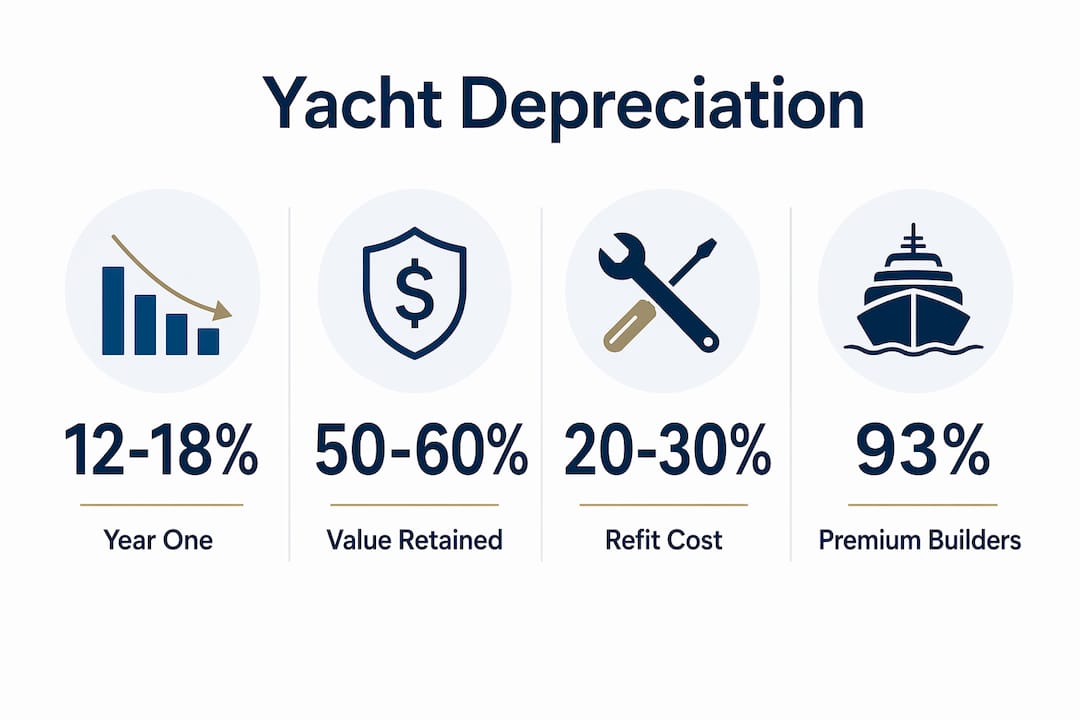
Yacht value depreciation follows a non-linear curve. The steepest losses happen early, then the rate slows considerably as the vessel ages. Annual depreciation rates follow a clear pattern: 12–18% in year one, 7–10% in years 1–3, 5–7% in years 3–7, and 3–5% in years 7–15. That front-loaded loss structure is the single most important number for any buyer to internalize.
By year five, most well-maintained yachts retain 50–60% of their original value. That means a $5 million yacht purchased new could be worth $2.5–$3 million five years later. The loss is real, but it is also predictable, which makes it manageable.

How age brackets behave differently
New yachts carry a premium that evaporates the moment they change hands. A vessel in its first year is essentially paying a luxury tax on novelty. Yachts aged 1–3 years still carry significant depreciation pressure, but the rate begins to ease. From years 3–7, the curve flattens noticeably, and buyers in this window often find the best balance of modern condition and reduced price. Yachts older than 15 years tend to stabilize further, though rising maintenance costs begin to offset the slower value loss.
The first-sale opportunity
The transition from new to pre-owned is where the largest single value drop occurs. That drop is a buying opportunity, not a warning sign. A yacht that sold new for $8 million and is now listed at $6.5 million after 18 months of careful ownership has already absorbed the worst of its depreciation. The next buyer enters at a far more favorable point on the curve.
Pro Tip: Target yachts that are 2–4 years old from reputable builders. You avoid the steepest depreciation cliff while still acquiring a vessel in excellent condition with modern systems.
| Age bracket | Typical annual depreciation rate |
|---|---|
| Year 1 | 12–18% |
| Years 1–3 | 7–10% |
| Years 3–7 | 5–7% |
| Years 7–15 | 3–5% |
What key factors affect yacht depreciation value?
Builder reputation is the single most powerful factor in how a yacht holds its value. Ultra-premium builders like Feadship, Lürssen, and Oceanco command a 93% price premium over baseline market rates and retain value significantly better than mid-tier brands. Premium mid-tier builders like Benetti and Sanlorenzo command roughly a 20% premium over baseline. The shipyard name on the hull is not just a badge. It is a financial instrument.
Beyond builder prestige, several other variables shape how fast a yacht loses value:
- Maintenance history. A documented, consistent maintenance record signals to buyers that the vessel has been cared for. Gaps in service history create uncertainty, and uncertainty drives price down.
- Refit schedule. Major refits every 5–7 years cost 20–30% of a yacht’s value but skipping them reduces resale value even more. A well-timed refit is an investment, not an expense.
- Scarcity and craftsmanship. Limited production and established builders sustain pricing power in resale markets, much like classic cars or fine watches. A vessel from a shipyard with a 10-year waiting list does not depreciate the same way as one from a high-volume producer.
- Customization. Tasteful, high-quality refits and interior upgrades can preserve or even add value. Highly personal customizations that reflect only the original owner’s taste often reduce appeal to secondary buyers.
- Market dynamics. Buyer demand, available inventory, and broader economic conditions all influence resale pricing. A strong charter market can also support values by demonstrating a vessel’s earning potential.
Professional valuation models provide the most reliable picture of where a specific yacht sits. Hedonic regression models using length, age, and builder tier achieve an R² of 0.918 for motor yachts, meaning they explain more than 91% of price variation. That level of accuracy replaces guesswork with data.
Pro Tip: Before listing or purchasing any yacht, commission a professional valuation using a hedonic regression model. Broker estimates and anecdotal comparisons are not substitutes for market-calibrated data.
How does yacht depreciation compare with financial investment expectations?
Yachts are not financial investments in the traditional sense. 95% of yachts depreciate over their ownership life, and the belief that they appreciate or break even financially is incorrect for the vast majority of buyers. Treating a yacht as an appreciating asset leads to poor acquisition decisions and genuine financial disappointment.
The correct frame is this: a yacht is a depreciating lifestyle asset. The return comes through use, experience, and in some cases, charter income. Owners who align their expectations with that reality make better decisions at every stage of ownership.
The financial picture includes more than depreciation alone:
- Operating costs. Annual operating costs run roughly 10% of purchase price for newer vessels. As a yacht ages, those costs do not fall proportionally with the vessel’s declining value. An older yacht can cost 15–17% of its current market value annually to operate. That gap between declining asset value and stable operating costs is the hidden financial pressure of long-term ownership.
- Charter income. Placing a yacht in a managed charter program can offset operating costs meaningfully. It does not eliminate depreciation, but it reduces the net cost of ownership.
- Secondary market timing. Buying in the secondary market, rather than ordering new, avoids the steepest early losses. A 5-year-old, well-maintained yacht offers better value retention and steadier depreciation going forward. A 5-year-old Feadship priced at $14–17 million, for example, will depreciate at 4–6% annually thereafter, a far more predictable and manageable rate.
The yacht depreciation vs appreciation analysis is clear: plan for loss, optimize for lifestyle, and use the secondary market to your financial advantage.
What strategies can owners and investors use to manage depreciation?
Managing yacht value depreciation requires deliberate choices at every stage, from acquisition through to eventual sale. The following strategies reflect what experienced owners and advisors consistently apply.
-
Buy in the secondary market. Purchasing a 5-year-old vessel from a reputable builder avoids the steepest depreciation years. You inherit a vessel that has already absorbed its largest losses and enters a more stable depreciation phase. Explore yacht resale value tips to understand how timing affects net returns.
-
Prioritize builder reputation at acquisition. Feadship, Lürssen, and Oceanco vessels hold value better than mid-tier alternatives. The premium paid at purchase is partially recovered at resale through stronger pricing power. Review how shipyards shape outcomes before committing to a builder.
-
Maintain a documented service record. Every service, repair, and upgrade should be logged with dates, costs, and contractor details. Buyers pay more for certainty. A clean, complete service history is one of the most cost-effective ways to protect resale value.
-
Follow a refit schedule. Budget for major refits every 5–7 years. The cost is real, but the alternative is a vessel that enters the resale market looking tired and priced accordingly. A well-executed refit signals care and extends the vessel’s competitive life.
-
Use professional valuations before selling. Market conditions shift. A valuation based on current comparable sales and builder-tier data gives you a defensible asking price and prevents underpricing. The 2026 yachting market has specific dynamics that affect pricing windows.
-
Consider charter income carefully. Charter use generates revenue but also adds wear. Work with a qualified manager to structure charter programs that produce income without accelerating mechanical depreciation beyond what the revenue justifies.
Key takeaways
Yacht depreciation is predictable, front-loaded, and manageable when buyers enter the market with accurate data, the right builder selection, and a disciplined maintenance plan.
| Point | Details |
|---|---|
| Steepest losses happen early | Yachts lose 12–18% in year one; buying used avoids the worst of this curve. |
| Builder reputation drives retention | Ultra-premium builders like Feadship retain value far better than mid-tier alternatives. |
| Refits protect resale value | Skipping scheduled refits costs more at resale than the refit itself. |
| Operating costs rise with age | Older yachts can cost 15–17% of market value annually to run, compounding ownership expense. |
| Secondary market offers better economics | A 5-year-old vessel from a top builder delivers steadier, more predictable depreciation. |
What I’ve learned about depreciation that most buyers miss
Most buyers arrive at their first yacht purchase focused on the vessel itself: the layout, the range, the builder’s reputation. Depreciation is treated as a footnote. After years of working through acquisitions and resales at Baranofyachts, I can tell you that framing is exactly backwards.
The buyers who come out ahead financially are the ones who treat depreciation as the primary variable and everything else as secondary. They know the curve before they sign anything. They know that a $15 million new build will likely be worth $8–9 million in five years, and they have already decided whether that loss is acceptable given the lifestyle return they expect.
What surprises most first-time buyers is how predictable the depreciation curve actually is. It is not random. Builder tier, age, maintenance history, and refit timing explain the vast majority of price variation. The hedonic regression models used by professional valuers achieve over 91% predictive accuracy. That is not a rough estimate. That is a financial model you can plan around.
The other insight I share consistently: the secondary market is where the real value lives. Buying a 3 to 5-year-old vessel from a top-tier builder means someone else absorbed the brutal first-year loss. You enter at a point where the curve has already flattened, and your resale position three to five years later is far stronger than if you had bought new. That is not a compromise. That is a better deal.
Viewing a yacht as a depreciating lifestyle asset, rather than an investment vehicle, also changes how you make decisions about charter income, operating budgets, and eventual sale timing. The owners who struggle are the ones waiting for appreciation that will not come. The ones who thrive have already built the depreciation into their plan and focused on maximizing the experience the asset delivers.
— Jason
Baranofyachts and the value of informed yacht acquisition
Buying a yacht without understanding its depreciation profile is like buying real estate without reading the market. At Baranofyachts, we guide buyers through exactly this kind of analysis before any acquisition decision is made.

We work with buyers to identify vessels from builders with proven value retention, assess maintenance histories, and time purchases to avoid the steepest depreciation windows. Our team draws on current market data and professional valuation frameworks to give you a clear picture of what a vessel is worth today and where it is likely to sit in five years. Whether you are evaluating next-generation yacht design or working through the economics of a secondary market acquisition, our boat brokerage services are built to protect your position at every stage.
FAQ
What is the typical yacht depreciation rate in the first year?
Yachts lose 10–20% of their value in the first year after transitioning from new to pre-owned status. A $10 million yacht can lose up to $2 million in that period alone.
Do yachts ever appreciate in value?
95% of yachts depreciate over their ownership life. Rare exceptions include limited-production vessels from ultra-premium builders in strong demand, but appreciation is not a reliable financial expectation for most buyers.
Which builders retain yacht value best?
Ultra-premium builders like Feadship, Lürssen, and Oceanco command a 93% price premium and retain value significantly better than mid-tier alternatives. Builder reputation is the single strongest predictor of resale performance.
How do refits affect resale value?
Major refits every 5–7 years cost 20–30% of a yacht’s value but protect resale pricing. Skipping refits reduces market value by more than the refit would have cost.
Is buying a used yacht better than buying new for value retention?
Buying a 5-year-old, well-maintained yacht avoids the steepest early depreciation and delivers steadier value loss of 4–6% annually thereafter. The secondary market consistently offers better economics than purchasing new.
Recommended
Sold Listings


Design Your Yacht
"*" indicates required fields
Maximus III - PNW
As you step aboard MAXIMUS III, the first impression is her scale.
At 120 feet with an 8-meter beam and 294 GT of interior volume, this 2025 Crescent Custom tri-deck immediately feels open, balanced, and estate-like. A timeless look while still feeling fresh from the shipyard.
Currently Available


Get your yacht value Estimate
"*" indicates required fields