
Most yacht owners assume that only a new build can deliver a true step-change in value and experience. That assumption is costing them money. Strategic upgrades boost resale value by 10 to 20% and increase charter rates by 10 to 25%, with interior refits alone yielding 15 to 20% higher resale prices. The right upgrade program doesn’t just refresh a vessel. It repositions it in the market, attracts more discerning charterers, and aligns the yacht precisely with how you actually use it. In this article, we walk through the upgrades that deliver the greatest return, the sustainability investments that reduce operating costs, and how to decide between a refit and a new build.
Table of Contents
- Financial and lifestyle benefits of yacht upgrades
- Sustainability upgrades: Lower costs, greater appeal
- Refit versus new build: Making the best investment
- Choosing the right yard and upgrade strategy
- A smarter approach: What most yacht owners overlook
- Explore bespoke upgrade solutions with Baranof Yachts
- Frequently asked questions
Key Takeaways
| Point | Details |
|---|---|
| Upgrades boost ROI | Carefully chosen upgrades can raise resale value and charter rates by sizable margins. |
| Sustainability saves | Eco-friendly improvements reduce operating costs and attract premium buyers. |
| Refit for reliability | Refitting often yields greater reliability and financial sense for charter-focused yachts. |
| Yard selection matters | The right shipyard is crucial for achieving desired flexibility, engineering, or cost-efficiency. |
| Smart strategies win | Prioritizing upgrades based on real-world usage delivers better long-term results than following trends. |
Financial and lifestyle benefits of yacht upgrades
Having previewed the measurable benefits of yacht upgrades, let’s explore which upgrades deliver the greatest value and appeal for owners and charterers.
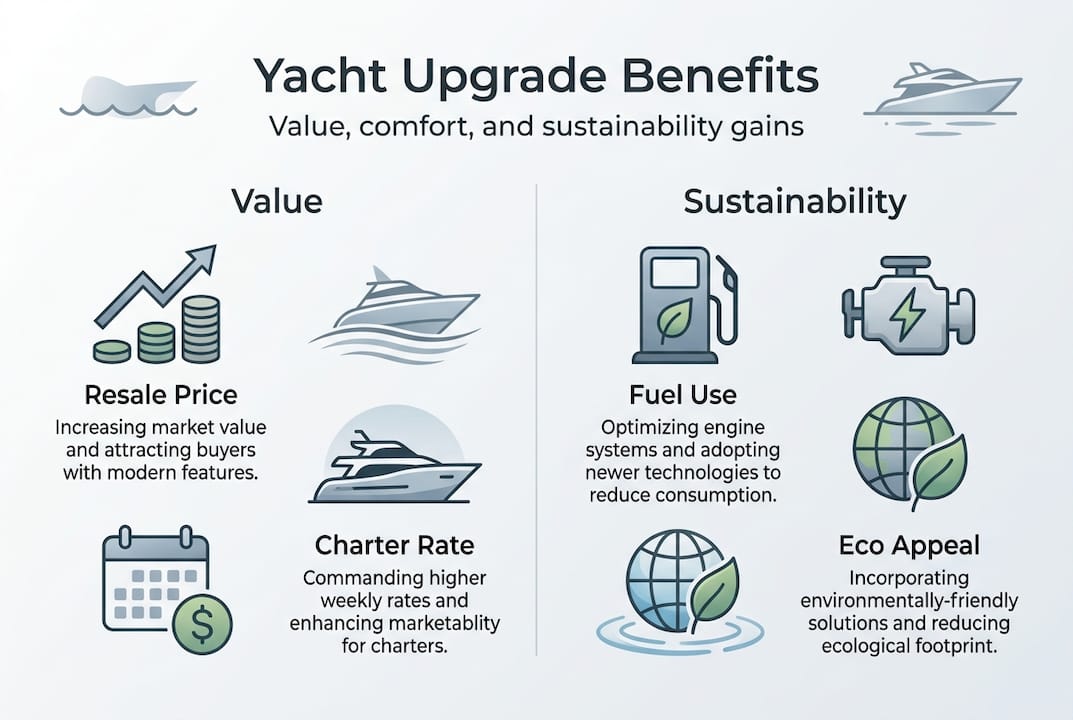
The financial case for upgrading a luxury yacht is more compelling than most owners realize. Many focus on the sticker price of a refit and stop there, without accounting for the revenue and resale upside that follows. Well-planned yacht upgrade impacts show that interior refits consistently yield 15 to 20% higher resale prices, while charter rate premiums of 10 to 25% are achievable after targeted improvements to comfort, technology, and onboard amenities. These are not marginal gains. On a vessel valued at $5 million, a 15% resale uplift represents $750,000 in recovered or created value.
Beyond the numbers, the lifestyle dimension is equally significant. Upgrades allow you to align the vessel with your actual usage patterns rather than accepting the compromises built into a previous owner’s preferences. A family-focused owner might prioritize expanded cabin configurations and quieter mechanical systems. A charter-focused owner might invest in entertainment technology, premium galley equipment, and enhanced water sports platforms. Both paths lead to a vessel that performs better for its intended purpose and commands stronger market interest.
Key upgrades that consistently deliver measurable returns include:
- Interior refits: New soft furnishings, cabinetry, and lighting schemes produce the highest visible impact per dollar spent and directly influence charter guest satisfaction scores.
- Navigation and communication technology: Modern integrated bridge systems, satellite connectivity, and AV upgrades are expected by today’s charterers and buyers alike.
- Deck and outdoor living spaces: Upgraded sunpads, shade structures, and tender garages increase usable space and perceived luxury without structural complexity.
- Mechanical system overhauls: Engine servicing, generator upgrades, and HVAC improvements reduce downtime and operating costs while improving guest comfort.
Thinking carefully about optimizing yacht resale value before committing to an upgrade scope helps ensure your capital goes where it generates the most return. The vessels that command premium pricing share a common trait: every system and space feels intentional, current, and well-maintained.
Pro Tip: Interior refits deliver the strongest combination of charter rate uplift and resale value improvement. If your budget requires prioritization, start there before addressing mechanical or deck upgrades.
The personalization dimension of upgrades also speaks directly to ownership exclusivity. A yacht that reflects your specific aesthetic and operational preferences is not just more enjoyable to use. It is also more distinctive in a crowded market, which translates to stronger buyer interest when the time comes to sell.
Sustainability upgrades: Lower costs, greater appeal
Beyond lifestyle and financial gains, sustainability upgrades are increasingly vital. Let’s examine their cost, value, and market impact.

The economics of eco-friendly upgrades have shifted dramatically. What once felt like an idealistic investment now delivers hard financial returns alongside genuine environmental benefits. Hybrid propulsion reduces fuel consumption by up to 30%, which on a vessel burning significant quantities of diesel annually translates to tens of thousands of dollars in annual savings. That figure compounds over the ownership period and makes the upfront installation cost far more palatable.
For owners not ready to commit to hybrid propulsion, energy-saving yacht audits reveal that low-hanging fruit like LED lighting conversions, shore power connections, and regular hull cleaning and antifouling maintenance deliver 5 to 10% energy savings with minimal capital outlay. These are changes that can often be completed during a standard annual refit without extending the yard period significantly.
The market impact of sustainability credentials is growing. Eco-conscious buyers, particularly those under 50, actively seek vessels with documented environmental performance. Sustainability upgrades command a 10 to 15% resale premium in today’s market, and that gap is widening as regulatory pressure increases in popular cruising regions like the Mediterranean and Caribbean.
| Upgrade type | Estimated savings | Market impact |
|---|---|---|
| Hybrid propulsion system | Up to 30% fuel cost reduction | 10 to 15% resale premium |
| LED lighting conversion | 5 to 8% energy savings | Improved charter appeal |
| Shore power connection | Reduced generator hours | Lower maintenance costs |
| Hull cleaning and antifouling | 2 to 5% fuel efficiency gain | Maintained performance ratings |
| Solar panel installation | Variable, 10 to 20% auxiliary power | Strong eco-buyer appeal |
The practical benefits extend beyond direct cost savings. Vessels with modern energy management systems are easier to operate with smaller crew complements, which reduces payroll costs and simplifies scheduling. Shore power connectivity, in particular, eliminates generator noise and exhaust during marina stays, which is a significant quality-of-life improvement for owners and guests alike.
When you explore yacht configuration options for a new build or major refit, integrating sustainability systems at the design stage is always more cost-effective than retrofitting them later. Planning for hybrid capability, solar readiness, and efficient hull forms from the outset avoids the structural complications and additional yard time that retrofits often require.
The eco-friendly upgrades that generate the strongest combined return are those that reduce visible operating costs, improve guest comfort, and align with emerging regulatory requirements simultaneously. Hybrid propulsion, LED systems, and shore power connectivity check all three boxes.
Refit versus new build: Making the best investment
After understanding eco upgrades, the crucial choice remains: should you upgrade, refit, or build new? Here’s how to decide.
This is the question we hear most often from owners who have outgrown their current vessel or who are re-entering the market after time away. The answer depends on your usage profile, timeline, and capital allocation priorities rather than on any universal rule.
Refits represent strategic capital intelligence over new builds for charter and repeat use, prioritizing reliability over novelty. A well-executed refit on a proven hull delivers a vessel whose structural integrity and systems performance are already understood. There are no surprises from new construction, no commissioning period where teething issues emerge, and no waiting 18 to 36 months for delivery. For charter operators, that reliability is a direct revenue protection measure.
New builds, by contrast, offer full customization from the keel up. Every system, space, and specification reflects your preferences without compromise. However, the capital requirement is substantially higher, the timeline is longer, and the first season often involves resolving issues that only emerge under real operating conditions.
| Factor | Refit | New build |
|---|---|---|
| Typical cost | 20 to 50% of new build price | Full market price |
| Timeline | 3 to 12 months | 18 to 36 months |
| Customization | Moderate, within existing structure | Complete |
| Reliability | Proven hull and systems | Commissioning period required |
| Charter readiness | Faster to market | Delayed by build timeline |
Here is a straightforward framework for making the decision:
- Assess your timeline. If you need the vessel in service within 12 months, a refit is almost always the right path.
- Evaluate the existing hull. A sound hull in good structural condition is a strong foundation for a refit. A compromised hull changes the calculus entirely.
- Define your customization requirements. If your needs can be met within an existing layout, refitting is more efficient. If your vision requires fundamental structural changes, a new build may be justified.
- Model the charter revenue impact. For charter-focused owners, the faster return to service that a refit enables often outweighs the customization advantages of a new build.
“A refit is not a compromise. It is a precision investment in a vessel whose performance envelope is already proven. For charter and repeat-use owners, that certainty has real financial value.”
Pro Tip: If your primary goal is optimizing charter performance and revenue continuity, prioritize a refit over a new build. The faster return to service and lower capital outlay typically deliver stronger near-term returns.
For owners who are genuinely weighing a new build, understanding what to consider before building your yacht is an essential first step. And for those drawn to full customization, custom yacht builds at the bespoke level offer an experience that a refit simply cannot replicate.
Choosing the right yard and upgrade strategy
Choosing whether to upgrade or build new is only part of the equation. The right yard and strategy are equally important to maximizing your investment.
Yard selection is where many otherwise well-planned projects lose momentum. Owners and their project managers sometimes choose a yard based on reputation alone, without matching the yard’s core competency to the specific nature of the project. That mismatch creates delays, cost overruns, and outcomes that fall short of expectations.
Yard choice is critical: refit yards offer flexibility and adapt quickly to surprises; new-build yards specialize in major engineering but are often less adaptable to mid-project changes; commercial yards are cost-efficient for straightforward, well-defined scopes. Understanding these distinctions before signing a contract protects your timeline and budget.
“The yard that built the finest new superyacht in the world may not be the right choice for a complex refit. Match the yard’s strengths to your project’s demands, not to its reputation alone.”
Key factors to weigh when selecting your yard include:
- Specialization: Does the yard have documented experience with projects of your vessel’s size, type, and scope? Ask for references from comparable projects completed in the last three years.
- Flexibility and responsiveness: Refits routinely surface unexpected conditions behind panels and under decks. A yard that handles surprises methodically rather than using them as leverage for cost escalation is worth a premium.
- Subcontractor network: Most yards rely on specialist subcontractors for electrical, HVAC, and interior work. The quality of those relationships directly affects your project’s outcome.
- Geographic location: Yard location affects logistics costs, owner access during the build, and crew travel expenses. A yard that is convenient for your cruising region reduces friction throughout the project.
- Communication and reporting: Clear, consistent progress reporting is not optional. It is the mechanism by which problems are caught early rather than discovered at delivery.
Reviewing how 2025 projects are informing better builds in 2026 offers useful perspective on how yard relationships and project management practices translate directly into on-water outcomes. The shipyard selection tips from experienced industry observers reinforce the same principle: the right yard for your project is the one whose strengths align precisely with your scope, not simply the most prestigious name on the list.
A smarter approach: What most yacht owners overlook
We have worked with enough owners through refit and new build cycles to recognize a consistent pattern. The projects that underperform financially are rarely the ones that ran over budget on a specific line item. They are the ones where the upgrade scope was driven by trend rather than by the vessel’s actual usage profile and long-term maintenance demands.
Owners who chase the latest interior aesthetic or the most talked-about technology often find themselves refitting again sooner than expected, because those choices age quickly. The owners who achieve the strongest long-term value invest in maintenance and reliability, energy efficiency, and timeless comfort. Those choices compound over time rather than depreciate.
The most overlooked insight in luxury yacht upgrades is this: the vessel that is easiest to maintain and most reliable in operation will always command stronger charter rates and buyer interest than the vessel with the most impressive feature list. Reliability is invisible when it is working, but its absence is immediately and expensively apparent.
Pro Tip: Before finalizing any upgrade scope, map every proposed change against your actual usage calendar and your maintenance budget. If an upgrade adds complexity without adding proportional value to your specific use case, it belongs lower on the priority list.
Smart capital allocation, aligned with real-world usage and honest maintenance planning, consistently outperforms trend-following in this market. That is the discipline we bring to every project we manage.
Explore bespoke upgrade solutions with Baranof Yachts
Ready to put these upgrade strategies into action? At Baranof Yachts, we connect your vision directly to the expertise, yard relationships, and project management discipline needed to execute it with precision.

Whether you are refining an existing vessel or starting from the keel up, our team brings the conductor’s eye that keeps every subsystem, timeline, and budget line in harmony. Explore your options by visiting our configure your yacht tool to define your specifications, or learn more about our bespoke yacht builds for owners who want full customization from concept through delivery. The first conversation costs nothing. The clarity it provides is invaluable.
Frequently asked questions
How much can yacht upgrades increase resale value?
Interior refits yield 15 to 20% higher resale prices, making them the single highest-return upgrade category for most vessels. Broader strategic upgrade programs can push overall resale value gains to 20% above pre-upgrade market price.
Do sustainable upgrades increase market appeal?
Yes. Sustainability upgrades command a 10 to 15% resale premium and attract a growing segment of eco-conscious buyers, particularly in the under-50 demographic that is increasingly active in the luxury yacht market.
Is refitting more cost-effective than building new?
For charter and repeat-use owners, refits provide greater reliability and strategic value over new builds, with lower capital outlay, faster return to service, and a proven performance baseline that reduces commissioning risk.
What are quick-win energy upgrades for yachts?
LED lighting, shore power, and hull maintenance deliver 5 to 10% energy savings with minimal investment and can typically be completed within a standard annual refit period without significant additional yard time.
What key factors should owners weigh when choosing a shipyard?
Match the yard’s core competency to your project type: refit yards offer flexibility, new-build yards handle major engineering, and commercial yards provide cost-efficiency for well-defined scopes. Subcontractor quality and communication standards matter as much as the yard’s headline reputation.
Recommended
Sold Listings


Design Your Yacht
"*" indicates required fields
Maximus III - PNW
As you step aboard MAXIMUS III, the first impression is her scale.
At 120 feet with an 8-meter beam and 294 GT of interior volume, this 2025 Crescent Custom tri-deck immediately feels open, balanced, and estate-like. A timeless look while still feeling fresh from the shipyard.
Currently Available


Get your yacht value Estimate
"*" indicates required fields