
For owner-operators on a single vessel under 30 meters, YachtWyse or YACHTWAVE will serve you better than any enterprise suite. Charter operators running three to fifteen vessels should trial SupaSailing or Floatist first. Fleet managers and superyacht technical teams with ISM obligations belong in Seahub, Aquator Marine, or DeepBlue territory. That is the short answer to this yacht management tools comparison. Everything below explains the reasoning, the trade-offs, and the questions you need to ask before signing any contract.
Top picks at a glance:
- Owner-operator, single vessel: YachtWyse (mobile-first, fast onboarding) or YACHTWAVE (free personal edition, simple scaling)
- Charter operator, 3–15 vessels: SupaSailing (modular, shared data model) or Floatist (turnaround and guest check-in workflows)
- Fleet/enterprise, ISM-obligated: Seahub (planned maintenance depth) or Aquator Marine (ISM and refit project management)
- Crew sourcing: Crewtoo or CrewBay for recruitment workflows; Find a Crew for marketplace reach
- Marina-connected operations: Dockwa or Dockmaster for berth and slip management
Pro Tip: Before you open a single vendor demo, write down your single biggest operational pain point — missed maintenance intervals, certificate expiry surprises, or charter turnaround chaos. The platform that solves that one problem with the least friction is almost always the right starting point, regardless of how many other features it advertises.
Table of Contents
- Which yacht management tools should you compare first?
- Platform profiles: what each tool actually does
- How do these platforms actually differ where it matters operationally?
- How do you choose the right platform for your operation?
- What does implementation actually cost, and when do you see a return?
- Baranofyachts’ practical checklist for moving from spreadsheets to a platform
- Key Takeaways
- What we have learned from watching owners choose the wrong platform
- Baranofyachts can help you select and implement the right platform
Which yacht management tools should you compare first?
The table below covers all 27 platforms in this yacht management tools comparison. Read across each row to eliminate candidates that do not match your operation type, then use the pricing signal and implementation time columns to narrow to a shortlist of two or three for live trials.
| Platform | Best For | Core Modules | Integrations | Mobile / Offline | Pricing Signal | Implementation | Support | Scalability | Compliance |
|---|---|---|---|---|---|---|---|---|---|
| SupaSailing | Multi-domain ops / management companies | Maintenance, charter, refit, inventory, crew | Accounting, broker/charter platforms | Web-native, mobile-responsive | Tiered / per-vessel | Days–weeks | Onboarding team | Multi-vessel, multi-domain | ISM, flag-state |
| Seazone | Mid-size charter & management | Charter ops, maintenance, crew, provisioning | PMS, accounting | Web-native | Tiered / per-vessel | Days–weeks | Self-serve + support | Mid-scale fleets | Compliance docs |
| Seahub | Fleet / superyacht technical teams | Planned maintenance, compliance, documentation | PMS, AIS logs | Mobile-responsive | Per-vessel subscription | Weeks | Dedicated onboarding | Multi-vessel fleets | ISM, STCW, flag-state |
| Aquator Marine | Enterprise superyacht / ISM-heavy | ISM, refit management, compliance, maintenance | PMS, classification bodies | Web-native | Enterprise / custom | Weeks–months | Managed onboarding | Enterprise / large fleets | ISM, refit, flag-state |
| Seaventis | Early adopters / AI-native workflows | AI-assisted maintenance, crew, ops | API-first | Mobile-native | Not publicly listed | Fast (AI-guided) | Self-serve | Scaling | Compliance modules |
| YachtWyse | Owner-operators / single vessel | Maintenance, logs, crew basics | Limited | Mobile-first | Low / per-vessel | Days | Self-serve | Single vessel | Basic compliance |
| DeepBlue | Integrated ops / owner dashboards | Maintenance, finance, crew, compliance | Accounting, AIS, owner reporting | Mobile-responsive | Tiered / per-vessel | Weeks | Onboarding + support | Multi-vessel | ISM, STCW |
| IDEA / MMV | Large superyachts / legacy credibility | Technical PMS, ISM, classification | Classification bodies, PMS | Desktop-primary | Enterprise / custom | 6 months | Managed | Large fleets | ISM, class, flag-state |
| Dockwa | Marina-connected charter ops | Berth booking, marina integration | Marina PMS, charter platforms | Mobile | Marketplace / subscription | Days | Self-serve | Marina networks | — |
| YachtCloser | Brokerage operations | Deal workflow, transaction docs | Broker platforms | Web | Per-user / subscription | Days | Self-serve | Brokerage scale | — |
| Crewtoo | Crewing agencies / crew modules | Crew recruitment, rotation, certs | HR platforms | Mobile | Subscription | Days–weeks | Self-serve + support | Agency scale | STCW cert tracking |
| CrewBay | Crew sourcing / placement | Marketplace, crew profiles, hiring | — | Mobile | Marketplace / subscription | Days | Self-serve | Marketplace | — |
| Floatplan | Voyage planning / safety-first | Voyage planning, safety logs, crew lists | — | Mobile | Free / freemium | Hours | Self-serve | Single vessel | Safety compliance |
| DockManager | Marina / slip management | Dock ops, slip management, billing | Marina PMS | Web + mobile | Per-slip / subscription | Days | Self-serve | Marina scale | — |
| Find a Crew | Crew recruitment / marketplace | Crew directory, job listings | — | Mobile | Subscription | Hours | Self-serve | Marketplace | — |
| VeriShip | Logistics / shipment tracking | Shipment tracking, logistics | Logistics platforms | Web | Subscription | Days | Self-serve | Logistics scale | — |
| MarineTraffic | AIS / movement analytics | Live AIS, historical tracking, port data | AIS feeds, navigation | Web + mobile | Freemium / subscription | Hours | Self-serve | Global | — |
| MarineLink | Market research / news | Industry news, reference portal | — | Web | Free | — | — | — | — |
| Sailsense | Telematics / connected monitoring | Sensor monitoring, alerts, vessel data | NMEA, hardware gateways | Mobile + hardware | Hardware + subscription | Weeks | Technical support | Multi-vessel | — |
| Nauticoncept | Telematics-fed maintenance | Fleet management, engine data, maintenance | Hardware gateways, NMEA | Mobile + hardware | Hardware + subscription | Weeks | Technical support | Multi-vessel | Maintenance compliance |
| Charter Manager App | Charter operators | Charter ops, guest management, turnaround | Booking platforms | Mobile | Subscription | Days | Self-serve | Charter fleets | — |
| Floatist | Charter fleet operators | Turnaround, guest check-in, charter ops | Booking platforms | Mobile-first | Per-vessel subscription | Days | Self-serve + support | Charter fleets | — |
| YACHTWAVE | Owner-operators / low-cost entry | Maintenance logs, basic crew, voyage | Limited | Mobile | Free personal / paid fleet tiers | Hours–days | Self-serve | Small fleets | Basic |
| Quartermaster | Captains / engineers on deck | Mobile work cards, maintenance logs | — | Mobile-first / offline | Subscription | Days | Self-serve | Single vessel | — |
| HelmOps | Charter + operations coordination | Charter ops, crew, maintenance coordination | Charter platforms | Web + mobile | Subscription | Days–weeks | Support team | Charter fleets | Compliance docs |
| Vessel Vanguard | Fleet oversight / monitoring | Fleet dashboards, maintenance, compliance | — | Web + mobile | Per-vessel subscription | Days–weeks | Self-serve + support | Multi-vessel fleets | Compliance tracking |
| Dockmaster | Marina / berth management | Slip management, billing, marina ops | Marina PMS | Web + mobile | Per-slip / subscription | Days | Self-serve | Marina scale | — |
For smaller vessels, the columns that matter most are mobile UX, implementation time, and pricing signal. For fleets and ISM-obligated superyachts, weigh compliance support, scalability, and integration depth above all else.
Platform profiles: what each tool actually does
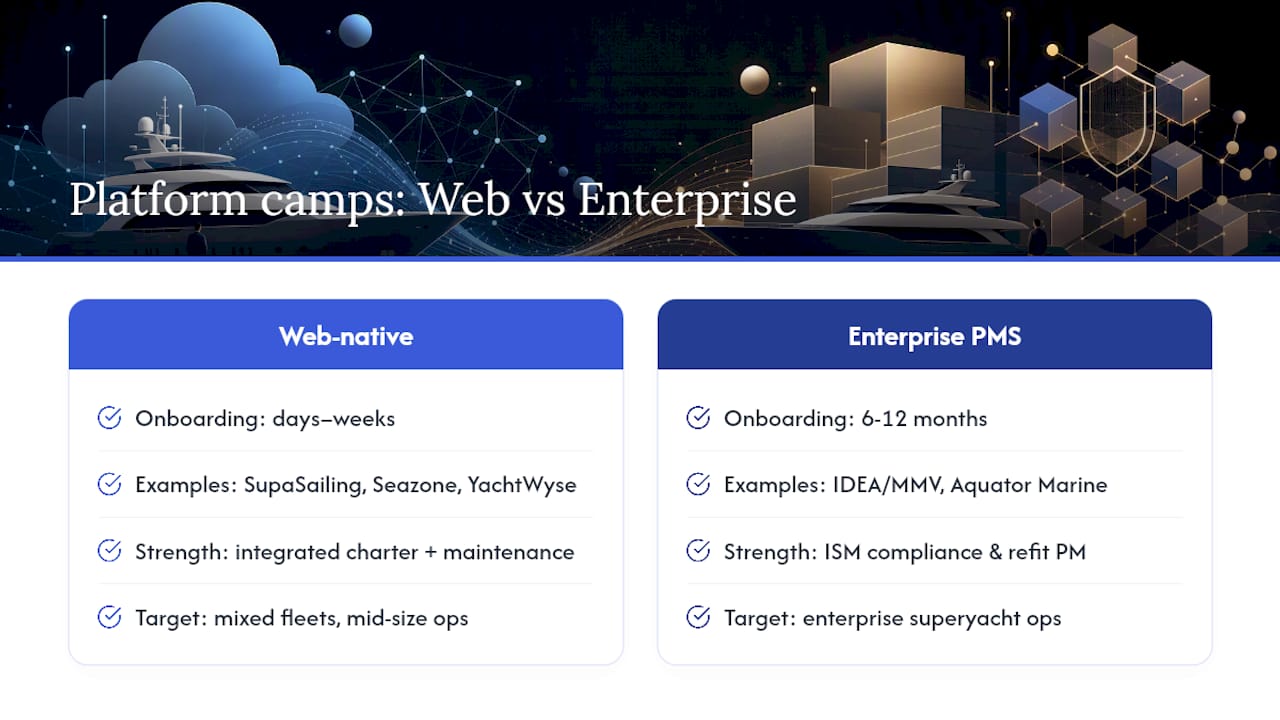
The market divides cleanly into two camps. Web-native platforms (SupaSailing, Seazone, Floatist, HelmOps, DeepBlue, YachtWyse, YACHTWAVE, Quartermaster, Seaventis) typically onboard in days to a few weeks. Legacy enterprise PMS platforms (IDEA/MMV, Aquator Marine) often require six to twelve months for full implementation, with dedicated project teams on both sides. Knowing which camp a vendor belongs to before you book a demo saves considerable time.
SupaSailing covers charter, fleet, and refit workflows inside a single shared data model, meaning a maintenance record created by the engineer is immediately visible to the owner dashboard and the charter booking module without any manual export. That architecture suits management companies running mixed fleets where the same vessel alternates between private use and charter. Onboarding is measured in weeks, not months.
Seazone targets mid-size charter and management companies with a practical UX that crews adopt quickly. Its strength is operational breadth without the administrative overhead of an enterprise system. Onboarding is fast, and the platform’s charter operations module handles provisioning and crew scheduling in a single workflow.
Seahub is the maintenance-first choice for superyacht technical teams. Its planned maintenance module tracks intervals by calendar date and by engine hours, which is the operationally correct approach for preventing both over-maintenance and missed service windows. Documentation depth for ISM and STCW compliance is a genuine differentiator here.
Aquator Marine is built for enterprise superyacht operations where ISM compliance and refit project management are the primary concerns. It handles the complexity of classification body documentation and flag-state reporting that smaller platforms simply do not address. Implementation is longer and requires internal project ownership, but the compliance depth justifies that investment for vessels where a missed ISM audit carries real financial and legal exposure.
Seaventis is the AI-native entrant in this field. Its architecture is designed around AI-assisted workflows rather than bolted-on AI features, which makes it interesting for early adopters willing to shape the product. Pricing is not publicly listed, so expect a discovery call before any numbers appear.
YachtWyse is the cleanest mobile-first option for owner-operators running a single vessel. Setup takes days, the interface is built for captains rather than software administrators, and the feature set stays focused on what a single-vessel operation actually needs: maintenance logs, crew basics, and voyage records.
DeepBlue connects maintenance, finance, crew, and compliance in one system with role-specific reporting that gives owners a real-time dashboard without requiring them to chase the captain for a weekly summary. The integration of those modules eliminates the manual spreadsheet consolidation that consumes hours of administrative time each week on vessels that have not yet adopted a connected platform.
IDEA / MMV carries the deepest installed-base history of any platform in this comparison. Large superyacht programs that have operated on IDEA for years benefit from classification body familiarity and technical PMS depth that newer platforms are still building toward. The trade-off is a desktop-primary interface and an implementation timeline that reflects the system’s complexity.
Dockwa solves a specific problem: marina and berth booking integration for charter operations that need to coordinate slip availability alongside guest scheduling. It works best as a complement to a primary management platform rather than as a standalone system.
YachtCloser handles the deal workflow side of brokerage operations, from offer to closing documentation. It is not a maintenance or operations platform; it is a transaction management tool for brokers and brokerage-focused management companies.
Crewtoo and CrewBay both address crew management, but from different angles. Crewtoo focuses on recruitment workflows, rotation scheduling, and certificate tracking for crewing agencies and operators managing their own crew pipeline. CrewBay operates more as a marketplace, connecting vessels with available crew through profile-based sourcing. Find a Crew serves a similar marketplace function with broader directory reach.
Floatplan is a voyage planning and safety tool rather than a full management platform. Its strength is structured voyage filing, crew lists, and safety check workflows, which makes it a useful complement to a primary system for vessels where the captain wants a dedicated safety layer.
DockManager and Dockmaster both address marina and slip management. DockManager focuses on operational dock workflows and billing; Dockmaster adds berth management features suited to larger marina operations. Neither is a vessel management platform.
VeriShip brings logistics and shipment tracking into marine operations, which matters for vessels that manage complex provisioning supply chains or spare parts sourcing across multiple ports.
MarineTraffic provides live AIS vessel tracking and historical movement data. For operations that need to monitor fleet positions, verify arrival times, or analyze route patterns, it is the standard reference tool. The freemium tier covers basic tracking; subscription tiers unlock historical data and API access for integration with management platforms.
MarineLink is an industry news and reference portal rather than an operational tool. It belongs in a market intelligence workflow, not a software stack.
Sailsense and Nauticoncept both pair hardware sensors with software platforms to deliver telematics-fed maintenance triggers. Sailsense focuses on connected monitoring and alerts; Nauticoncept pairs hardware gateways with fleet management software to ingest engine data and feed maintenance workflows directly. For fleets that use NMEA data, platforms that ingest engine hours and AIS traces provide higher-fidelity maintenance triggers and reduce the risk of overtime on service intervals.
Charter Manager App handles charter operations and guest management with a focus on turnaround workflows, which overlaps with Floatist. Floatist’s differentiator is its guest check-in loop, which is tighter and more mobile-native than most competitors in the charter-ops category.
YACHTWAVE offers a free personal edition for single-vessel owners and paid fleet tiers for operators who want to scale without a large upfront commitment. It is the lowest-friction entry point in this comparison for owners who are moving off spreadsheets for the first time.
Quartermaster is a mobile-first tool built for on-deck execution: work cards, maintenance logs, and quick access to vessel records without requiring a laptop. It suits captains and engineers who need field-ready access rather than a full management suite.
HelmOps coordinates charter and operations workflows in a single platform, with a support team that assists during onboarding. It sits between the lightweight charter apps and the full enterprise suites in terms of complexity and capability.
Vessel Vanguard provides fleet-level dashboards and compliance tracking for operators who need oversight across multiple vessels without the full weight of an enterprise PMS. It is a practical mid-tier option for growing fleets.
How do these platforms actually differ where it matters operationally?
The feature categories below are the ones that determine whether a platform gets adopted or abandoned within the first 90 days. We have organized them by functional area, with notes on what good looks like and where platforms typically diverge.
Maintenance and planned maintenance
Engine-hour-linked maintenance scheduling is the single clearest differentiator between yacht-specific platforms and generic work-order tools. A platform that schedules service only by calendar date will trigger unnecessary maintenance on a vessel that has been in refit for three months and missed engine hours, and will miss a service on a vessel that ran hard through a charter season. Seahub, DeepBlue, and Nauticoncept all support engine-hour triggers natively. For vessels using telematics or NMEA data feeds, this capability alone can justify the subscription cost by preventing a single premature engine overhaul.
General maintenance tools like MaintainX, Fiix, or ServiceM8 are viable for maintenance-heavy operations that do not need full PMS functionality, but they require custom configuration to handle vessel-specific intervals and lack the compliance documentation layer that ISM-obligated vessels need.
Crew management and STCW compliance
Certificate expiry is the compliance risk that catches operators off guard most often. A crew member whose STCW certificate lapses mid-charter creates both a legal exposure and an operational disruption. Seahub, DeepBlue, Crewtoo, and Aquator Marine all include certificate tracking with expiry alerts. The ISM Code sets the framework that most compliance modules reference when advertising safety management features, and any platform claiming ISM support should be tested against its actual documentation workflows, not just its marketing copy.
Charter operations and turnaround
Charter-specific workflows, guest check-in, turnaround checklists, and provisioning coordination are where Floatist, HelmOps, Seazone, and Charter Manager App separate from general management platforms. The key question on demo is whether the turnaround checklist is customizable to your vessel’s specific handover sequence, or whether it is a fixed template that the crew will work around rather than with.
Finance, owner reporting, and integrations
DeepBlue’s connected architecture is the clearest example of what integrated finance and owner reporting looks like in practice: maintenance costs, crew expenses, and charter revenue flow into a single owner dashboard without manual consolidation. Platforms that keep finance in a separate module, or that require a CSV export to your accounting software, add administrative friction that compounds across a season. Ask every vendor on demo whether their accounting integration is bidirectional or export-only.
Mobile UX and offline capability
Mobile work orders and offline-capable field execution are operational must-haves for on-deck maintenance, particularly on vessels where the engineer is working in an engine room with no reliable Wi-Fi signal. Quartermaster and YachtWyse are built mobile-first from the ground up. Seahub and DeepBlue offer mobile-responsive interfaces that work well in practice. Legacy platforms like IDEA/MMV are primarily desktop tools, which creates friction for crew who need field access.
| Feature Area | Essential for Single Yacht | Essential for Charter Fleet | Essential for Enterprise / ISM |
|---|---|---|---|
| Engine-hour maintenance triggers | Recommended | Required | Required |
| Certificate expiry alerts | Recommended | Required | Required |
| Charter turnaround workflows | Optional | Required | Required |
| Owner financial dashboard | Optional | Recommended | Required |
| Offline mobile access | Recommended | Required | Required |
| ISM documentation module | Optional | Recommended | Required |
| AIS / telematics integration | Optional | Recommended | Required |
| Multi-vessel scalability | Not needed | Required | Required |
How do you choose the right platform for your operation?
The most reliable shortlisting method starts with one question: what is the single operational failure that costs you the most time or money right now? Practitioners consistently recommend matching platform selection to the primary operational pain point rather than selecting for feature volume, because a platform that solves your real problem with a clean interface will be adopted by your crew, while a feature-rich platform that does not fit your workflow will be abandoned within a quarter.
Step-by-step shortlisting framework:
- Map your current workflows. List every spreadsheet, shared folder, and manual process your team uses for maintenance, crew records, compliance, charter scheduling, and finance. This inventory becomes your data migration scope.
- Identify your primary pain point. Choose one: missed maintenance intervals, certificate expiry exposure, charter turnaround chaos, owner reporting delays, or crew sourcing friction.
- Match pain point to platform category. Maintenance-first: Seahub, Quartermaster, Nauticoncept. Charter-first: Floatist, Seazone, HelmOps, Charter Manager App. Compliance-first: Aquator Marine, DeepBlue, Seahub. Crew-first: Crewtoo, CrewBay, Find a Crew. Owner reporting: DeepBlue, SupaSailing.
- Build a shortlist of two to three platforms from the matching category. For vessels under 30 meters, add YACHTWAVE or YachtWyse as a simplicity benchmark.
- Design a 30-minute captain test. Import real data (one vessel’s maintenance log, three crew certificates, one charter booking). Ask the captain to complete three tasks without assistance: log a maintenance event, check a certificate expiry date, and generate an owner report. The platform that the captain completes without calling for help is the one the crew will actually use.
- Score each platform on: task completion time, data import friction, mobile usability, and support response during the trial.
Questions to ask every vendor on demo:
- How does data migration work, and what format do you accept for historical records?
- Does the platform work offline, and how does it sync when connectivity returns?
- How are maintenance tasks linked to engine hours, and what data source do you use?
- Is your accounting integration bidirectional, or export-only?
- What is your API availability, and which platforms do you have native integrations with?
- What is your support SLA during onboarding, and what does post-go-live support look like?
- How is pricing structured: per-vessel, per-user, or tiered by feature set?
For multi-vessel fleet operations, add: how does the platform handle vessels with different flag states, and can you set role-based access so the engineer on Vessel A cannot edit records on Vessel B?
Shortlist mapping by operation profile:
| Operation Profile | Trial First | Trial Second | Simplicity Benchmark |
|---|---|---|---|
| Single owner, vessel under 30m | YachtWyse | YACHTWAVE | Floatplan (safety layer) |
| Charter operator, 3–15 vessels | Floatist | Seazone or HelmOps | Charter Manager App |
| Fleet manager, ISM-obligated | Seahub | Aquator Marine | DeepBlue |
| Brokerage operations | YachtCloser | SupaSailing | — |
| Marina / berth management | Dockwa | Dockmaster | DockManager |
What does implementation actually cost, and when do you see a return?
Web-native platforms generally onboard in a few days to a few weeks. Legacy desktop systems like IDEA/MMV typically require multiple months for full enterprise implementation. The gap is not primarily about software complexity; it is about data migration and training. Teams consistently underestimate the effort required to digitize historical maintenance records, particularly for vessels that have been running on paper logs or disconnected spreadsheets for several years. That digitization effort is the single most common reason onboarding timelines extend beyond initial estimates.
Primary cost drivers to budget for:
- Subscription model: per-vessel pricing typically scales more predictably for fleets than per-user pricing, which can spike when you add temporary crew or contractors
- Data migration: historical record digitization, especially refit documentation and certificate archives
- Hardware and telematics: Sailsense and Nauticoncept require hardware gateway installation, which adds upfront cost and installation time
- Integrations: bidirectional accounting integrations and AIS data feeds often carry additional setup fees
- Training: crew training time is a real operational cost, particularly for vessels where the engineer and captain are the same person
A simple ROI model using conservative assumptions:
A missed ISM audit finding can result in significant port state control detention costs; this is why maintenance matters for boat & PWC owners. Preventing major engine repairs through engine-hour-triggered maintenance can save substantially more than the annual subscription cost of these platforms. Captain and purser administrative time saved by eliminating weekly spreadsheet consolidation compounds across a season into a material labor saving. These are the three ROI levers worth quantifying with your own numbers before you present a software budget to an owner.
Understanding how software costs fit within your broader yacht operational budget is the right frame for that conversation, because a platform that prevents one compliance detention pays for itself many times over.
Pro Tip: Set up role-based access and link maintenance tasks to engine hours before you go live, not after. These two configuration choices are the non-obvious design decisions that most teams skip during onboarding and then spend months trying to retrofit. Getting them right at setup prevents both accountability gaps and unnecessary maintenance events.
How this comparison was compiled
This analysis draws on public vendor documentation, vendor-published positioning guides, third-party buyer guides, and publicly available case study references. No vendor paid for inclusion or placement. The criteria weighted most heavily in the comparison are: maintenance module depth (engine-hour triggers, planned maintenance), compliance support (ISM, STCW, flag-state documentation), onboarding time and implementation friction, mobile and offline capability, and integration breadth.
Methodology notes:
- Pricing signals are drawn from public vendor pages and third-party guides; exact pricing requires a vendor quote, as most platforms do not publish per-vessel rates publicly
- Feature parity claims should be verified on demo with your specific vessel configuration and flag state
- Onboarding timelines reflect typical ranges reported in public guides; actual timelines depend on data migration scope and internal resource availability
- Vendor roadmaps are not reflected here; features described are based on publicly available information
Readers can adapt this methodology to their own procurement by using the shortlist mapping table above as a starting framework, then scoring each shortlisted platform against the five weighted criteria using their own trial results.
Baranofyachts’ practical checklist for moving from spreadsheets to a platform
The transition from spreadsheets to a management platform is where most implementations either gain momentum or stall. The steps below reflect the sequence we recommend to owners and captains moving through this process, with role assignments that keep accountability clear at each stage.
Step-by-step transition checklist:
- Inventory all current spreadsheets and paper logs (Owner + Captain): list every document used for maintenance, crew records, certificates, provisioning, and finance. Assign a data owner to each.
- Clean and standardize data (Captain + Engineer): remove duplicate entries, standardize date formats, and verify that all certificate expiry dates are current before migration.
- Select a pilot vessel (Owner + Captain): for fleets, choose the vessel with the most complete existing records and the most engaged captain. A clean pilot produces a faster go-live and a better adoption model for the rest of the fleet.
- Configure role-based accounts (Captain + Purser): set permissions before crew access is granted. Engineer sees maintenance and inventory; purser sees provisioning and finance; owner sees the dashboard and reports only.
- Run pilot tasks with crew (Captain + Engineer): complete three real tasks in the platform during the first week: log a maintenance event, update a crew certificate, and generate one owner report. Do not proceed to full go-live until all three complete without friction.
- Set up engine-hour-linked maintenance triggers (Engineer + Platform admin): configure at least the top five maintenance tasks to trigger on engine hours rather than calendar dates alone.
- Owner reporting setup and sign-off (Owner + Purser): confirm the owner dashboard shows the metrics the owner actually reviews: maintenance status, certificate exposure, and financial summary.
- Go-live and 30-day review (All roles): schedule a 30-day review to assess adoption, identify any workflow gaps, and adjust role permissions based on actual usage.
Role responsibilities during migration:
| Role | Migration Responsibilities | Go-Live Sign-Off |
|---|---|---|
| Owner | Approve platform selection, review dashboard setup, confirm reporting format | Dashboard and financial summary |
| Captain | Lead pilot tasks, verify maintenance records, confirm crew access | Maintenance module and crew records |
| Engineer | Configure engine-hour triggers, migrate maintenance logs, test offline access | Maintenance triggers and mobile access |
| Purser | Migrate provisioning and financial records, configure accounting integration | Provisioning and finance modules |
First 90-day metrics to track:
- Certificate expiry alerts triggered vs. certificates that expired without alert (target: zero unalerted expiries)
- Maintenance tasks completed on engine-hour triggers vs. calendar-only (target: all top-five tasks on engine-hour triggers by day 60)
- Owner report generation time (target: under 15 minutes per report by day 30)
Pro Tip: Run a 30-minute captain test with real data during the trial phase, before you commit to a platform. Import one vessel’s actual maintenance log, three real crew certificates, and one charter booking. Ask the captain to complete those three tasks without assistance. The platform that the captain finishes without calling for help is the one the crew will use consistently after go-live.
Effective crew management during the migration phase is as important as the technical configuration. Crew who understand why the platform exists and what it does for them adopt it faster than crews who receive a login and a manual.
Key Takeaways
The right yacht management platform is determined by operational fit and crew adoption, not feature count. Choosing by feature volume is the most common and most costly mistake in this category.
| Point | Details |
|---|---|
| Match platform to pain point | Identify your single biggest operational failure first; select the platform that solves it cleanly. |
| Web-native vs. legacy PMS | Web-native platforms onboard in days to weeks; legacy enterprise systems typically require six to twelve months. |
| Engine-hour triggers matter | Linking maintenance to engine hours, not just calendar dates, prevents both over-maintenance and missed service windows. |
| 30-minute captain test | Import real data and run three tasks without assistance; the platform the captain completes is the one the crew will adopt. |
| Baranofyachts advisory | Baranofyachts provides platform selection guidance and implementation oversight for owners moving from spreadsheets to a management system. |
What we have learned from watching owners choose the wrong platform
The pattern repeats itself often enough that it deserves a direct statement: owners who select a platform based on a polished demo and a long feature list are the same owners who call six months later with a system their crew has stopped using. The platform is running. The spreadsheets are back.
The reason is almost always the same. The demo was conducted by the vendor’s most experienced operator on clean, pre-loaded data. The captain’s first real task was importing three years of paper maintenance logs. The engineer’s first real task was configuring engine-hour triggers for twelve maintenance items. Neither of those tasks appeared in the demo, and neither was scoped into the onboarding timeline.
What actually predicts adoption is not the feature set. It is the ratio of capability to friction at the point of first real use. A platform that does seven things well and loads in two seconds on a phone in an engine room will be used. A platform that does twenty things adequately and requires a laptop and a stable internet connection will not.
The other underappreciated factor is the owner dashboard. Owners who can see maintenance status, certificate exposure, and financial summary in one view without asking the captain for a weekly report are owners who stay engaged with the platform and fund its continued use. That visibility is what connected platforms like DeepBlue deliver, and it is the ROI argument that resonates most clearly with owners who are not themselves operators.
We also observe that the compliance dimension is consistently underweighted during selection and overweighted after an incident. The ISM Code is not a checkbox; it is a living documentation requirement that a good platform makes manageable and a bad one makes worse. Choosing a platform with genuine ISM support before you need it is materially cheaper than retrofitting compliance documentation after a port state control inspection.
Baranofyachts can help you select and implement the right platform
There are strong platforms in this comparison for every operation type, from YACHTWAVE’s free personal edition for single-vessel owners to Aquator Marine’s enterprise ISM suite for large superyacht programs. Selecting among them is a procurement decision with real operational consequences, and the shortlisting, trial design, and implementation oversight that determine whether a platform succeeds are exactly the kind of project management work that Baranofyachts handles for clients.

We work with owners, captains, and management companies to map current workflows, identify the primary operational pain point, design vendor trials with real data, and oversee the migration from spreadsheets to a live platform. Our engagement model covers initial consultation through go-live review, with project management fees structured to the scope of the implementation. For owners who want a second opinion before committing to a platform, a single consultation often clarifies the shortlist and prevents a costly wrong selection.
If you are ready to move from spreadsheets to a system that your crew will actually use, start with a platform selection consultation and bring your current workflow inventory to the first call. We will help you match your operation to the right platform and build an implementation plan that accounts for your data migration scope, your crew’s technical comfort, and your owner’s reporting requirements.
Useful sources and further reading
The sources below were used to inform this comparison and are worth reviewing directly for verification and deeper context.
-
Yacht Management Software: Features, Comparison & How to Choose — Yachtpedia: Covers onboarding timelines, the value of engine-hour maintenance scheduling, and the recommendation that sub-30m yachts prioritize simplicity over enterprise suites. The most balanced independent buyer guide currently available.
-
DeepBlue Yacht Management Software: — Vendor positioning that illustrates how integrated platforms eliminate data silos and enable real-time reporting across maintenance, finance, and compliance. Useful for understanding what a connected architecture looks like in practice.
-
Yacht Management Software 2026: Honest Comparison Guide — SupaSailing: — Public vendor guide that validates the market split between web-native platforms and legacy PMS, with onboarding and time-to-value signals for multiple entrants.
-
The 6 Best Yacht Management Software for 2026 — Guideflow Blog: Practitioner-oriented guide recommending that platform selection match the single primary operational pain point rather than feature volume. Useful framing for shortlisting conversations.
-
Best Yacht Maintenance Software (2026) — Gitnux: Evidence for maintenance-focused, mobile-first tools, offline capability, and hardware-plus-software pairings for tech-heavy operations. Covers alternatives like MaintainX and Fiix for maintenance-only use cases.
-
International Maritime Organization — ISM Code: The primary source for ISM Code requirements. Any platform claiming ISM compliance should be tested against the actual documentation requirements defined here.
Recommended
Sold Listings


Design Your Yacht
"*" indicates required fields
Maximus III - PNW
As you step aboard MAXIMUS III, the first impression is her scale.
At 120 feet with an 8-meter beam and 294 GT of interior volume, this 2025 Crescent Custom tri-deck immediately feels open, balanced, and estate-like. A timeless look while still feeling fresh from the shipyard.
Currently Available


Get your yacht value Estimate
"*" indicates required fields