

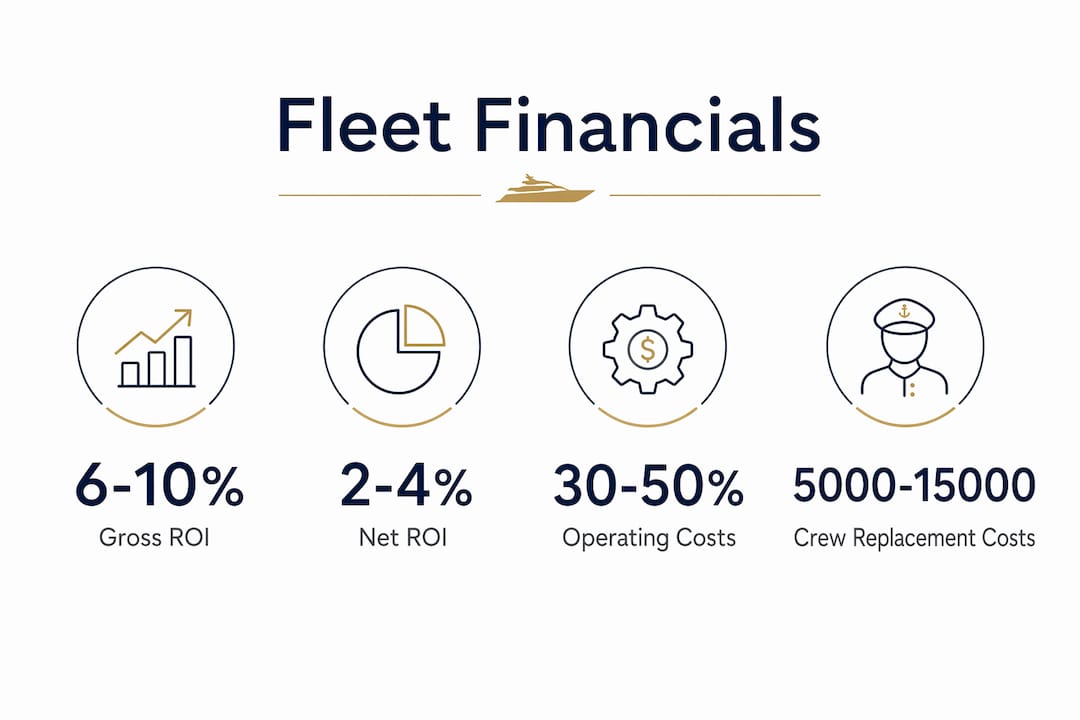
A yacht fleet investment strategy is a structured plan to acquire, operate, and manage multiple yachts as income-generating assets while preserving long-term capital value. Unlike single-vessel ownership, fleet investment requires coordinated charter operations, crew management, maintenance scheduling, and financial modeling across multiple assets simultaneously. Charter programs can yield 6–10% gross ROI annually, though net returns after expenses typically settle between 2–4%. For investors and family offices evaluating high-value maritime assets, understanding this strategy is the foundation for making sound capital allocation decisions in 2026.
What does a yacht fleet investment strategy involve?
A yacht fleet investment strategy covers four core disciplines: vessel selection, operational management, crew coordination, and charter revenue generation. Each discipline affects the others, so weakness in one area creates knock-on effects across the entire portfolio.
Vessel selection criteria
Selecting yachts for a charter fleet requires aligning vessel features with market demand, not personal preference. Vessel layout, amenities, and flag registration must match what charter clients actively book in your target market. A yacht that appeals to the owner but lacks the cabin configuration or deck space that charter guests prioritize will underperform regardless of its build quality. Age, condition, and resale liquidity also matter. Vessels under 10 years old with strong builder reputations hold value better and attract premium charter rates.

Operational management at fleet scale
Managing multiple vessels requires a centralized management layer for maintenance synchronization, crew cross-training, and spare parts inventory. This is fundamentally different from running a single yacht. A single-vessel owner can manage reactively. A fleet operator must manage proactively, because a maintenance failure on one vessel affects booking schedules across the entire fleet.
Key operational components include:
- Centralized maintenance scheduling to stagger haul-outs and prevent simultaneous downtime
- Standardized spare parts inventory shared across vessels to reduce procurement costs
- Fleet management software that centralizes vessel data, automates crew certification tracking, and delivers real-time KPI dashboards
- Professional management companies that handle day-to-day operations, charter bookings, and compliance
Pro Tip: Standardize vessel specifications across your fleet where possible. Identical or near-identical engine models and subsystems allow your maintenance team to work across vessels without retraining, cutting labor hours significantly.
Crew management and retention
Replacing a single crew member costs EUR 5,000 to EUR 15,000, making retention a direct financial priority. Fleet ownership creates a structural advantage here. Crew members can advance from smaller vessels to larger ones within the same organization, giving them a career path that single-vessel operators cannot offer. Cross-training crew across vessel types also builds operational resilience. When one vessel is out of service, trained crew can redeploy rather than sit idle.
What are the financial benefits and risks of investing in a yacht fleet?
The financial case for yacht fleet investment rests on charter revenue offsetting operating costs, not on generating pure profit. Charter income typically subsidizes ownership costs and should not be treated as passive income. Investors who enter fleet ownership expecting consistent cash flow without active management involvement consistently underperform those who treat it as an operating business.
Return and cost structure
Gross charter ROI runs 6–10% annually, but operating costs consume 30–50% of gross charter revenue. That compression is the defining financial reality of yacht fleet investment. Net returns of 2–4% are realistic for well-managed fleets in strong charter markets.
For superyacht-class assets, the numbers scale considerably. Superyachts in charter generate gross weekly income between $120,000 and $180,000 during peak seasons. Annual running costs for these vessels typically range from $3.5M to $5M, meaning charter contributions offset 20–30% of annual operating costs at best.
Fixed cost components investors must model include:
- Annual dockage fees: $12,000 to $40,000 for standard yachts in 2026
- Management fees: 15–25% of gross charter revenue
- Cleaning per charter: $150–$500 per booking
- Crew salaries, insurance, and fuel: variable but substantial
Depreciation, tax, and liquidity risks
Accelerated depreciation tax incentives help offset ownership costs but do not convert charter operations into a passive income source. Investors should model depreciation as a cost mitigation tool, not a profit driver. For a deeper breakdown of how depreciation affects asset value over time, Baranofyachts covers yacht depreciation for investors in detail.
The primary risks in fleet investment are high upfront capital requirements, maintenance complexity that scales with vessel count, and limited asset liquidity. Yachts are not liquid assets. Selling a vessel quickly at fair market value is difficult, particularly in a soft charter market. Seasonal demand variability also creates revenue gaps that fixed operating costs do not accommodate.
Superyacht investment is best understood as a lifestyle asset with portfolio diversification benefits, not a pure financial investment. Investors who frame it correctly make better decisions about capital allocation and exit timing.
How to implement an effective yacht fleet investment strategy
Building a fleet investment that performs requires deliberate sequencing. Rushing vessel acquisition before establishing operational infrastructure is the most common and costly mistake.
-
Define your geographic market first. Charter demand concentrates in specific regions: the Mediterranean, the Caribbean, and the South Pacific lead global charter volume. Your vessel selection, flag registration, and seasonal pricing must align with the demand patterns of your chosen market.
-
Build a financial model before acquiring vessels. Model gross revenue, operating costs, management fees, depreciation, and debt service at conservative occupancy assumptions. A full yacht cost breakdown for 2026 helps investors set realistic baseline figures before committing capital.
-
Engage a professional management company early. Fleet management companies bring established broker relationships, charter marketing infrastructure, and compliance expertise that individual investors cannot replicate quickly. Their management fees of 15–25% of gross revenue are offset by higher occupancy rates and lower operational errors.
-
Implement fleet management software from day one. Fleet management software centralizes vessel data, automates crew certification tracking, and provides financial reporting. Starting with manual systems and migrating later is expensive and disruptive.
-
Coordinate maintenance schedules across vessels. Staggering haul-outs prevents grounding the entire fleet simultaneously and optimizes yard usage. Bulk purchasing of consumables and spare parts across the fleet reduces per-unit costs meaningfully.
-
Build charter marketing infrastructure. Fleet owners gain marketing advantages through targeted digital advertising and referral programs, with referral rates reaching 35% among satisfied fractional owners. Broker relationships and online booking platform presence directly affect occupancy rates.
Pro Tip: Track KPIs by vessel, not just by fleet aggregate. Revenue per available charter day, maintenance cost per vessel, and crew turnover rate by vessel reveal which assets are performing and which are dragging portfolio returns.
What are modern trends shaping yacht fleet investment in 2026?
The yacht fleet investment market is shifting in ways that create both new opportunities and new competitive pressures for investors entering in 2026.
-
Family office participation is growing. Ultra-high-net-worth family offices increasingly treat yacht fleets as alternative assets within diversified portfolios, alongside art, real estate, and private equity. This raises the sophistication of capital entering the market.
-
Fractional ownership models are expanding. The yacht charter market is projected to grow at a CAGR of 5.6% from 2023 to 2028, driven by demand for fractional and hybrid ownership structures. These models reduce entry costs and spread operational burdens across multiple stakeholders.
-
Fleet management software adoption is accelerating. Centralized platforms that deliver real-time vessel status, automated compliance tracking, and financial dashboards are becoming standard practice for fleets of three or more vessels.
-
Fuel efficiency and sustainability are now selection criteria. Charter clients and flag state regulators increasingly favor vessels with lower emissions profiles. Investors selecting vessels for 2026 and beyond must factor fuel efficiency into acquisition decisions, not just charter appeal.
-
Digital marketing drives charter revenue. Online booking platforms and social media presence now directly influence occupancy rates. Fleets with professional digital marketing infrastructure outperform those relying solely on broker networks. Baranofyachts covers yacht marketing strategies for investors who want to understand how brand positioning affects charter revenue.
Key Takeaways
A yacht fleet investment strategy generates the best results when investors treat it as an operating business with active management, not as a passive income vehicle.
| Point | Details |
|---|---|
| Net ROI reality | Expect 2–4% net returns after operating costs consume 30–50% of gross charter revenue. |
| Fleet operations require infrastructure | Centralized management, fleet software, and coordinated maintenance are non-negotiable at scale. |
| Crew retention is a financial lever | Replacing one crew member costs EUR 5,000–EUR 15,000; fleet career paths reduce this cost. |
| Charter income subsidizes, not profits | Tax incentives and charter revenue offset costs but do not create passive income. |
| Vessel selection drives performance | Align layout, amenities, and flag registration with charter market demand, not owner preference. |
What I’ve learned about fleet investment that most guides won’t tell you
The most persistent misconception I encounter is that scaling from one yacht to a fleet is simply a matter of multiplying what already works. It is not. Managing a yacht fleet requires transforming organizational habits entirely: centralized standardization, coordinated maintenance, and cross-crew training are prerequisites for scaling beyond two or three vessels successfully. Investors who skip this infrastructure phase and acquire vessels quickly almost always face a crisis within 18 months.
The second thing I’ve observed is that the investors who perform best treat charter revenue as a cost offset, not a return. They build their financial models around the lifestyle value and portfolio diversification benefits of the asset, then let charter income reduce their net carrying cost. That mental framing changes every decision they make, from vessel selection to management company choice.
The third insight is less comfortable. The yacht fleet investment market rewards operational discipline more than capital size. A well-managed fleet of three mid-size vessels will consistently outperform a poorly managed fleet of six. The conductor’s eye matters more than the size of the orchestra.
— Jason
Baranofyachts and the investors who think in fleets
Investors who approach yacht fleet ownership with financial discipline and long-term vision need partners who understand both the asset and the operation.

Baranofyachts works with investors and family offices at the intersection of custom yacht design, project management, and fleet strategy. We bring the same meticulous approach to fleet asset selection that we apply to individual custom builds, ensuring that every vessel in your portfolio is specified for charter performance and long-term value retention. Our team understands the subsystems, flag registration considerations, and build specifications that separate high-performing charter assets from costly underperformers. For investors ready to think seriously about next-generation yacht design and fleet-grade asset quality, Baranofyachts is the starting point.
FAQ
What is a yacht fleet investment strategy?
A yacht fleet investment strategy is a structured plan to acquire and operate multiple yachts as assets, using charter revenue to offset operating costs while preserving long-term capital value. It requires coordinated management across vessel selection, crew operations, maintenance, and charter marketing.
What gross ROI can a charter yacht fleet generate?
Charter programs typically yield 6–10% gross ROI annually, with net returns of 2–4% after operating costs. Operating costs commonly consume 30–50% of gross charter revenue.
How does fleet ownership improve crew management?
Fleet ownership allows crew members to advance across vessels within the same organization, reducing turnover. Replacing a single crew member costs EUR 5,000 to EUR 15,000, so retention directly reduces operating costs.
What are the biggest risks in yacht fleet investment?
The primary risks are high upfront capital requirements, limited asset liquidity, maintenance complexity at scale, and seasonal demand variability that creates revenue gaps against fixed operating costs.
Is yacht fleet investment suitable for passive income?
Yacht fleet investment is not a passive income vehicle. Charter revenue subsidizes ownership costs and tax incentives help offset depreciation, but active operational management is required to sustain performance and protect asset value.
Recommended
Sold Listings


Design Your Yacht
"*" indicates required fields
Maximus III - PNW
As you step aboard MAXIMUS III, the first impression is her scale.
At 120 feet with an 8-meter beam and 294 GT of interior volume, this 2025 Crescent Custom tri-deck immediately feels open, balanced, and estate-like. A timeless look while still feeling fresh from the shipyard.
Currently Available


Get your yacht value Estimate
"*" indicates required fields