
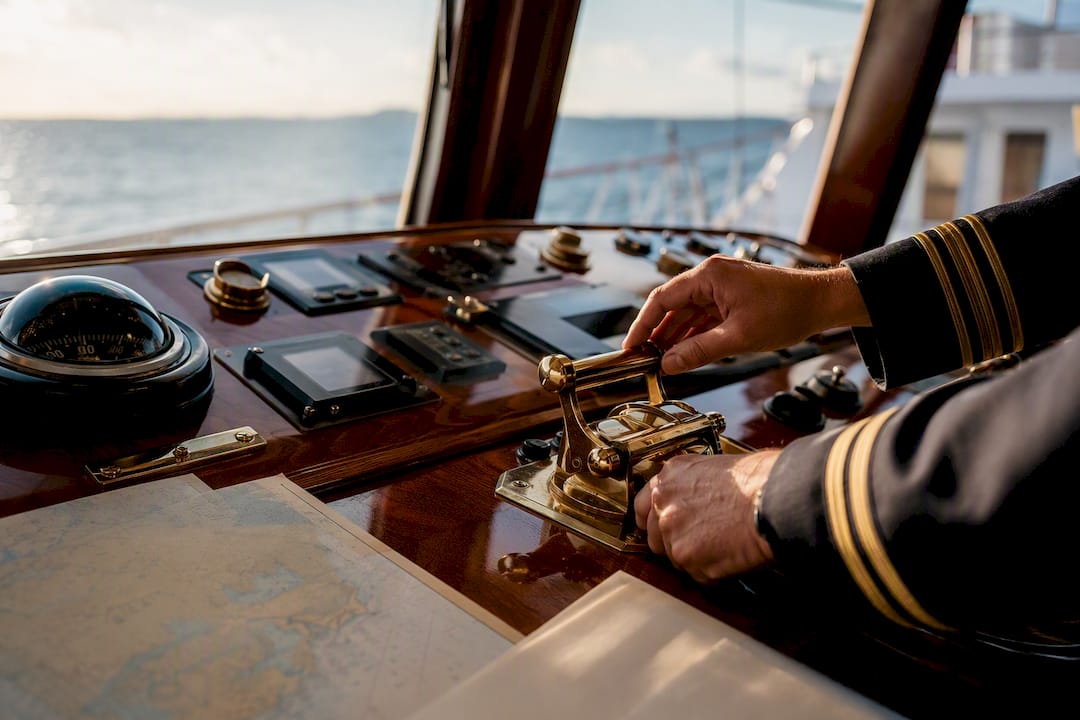
A yacht crew is organized under a captain into three core departments: bridge/deck, engineering, and interior/galley, with pursers and specialists joining the mix once a vessel grows large enough to need them. Every crew member holds baseline STCW certification, carries a valid ENG1 medical certificate (or a flag-state equivalent), and fits into a rough industry rule of thumb of one crew member per 5 meters of yacht length. This guide walks through what each department actually does, who reports to whom, and what it takes to move up the ranks. Here is what we cover:
- Core departments and why the split exists
- Role-by-role responsibilities across every common rank
- How crew size scales with yacht length and charter use
- Certifications, medicals, and documentation requirements
- Career progression, pay factors, and modern crew-management tools
Key Takeaways
Yacht crew structure follows a predictable hierarchy under the captain, with department size and complexity scaling directly with vessel length and charter use.
| Point | Details |
|---|---|
| Core departments | Bridge/deck, engineering, and interior/galley report to the captain, with pursers added on larger yachts. |
| Crew scales with length | Expect roughly one crew member per 5 meters, with charter yachts running higher interior counts. |
| Certifications are non-negotiable | STCW baseline, officer CoCs, and a valid ENG1 or flag-state medical certificate apply to every hire. |
| Career paths reward specialization | Endorsements, documented sea time, and specialty skills like tender driving accelerate promotion. |
| Structure shifts by type and season | Sailing yachts lean deck-heavy, motor yachts lean engineering-heavy, and charter staffing swells in peak season. |
| Plan crew early with Baranofyachts | Baranofyachts integrates crew sizing into new-build and refit project management from the design phase onward. |
Table of Contents
- Understanding Yacht Crew Structure: The Core Departments
- Yacht Crew Positions: Who Does What and Who Outranks Whom
- How Many Crew Does a Yacht Need?
- Certifications, Medicals, and Documentation Every Crew Member Needs
- Career Progression and Pay: What Actually Moves the Needle
- Modern Crew Management: Tools That Reduce Administrative Load
- Chain of Command: How Yacht Crews Actually Communicate
- Motor Yachts vs. Sailing Yachts: How Crew Structure Differs
- Charter Season vs. Off-Season: How Staffing Levels Shift
- Why Crew Planning Belongs in Every Build Conversation
- How Baranof Yacht Sales Helps You Get Crew Sizing Right From Day One
- Frequently Asked Questions
- Sources
Understanding Yacht Crew Structure: The Core Departments
Every yacht, from a 25-meter cruiser to a 90-meter charter vessel, splits its crew into functional departments that mirror the ship itself: how it moves, how it runs, and how it takes care of the people aboard. Understanding this framework is the fastest way to make sense of any job posting or org chart you encounter in the industry.
- Bridge/deck handles navigation, safety, exterior maintenance, and guest-facing water activities. This department reports directly to the captain and typically includes the chief officer, bosun, and deckhands.
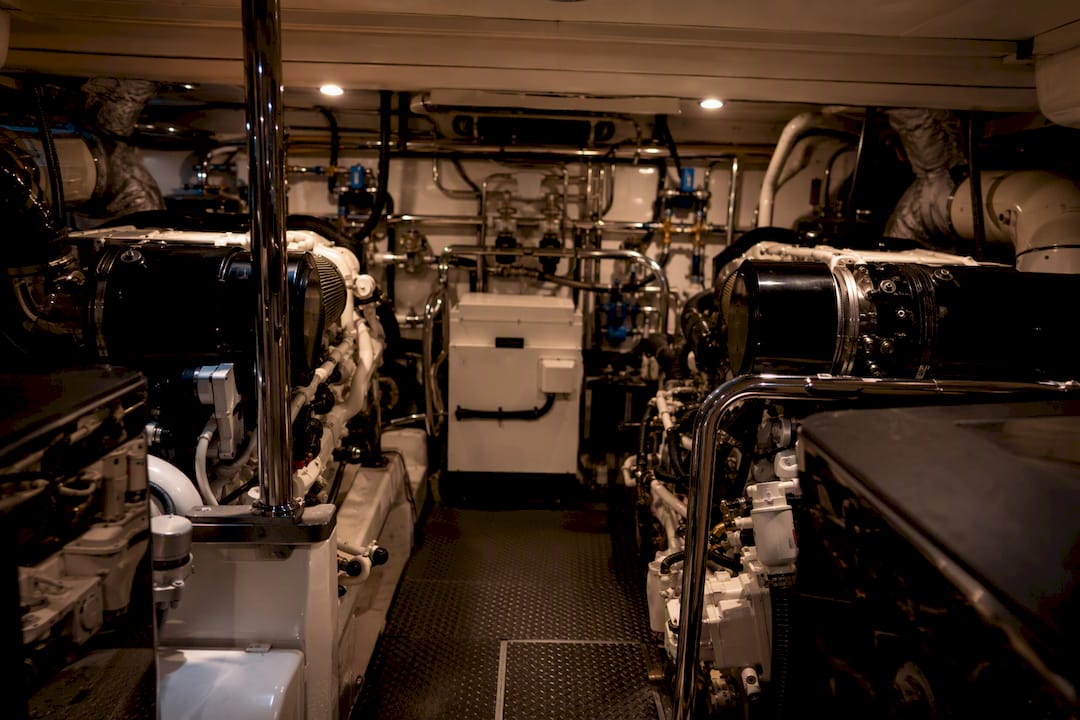
- Engineering owns every mechanical, electrical, and technical system onboard, from propulsion to air conditioning to watermakers. The chief engineer answers to the captain but operates with significant technical autonomy.
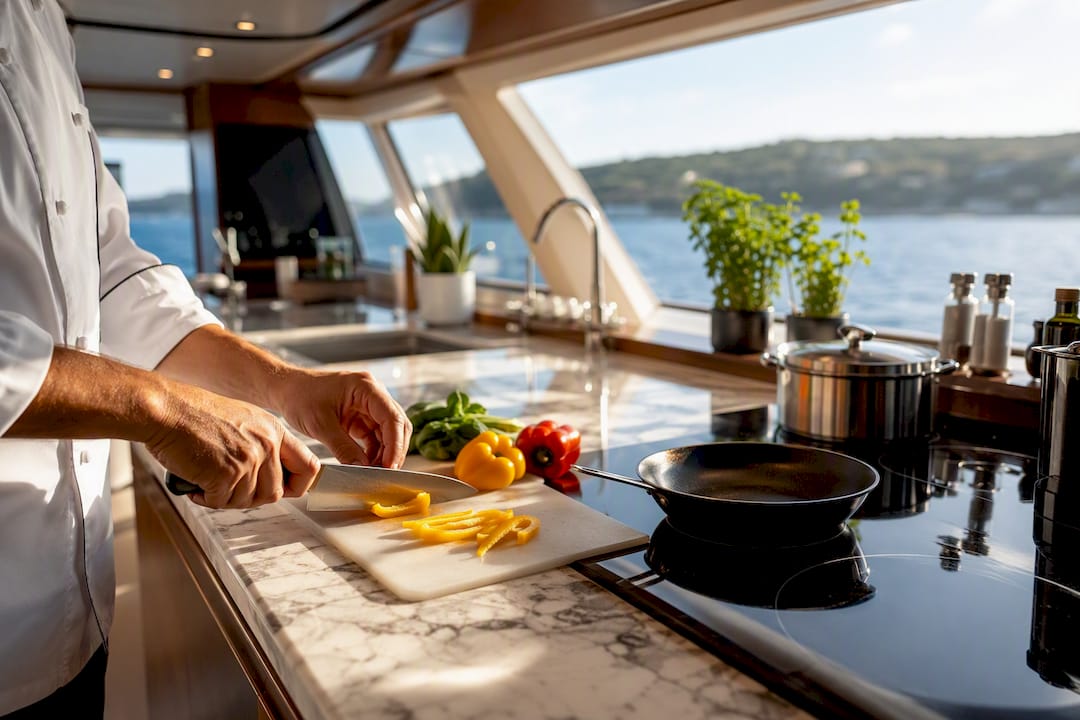
- Interior/galley covers housekeeping, food service, provisioning, and guest experience. On larger yachts, this splits further into stewardesses, a head chef running a dedicated galley team, and sometimes a dedicated laundry specialist.
- Purser/admin appears once a yacht’s finances, guest logistics, and compliance paperwork outgrow what a chief steward or captain can manage alongside their other duties.
Beyond these four, larger yachts add specialist roles that do not fit neatly into any single department. Wellness officers, dive instructors, and dedicated tender/watersports crew often report jointly to the chief officer for safety matters and to the chief steward for guest scheduling. The Complete Guide To Yacht Crew Roles & Responsibilities confirms this departmental split holds consistently across industry guides, which makes it a reliable framework for evaluating any yacht’s staffing regardless of size.
Yacht Crew Positions: Who Does What and Who Outranks Whom
The captain sits at the top of every yacht crew hierarchy, holding final authority over safety, compliance, and owner relations, plus the ultimate call on any operational decision. Everything below that role branches into three chains of command that rarely cross except at the top.
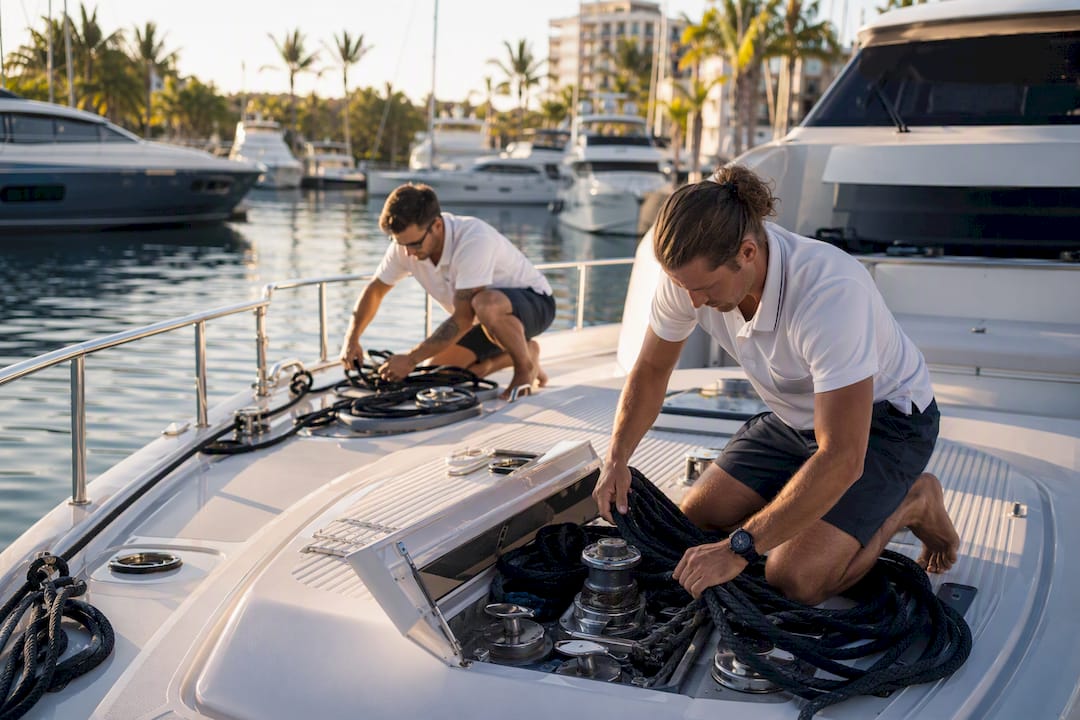
On the deck side, the chief officer (sometimes called first mate) runs day-to-day deck operations, watchkeeping schedules, safety drills, and guest exterior activities like water toys and tender runs. Below the chief officer, the bosun supervises maintenance and the deckhand team; smaller yachts under roughly 40 meters often skip this rank entirely and have deckhands report straight to the chief officer. Deckhands handle exterior upkeep, line handling, tender operations, and general maintenance, and this is where nearly every deck career starts.
Engineering runs on a similar ladder. The chief engineer owns every technical system and carries the certification to prove it, supported by a second or third engineer on larger yachts where watch rotations demand more coverage. The Electro-Technical Officer (ETO) typically shows up once a yacht passes the 50-meter mark, because that is when AV, navigation electronics, and automation systems get complex enough to justify a dedicated specialist, according to Moonen’s crew guide.
Interior follows guest-facing logic rather than technical logic. A chief stewardess (sometimes titled purser on yachts that combine the roles) manages service standards, inventory, and the stewardess team. Stewardesses handle cabin service, table service, and guest requests. The head chef runs the galley independently, reporting to the captain on provisioning budgets but rarely taking direction from the chief stewardess on culinary matters.
Smaller yachts merge roles constantly. A 30-meter private yacht might combine chief officer and captain duties, or have one steward handling service and light housekeeping alone. YACREW’s industry compendium notes this merging is standard practice below a certain size threshold, not a sign of an understaffed vessel.
Pro Tip: When evaluating a job listing, check whether the title matches the yacht’s size. A “chief steward/purser” title on a 35-meter yacht usually means one person is doing two jobs, which is normal. The same title on an 80-meter yacht usually means two distinct roles with separate reporting lines.
How Many Crew Does a Yacht Need?
Crew size scales predictably with length, though charter yachts break the pattern in one consistent direction. The industry’s working rule of thumb puts crew count at roughly one crew member per 5 meters of yacht length, with sailing yachts often running slightly leaner than motor yachts of the same size because they carry less hotel-style infrastructure.
Sample complements by size band:
- Under 30 meters: 3 to 6 crew, often with merged roles (captain doubling as chief officer, one steward covering all interior service)
- 30 to 50 meters: 6 to 12 crew, with distinct department heads but shallow benches in each department
- 50 meters and above: 12 to 25+ crew, with full departmental depth including ETOs, pursers, and specialist roles
Charter operations consistently push interior staffing higher than private yachts of the same length need. Guests on a charter week expect turndown service, multi-course dining, and rapid response to requests that a private owner’s smaller circle might not demand daily. That staffing bump carries knock-on effects for provisioning, laundry cycles, and service scheduling that ripple through the whole interior department, not just the headcount.
Certifications, Medicals, and Documentation Every Crew Member Needs
Every crew member, regardless of department or rank, starts with STCW (Standards of Training, Certification and Watchkeeping) basic safety training. This baseline covers firefighting, sea survival, first aid, and personal safety, and no reputable yacht will hire without it.
From there, requirements branch by role:
- Officers need a Certificate of Competency (CoC) scaled to the yacht’s tonnage and their intended rank, issued through a flag administration’s approved training pathway.
- Engineers need role-specific engineering certificates tied to the horsepower and complexity of the vessel’s systems, not a generic engineering credential.
- All crew need a valid medical certificate, typically an ENG1 (the UK Maritime and Coastguard Agency’s standard) or an equivalent recognized by the yacht’s flag state, renewed on a routine schedule, usually every one to two years depending on age and role.
STCW training is a universal regulatory baseline across virtually every hiring guide in the industry, which makes it the first line item any captain checks on a resume. Keep every certificate, endorsement, and sea-service letter organized in one place. Flag administrations publish their exact requirements directly, and verifying against the primary source beats trusting a recruiter’s summary. Our crew training workflow guide walks through documentation practices for new-build crews in more depth.
Career Progression and Pay: What Actually Moves the Needle
Deck careers typically run deckhand to bosun (on larger yachts) to third officer, second officer, chief officer, and eventually captain, with each rung requiring both sea time and the next-tier CoC. Engineering follows a parallel ladder from junior engineer to third, second, and chief engineer, gated almost entirely by certificate level and documented hours on comparable horsepower systems. Interior careers move from junior steward/stewardess to senior stewardess to chief stewardess or purser, with promotion driven more by service reputation and organizational skill than by formal exams.
A few things accelerate that climb faster than time alone:
- Higher-tier endorsements completed ahead of schedule, rather than the minimum required for your current rank
- Documented sea time on yachts comparable in size to where you want to work next
- Specialty skills like tender driving certifications, dive instructor credentials, or formal culinary training, which reduce the total complement a captain needs to hire because one crew member covers two functions
Pay varies enormously by yacht size, charter versus private status, seasonality, and nationality, and any number quoted without those variables attached should be treated skeptically. Charter yachts generally pay better once gratuities are factored in, but private yachts often offer more schedule stability and longer-term contracts. Benefits packages, tip pooling policies, and whether a yacht covers flights home vary yacht to yacht and are worth negotiating explicitly rather than assuming. Our yacht careers guide breaks down training pathways and hiring trends in more detail for readers mapping out a longer-term plan.
Modern Crew Management: Tools That Reduce Administrative Load
Crew management has moved well past spreadsheets and paper logbooks. Platforms built specifically for yacht operations now combine multi-tab crew profiles, certification expiry alerts, onboarding checklists, charter-ready assignment workflows, and hours-of-rest logging into a single system.
That last feature matters more than it sounds. MLC 2006 work and rest hour rules are notoriously easy to violate by accident on a busy charter itinerary, and automated tracking has started replacing manual logs specifically to close that compliance gap.
Crew-management software is shifting a captain’s administrative load onto automated workflows and alerts, freeing up time for safety oversight and guest-focused leadership rather than paperwork.
Tools like YOT’s crew app go further, pairing a document wallet with renewal reminders and an AI assistant for quick regulatory lookups at sea. Before adopting any platform, ask a few practical questions: Does it work offline or with poor connectivity at sea? Does it support multiple vessels under one fleet account? How is crew personal data stored and protected?
Chain of Command: How Yacht Crews Actually Communicate
Yacht crews run on a structure borrowed directly from merchant marine tradition, and it works the same way on a 35-meter charter yacht as it does on a container ship. The captain holds final authority on everything, but day-to-day communication flows through department heads first, not straight to the top. Industry compendia describe this as a military-like chain of command with clearly defined reporting lines, and that structure exists for a practical reason: it keeps decisions moving fast during safety events and keeps guest requests from bottlenecking at the captain’s cabin.
A deckhand with a maintenance issue reports to the bosun or chief officer, not the captain directly. A stewardess handling a guest complaint escalates to the chief stewardess first. An engineer flags a mechanical concern to the chief engineer, who then briefs the captain if it affects safety or itinerary. This layered approach protects the captain’s time for the decisions that actually need that level of authority.
Formal communication tools reinforce the structure. Morning department head meetings, radio protocols for deck and bridge operations, and standardized handover logs between watches all keep information moving predictably. Smaller yachts compress this naturally, since a 5 person crew has fewer layers to pass information through, but even a compact crew tends to preserve the basic principle: problems go up through a direct supervisor before they reach the captain, and instructions come down the same path in reverse. Guests rarely see this structure directly, but it is the reason a well-run yacht feels effortless from the owner’s chair while running a tightly coordinated operation below deck.
Motor Yachts vs. Sailing Yachts: How Crew Structure Differs
Crew structure follows the same departmental logic across motor and sailing yachts, but the balance of people within each department shifts noticeably. Motor yachts lean heavier on engineering and interior staff relative to their length, because generators, stabilizers, air conditioning, and complex hotel systems demand more technical attention than a sailing yacht’s simpler mechanical footprint.
Sailing yachts, by contrast, put more weight on deck department headcount relative to overall crew size. Sail handling, rigging maintenance, and sail changes require hands on deck in a way that motor yachts, running primarily on engines, do not. A sailing yacht captain also typically holds deeper hands-on sailing experience than a motor yacht captain, since active sail trim and tactical decisions during passage require it in a way that steering a motor yacht does not.
Engineering aboard a sailing yacht is usually leaner. A large sailing yacht might carry a single engineer covering generators, watermakers, and basic mechanical systems, where a motor yacht of the same length would justify a chief engineer plus a second engineer working watch rotations. The trade-off shows up in deck department size instead, where a sailing yacht carries more deckhands relative to its length to handle sail evolutions.
Interior structure stays fairly consistent between the two types, since guest service expectations do not change much based on propulsion method. The one exception is smaller sailing yachts under about 25 meters, where interior roles merge more aggressively than on a motor yacht of comparable length, simply because the deck demands on a sailing crew leave less room for a large interior team. Anyone comparing job postings across both yacht types should read complement numbers with propulsion type in mind, not just overall length.
Charter Season vs. Off-Season: How Staffing Levels Shift
Crew structure is not static across the calendar year, and this is one of the more practical realities that job seekers underestimate when comparing offers. Charter yachts staff up meaningfully for the busy season, typically running from late spring through early fall in the Mediterranean and winter months in the Caribbean, then scale back or shift contracts once bookings thin out.
During peak charter season, interior departments in particular run at full strength or beyond it, sometimes bringing on temporary “day workers” or freelance stewardesses and deckhands to cover back-to-back charters with no downtime between guest turnovers. These short-term hires typically work on rolling day-rate contracts rather than the standard permanent crew agreements that year-round crew sign, and they rarely carry the same benefits or job security.
Off-season staffing looks different depending on whether the yacht is a private vessel or dedicated charter boat. Private yachts often keep a stable core crew year-round regardless of season, since the owner’s use pattern does not follow the charter calendar. Charter yachts, by contrast, frequently reduce interior headcount once the season ends, retaining a skeleton crew, usually captain, chief engineer, and one or two others, to handle maintenance, winterization, or a shipyard period.
This seasonal rhythm affects career planning directly. Crew chasing fast advancement often prefer charter yachts specifically because the compressed, high-intensity season generates sea time and reference letters faster than a slower-paced private yacht schedule. Others prioritize the stability of a private yacht contract precisely to avoid the seasonal contract uncertainty that charter crew accept as part of the trade-off. Neither path is objectively better, but understanding which one you are signing up for before accepting a position saves considerable frustration down the line.
Why Crew Planning Belongs in Every Build Conversation
Crew structure decisions get made too late in most new-build and refit projects, usually after layout and systems are already locked in. We have seen how much smoother a delivery goes when crew cabin count, engineering complexity, and interior workflow get planned alongside the naval architecture rather than bolted on afterward. If you are weighing a purchase or refit, it is worth raising crew sizing with your project team early, alongside layout and systems decisions.
How Baranof Yacht Sales Helps You Get Crew Sizing Right From Day One
Getting crew structure right after a yacht is already built means retrofitting cabins, reworking galley workflows, or discovering too late that the engine room layout leaves no clearance for a second engineer’s watch station. Baranofyachts builds crew planning into the project management process from the earliest design conversations, so cabin counts, interior workflow, and technical systems match the complement you actually intend to run, whether that is a lean private crew or a full charter-ready team.

Our team works alongside naval architects and shipyards to make sure crew logistics, from ETO workstations to provisioning storage, get resolved before steel is cut or a refit begins, not after. If you are planning a new build or considering a refit and want crew composition addressed as part of the design process, explore how our project management approach shapes better outcomes, or reach out to discuss your specific build through our current design work.
Frequently Asked Questions
What is the standard yacht crew hierarchy?
The captain sits at the top, with three department heads reporting directly: the chief officer (deck), chief engineer (engineering), and chief stewardess or purser (interior). Each department head supervises their own team, and communication generally flows up through this chain rather than directly to the captain.
How many crew members does a yacht typically need?
A common estimate is one crew member per 5 meters of yacht length, though sailing yachts often run leaner and charter yachts typically carry more interior staff than private yachts of similar size.
Do all yacht crew need STCW certification?
Yes. STCW basic safety training is the universal baseline for every crew member regardless of department, with officers and engineers requiring additional role-specific certificates and Certificates of Competency on top of it.
What is an ENG1 medical certificate?
It is a seafarer medical fitness certificate issued under UK Maritime and Coastguard Agency standards, and it is one of the most widely accepted medical credentials in yachting. Many flag states accept equivalent medical certificates, so it is worth confirming which standard your target yacht’s flag state requires.
When does a yacht need a purser?
Pursers typically appear once a yacht’s administrative workload, guest logistics, and financial management exceed what a chief stewardess or captain can reasonably handle alongside their primary duties, usually on yachts in the 50-meter-plus range or on busy charter operations.
Is crew structure different on sailing yachts compared to motor yachts?
Yes. Sailing yachts generally carry more deckhands relative to length to manage sail handling, while motor yachts lean heavier on engineering and interior staff to support their more complex mechanical and hotel systems.
Sources
- Yacht Crew Management: Hiring, Training & Retention Guide — Yachtpedia
- Seaventis — Crew management features
Recommended
Sold Listings


Design Your Yacht
"*" indicates required fields
Maximus III - PNW
As you step aboard MAXIMUS III, the first impression is her scale.
At 120 feet with an 8-meter beam and 294 GT of interior volume, this 2025 Crescent Custom tri-deck immediately feels open, balanced, and estate-like. A timeless look while still feeling fresh from the shipyard.
Currently Available


Get your yacht value Estimate
"*" indicates required fields