

There is a persistent assumption in the luxury maritime world that steel hulls and teak decks are the immovable pillars of quality. That assumption is increasingly worth questioning. The reality of modern yacht construction is far more nuanced, with sustainability pressures, performance engineering, and evolving client expectations reshaping what “best-in-class” actually means. Whether you’re commissioning your first custom build or adding to a growing fleet, understanding the full spectrum of available materials gives you a decisive advantage. This guide cuts through the noise, laying out the real trade-offs so you can make choices that serve your vision today and hold their value long into the future.
Table of Contents
- Core yacht building materials: An overview
- Hull materials: Strength, sustainability, and performance compared
- Decking evolution: From teak prestige to advanced synthetics
- Material innovations and client priorities: Making the right choice
- Our perspective: Rethinking material prestige for today’s luxury yachts
- Commission your next yacht with the right materials
- Frequently asked questions
Key Takeaways
| Point | Details |
|---|---|
| Material selection is strategic | The right blend of metals, composites, and woods delivers both luxury and long-term value. |
| Sustainability influences choices | Bio-based and synthetic materials are reshaping both environmental impact and cost of ownership. |
| Prestige and practicality can align | Modern synthetics often outperform traditional options like teak in durability and sustainability. |
| Custom builds require expert input | Collaborating with seasoned professionals ensures your yacht reflects your style and priorities without material pitfalls. |
Core yacht building materials: An overview
Having set the stage for why materials matter so much, let’s break down today’s core categories and what each brings to a luxury yacht.
Yacht construction draws from three primary material families: metals, composites, and natural or engineered woods. Each family plays a distinct role, and modern builds often blend all three to achieve the performance, aesthetic, and regulatory profile a client requires. The days of a single-material approach are largely behind us. What you see in leading shipyards today is a sophisticated orchestration of materials, each chosen with surgical precision for its specific application.
Metals remain the backbone of large-displacement yacht construction. Aluminum and steel dominate this category, with each suited to different vessel sizes and use cases. Steel is the workhorse for ocean-crossing superyachts above 40 meters, prized for its structural integrity and resistance to catastrophic damage. Aluminum, on the other hand, is the preferred choice for performance-oriented builds where weight savings translate directly into speed, fuel efficiency, and range.
Composites have transformed the industry over the past three decades. Fiberglass (formally glass-reinforced plastic, or GRP) is the standard for production and semi-custom yachts under 40 meters. Carbon fiber takes this further, offering exceptional stiffness and strength-to-weight ratios at a premium price point. More recently, bio-based composites, using natural fibers and plant-derived resins, are entering serious consideration for clients who prioritize environmental credentials alongside performance. As industry trends in yacht materials continue to evolve, bio-composites are moving from experimental to credible.
Wood and engineered alternatives sit at the intersection of tradition and innovation. Classic teak endures as a prestige material, particularly for decking. Maritime pine, treated with modern methods, is re-emerging as a structurally sound and environmentally favorable option for hulls and interior applications. The critical distinction here is that “wood” no longer means what it did in the 1970s. Today’s engineered timbers and hybrid wooden structures are far removed from the maintenance-heavy originals.
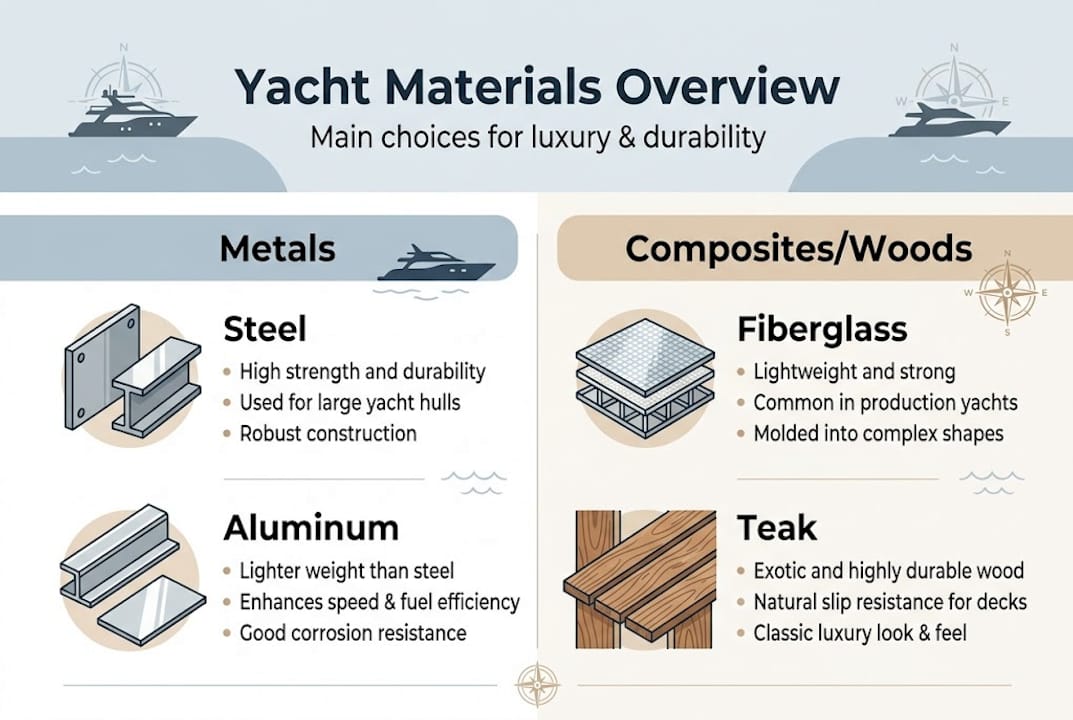
To orient your thinking, here’s a summary of the core material categories and their primary applications:
| Material | Primary use | Key strength | Key consideration |
|---|---|---|---|
| Steel | Hull (large vessels) | Structural robustness | Weight, anti-corrosion treatment |
| Aluminum | Hull, superstructure | Lightweight, customizable | Galvanic corrosion risk |
| Fiberglass (GRP) | Hull, deck | Cost-effective, versatile | Mid-range environmental impact |
| Carbon fiber | Hull, spars, structures | Strength-to-weight ratio | Low impact resistance, cost |
| Bio-composites | Hull, panels | Low environmental impact | Emerging, limited track record |
| Teak | Decking, interior | Prestige, natural feel | Supply constraints, maintenance |
| Maritime pine | Hull, interior | Sustainable, low GWP | Requires modern treatment |
Metals offer robustness and longevity in harsh marine conditions, while composites provide efficiency and customization, and that distinction drives almost every material conversation we have with clients during the early design phase. Knowing where each category excels allows you to build a specification that doesn’t compromise unnecessarily in any direction.
Hull materials: Strength, sustainability, and performance compared
With the categories introduced, it’s crucial to understand how these material choices play out where it matters most: the hull.
The hull is your yacht’s primary defense against the sea, and its material determines not just structural performance but also running costs, environmental footprint, and long-term maintenance demands. Getting this decision right at the outset is one of the most consequential choices you’ll make in the commissioning process.
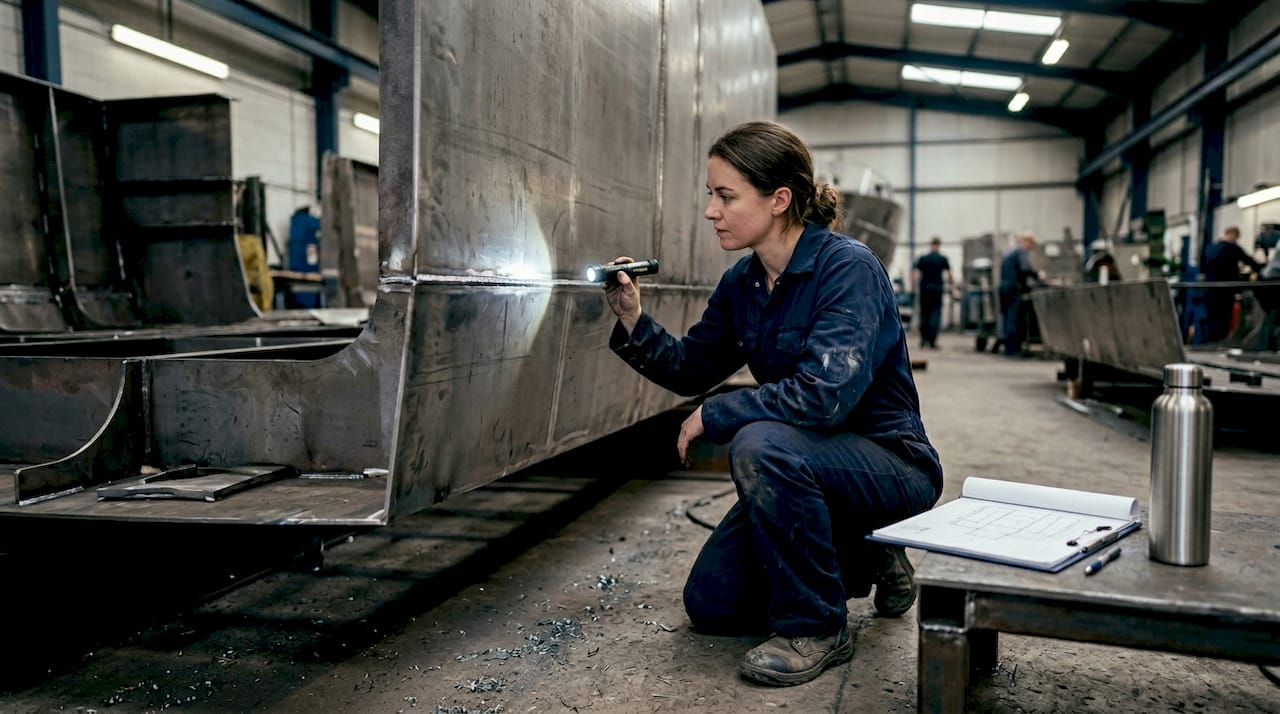
Steel remains the standard for large superyachts because it absorbs impact exceptionally well and is straightforward to repair in almost any port in the world. The trade-off is significant weight, which affects fuel consumption and speed. Steel also requires robust anti-corrosion systems, including sacrificial anodes, coatings, and cathodic protection. Neglecting these systems creates costly problems that compound over time.
Aluminum delivers a striking weight advantage, often 15 to 20 percent lighter than steel for comparable structural integrity. That weight savings directly improves performance metrics across every voyage. However, aluminum is sensitive to galvanic corrosion when it comes into contact with dissimilar metals in a saltwater environment. Proper electrical isolation of all underwater fittings is non-negotiable. When this is done correctly, as it should be on any properly managed build, the maintenance and reliability trade-offs are very manageable.
Composite hulls occupy a wide range of performance profiles. Standard GRP is well understood, predictable, and cost-effective for mid-range luxury yachts. Carbon fiber takes performance to its ceiling, with racing pedigree translating into genuinely breathtaking speed and efficiency. The limitation of carbon is its relatively low impact resistance compared to metals. A grounding event that a steel hull would shrug off can cause serious structural damage to carbon fiber, which requires specialist repair facilities.
The frontier of hull materials is bio-based composites, and the data here is genuinely striking. Flax/bio-epoxy hulls reduce greenhouse warming potential by 14%, human toxicity potential by 13%, and resource depletion by 75% versus glass/polyester composite hulls. Maritime pine hulls show a lower overall environmental impact than either aluminum or typical composites. These are not marginal differences. For clients who face increasing regulatory scrutiny in European ports or who simply want their vessel to reflect their environmental values, these figures deserve serious weight in the decision.
Statistic callout: A 75% reduction in resource depletion for bio-based composite hulls versus conventional GRP is not a future projection. It reflects current, peer-reviewed lifecycle analysis. This is reshaping how forward-thinking clients approach hull specification.
Pro Tip: Request a lifecycle assessment (LCA) for any hull material your designer proposes. LCAs quantify environmental impact across the vessel’s full lifespan, including manufacture, maintenance, and end-of-life disposal, giving you a transparent comparison that marketing language cannot replicate.
Decking evolution: From teak prestige to advanced synthetics
While hulls carry the structure, a yacht’s deck is where luxury and practicality most visibly meet. Let’s explore how these surfaces are evolving.
Teak has defined the luxury deck experience for generations. Its warm amber tones, natural grip underfoot, and resistance to moisture, sun, and saltwater made it functionally ideal and aesthetically irreplaceable. That story is now complicated by two converging pressures: the depletion of sustainable teak forests and the emergence of synthetic alternatives that match or exceed teak’s performance in several key metrics.
Deck materials have traditionally relied on teak for its durability, non-slip properties, and resistance to moisture and saltwater. However, sustainability concerns are driving a significant shift toward synthetic alternatives. Flexiteek, a PVC-based synthetic, offers low maintenance, recyclability at end of life, and a service life of 15 to 20 years compared to teak’s 8 to 12 years. That near-doubling of service life alone represents substantial value over the ownership period, particularly for clients who use their vessels intensively.
The practical considerations for decking extend well beyond material composition:
- Grip performance: Both teak and quality synthetics perform well when wet, but surface texture and seam design matter significantly for safety.
- Heat retention: Teak stays cooler underfoot in direct sun than many synthetic alternatives, a genuine comfort factor in tropical cruising.
- Aesthetic range: Synthetics now offer color and grain variations that teak cannot, opening design possibilities that align with contemporary interior styling.
- Maintenance burden: Teak requires regular oiling, sanding, and caulk replacement. Quality synthetics need little more than routine washing.
- Repairability: Teak is easily spot-repaired by a skilled craftsman. Synthetics vary in repairability depending on product and installation method.
“The conversation around decking has matured significantly. Clients today are asking not just ‘how does it look?’ but ‘what does it cost over ten years, and can I recycle it when the vessel is eventually refitted?’ Those are the right questions.” — Superyacht industry commentary, 2026
The demand for teak refits on superyachts over 60 meters remains high, which keeps supply pressure elevated and prices firm. For new builds, however, exploring custom decking preferences with an open mind allows you to match surface performance precisely to how and where you intend to use the vessel.
Pro Tip: If teak is important to your identity as an owner, consider a hybrid approach: retain teak in the most visible social areas (cockpit, sun deck) and specify synthetic alternatives for working decks and areas with high foot traffic. This approach reduces maintenance significantly while preserving the aesthetic statement where it matters most.
Material innovations and client priorities: Making the right choice
With evolving choices, how do you match materials to your project’s goals and values?
The most successful custom builds we have guided share one common trait: the client arrived with clear priorities, then engaged genuinely with how those priorities translated into material specifications. The process is not simply about selecting from a catalog. It is a structured conversation about performance, identity, longevity, and value.
Here is a practical framework for approaching material decisions during commissioning:
- Define your performance envelope. Where will the vessel cruise? How fast do you need to travel, and over what range? A long-range explorer yacht crossing the Pacific has fundamentally different hull requirements than a Mediterranean day boat designed for style and comfort.
- Establish your environmental position. Are green credentials important to you personally, or will the vessel operate in jurisdictions where environmental regulations are tightening? Either answer shapes which materials become relevant.
- Assess your maintenance appetite. Be honest about how the vessel will be staffed and managed. Beautiful materials require consistent care. If the vessel will spend extended periods without a full-time crew, durability and low-maintenance profiles should weigh heavily.
- Consider resale and legacy. Craftsmanship evaluation tips consistently point to material quality as a primary factor in resale value. Durable, premium materials with transparent provenance hold their value better than cost-cutting choices that look comparable at delivery but degrade faster.
- Engage your designer in a transparent material dialogue. Hybrid and bio-based options are gaining traction for both performance and environmental reasons. A designer who dismisses these without analysis is not serving your interests fully.
Metals offer robustness and longevity while composites deliver efficiency and customization, and the traditional prestige of teak finds its counterpart in the practicality and sustainability of synthetics. The best builds we see are those that treat these not as competing ideologies but as a toolkit, with each material selected for the role it performs best.
Exploring current customization trends reveals that clients are increasingly comfortable specifying unconventional combinations: carbon fiber hulls with reclaimed wood interiors, or aluminum superstructures paired with bio-composite deck panels. These combinations reflect genuine sophistication, not compromise.
Our perspective: Rethinking material prestige for today’s luxury yachts
The conventional assumption in luxury maritime circles has long been that certain materials carry inherent prestige, and that prestige translates directly to quality. We think this framework is overdue for revision.
Teak is beautiful. Steel is strong. Carbon fiber is fast. None of these facts are in dispute. What we have observed, through years of guiding clients through custom builds, is that the truly standout vessels are not those built from the most prestigious materials. They are built from the most appropriate materials, chosen with full knowledge of their properties and with complete transparency about the trade-offs involved.
Advances in synthetics and bio-composites are rewriting what distinction looks like. A client who specifies a bio-epoxy hull because they understand its 75% reduction in resource depletion has made a choice that is more sophisticated, not less luxurious, than defaulting to convention. The vessel reflects genuine knowledge, not just purchasing power.
The clients who participate most deeply in material discussions end up with yachts that perform better and last longer. They also tend to find the ownership experience more satisfying, because they understand what they have. Our experience strongly suggests that transparency in material selection is itself a form of luxury. Understanding this is also central to expert resale strategies that protect your asset over the long term.
Commission your next yacht with the right materials
If you’re ready to turn insight into action, our team stands ready to guide your next-level project.
At Baranof Yachts, we bring the kind of material expertise that prevents costly missteps before they happen. Every build we manage involves a rigorous material selection process, matched precisely to your cruising profile, lifestyle expectations, and long-term ownership goals. We work with a trusted network of naval architects and shipyards who share our commitment to precision and transparency.

Whether you want to explore a custom yacht consultation or are ready to start your yacht design in earnest, our team is positioned to translate your priorities into a specification that delivers on every front. You can also explore bespoke options that reflect the full range of what modern custom builds can achieve. Your vision deserves materials that match it.
Frequently asked questions
What is the most sustainable material for luxury yacht hulls?
Bio-based composites like flax/bio-epoxy and maritime pine are currently the most sustainable hull options. Flax/bio-epoxy hulls reduce resource depletion by up to 75% compared to conventional fiberglass, making them a credible choice for environmentally conscious clients.
Why is teak decking being replaced on luxury yachts?
Teak is increasingly replaced due to sustainability concerns around forest depletion and the rise of advanced synthetic alternatives. Synthetic alternatives like Flexiteek last 15 to 20 years, nearly double teak’s 8 to 12 year lifespan, and are fully recyclable at end of life.
What are the tradeoffs between aluminum and composites for yacht hulls?
Aluminum offers excellent strength, global repairability, and structural flexibility, but requires careful electrical isolation to prevent galvanic corrosion. Composites are lighter and highly customizable, but certain types like carbon fiber can have low impact resistance that makes damage repair more complex and location-dependent.
How do material choices influence yacht resale value?
Materials directly affect both the perceived luxury of a vessel and its long-term maintenance profile, both of which drive resale prices. Premium, durable, and sustainable materials with documented provenance consistently attract stronger valuations at resale compared to cost-driven substitutions that may show wear or obsolescence sooner.
Recommended
Sold Listings


Design Your Yacht
"*" indicates required fields
Maximus III - PNW
As you step aboard MAXIMUS III, the first impression is her scale.
At 120 feet with an 8-meter beam and 294 GT of interior volume, this 2025 Crescent Custom tri-deck immediately feels open, balanced, and estate-like. A timeless look while still feeling fresh from the shipyard.
Currently Available


Get your yacht value Estimate
"*" indicates required fields