
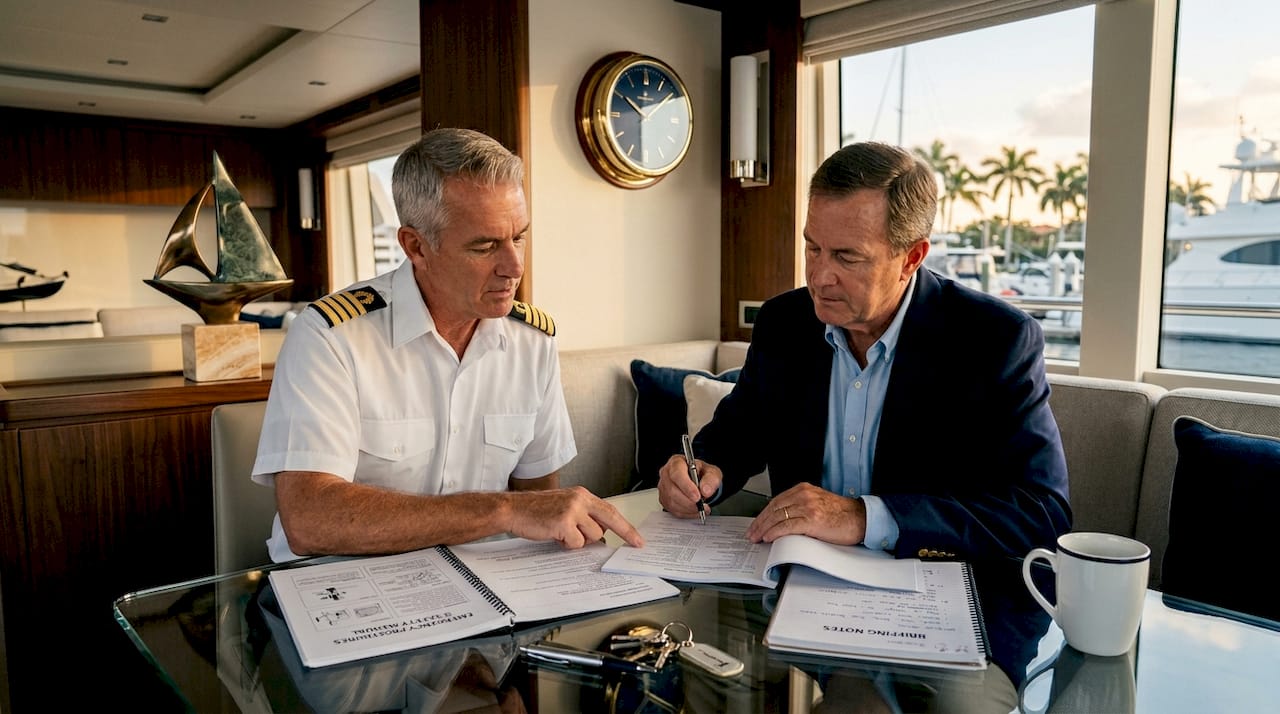
A yacht owner briefing is a structured communication session that aligns owners, captains, and crew on safety protocols, operational responsibilities, and vessel-specific procedures before any voyage, charter, or handover. Knowing how to organize yacht owner briefings is the difference between a crew that operates with precision and one that improvises under pressure. In the luxury yacht sector, where vessels carry significant financial and personal value, a poorly structured briefing creates gaps in accountability that compound quickly. The industry standard for these sessions draws from frameworks like the Yacht Safety Management System (YSMS), formal refit handover protocols, and charter preference documentation. Each approach shares one principle: documented, role-specific communication prevents costly misunderstandings.
How to organize yacht owner briefings: core components and frameworks
A well-organized owner briefing covers five non-negotiable themes, regardless of vessel size or operational context. Safety briefing content includes emergency gear locations, radio operations, GPS reading, flare and fire equipment use, man-overboard drills, anchoring procedures, onboard hazards, and first-aid welfare. These are not optional additions. They are the structural backbone of every briefing, and skipping any one of them creates a measurable gap in crew preparedness.
The YSMS approach takes this further by customizing waterproof checklists to each yacht’s specific systems, then requiring two-person verification for every item ticked. Two-person verification is not bureaucratic caution. It is the single most effective method for catching the kind of small oversights that escalate into serious incidents at sea.
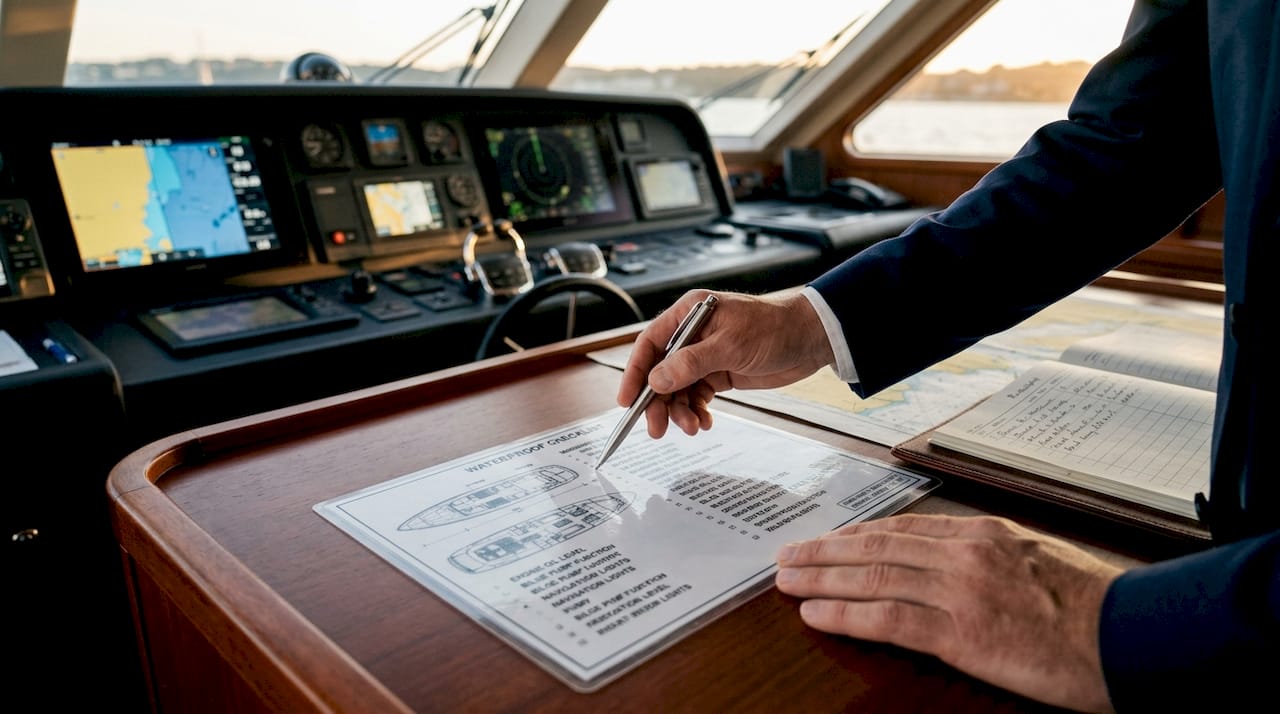
Aligning your briefing content directly with onboard logs and checklists embeds procedural accountability into daily operations. When crew members know that briefing points are tied to departure logs, weekly safety checks, and monthly reviews, the briefing stops being a one-time event and becomes the foundation of ongoing operational culture.
Key components to include in every structured briefing:
- Safety equipment: Life raft location, EPIRB activation, fire suppression systems, and personal flotation device stowage
- Communication protocols: VHF channel assignments, satellite phone procedures, and escalation hierarchy from crew to captain to owner
- Emergency procedures: Man-overboard recovery steps, medical emergency contacts, and nearest port of refuge
- Operational hazards: Vessel-specific clearance restrictions, fuel system quirks, and tender launch procedures
- Crew welfare: Watch schedules, rest hour compliance under MLC 2006, and onboard medical supplies
Pro Tip: Adapt your briefing framework to the yacht’s specific subsystems before every session. A vessel with a custom stabilizer system or a hybrid propulsion setup requires briefing points that a generic template will miss entirely.
How to prepare briefings for different operational scenarios
Charter briefings, refit handovers, and routine operational briefings each serve a distinct purpose, and treating them as interchangeable is one of the most common mistakes we see in yacht management.
A charter pre-trip briefing focuses on guest experience and safety. Charter preference sheets submitted at least two weeks before embarkation give the captain and crew precise information about guest dietary needs, celebrations, physical limitations, and emergency contacts. This data directly shapes the briefing agenda, allowing the crew to address specific guest scenarios rather than delivering a generic safety talk.
A refit handover briefing operates on an entirely different axis. Refit briefs convert owner intent into a defined yard plan by answering six core questions: what are the goals, what work packages are included or excluded, what inspections are required, who holds approval authority, what is the delivery date, and who signs off. Without answers to all six, the briefing produces ambiguity rather than clarity.
Routine operational briefings sit between these two extremes. They are typically shorter, crew-focused, and tied to seasonal transitions or crew changes. The participants, timing, and documentation requirements differ by scenario:
- Charter pre-trip brief: Held 24 to 48 hours before embarkation, involving captain, chief steward, and chef. Documentation includes the completed preference sheet and a signed safety acknowledgment from the charter party.
- Refit handover brief: Held at yard delivery, involving owner, captain, project manager, and yard representative. Documentation includes scope confirmation, snag list annex, and signed acceptance certificate.
- Routine operational brief: Held at season start or after a crew change, involving full crew. Documentation includes updated emergency card, revised watch schedule, and log acknowledgment signatures.
- Post-incident debrief: Held within 24 hours of any incident, involving all relevant crew. Documentation includes incident report, corrective action plan, and updated procedure notes.
Early preparation is the controlling variable in all four scenarios. Ambiguities that surface during a briefing almost always trace back to documentation that was not prepared in advance.
What are best practices for conducting efficient yacht owner briefings?
The execution of a briefing determines whether the preparation translates into crew understanding. A briefing that runs without structure loses focus, and a briefing that runs too long loses the room. Briefings modeled on formal yacht check-ins should last between 30 and 60 minutes. This window is long enough for thorough coverage and short enough to hold attention on complex vessels.
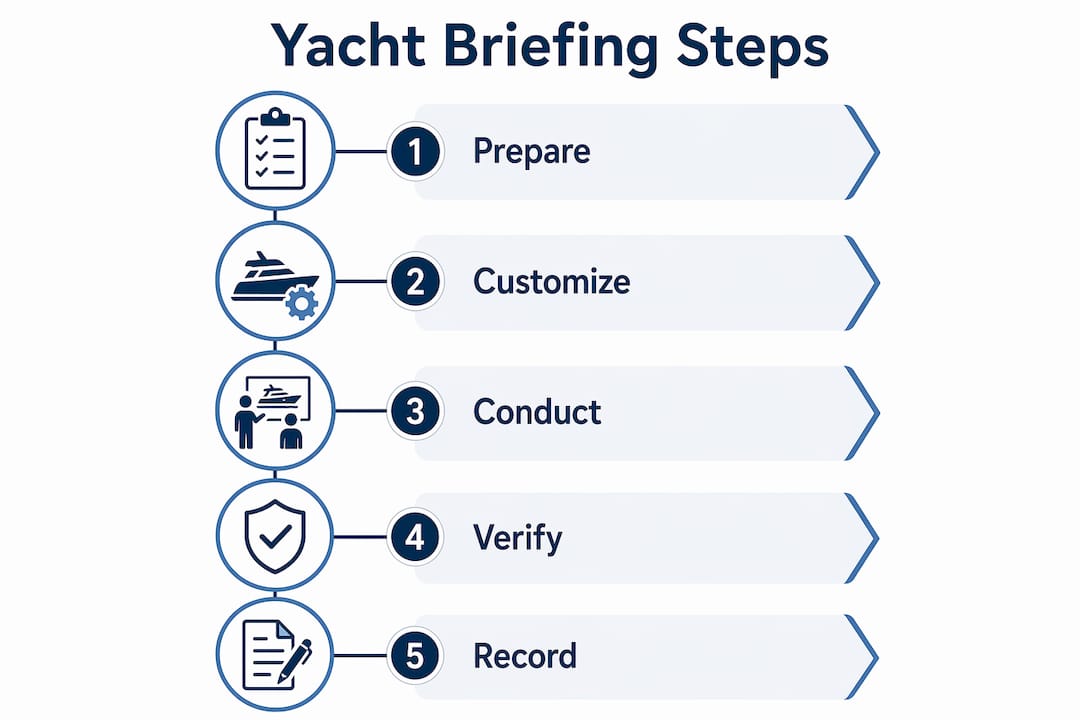
Follow this step-by-step procedure for every owner briefing:
- Set the agenda in writing 48 hours in advance. Distribute it to all participants so no one arrives unprepared.
- Open with a scope confirmation. State clearly what the briefing covers and what falls outside its scope. This prevents scope creep mid-session.
- Conduct the physical walkthrough. Move through the vessel systematically, covering each safety station, operational system, and crew station in sequence.
- Use printed waterproof checklists. Mark each item with two-person verification. One person reads, one confirms. Both initial the sheet.
- Review the snag list or outstanding items. For handover briefings, documented snag lists with prioritized items and warranty schedules prevent post-briefing disputes.
- Collect signatures. Every participant signs the briefing record. This converts verbal agreement into a time-stamped document.
- Distribute copies. Captain retains the original. Owner and any yard representative receive copies. Digital backup is stored in the vessel management system.
The following table shows how briefing format varies by scenario and what documentation is required at each stage:
| Briefing type | Duration | Key participants | Required documentation |
|---|---|---|---|
| Charter pre-trip | 30 minutes | Captain, chief steward, chef | Preference sheet, safety acknowledgment |
| Refit handover | 45 to 60 minutes | Owner, captain, yard rep | Scope confirmation, snag list, acceptance certificate |
| Routine operational | 20 to 30 minutes | Full crew | Updated emergency card, log signatures |
| Post-incident debrief | 30 to 45 minutes | Relevant crew | Incident report, corrective action plan |
Pro Tip: Seat the owner and captain side by side during the walkthrough, not across from each other. This physical arrangement signals collaboration rather than evaluation, and it measurably reduces defensive communication from crew members.
How to maintain briefing consistency through recordkeeping and accountability
A briefing that produces no lasting record produces no lasting change. Linking briefing content to routine logs creates a living system where departure checks, weekly safety reviews, and monthly equipment inspections all trace back to the original briefing framework. Assigning a named crew member as the accountability owner for each checklist category is what separates vessels with strong safety cultures from those that re-brief from scratch every season.
The choice between paper and digital log systems carries real operational consequences. Consider the tradeoffs:
| Factor | Paper logs | Digital systems |
|---|---|---|
| Accessibility at sea | Immediate, no power required | Requires device and connectivity |
| Audit trail | Manual, prone to gaps | Automatic timestamps and version history |
| Crew adoption | Familiar, low learning curve | Requires training and consistent use |
| Integration with briefings | Manual cross-referencing | Can link directly to briefing records |
| Cost | Minimal | Subscription or setup cost |
Paper logs remain the standard on many vessels because they work without infrastructure. Digital systems like those offered through yacht management platforms provide automatic audit trails and version history, which is particularly valuable during insurance claims or flag state inspections.
The practical approach we recommend combines both. Use waterproof paper checklists during the briefing itself and the physical walkthrough, then transfer confirmed items into a digital log within 24 hours. This gives you the reliability of paper in the moment and the searchability of digital records over time.
Briefing drift, where crew gradually deviate from briefed procedures without anyone noticing, is the primary risk that recordkeeping prevents. When each checklist item has a named owner and a documented completion date, drift becomes visible before it becomes dangerous.
Key takeaways
Effective yacht owner briefings require structured preparation, scenario-specific content, two-person verification, and signed documentation to convert communication into lasting operational accountability.
| Point | Details |
|---|---|
| Define briefing type first | Charter, refit, and operational briefings each require different participants, timing, and documentation. |
| Use two-person verification | YSMS-style checklists with dual sign-off reduce human error during safety and handover reviews. |
| Timebox every session | Keep briefings between 30 and 60 minutes to maintain focus without sacrificing thoroughness. |
| Document and sign everything | Signed records with snag lists and warranty schedules prevent post-briefing disputes and liability gaps. |
| Assign accountability owners | Named crew members responsible for each checklist category sustain briefing standards between sessions. |
What I’ve learned from watching briefings succeed and fail
After working through dozens of yacht handovers and charter preparations, the pattern that stands out most clearly is this: the briefings that fail are almost never missing information. They are missing structure. An owner who has spent years aboard their vessel often assumes the captain knows what they know. A captain who has managed the vessel through a refit assumes the yard representative understands the operational context. These assumptions, left unexamined, produce exactly the kind of miscommunication that a well-run briefing is designed to prevent.
The most effective briefings I have observed treat the session as a formal transfer of knowledge, not a conversation. The agenda is written. The walkthrough follows a fixed sequence. Every item gets two signatures. The snag list is printed before the meeting starts, not assembled during it. This level of preparation feels excessive until the moment it prevents a dispute over a warranty item or a safety incident that traces back to a missed briefing point.
One thing I would push back on is the instinct to shorten briefings for experienced crews. Familiarity with a vessel is not the same as current knowledge of its systems. A yacht renovation or refit changes subsystems, clearances, and operational procedures in ways that even experienced crew members need to be formally briefed on. Treating a post-refit handover as a casual walkthrough is a genuine risk, not a time-saving measure.
The owners and managers who build the strongest operational cultures are the ones who integrate briefing processes into their broader yacht management strategy, not as a compliance exercise, but as the mechanism through which standards are set, communicated, and maintained.
— Jason
How Baranofyachts supports your briefing and yacht management process
At Baranofyachts, we understand that a well-organized owner briefing is only as strong as the vessel configuration behind it. Our team works with owners and captains from the earliest design stages through to delivery, building the kind of documented, system-specific knowledge that makes every briefing precise and purposeful.

Whether you are preparing for a charter season, managing a post-refit handover, or configuring a new build from the ground up, Baranofyachts provides the expertise and resources to support every stage of that process. Our project management approach ensures that the operational details of your vessel are documented, organized, and ready to brief from day one. Reach out to our team to discuss how we can support your yacht management and briefing strategy.
FAQ
What is a yacht owner briefing?
A yacht owner briefing is a structured session where owners, captains, and crew align on safety procedures, operational protocols, and vessel-specific responsibilities before a voyage, charter, or handover. It produces signed documentation that serves as the operational record for that period.
How long should a yacht owner briefing last?
Briefings should run between 30 and 60 minutes, depending on vessel complexity and briefing type. This range allows thorough coverage of safety and operational content without losing participant focus.
What documents are required for a refit handover briefing?
A refit handover briefing requires a signed scope confirmation, a prioritized snag list with warranty schedules, and a formal acceptance certificate signed by the owner, captain, and yard representative.
What is two-person verification in a yacht briefing?
Two-person verification is the practice of having one crew member read each checklist item aloud while a second crew member confirms and both initial the sheet. The YSMS framework uses this method to reduce human error during safety and operational reviews.
How do charter preference sheets improve owner briefings?
Charter preference sheets submitted at least two weeks before embarkation give the crew specific information about guest needs, dietary requirements, and emergency contacts, allowing the briefing to address real scenarios rather than generic procedures.
Recommended
Sold Listings


Design Your Yacht
"*" indicates required fields
Maximus III - PNW
As you step aboard MAXIMUS III, the first impression is her scale.
At 120 feet with an 8-meter beam and 294 GT of interior volume, this 2025 Crescent Custom tri-deck immediately feels open, balanced, and estate-like. A timeless look while still feeling fresh from the shipyard.
Currently Available


Get your yacht value Estimate
"*" indicates required fields