
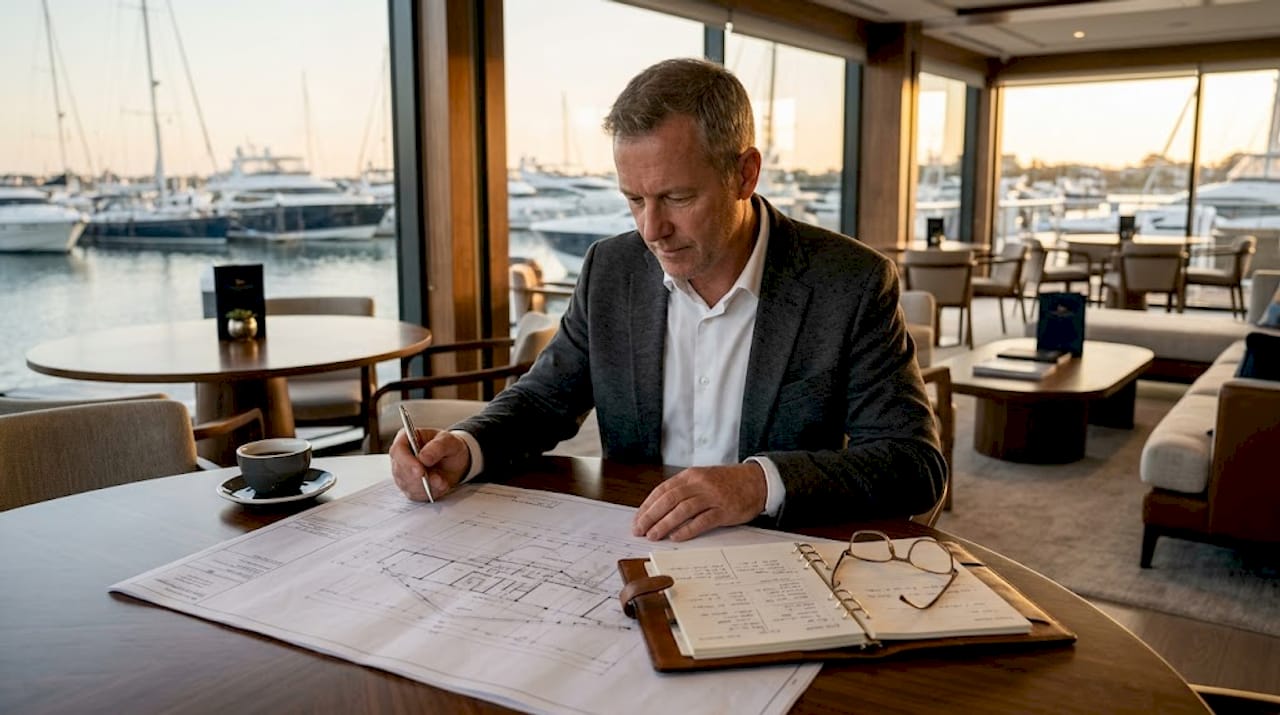
When you commission a luxury yacht, the governance structure surrounding that project is every bit as important as the hull design or propulsion system you select. Most owners enter their first custom build or major refit assuming a project manager will fully guard their interests, and that assumption can cost millions. The owner’s representative (OR) is a distinct professional role, one that places a single, empowered advocate squarely in your corner from the first briefing through to the final sea trial, ensuring that your vision, your budget, and your authority never become diluted by competing agendas.
Table of Contents
- What is a yacht owner’s representative?
- Why owner’s representatives matter: The risks they prevent
- Core responsibilities: What an owner’s representative actually does
- When and why to engage an owner’s representative
- Owner’s representatives in superyacht governance and wealth management
- A fresh perspective: The owner’s representative is your ultimate insurance — if you empower them early
- Connect with expert owner’s representatives for your next yacht project
- Frequently asked questions
Key Takeaways
| Point | Details |
|---|---|
| Single point of control | An owner’s representative centralizes approvals and keeps your vision intact throughout the project. |
| Reduces costly risks | Engaging an owner’s representative early mitigates ambiguity, scope creep, and budget overruns. |
| Advanced oversight | Owner’s representatives act as a governance layer, streamlining yacht management for family offices and multiple assets. |
| Protects your interests | The owner’s representative works solely for you, not for shipyards or third parties. |
| Essential for complex projects | High decision load or multi-party builds benefit most from a skilled owner’s representative. |
What is a yacht owner’s representative?
An owner’s representative is not simply a senior project manager wearing a different badge. The distinction matters profoundly in luxury yachting, where a single unresolved ambiguity can trigger cascading cost overruns or specification drift that compounds across months of construction. As defined in practice, an owner’s representative “is appointed to speak for and represent the yacht owner’s interests between the owner and the delivery team.” That definition carries real operational weight.
Where a project manager may owe loyalty to a shipyard schedule, a management company’s margin, or a delivery program, the OR answers to one party only: you. The OR’s core functions include translating your vision into formal technical briefs, reviewing and approving design variations, controlling the flow of decisions, and maintaining a defensible paper trail that protects your interests through warranty periods and beyond. Think of the OR as the conductor’s eye over the entire orchestra of contractors, naval architects, class surveyors, and outfitting specialists, ensuring every instrument stays in tune with your original score.
Here is a summary of how an OR’s responsibilities evolve across major project phases:
| Project phase | Owner’s representative responsibilities |
|---|---|
| Brief and scope development | Translating owner priorities into documented technical requirements |
| Design and engineering | Reviewing drawings, flagging conflicts, approving design changes |
| Construction and outfitting | Attending inspections, managing change orders, tracking costs |
| Systems commissioning | Witnessing tests, signing acceptance protocols, documenting deficiencies |
| Sea trials and delivery | Confirming performance against specification, managing punch lists |
Key functions the OR performs throughout a project include:
- Acting as the single authorized decision route for all scope and design questions
- Documenting every variation request and its commercial impact before approval
- Maintaining cost-to-complete forecasts updated against approved scope
- Coordinating input from independent surveyors, flag state, and class societies
- Providing the owner with clear, unfiltered reporting rather than yard-filtered updates
This is what project management for better yachts looks like when it truly serves the owner rather than the delivery chain.
Why owner’s representatives matter: The risks they prevent
Without an empowered OR in place, a superyacht project becomes a governance vacuum. Multiple stakeholders, the shipyard production team, the naval architect, the interior designer, the captain, and various subcontractors, each make incremental decisions that appear minor in isolation but collectively reshape your yacht into something that no longer perfectly reflects your brief. That is project drift, and it is far more common than the industry likes to publicize.
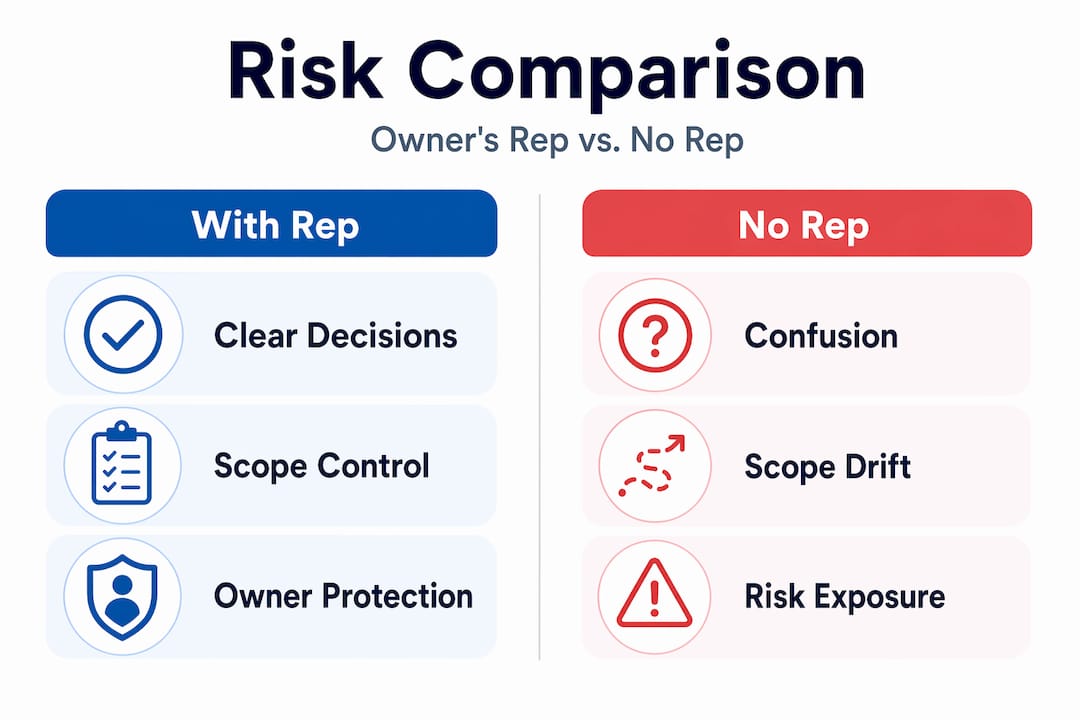
The risk landscape is specific and well-documented. Contract and scope ambiguity, combined with a lack of formal change control, greatly increases owner liability on any given build. When nobody with exclusive owner-side authority is reviewing variation orders before they are executed, costs escalate and accountability blurs. An OR is distinct from a project manager precisely because the OR always represents the owner’s interests exclusively, not the interests of the shipyard schedule or the management company’s fee structure.
Consider the phases where risk concentrates most sharply:
- Scope finalization: Ambiguous specifications at this stage become expensive disputes during build.
- Design freeze: Changes introduced after freeze are the single largest driver of cost overruns in superyacht projects.
- Outfitting and systems integration: Subsystems from multiple suppliers create clearance conflicts and knock-on effects that only a vigilant OR catches early.
- Commissioning: Deficiencies accepted informally at this stage are extremely difficult to enforce under warranty later.
- Delivery: Handover documentation that lacks owner sign-off creates long-term accountability gaps.
Here is how the project experience typically compares depending on whether an OR is engaged:
| Factor | With an owner’s representative | Without an owner’s representative |
|---|---|---|
| Scope control | Documented and owner-approved at each stage | Subject to shipyard interpretation |
| Change order management | Reviewed, costed, and approved before execution | Often executed first, charged later |
| Reporting quality | Independent, unfiltered owner updates | Filtered through delivery team’s interests |
| Warranty position | Supported by formal acceptance records | Weakened by informal sign-offs |
| Decision velocity | Centralized through one authorized voice | Fragmented across multiple stakeholders |
Pro Tip: Involve your OR at the scope definition stage, before you sign the build contract, so that all owner preferences are locked into the specification. Ambiguities removed early cost nothing. Ambiguities resolved mid-build cost time, money, and sometimes relationships.
Thinking carefully about protecting owner interests from the outset is the foundation of a satisfying ownership experience, and it connects directly to how exclusive yacht ownership should be structured from day one.
Core responsibilities: What an owner’s representative actually does
Now that the importance of the role is clear, it is worth inspecting what an owner’s representative does on a practical, day-to-day project basis. The work is both strategic and granular, requiring someone who can interpret a naval architecture drawing in the morning and negotiate a variation order’s commercial terms in the afternoon.
Structured OR engagements typically include defined phases: brief and scope development, technical design reviews, factory and workshop inspections, change management, systems commissioning, and formal handover. Each phase generates specific deliverables that build the defensible record your legal and warranty position depends upon.
Typical weekly activities an OR manages include:
- Reviewing updated build schedules and flagging milestone risks to the owner
- Attending yard meetings to monitor progress against agreed scope
- Evaluating variation requests from the builder and providing written approval or rejection with reasoning
- Coordinating independent specialist reviews for critical subsystems such as stabilization, audio-visual integration, or custom galley equipment
- Issuing weekly owner reports covering cost, schedule, and quality status in plain language
- Maintaining a live variation log that tracks every approved change and its cumulative budget impact
- Conducting or commissioning inspections at key structural milestones, such as keel laying, deck fitting, and systems installation
When preparing to build your yacht, the quality of your initial technical brief is the single biggest determinant of whether the OR can do this work effectively. A vague brief creates a weak foundation; a precise, detailed brief gives the OR the authority to hold the yard accountable throughout the entire program.
Pro Tip: Insist on written acceptance standards for each major system before construction begins. These standards form the baseline for warranty enforcement after delivery, and without them, disputes become matters of opinion rather than contractual fact.
The OR’s role is especially critical during the commissioning phase, when luxury yacht upgrades and bespoke fitments are being tested under real operating conditions for the first time. This is where the gap between specification and execution becomes visible, and a skilled OR converts that gap into a formal punch list rather than an informal and unenforceable verbal agreement.

When and why to engage an owner’s representative
Understanding the specifics of engagement helps you time and justify the decision to bring in an owner’s representative. The simple answer is: earlier than you think necessary.
Projects with high decision load or significant technical and commercial complexity benefit most from owner representation. But complexity is not measured purely in vessel size. A 30-meter custom build with highly bespoke interior systems, a novel propulsion configuration, or an unusually compressed delivery timeline can carry greater governance risk than a larger, more standardized specification. The OR is a governance layer, not a luxury reserved for the largest projects.
The most common project triggers that make OR engagement mission-critical include:
- Multi-yard or multi-contractor builds where accountability for interface management is unclear.
- Custom or first-of-class specifications where the shipyard has limited prior experience with your specific requirements.
- Owner-supplied equipment where the coordination between owner-furnished items and yard-installed systems creates commercial boundary disputes.
- Compressed schedules driven by charter commitments, event delivery deadlines, or seasonal launching windows.
- Owners based internationally who cannot maintain direct and regular yard presence throughout a build lasting 18 to 48 months.
- Refit projects on existing yachts where hidden conditions discovered mid-project require rapid, commercially sound decision-making.
“The most effective owner’s representatives serve as a governance architecture for the entire project, ensuring that the owner’s voice is not just heard but acted upon at every consequential decision point.”
For established collectors managing multiple assets, the OR is part of a broader discipline rather than a project-by-project decision. Thinking about optimizing yacht resale value from the moment you commission a new build, for example, changes the specification decisions your OR advocates for, and good yacht resale preparation begins with the quality of build documentation the OR generates.
Owner’s representatives in superyacht governance and wealth management
For the most sophisticated owners, the owner’s representative is not only a project role but an integrated part of long-term yacht investment strategy. Family offices managing ultra-high-net-worth (UHNW) portfolios increasingly treat superyacht assets with the same governance rigor applied to real estate or private equity holdings. Owner representation in superyacht asset management provides a governance and control layer that streamlines oversight and can generate meaningful cost reductions through tighter change management and reduced dispute resolution costs.
Here is how the key roles compare within that governance framework:
| Role | Primary accountability | Scope of authority | Owner-exclusive? |
|---|---|---|---|
| Yacht broker | Transaction facilitation | Purchase and sale negotiation | Generally no |
| Project manager | Build delivery | Schedule and cost management | Often shared with yard |
| Owner’s representative | Owner’s interests | All decisions affecting owner | Yes, exclusively |
| Flag state surveyor | Regulatory compliance | Certification and safety | No |
The benefits to UHNW owners and family offices of formalizing OR engagement include:
- Consistent governance language across all yacht assets within the portfolio
- Auditable decision trails that support insurance, financing, and resale due diligence
- Reduction of “key person risk” when the owner or principal cannot maintain direct project involvement
- Alignment between the yacht’s technical specification and long-term cruising or charter strategy
- Professional interface with legal counsel during contract negotiation and dispute resolution
Understanding where your yacht sits within your broader superyacht market context is essential for positioning the OR’s mandate correctly and ensuring the role delivers value far beyond the build period.
A fresh perspective: The owner’s representative is your ultimate insurance — if you empower them early
You have read the structural and governance benefits. But what is the one move most owners consistently underestimate? It is not the decision to hire an OR. It is the decision to empower them before the yard is even selected.
We have observed, again and again across complex high-end builds, that the most costly project mistakes do not originate from technical fumbles or shipyard incompetence. They originate from unclear owner briefings and post-hoc decision making. When the OR is brought in after the build contract is signed, they spend the first weeks of their engagement unpacking ambiguities the contract should never have contained. That is reactive governance, and it is far less effective than the proactive kind.
Think of the OR as the family CFO for your build. You would not ask your CFO to manage a major acquisition after the term sheet was already executed. You bring them in during the due diligence phase, so their analysis shapes the deal structure itself. The OR’s role in yacht construction is precisely analogous: their input during yard selection, contract negotiation, and specification finalization sets the quality ceiling for everything that follows.
Many owners wait because they underestimate how quickly scope ambiguity compounds. A single vague paragraph in the build specification, say, one that describes an interior finish standard as “high quality” without defining a reference sample or an accepted comparable, becomes a source of genuine dispute 18 months later when the delivered result falls short of the owner’s mental image. An OR engaged early turns that paragraph into a precise, agreed, and photographed reference standard before the contract is signed. The project risk and scope clarity established at the brief stage is the most leveraged investment you can make in the entire project.
Empowering the OR also means giving them genuine authority. An OR who must seek approval for every minor decision becomes a bottleneck rather than a protector. The well-structured OR mandate defines pre-authorized decision thresholds, ensures the OR has direct yard access without the owner’s constant involvement, and establishes that their sign-off is required before any variation is executed. That structure is what separates a project that delivers on its promise from one that arrives late, over budget, and full of compromises the owner never consciously agreed to.
Connect with expert owner’s representatives for your next yacht project
Ready to put these concepts into practice on your own project? At Baranof Yachts, we bring the same rigorous, owner-first approach to every build and refit we oversee. Our experience in custom yacht building means we understand how bespoke specifications translate into practical governance requirements, and how to structure an OR mandate that truly protects your investment at every phase.

Whether you are starting a new specification from scratch or navigating a complex refit, we are here to serve as your single, trusted point of authority throughout the process. You can configure your new yacht with our team’s guidance, or speak directly with a yacht representative to discuss how owner’s representation fits your specific project. Your vision deserves the protection of an expert in your corner from day one.
Frequently asked questions
What is the difference between a yacht owner’s representative and a project manager?
An OR works for the owner, while a project manager often acts on behalf of the shipyard or management company, meaning their loyalties and priorities may not align exclusively with yours.
When should I hire an owner’s representative for my yacht project?
Hire an OR as early as the scoping and budgeting phase, because early involvement reduces owner exposure by adding clarity to scope and change control from the very outset of the project.
How does an owner’s representative protect my investment?
An OR manages project decisions, tracks cost exposures, and maintains formal documentation, and as the role is designed to safeguard the owner’s interests through every stage from brief through handover.
Is an owner’s representative necessary for smaller yachts?
While the role is especially valuable in large and complex builds, owner representation adds clarity and risk reduction to almost any size project where decision accountability could otherwise become blurred.
Recommended
Sold Listings


Design Your Yacht
"*" indicates required fields
Maximus III - PNW
As you step aboard MAXIMUS III, the first impression is her scale.
At 120 feet with an 8-meter beam and 294 GT of interior volume, this 2025 Crescent Custom tri-deck immediately feels open, balanced, and estate-like. A timeless look while still feeling fresh from the shipyard.
Currently Available


Get your yacht value Estimate
"*" indicates required fields