
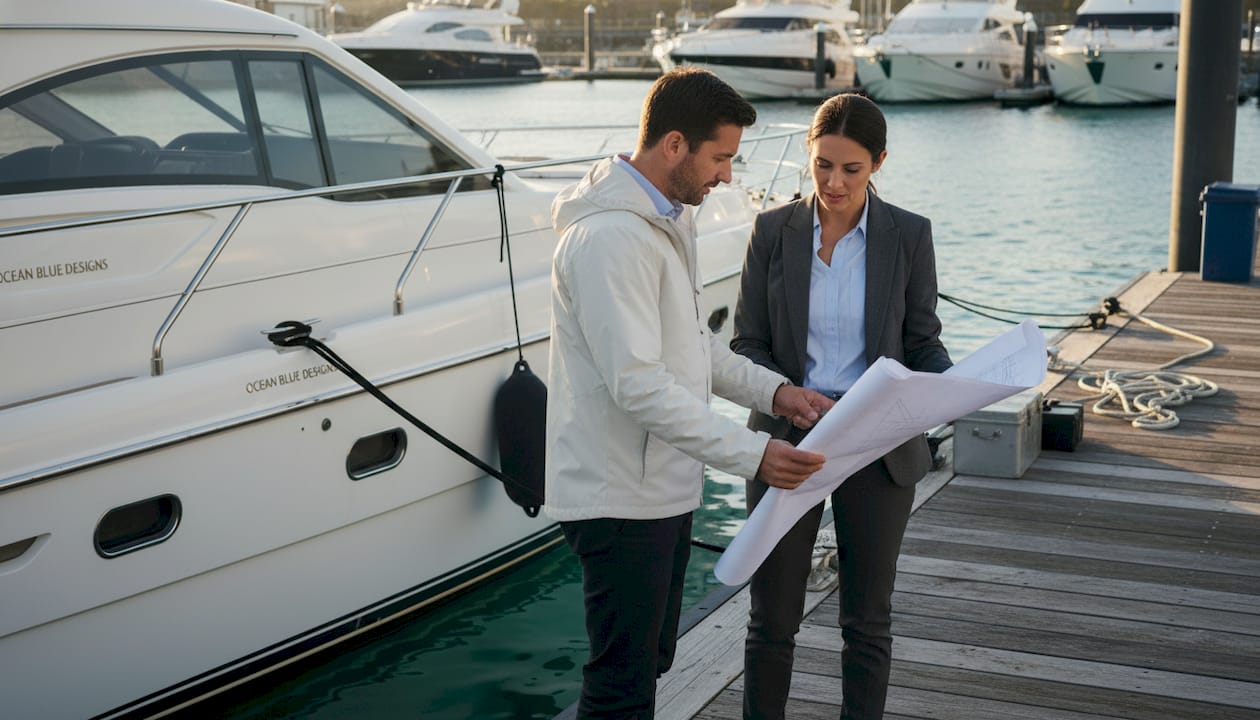
Every yacht that rolls out of a production yard is built to satisfy an average. It fits a general profile, suits a broad taste, and meets middle-of-the-road expectations. If you’re reading this, you’re not average, and neither are your expectations. You want a vessel that reflects your lifestyle, performs on your terms, and creates the kind of onboard experience that no catalog can deliver. The good news is that today’s luxury yacht customization options are broader and more sophisticated than ever, and the process, when handled with the right team and structure, can be as rewarding as the result.
Table of Contents
- Define your vision: key decisions before customizing
- What’s possible: types of yacht customization
- Assemble your team: who you’ll need for a successful project
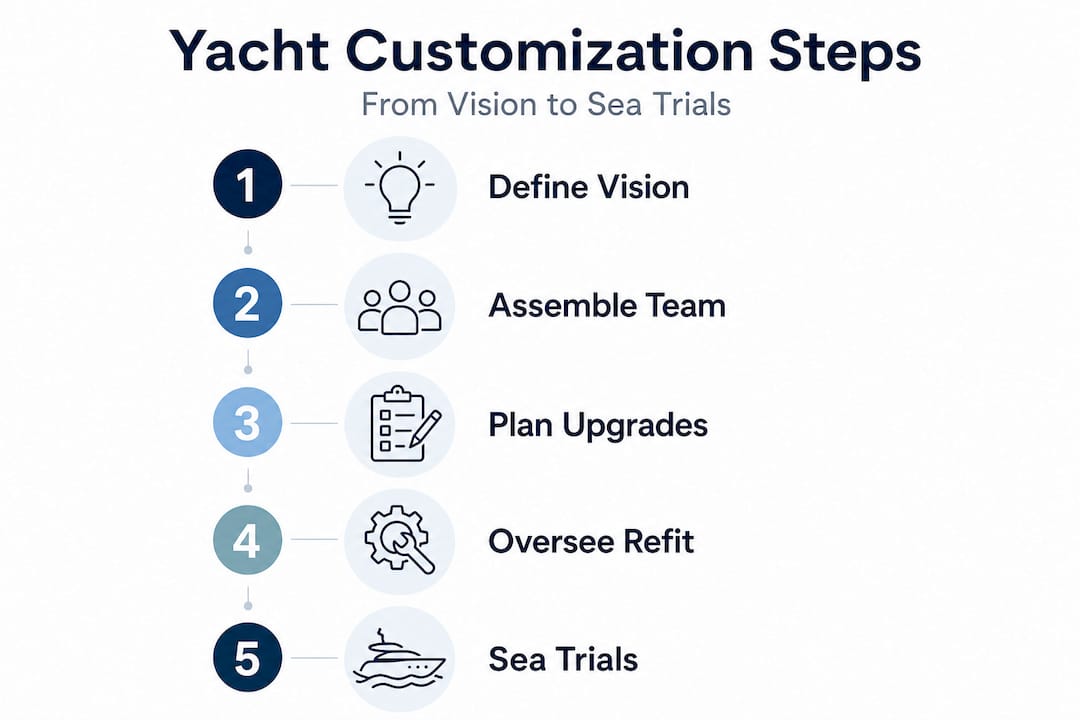
- Customization step-by-step: the process from sketches to sea trials
- Why true yacht customization means more than looks
- Ready to customize? Step into your ultimate yacht experience
- Frequently asked questions
Key Takeaways
| Point | Details |
|---|---|
| Vision drives success | Clarify your priorities before starting to ensure your customization delivers both style and substance. |
| Deep upgrades add value | Architectural and system improvements bring longer-term comfort, performance, and resale benefits. |
| The right team matters | Choosing proven designers, architects, and project managers is essential for a seamless experience. |
| Step-by-step process | Follow a rigorous process from sketches to sea trials for best results and peace of mind. |
Define your vision: key decisions before customizing
With the value of customization clear, the next step is laying a solid foundation for success, beginning with your vision and priorities.
Before any designer touches a sketch pad or any yard quotes a timeline, you need clarity. That clarity starts with a single, honest question: how do you actually use your yacht? The answer shapes every decision that follows, from cabin count to propulsion type to entertainment configuration.
Consider the primary purpose of your vessel:
- Entertainment and hosting: If you frequently welcome large groups aboard, you’ll prioritize open deck spaces, generous saloon layouts, a fully equipped galley, and high-quality audio-visual systems.
- Adventure and expedition: Long-range cruising calls for extended fuel capacity, reinforced hulls, redundant navigation systems, and storage for water sports or dive equipment.
- Family use: Families often prioritize safety features, multiple staterooms with en suite bathrooms, dedicated children’s areas, and lower deck stability.
- Business and corporate hosting: This demands a more refined aesthetic, private meeting spaces, reliable connectivity, and a crew that operates with near-invisible efficiency.
The next critical distinction is understanding the difference between aesthetic customization and foundational upgrades. Planning your new yacht effectively means recognizing early that new upholstery and custom artwork are entirely different undertakings from reconfiguring a lower deck layout or replacing an outdated HVAC system. As builder messaging consistently notes, the contrast between aesthetic customization and deeper architectural or system work is fundamental to scope, cost, and outcome.
Pro Tip: Create two lists before your first consultation: absolute must-haves and nice-to-haves. This single exercise keeps budget conversations grounded and helps your team prioritize what genuinely moves the needle for your experience versus what would simply be pleasant to have.
What’s possible: types of yacht customization
Now that you know what you want, explore the spectrum of what’s achievable in today’s high-end yacht customization.
The range of possibilities available to you is genuinely impressive. Think of your yacht as a platform, one that can be refined in almost every dimension once you know where to focus. Here are the four major areas:
- Interior: Custom stateroom configurations, bespoke joinery, handcrafted furniture, spa and wellness rooms, dedicated cinema lounges, and climate control systems tailored to your preferred zones.
- Exterior: Unique colorways, custom hull graphics, reconfigured deck layouts, swim platforms, integrated pools or jacuzzis, and garage expansions for tenders and toys.
- Systems: Advanced navigation suites, integrated smart home automation, customized lighting scenes, premium A/V throughout, renewable energy solutions, and hybrid or fully electric propulsion.
- Performance: Upgraded stabilization systems (both underway and at anchor), refined propulsion for quieter or faster passages, and vibration-dampening technologies that make a genuine difference to comfort.
Here is a clear comparison to help frame your thinking:
| Customization type | Examples | Typical cost level | Time investment | Long-term value impact |
|---|---|---|---|---|
| Aesthetic | Paint, upholstery, art, soft furnishings | Low to moderate | Weeks | Moderate |
| Architectural | Cabin reconfigurations, volume changes | High | Months | Very high |
| Systems | Navigation, automation, HVAC, propulsion | Moderate to high | Weeks to months | High |
| Performance | Stabilizers, propellers, hull refinements | Moderate to high | Weeks to months | High |
The best refit outcomes typically preserve the agreed hull and exterior signature while modernizing interior systems and volumes, which means you can protect the structural identity of a proven hull while transforming everything the owner and guests actually experience.
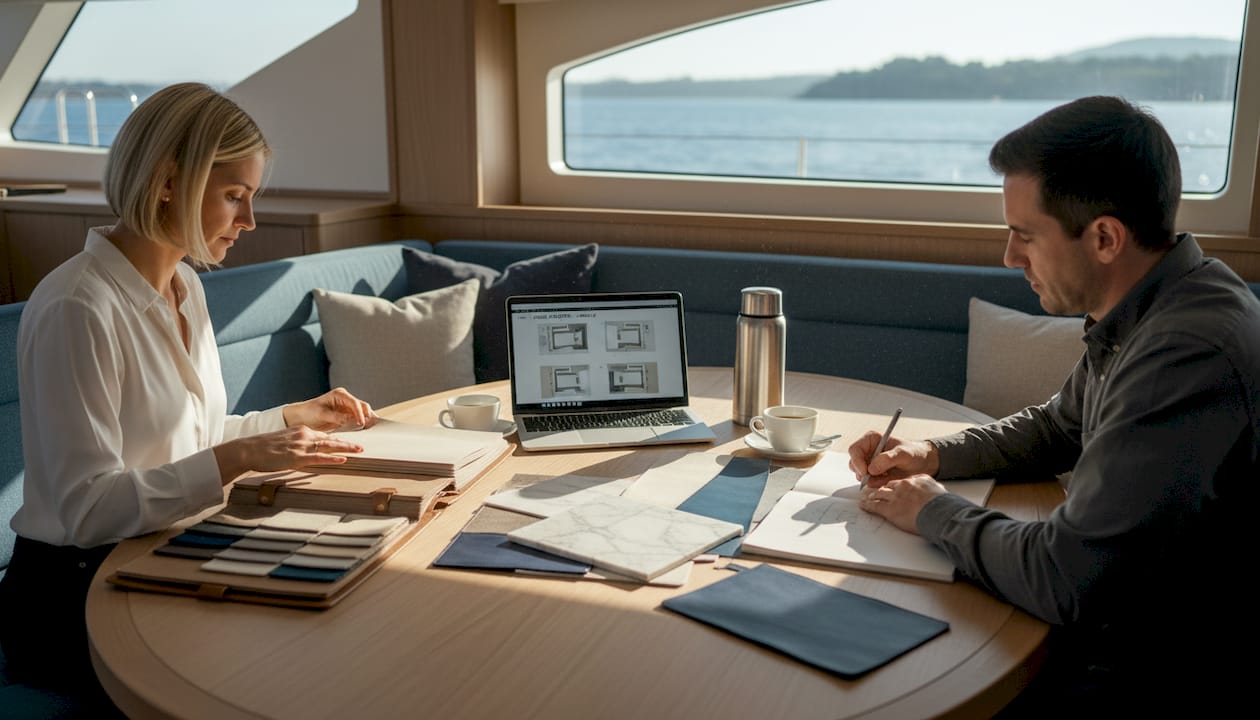
Pro Tip: Architectural changes, such as redesigning cabin layouts or moving bulkheads, require expertise across hull structure, marine systems, and interior design simultaneously. They offer the deepest personalization, but they demand a team that can coordinate across all three disciplines without creating knock-on effects elsewhere in the vessel.
When modernizing your yacht, material selection also plays a pivotal role. The right yacht building materials affect everything from structural integrity to acoustic performance, and from maintenance requirements to overall aesthetic longevity.
Assemble your team: who you’ll need for a successful project
Only with the right team can your vision become reality; here’s who you’ll need and why they matter.
A yacht customization project, especially one involving architectural or system-level work, is an orchestrated effort. No single person can manage every dimension. Think of the team as a well-rehearsed symphony, with each player executing their part while remaining in sync with the whole.
| Role | Key responsibilities | What to look for |
|---|---|---|
| Owner’s representative | Advocates for your interests throughout the project | Strong communication skills, yacht project experience |
| Naval architect | Structural integrity, stability calculations, regulatory compliance | Classification society experience, refit portfolio |
| Interior designer | Aesthetic vision, material sourcing, layout optimization | Luxury maritime portfolio, attention to detail |
| Marine systems engineer | Navigation, automation, propulsion, electrical systems | Systems integration expertise, manufacturer relationships |
| Project manager | Timeline, budget, contractor coordination, reporting | Proven track record in complex refit or new build projects |
“Best outcomes typically preserve an agreed hull and exterior signature while comprehensively renewing interior volumes and modernizing systems.” — Modern Yacht Refit: European Yards Renew Vessels
This perspective captures the core challenge every team faces: honoring what works about a vessel while transforming what doesn’t. That balance requires constant communication between roles that don’t always naturally align.
Here are some practical tips for team due diligence and ongoing communication:
- Check references across completed projects, not just conceptual renders. Ask specifically about budget adherence and how surprises were handled mid-project.
- Request a unified communication protocol from day one. A single shared project management platform reduces the risk of misaligned information between your designer and your naval architect.
- Define decision-making authority clearly. Know which decisions are yours alone, which your project manager can handle independently, and which require full team input.
- Schedule regular milestone reviews rather than relying on ad-hoc updates. Structured check-ins keep the project moving and surface issues before they escalate.
When it comes to hull restoration expertise, choosing a yard with a verifiable track record matters enormously. The hull is the foundation upon which every other system depends, and cutting corners there affects everything built above it.
Customization step-by-step: the process from sketches to sea trials
With your team in place, it’s time to move from ideas to action. Here is how the full process unfolds.
A disciplined, sequential approach reduces risk, prevents costly rework, and keeps the project aligned with your original vision. Each stage builds on the last, and each one has specific verification points you should insist on.
-
Vision and brief development: Document your lifestyle goals, preferred use cases, aesthetic references, and performance expectations in a formal brief. This becomes the north star for every subsequent decision. Verify that every team member has reviewed and understood it before any design work begins.
-
Concept sketches and design direction: Your designer produces initial sketches and mood boards based on the brief. This is where broad strokes are set: interior palette, deck layout philosophy, exterior character. Verify alignment with your brief before approving progression.
-
3D modeling and technical drawings: Concepts translate into detailed three-dimensional models and technical drawings. The naval architect cross-checks these against structural requirements and stability calculations. Verify that all proposed changes have been reviewed for regulatory compliance at this stage.
-
Material and systems specification: Every material, fixture, and system component is specified and sourced. Lead times are identified and procurement is initiated. Verify that your yacht configuration decisions at this stage won’t create scheduling conflicts downstream.
-
Build or refit execution: The yard begins physical work. Regular site visits are non-negotiable. Verify progress against the approved drawings at every milestone, not just at the end of each phase.
-
Onboard systems commissioning: All navigation, automation, electrical, and mechanical systems are installed and individually tested. Verify each subsystem independently before integrated testing begins, since problems discovered in isolation are far easier and cheaper to resolve.
-
Final inspection and sea trials: This is where everything comes together. The best refit strategies always include rigorous sea trial verification, testing performance, comfort, and systems function under real operating conditions.
Pro Tip: Insist on at least two sea trial legs under different conditions, ideally varying sea state and speed. A yacht that performs beautifully in calm harbor water may reveal vibration, noise, or stability issues in open water that are far easier to address before final acceptance than after delivery.
Why true yacht customization means more than looks
Many affluent owners invest heavily in their vessel’s appearance and then feel a nagging sense that something is still missing once they’re underway. We’ve seen this pattern enough times to speak to it plainly.
The most visually stunning saloon means very little if the HVAC system hums at an irritating frequency throughout dinner, or if the stabilizers fail to compensate adequately in a moderate swell. Your guests won’t spend the passage admiring the bespoke marble countertops if they’re uncomfortable. They will, however, remember every minute of a perfectly quiet, perfectly stable evening at anchor off the coast of somewhere spectacular.
The uncomfortable truth is that aesthetic-only upgrades often miss the full value potential unlocked by system and volume renewal. A vessel with a reconfigured lower deck, a properly integrated smart automation system, and a next-generation stabilization package will outperform and outsell a vessel with flawless interiors and aging subsystems, every time.
We’ve also observed that owners who focus exclusively on visual customization tend to revisit their yachts for additional work within two to three years, once the operational limitations of unaddressed systems become apparent in everyday use. Investing in systems from the outset, alongside the aesthetic vision, is simply the more efficient path.
The goal of true customization is a vessel that feels and performs differently, not just one that looks different. When you walk aboard a yacht where every system has been thoughtfully specified, properly integrated, and rigorously commissioned, you experience a kind of seamless ease that no interior decoration alone can replicate. That is what we mean by genuine personalization.
Consider sustainable yacht upgrades as part of this broader picture. Hybrid propulsion, solar-assisted energy, and advanced waste management systems don’t just reduce operational costs; they reflect a sophistication of ownership that resonates in resale value and in the way the vessel is perceived by guests and peers alike.
Pro Tip: Your guests will remember seamless comfort long after they forget a trending color palette. Build your customization budget around experience first, and aesthetics second.
Ready to customize? Step into your ultimate yacht experience
If this guide has sparked ideas, sharpened your focus, or confirmed a direction you were already considering, the natural next step is to move from reflection to action.

At Baranof Yachts, we work with owners at every stage of this process, from the first conversation about vision and lifestyle fit through to delivery and beyond. Whether you want to start your yacht configuration using our online tools, explore what bespoke yacht building looks like in practice, or simply talk through your options with someone who has managed complex projects from concept to sea trial, we are ready to help. Our custom build support is designed to make the process clear, manageable, and genuinely exciting at every stage. Reach out to begin the conversation.
Frequently asked questions
How much does it cost to customize a yacht?
Costs range widely based on the scope of your project. Deeper architectural and system customization commands significantly higher premiums than surface-level aesthetic updates, with major refits running from hundreds of thousands to several million dollars depending on vessel size and complexity.
What is the typical timeline for a major yacht customization?
A full architectural and systems refit can take anywhere from six months to well over a year. Comprehensive renewal requires substantial time for planning, procurement, execution, and verification, particularly when structural changes are involved.
Do I need to hire a naval architect for my customization?
If your plans involve any layout changes, bulkhead modifications, or significant system upgrades, a naval architect is essential. Naval architects are crucial when renewing vessel volumes and systems, ensuring structural safety, regulatory compliance, and correct stability performance throughout.
Is it better to buy new or refit an existing yacht if I want full customization?
Both routes can deliver exceptional outcomes depending on your goals and timeline. New builds offer complete creative control from the keel up, while refit strategies can modernize and personalize proven hulls, often preserving what already works while transforming the onboard experience entirely.
Recommended
Sold Listings


Design Your Yacht
"*" indicates required fields
Maximus III - PNW
As you step aboard MAXIMUS III, the first impression is her scale.
At 120 feet with an 8-meter beam and 294 GT of interior volume, this 2025 Crescent Custom tri-deck immediately feels open, balanced, and estate-like. A timeless look while still feeling fresh from the shipyard.
Currently Available


Get your yacht value Estimate
"*" indicates required fields