
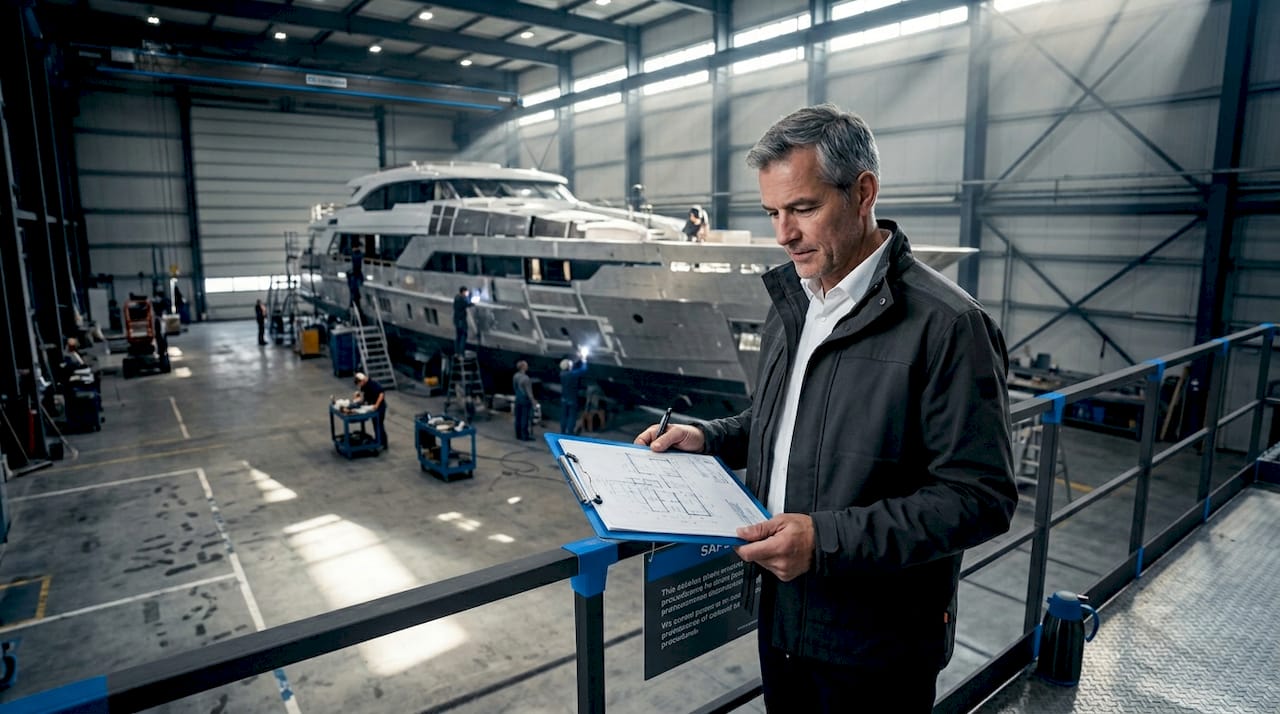
Most people assume a shipyard is simply a place with cranes, dry docks, and skilled tradespeople who assemble a vessel and hand it over. That assumption costs owners months of delays, unexpected costs, and compromised results. The truth is that a shipyard’s project philosophy, engineering systems, and willingness to partner transparently with you are the actual variables that determine whether your custom yacht is delivered on time, on budget, and exactly as envisioned. Understanding what a shipyard truly does, and how to evaluate one beyond location or legacy, is one of the most strategic decisions you will make in the entire build process.
Table of Contents
- What defines a shipyard’s role in yacht construction?
- New build vs. refit: Matching shipyard specialty to your project
- Engineering–production integration and change control: The quality multiplier
- Project management and owner partnership: The invisible advantage
- What most owners miss: Why your shipyard choice is more than a facility
- Start your yacht journey with the right partners
- Frequently asked questions
Key Takeaways
| Point | Details |
|---|---|
| Beyond building | Shipyards deeply influence design, quality, and timeline through project management and technical coordination. |
| Match yard to mission | Success depends on choosing a shipyard that specializes in your specific project—new build or refit. |
| Engineering integration | Close collaboration between engineering and production correlates with on-time, high-quality delivery. |
| Project partnership | Transparent, partnership-driven shipyards offer better processes and owner satisfaction. |
| Early planning pays off | Proactive change control and project planning save time and money, elevating the final yacht outcome. |
What defines a shipyard’s role in yacht construction?
A shipyard is not a passive factory. Think of it less like a workshop and more like a conductor leading a full orchestra through a complex, multi-year performance. Every subsystem, every supplier, every design revision, and every regulatory checkpoint flows through the shipyard’s coordination. When that coordination breaks down, even small oversights produce knock-on effects that ripple through timelines, budgets, and ultimately, the quality of your yacht.
At its core, a shipyard’s responsibilities include:
- Technical planning and engineering oversight: Translating naval architect drawings into actual production sequences, verifying clearances, and ensuring subsystems integrate without conflict.
- Procurement and supply chain management: Sourcing materials and systems components, often from global suppliers, well ahead of when they are needed on the build floor.
- Change control management: Tracking and formally managing every design modification so that late-stage revisions don’t cascade into structural or mechanical surprises.
- Owner communication and reporting: Providing transparent progress updates, milestone confirmations, and financial reporting so you always know exactly where your yacht stands.
As we emphasize in our approach to project management in yacht builds, each of these functions requires dedicated systems and experienced personnel. A yard that treats these as afterthoughts will always struggle to deliver at the highest level, regardless of how skilled its tradespeople are.
The relationship between engineering and production is where yards most often separate themselves. When engineering teams work in isolation from production floor teams, design revisions arrive late, creating expensive rework. The naval architect coordination process must be embedded into the build schedule from day one, not treated as a handoff that happens once and never revisits.
Leading industry voices confirm this reality. According to shipyard CEOs, engineering–production coordination and change control materially affect both quality and schedule, specifically by eliminating late-stage revisions and integrating engineering more closely with production. This is not a theoretical benefit. It is the difference between a yacht delivered as specified and one that has accumulated dozens of undocumented field changes.
“The yards that perform best for owners are those where the engineering team and the build team are essentially one team, not two departments that occasionally talk.” — A consistent observation from top-tier shipyard leaders.
Pro Tip: When evaluating a shipyard, ask directly how engineering change orders are logged, reviewed, and communicated to the owner. A yard with a clear, digital change control process is demonstrating a mature project culture. One that answers vaguely should raise immediate concern.
New build vs. refit: Matching shipyard specialty to your project
Not all shipyards are built the same, and we mean that quite literally. The infrastructure, workforce culture, and operational workflow of a yard specializing in ground-up new builds looks very different from a yard that excels at complex refits or periodic major maintenance. Choosing the wrong yard type for your project is one of the most preventable yet most costly mistakes in luxury yacht commissioning.

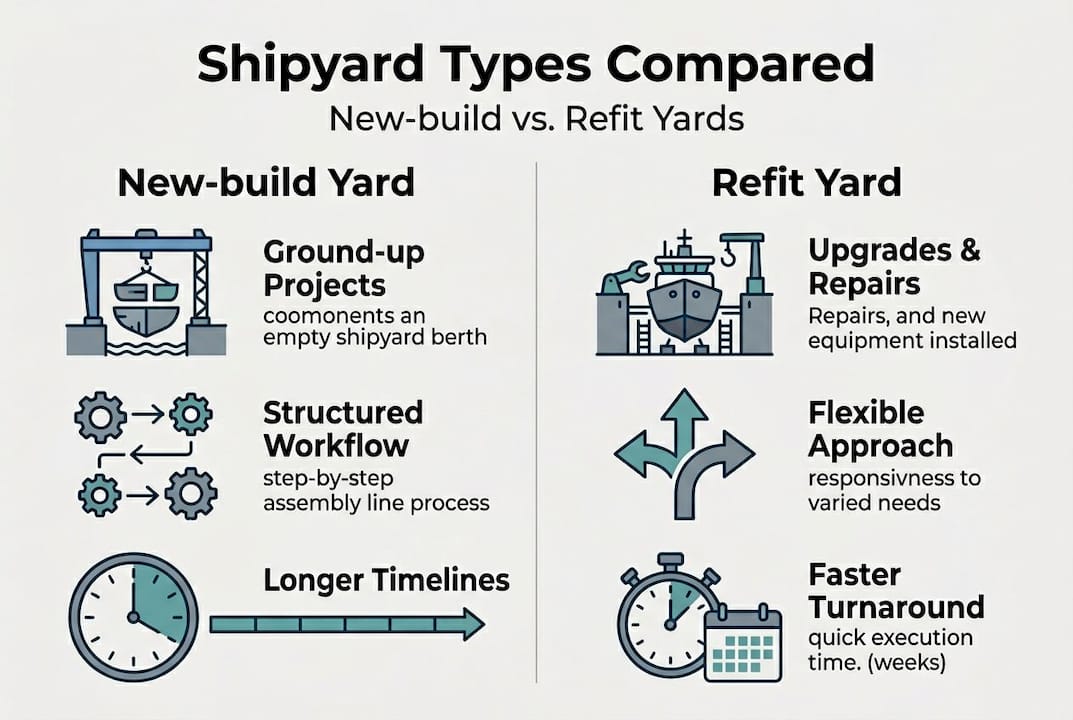
Here is a direct comparison of the three primary yard types you will encounter:
| Yard type | Primary focus | Workflow mentality | Best suited for |
|---|---|---|---|
| New-build yards | Ground-up construction | Sequential, long-horizon planning | Custom and semi-custom builds |
| Refit yards | Upgrades, modifications, maintenance | Adaptive, reactive, high-speed turnaround | Major upgrades, interior refreshes |
| Commercial yards | Volume production | Standardized, efficiency-driven | Commercial vessels, some production yachts |
The core insight here is that the matching of yard type to the project mission is not just a logistical question. It shapes the culture and daily decisions of everyone working on your vessel. A refit yard is optimized for speed, problem-solving on the fly, and adapting to existing structures. Those qualities are genuinely valuable during a major upgrade, but they can become liabilities during a new-build project that demands disciplined, long-range planning and sequential construction logic.
Similarly, forcing a new-build yard to handle a major refit often results in slow turnaround times and cost overruns because their workflow was never designed for the kind of parallel, adaptive work that refits require. The yacht upgrade shipyard approaches that work for one project type simply don’t translate to another.
Key factors to assess when matching a yard to your project:
- Track record in your specific project type: Completed vessel portfolios tell a clearer story than any brochure.
- Crew and subcontractor familiarity: Does the yard have established relationships with the specialists your build requires?
- Regulatory experience: Class society (such as Lloyd’s Register or Bureau Veritas) relationships and experience with specific flag state requirements matter enormously.
- Flexibility within their specialty: Even within new-build work, yards vary in their capacity to accommodate late-stage owner customizations.
Industry research confirms that owners should expect different yard mentalities for new-build versus refit work, and that matching the yard type to the project mission is repeatedly highlighted as a practical success factor.
Pro Tip: Don’t be swayed by a yard’s overall reputation if their recent project list doesn’t align with what you’re commissioning. A prestigious yard with an impressive new-build legacy may be the wrong choice for a major interior refit, and vice versa.
Engineering–production integration and change control: The quality multiplier
This is the section most clients wish they had read before signing a build contract. Engineering–production integration is the degree to which your yard’s design and engineering teams work in real time alongside the production floor. When this integration is tight, the result is a build that stays true to spec, delivers on schedule, and avoids the costly surprises that plague poorly coordinated projects.
Consider the sequential impact of strong engineering–production integration:
- Design sign-off: All drawings are reviewed and approved with input from production supervisors before any material is cut or welded, catching interference issues early.
- Procurement alignment: Materials and equipment are ordered in direct alignment with the build schedule, preventing both costly delays and expensive warehousing of components ordered too early.
- Change order management: Any owner-requested or design-driven change is formally logged, assessed for schedule and cost impact, and communicated before implementation, never after.
- Subsystem coordination: Mechanical, electrical, and interior fit-out teams work from a shared, updated model so that a routing change in one system doesn’t create a clearance problem in another.
- Pre-delivery inspection: Final quality checks are conducted against the original specification plus all formally approved changes, ensuring nothing has slipped through undocumented.
The importance of this discipline is amplified by where the market stands today. As we’ve detailed in our analysis of engineering integration essentials, custom orders now represent the dominant share of luxury yacht commissions. With 68% of luxury yacht orders now custom, the complexity of each individual project has risen dramatically, making coordinated engineering and production more critical than ever before.
Leading yards are investing in digital twin technology, 3D modeling environments, and cloud-based project management platforms to maintain this coordination at scale. These tools allow owners and project managers to evaluate build quality in real time rather than discovering issues only during a site visit.
| Integration approach | Schedule risk | Cost risk | Quality outcome |
|---|---|---|---|
| Siloed engineering and production | High | High | Inconsistent |
| Periodic coordination meetings | Medium | Medium | Moderate |
| Real-time digital integration | Low | Low | Consistently high |
The data here is unambiguous. Yards that have invested in digital tools to eliminate late revisions and integrate engineering with production outperform those that rely on manual coordination and informal communication. This is the quality multiplier that separates a delivered yacht you are proud of from one that required years of post-delivery remediation.
Project management and owner partnership: The invisible advantage
The most experienced yacht owners we work with all share a common reflection: the yards that delivered exceptional results were the ones that made them feel like genuine partners in the process, not just clients waiting for a finished product. That partnership is built through advanced project management, proactive communication, and a shared commitment to your specific vision.
Here is what best-in-class project management looks like in a top-tier shipyard:
- Digital milestone tracking: Every phase of the build is mapped to a clear timeline with measurable milestones that you can review at any time, not just during scheduled site visits.
- Proactive procurement planning: Materials, equipment, and specialist subcontractors are secured well in advance of when they are needed, eliminating the schedule disruptions that come from reactive sourcing.
- Class society integration: Your yard maintains an active, collaborative relationship with the certifying class society throughout the build, not just at the final survey stage.
- Risk identification and escalation: Potential problems are surfaced early and presented to you with options and recommendations, rather than hidden until they become crises.
- Regular owner reporting: Structured progress reports, financial summaries, and photographic documentation keep you fully informed without requiring you to chase down updates.
The best yards understand that procurement and schedule reliability are not simply about geography or tradition. Market leaders emphasize early, proactive planning and digital tools to reduce late revisions, making project management a strategic function rather than an administrative one.
“A yard that manages projects reactively will always be one step behind. The best yards we know are already solving tomorrow’s problem while executing today’s task.”
When we manage project management secrets for our clients, we insist on this proactive posture because the stakes are simply too high for anything less. The financial investment in a custom luxury yacht demands a partner who is always one step ahead, not scrambling to catch up.
For owners connecting with us through our project advisory process, we bring this expectation directly into the yard selection and management process, ensuring you are never left wondering what is happening with your build.
Pro Tip: At your initial meetings with any shipyard, request examples of the project reporting format they use for owner updates. The depth, clarity, and frequency of that reporting tells you everything about how that yard views its relationship with clients.
What most owners miss: Why your shipyard choice is more than a facility
Here is the candid perspective we share with clients who have been focused on the wrong variables. After years of navigating custom builds across multiple yards and jurisdictions, we have observed a clear pattern: owners who prioritize a yard’s physical size, its geographic prestige, or its historical legacy over its actual project management culture and digital capabilities frequently end up disappointed. Not because the yard lacks skill, but because skill alone does not deliver a yacht on time and within budget.
The uncomfortable truth is that a smaller, less-famous yard with a rigorous digital project management system, strong engineering integration, and a genuine culture of owner partnership will almost always outperform a legendary yard with a passive, reactive approach to client communication and change control. Tradition matters for craftsmanship. It does not automatically produce disciplined project execution.
We also see owners overlook what we call the “culture fit” test. Does this yard’s team listen actively during pre-contract conversations? Do they push back thoughtfully on unrealistic timelines, or simply agree to everything to win the contract? Do they provide references you can actually call and speak to candidly? These behavioral signals predict how the relationship will function when the inevitable challenges arise mid-build.
The best yards we partner with treat owner transparency and deeper project management as genuine competitive advantages, not marketing talking points. When a yard actively invests in digital reporting platforms, change control systems, and proactive owner communication, it is telling you that its leaders understand the real nature of their service. They are not just building a yacht. They are managing your experience for several years and delivering an asset that will shape your life at sea.
Our strong advice: add digital transparency and cultural alignment to your non-negotiable selection criteria, alongside technical capability and portfolio fit.
Start your yacht journey with the right partners
Every insight in this guide points toward one foundational truth: the quality of your custom yacht depends on the quality of the team managing every step of its creation.

At Baranof Yachts, we function as the conductor’s eye across the entire commissioning process, from your first design conversation through to sea trials and delivery. We explore bespoke yacht options with you based on your specific vision, connect you with the right yard type for your project, and bring the project management discipline and owner transparency that this guide has outlined as the true differentiators. Whether you’re starting from a concept or ready to begin pre-construction guidance, we are ready to walk alongside you. Reach out today and let us show you how we manage your project with the precision and partnership your investment deserves.
Frequently asked questions
How does a shipyard’s engineering–production integration impact the final yacht?
Closer integration leads to higher build quality and fewer costly delays by minimizing late design changes that create expensive rework and schedule disruptions throughout the build.
What’s the difference between a refit yard and a new-build yard?
Refit yards focus on upgrades and maintenance with an adaptive, fast-turnaround mentality, while new-build yards manage ground-up construction through disciplined, long-horizon sequential planning with different expertise and workflow.
Why is early planning crucial in luxury yacht projects?
Early planning locks in procurement schedules and design decisions before production begins, preventing the costly downstream changes and delays that arise when revisions arrive late in the build sequence.
How does a shipyard partnership influence the yacht ownership experience?
A genuinely collaborative shipyard provides consistent transparency, proactive problem-solving, and structured communication that transforms a multi-year build from a stressful wait into a confident, informed ownership journey from day one.
What should owners look for besides shipyard reputation or location?
Owners should prioritize digital project tracking systems, a formal change control process, clear milestone reporting, and direct evidence of the yard’s philosophy toward owner partnership and engineering integration as primary selection criteria.
Recommended
Sold Listings


Design Your Yacht
"*" indicates required fields
Maximus III - PNW
As you step aboard MAXIMUS III, the first impression is her scale.
At 120 feet with an 8-meter beam and 294 GT of interior volume, this 2025 Crescent Custom tri-deck immediately feels open, balanced, and estate-like. A timeless look while still feeling fresh from the shipyard.
Currently Available


Get your yacht value Estimate
"*" indicates required fields