
An owner’s representative is a professional hired exclusively to act on the yacht owner’s behalf, overseeing every phase of acquisition or construction to protect budget, schedule, and quality without any conflict of interest. In the luxury maritime world, where a single custom build can span years and involve dozens of contractors, naval architects, and equipment suppliers, the benefits of owner’s representative engagement are not theoretical. They are the difference between a vessel delivered to specification and one that arrives late, over budget, and short of your vision. At Baranofyachts, we see this distinction play out on every complex project we manage.
What are the core benefits of an owner’s representative?
The most direct advantage of hiring an owner’s rep is independent advocacy. Every other party on a yacht project, from the shipyard to the broker to the systems integrator, carries financial interests that do not perfectly align with yours. The owner’s representative carries only one interest: yours. That structural independence is the foundation on which every other benefit is built.
The financial case is concrete. Hiring an owner’s rep can deliver cost savings of around 10% to 15% by improving scope clarity, managing change orders, and applying value engineering across the project. Their fee typically runs about 1% to 3% of total project cost for builds over $5 million, meaning the return on that investment is measurable from the first phase review. For a $10 million custom build, a 10% cost saving represents $1 million recovered against a $100,000 to $300,000 advisory fee.

Schedule protection is equally significant. Owner’s representatives accelerate critical decisions and coordinate pre-construction processes, resulting in approximately 19% faster project delivery on average. In yacht construction, where a delayed delivery can cascade into missed seasons, charter revenue losses, and penalty clauses, that schedule discipline has real dollar value.
Here is what the role delivers in practice:
- Independent scope review before contracts are signed, catching ambiguities that become expensive change orders later
- Change order management that filters requests through an owner-aligned lens, approving only what is justified
- Contractor and vendor evaluation using experience across multiple projects rather than a single build relationship
- Communication translation that converts complex technical updates into clear decision points requiring minimal owner time
- Risk identification across hull systems, subsystems, and regulatory compliance before problems become crises
Pro Tip: Engage your owner’s representative before the design phase begins, not after the shipyard contract is signed. The earlier the involvement, the greater the leverage over scope, cost, and schedule assumptions.
How does an owner’s rep differ from a construction manager or yacht broker?
This is the question we hear most often, and the confusion is understandable. All three roles touch a yacht project, but they operate at fundamentally different layers of accountability.
An owner’s representative focuses on governance and owner advocacy. A construction manager focuses on execution. The distinction matters because owner’s reps provide strategic direction from the earliest phases through closeout, while construction managers are primarily responsible for coordinating labor, materials, and daily site operations. A construction manager answers to the project. An owner’s representative answers to you.
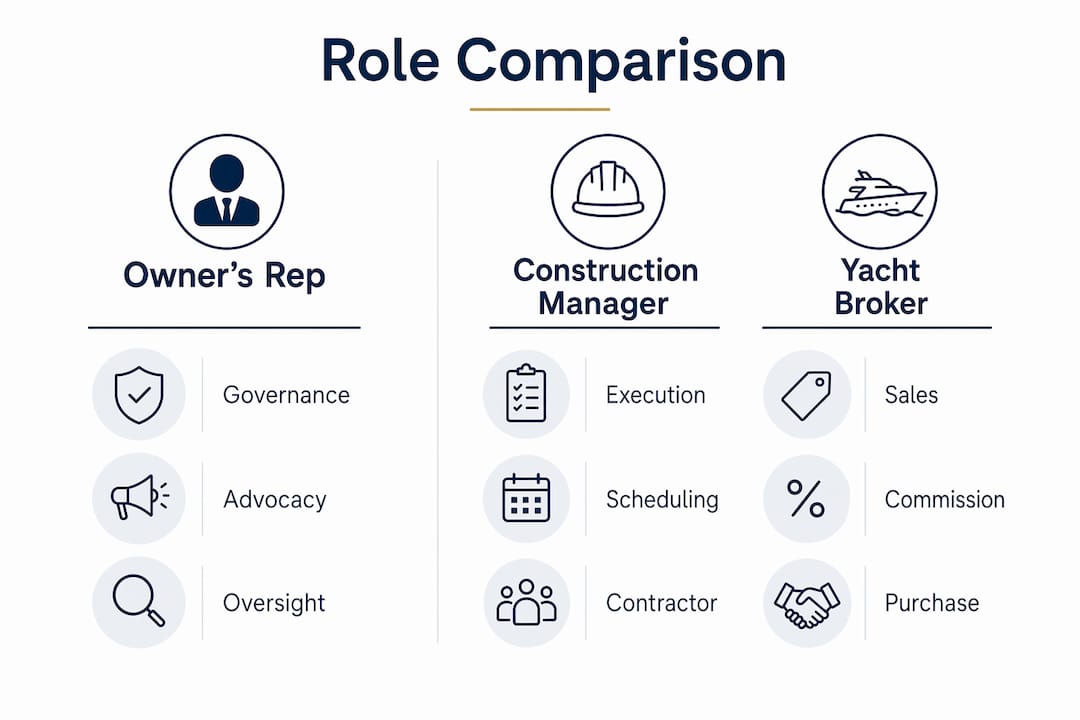
A yacht broker occupies a different position entirely. Brokers facilitate the purchase or sale of a vessel and earn a commission on that transaction. Their expertise is market knowledge, valuation, and negotiation at the point of sale. Once the contract is signed and the build or refit begins, their formal role ends. The owner’s rep steps in precisely where the broker steps out, carrying oversight through delivery and commissioning.
The table below clarifies the distinctions:
| Role | Primary focus | Answers to | Active phase |
|---|---|---|---|
| Owner’s representative | Governance, budget, schedule, owner advocacy | The owner exclusively | Planning through closeout |
| Construction manager | Execution, labor, daily site coordination | The project or contractor | Construction phase |
| Yacht broker | Purchase/sale facilitation, market valuation | Transaction commission | Acquisition only |
| Naval architect | Design and engineering specifications | Design contract | Design and review phases |
The owner’s rep vs. project manager distinction is equally worth noting. A project manager drives execution. An owner’s representative governs the project from the owner’s seat, reviewing what the project manager produces and ensuring it serves the owner’s interests rather than the contractor’s convenience.
When should you engage an owner’s representative for your yacht?
The answer is earlier than you think. Early owner’s rep involvement during project inception and design phases significantly improves budget accuracy, schedule reliability, and financing outcomes. The major scope and delivery decisions made in the first 10% of a project’s timeline have a disproportionate effect on the final 90% of its cost.
For a yacht acquisition or new build, the ideal engagement sequence looks like this:
- Pre-contract phase: Owner’s rep reviews shipyard qualifications, contract terms, payment milestones, and warranty provisions before you sign anything
- Design and engineering phase: Owner’s rep monitors design development, flags specification gaps, and coordinates between the naval architect, interior designer, and systems engineers
- Construction phase: Regular site visits, pay application reviews, change order management, and schedule tracking against agreed milestones
- Sea trials and commissioning: Independent verification that all systems perform to specification before final payment is released
- Closeout: Documentation review, warranty registration, and handover of all technical records
Fee structures vary by project scale and scope. For builds over $5 million, the 1% to 3% range is standard. Smaller refits may be structured as a fixed monthly retainer or a time-and-materials arrangement. Either way, the fee is modest relative to the financial exposure it protects.
Pro Tip: When evaluating candidates, prioritize owner’s representatives with direct experience in luxury yacht or superyacht projects. The subsystems, classification requirements, and contractor relationships in maritime construction differ substantially from commercial real estate or industrial builds. Relevant experience is not a preference. It is a requirement.
What deliverables can you expect from owner’s representative services?
The operational deliverables of a well-structured owner’s representative engagement include weekly project meetings, biweekly contractor coordination sessions, monthly board-level progress summaries, and on-site reviews conducted from the owner’s perspective. These are not informal check-ins. They are structured reporting cycles that create accountability and a documented record of project status.
Specific deliverables typically include:
- Pay application reviews that verify work is complete and correctly invoiced before funds are released
- Change order analysis that assesses whether requested changes are justified, fairly priced, and within scope
- Vendor contract reviews that identify terms unfavorable to the owner before execution
- Risk registers that track open issues, their probability, and mitigation actions
- Owner decision logs that document approvals and instructions, protecting the owner in any future dispute
One of the most underappreciated functions is converting complex project information into concise summaries that require minimal owner time. A luxury yacht build involves hundreds of technical decisions across hull structure, propulsion, navigation electronics, interior fit-out, and safety systems. The owner’s rep filters that complexity into the decisions that genuinely require your attention, and handles the rest within pre-agreed parameters. This protects your bandwidth for your core business and personal priorities.
The risk of confusing owner-side oversight with software tools or general project coordination is real. Explicit deliverables like pay application reviews and owner-aligned reports are what separate genuine advocacy from coordination theater.
How does an owner’s rep protect and maximize the value of your yacht investment?
A luxury yacht is among the most complex assets you will ever own. Its value at resale depends not only on the builder’s reputation but on the documented quality of construction, the completeness of technical records, and the absence of deferred maintenance or hidden defects. An owner’s representative protects all three.
The specific ways this value protection operates:
- Budget preservation: Rigorous change order management prevents scope creep from inflating project cost beyond the original investment thesis
- Schedule adherence: Faster delivery means earlier enjoyment, earlier charter deployment, and avoidance of penalty clauses that erode value
- Quality documentation: Independent oversight creates a paper trail of inspections, approvals, and test results that supports resale value and insurance claims
- Regulatory compliance: Owner’s reps track classification society requirements and flag compliance gaps before they become costly corrections
- Dispute protection: Maintaining independence avoids conflicts of interest and provides unbiased documentation if a dispute with a contractor or shipyard arises
Consider a scenario where a 30-meter custom build encounters a dispute over propulsion system performance during sea trials. Without an owner’s representative, the owner faces the shipyard’s technical team alone, relying on the same contractor who built the system to certify its performance. With an owner’s representative, there is an independent record of every specification, every test protocol, and every deviation from contract. That record is the difference between a negotiated remedy and a protracted legal dispute.
The value of independent oversight in luxury asset projects parallels what experienced advisors provide in high-value real estate, where personalized oversight benefits are well documented across complex acquisition and development scenarios.
Key takeaways
An owner’s representative delivers measurable financial, schedule, and quality protection by acting as the owner’s exclusive advocate from project inception through delivery.
| Point | Details |
|---|---|
| Independent advocacy | The owner’s rep answers only to you, eliminating conflicts of interest present in every other project role. |
| Cost savings of 10%–15% | Scope clarity and change order management return multiples of the 1%–3% advisory fee. |
| 19% faster delivery | Early decision coordination and schedule governance reduce project duration significantly. |
| Early engagement multiplies value | Involvement before design begins captures the greatest leverage over budget and scope. |
| Documented quality protects resale | Independent oversight creates records that support vessel value, insurance, and dispute resolution. |
Why the absence of an owner’s rep is the most expensive decision you can make
I have watched owners approach major yacht builds with complete confidence in their shipyard relationships, only to find themselves 18 months in, $2 million over budget, and arguing over what the contract actually required. The shipyard was not necessarily acting in bad faith. The problem was structural: no one in the room was exclusively accountable to the owner.
The misconception I encounter most often is that an experienced captain or a trusted broker can fill the owner’s rep role informally. They cannot. A captain’s expertise is operational. A broker’s expertise is transactional. Neither has the governance framework, the contract review discipline, or the change order management experience that a dedicated owner’s representative brings. Asking them to cover that ground is like asking your navigator to also serve as your legal counsel.
What I have found actually works is engaging the owner’s rep before the shipyard selection process begins. At that stage, they can shape the RFQ, evaluate yard capabilities, and negotiate contract terms that protect you from the outset. By the time construction starts, the governance structure is already in place. The project oversight framework is not being built under pressure. It is already running.
The other insight worth stating plainly: independence is not a feature of the role. It is the role. An owner’s rep who has financial relationships with the shipyard, the equipment suppliers, or the interior contractor is not an owner’s rep. They are a coordinator with a title. Verify independence before you sign any engagement letter.
— Jason
Expert owner’s representative services for your yacht project

At Baranofyachts, we provide owner’s representative services specifically designed for luxury yacht acquisitions, new builds, and major refits. Our team brings the conductor’s eye to every project, coordinating naval architects, shipyards, systems engineers, and interior specialists so that every decision serves your vision and protects your investment. We translate complex build milestones into clear owner decisions, manage change orders with discipline, and deliver documented quality from keel to commissioning. If you are planning a new build or acquisition, configure your ideal yacht with our team’s guidance, or explore what early project preparation looks like when owner advocacy is built in from day one.
FAQ
What does an owner’s representative do on a yacht project?
An owner’s representative manages budget oversight, schedule tracking, contractor coordination, change order review, and pay application approval on behalf of the yacht owner. Their role spans from pre-contract planning through sea trials and closeout.
How much does an owner’s representative cost?
Owner’s representative fees typically run 1% to 3% of total project cost for builds over $5 million, with smaller refits often structured as monthly retainers. The fee is offset by cost savings of 10% to 15% generated through scope management and change order control.
When should I hire an owner’s rep for a yacht build?
Engage an owner’s representative before the design phase begins, ideally during shipyard selection and contract negotiation. Early involvement captures the greatest leverage over budget accuracy, scope clarity, and schedule reliability.
How is an owner’s rep different from a yacht broker?
A yacht broker facilitates the purchase or sale transaction and earns a commission at closing. An owner’s representative provides ongoing project governance and owner advocacy from contract signing through delivery, covering phases the broker does not.
Does an owner’s representative need yacht-specific experience?
Yes. Maritime construction involves classification society requirements, specialized subsystems, and contractor relationships that differ substantially from commercial construction. An owner’s rep with direct luxury yacht or superyacht experience provides materially better protection than a generalist.
Recommended
Sold Listings


Design Your Yacht
"*" indicates required fields
Maximus III - PNW
As you step aboard MAXIMUS III, the first impression is her scale.
At 120 feet with an 8-meter beam and 294 GT of interior volume, this 2025 Crescent Custom tri-deck immediately feels open, balanced, and estate-like. A timeless look while still feeling fresh from the shipyard.
Currently Available


Get your yacht value Estimate
"*" indicates required fields