
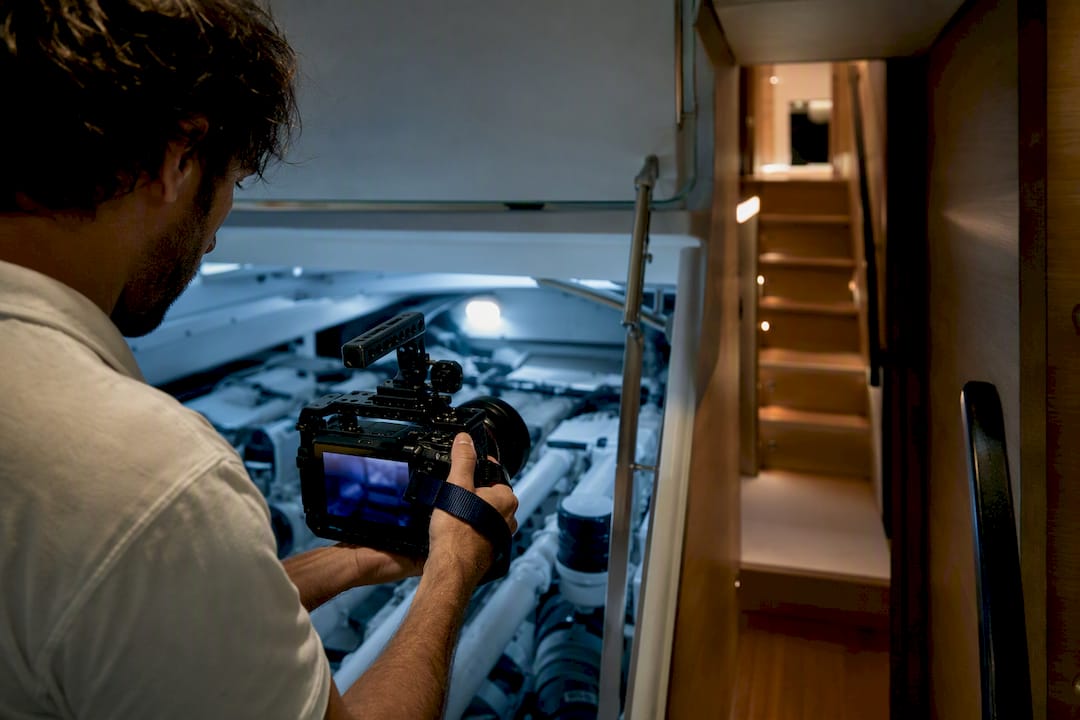
Yacht video walkthroughs let you judge a yacht’s layout, scale, and visible condition before committing to an in-person visit. They compress hours of dockside legwork into a single sitting and reveal cues that photos flatten out. They are also not a substitute for a sea trial or a professional survey, and treating them as one is the most common mistake we see buyers make.
TL;DR:
- Video walkthroughs reveal circulation, sight-lines, and finishes more accurately than photos, with footage of engine starts and sea-trials enhancing confidence.
- Using fixed objects as scale markers and slowing playback of engine and bilge segments helps identify hidden wear, corrosion, or mechanical issues.
- Virtual tours, especially 360° and 3D formats, offer immersive, self-directed exploration that assists in narrowing down options before an in-person visit.
- Requesting unedited footage, live video calls, and detailed close-ups expose potential staging or hidden faults that staged or edited videos might hide.
- Video reviews should be followed by targeted questions, sea trials, and surveys to verify structural and mechanical condition before purchase decisions.
Table of Contents
- What a Yacht Video Walkthrough Actually Covers
- What Should You Look For While Watching a Walkthrough?
- Which Video Format Should You Use to Evaluate a Yacht?
- Turning a Walkthrough Into a Decision
- What Can a Video Hide From You?
- What Standard Should a Walkthrough Actually Meet?
- How Baranofyachts Turns Footage Into a Decision
- Sources
What a Yacht Video Walkthrough Actually Covers
A well-produced walkthrough moves through the yacht the way you would if you were standing on the dock deciding whether to step aboard. That typically means the flybridge or bridge, the saloon, guest and owner cabins, the galley, exterior decks, the tender garage, and the engine room, usually in that order or reversed for effect.
Motion matters more than most buyers expect. Photos can hide a cramped passageway or an awkward stair transition behind a wide-angle lens. Video shows you circulation in real time. How does someone actually move from the saloon to the aft deck? Does the owner’s cabin feel generous walking through it, or just wide in a still frame? That continuous sense of scale is something no photo gallery replicates.
Provenance signals matter just as much as content. Ask who filmed the footage, when, and whether the yacht was underway for any of it.
- Broker-filmed walkthroughs, dated and identified, carry more weight than unattributed marketing clips
- The presence of sea-trial footage suggests the seller is comfortable showing the yacht performing, not just sitting at the dock
- Engine room footage, even brief, signals the seller isn’t avoiding the space buyers care about most
Broker video libraries that pair full interior tours with engine-room runs and sea-trial footage consistently build more buyer confidence than galleries showing only staged saloon shots.
What Should You Look For While Watching a Walkthrough?
Watching a yacht video with intent is different from watching it passively. You need a mental checklist running the entire time, because a 12-minute walkthrough often contains only 20 to 30 seconds of footage on any given detail that matters.
- Track sight-lines and circulation. Watch how the camera moves from the salon to the galley to the cabins. Tight turns, low headroom near stairwells, or awkward door swings show up in motion, not in stills.
- Use fixed objects as scale markers. A sofa, a stove, or a stateroom door frame gives you a reliable reference for cabin dimensions, since brokers rarely include a tape measure on camera.
- Scan finishes for wear patterns such as the effects that a marine ceramic coating for boats can help prevent. Faded teak, chipped gelcoat near hardware, and worn upholstery piping tell you more about actual use than the listing description does.
- Watch engine starts closely. Smoke color, start time, and unusual vibration are all visible on video, even if a full diagnostic isn’t.
- Check bilge condition where shown. Standing water, oil sheen, or corrosion around bilge pumps are red flags you can catch without stepping aboard.
- Request close-ups of documentation. Ask for a clear shot of the engine hour meter and any visible service tags or maintenance stickers.
Disqualifying red flags are usually visible if you know where to look: rust streaks below deck fittings, water staining on headliners, exhaust smoke that lingers rather than clears, or a seller who conveniently cuts away every time the camera nears the bilge.
Pro Tip: Play the walkthrough at half speed through any engine-room or bilge segment. Editors often trim these sections tightly, and slowing playback catches details a normal viewing speed will blur past.
Which Video Format Should You Use to Evaluate a Yacht?
Not every format serves the same purpose, and choosing the wrong one wastes time on both sides of the transaction.
- Linear, hosted walk-and-talks work best when you want seller or broker commentary alongside the visuals, especially for engine runs where narration explains what you’re hearing.
- 360° virtual tours let you explore at your own pace rather than the pace a video editor chose. Immersive 360° tours provide deck-by-deck, cabin-by-cabin exploration and are VR-ready, which gives buyers a near-physical sense of space before ever booking a flight.
- Manufacturer 3D guided tours serve a slightly different purpose: they let you explore interior volumes and circulation to prepare for an in-person visit, often before a specific hull even exists.
- Drone and exterior footage shows you hull profile, deck flow, and wake behavior in a way ground-level video simply cannot.
- VR and interactive tours with embedded specs add searchable hotspots, letting you tap a galley appliance or a stateroom feature to pull dimensions or model numbers on demand.
Some immersive providers now advertise a combined capture session, producing a full 360° tour plus HDR stills, with the finished asset live within about a week. That turnaround matters if you’re deciding whether to request fresh footage on a listing that’s several months old.
Turning a Walkthrough Into a Decision
A video is the starting point of a process, not the end of one. The workflow that works best follows a clear sequence: watch the full walkthrough once uninterrupted, then rewatch with your checklist, then request targeted clips of anything unclear, then pull service records, then schedule verification in person.
Once you’ve done the visual pass, send the broker specific, pointed questions rather than a vague request for “more information”:
- How many hours are on each engine, and when was the most recent haul-out?
- What refit or refresh work has been completed, and is there documentation?
- Is there active warranty coverage on major systems, and does it transfer?
- Can you provide a live video call to walk specific areas the recorded footage skipped?
If the footage shows anything structural, if the bilge looks consistently wet across multiple clips, or if the seller resists a direct follow-up question, that’s your cue to slow down rather than push forward. Manufacturer 3D tours are often positioned as an ideal first step before an in-person visit, and the same logic applies to broker walkthroughs. Use them to narrow your shortlist, then move into the yacht purchase process with a sea trial and a qualified survey once you’re genuinely interested.
What Can a Video Hide From You?
Video has real limits, and pretending otherwise gets buyers into trouble. Below-waterline condition, hidden corrosion behind panels, and intermittent mechanical faults that only appear under sustained load simply don’t show up on camera, no matter how good the footage is.
Sellers and even well-meaning brokers sometimes stage or edit selectively: bright cabin lighting that hides water staining, camera angles that avoid a worn helm console, or engine footage clipped before you hear an irregular knock. None of this is necessarily deceptive on purpose, but it happens often enough to warrant skepticism.
- Ask for raw, unedited footage of the engine room and bilge specifically
- Request a live video call so you can direct the camera yourself, in real time
- Push for close-ups of any area that felt rushed or oddly bright in the original clips
Pro Tip: If a seller hesitates on a live video call after offering a polished pre-recorded tour, treat that hesitation as information. A yacht in genuinely good condition rarely needs careful staging.
What Standard Should a Walkthrough Actually Meet?
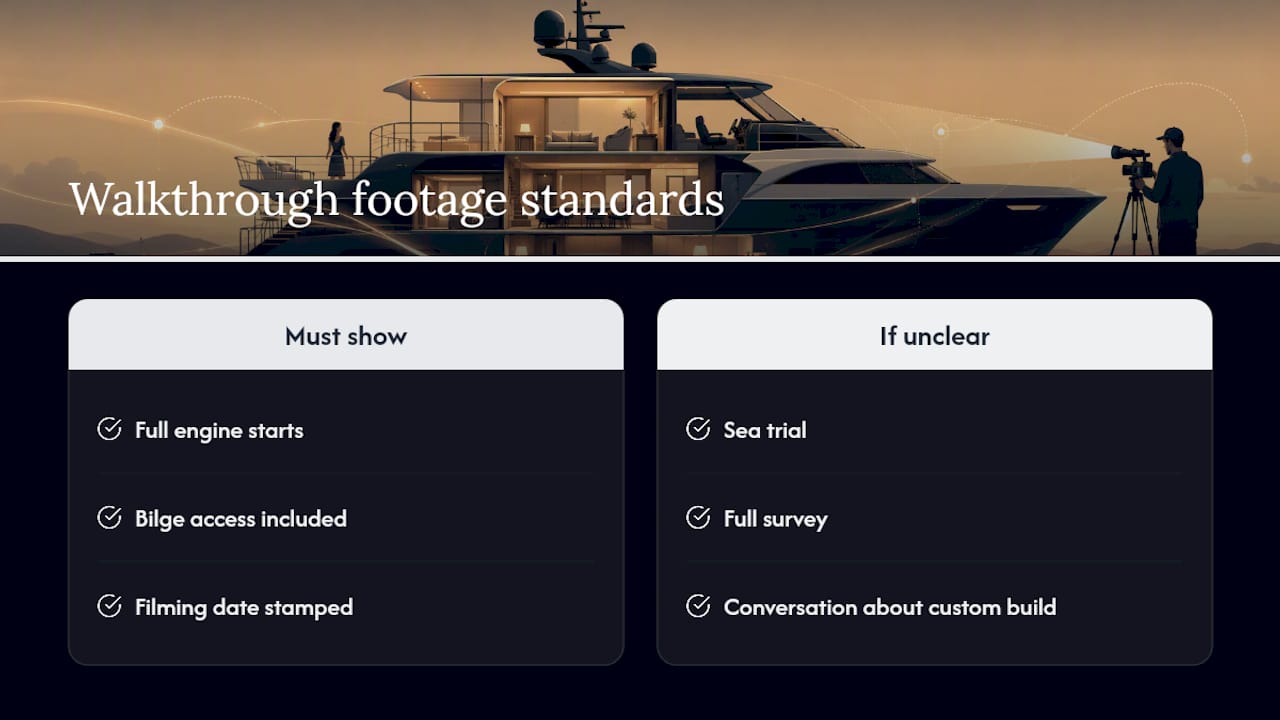
We ask brokers we work with for footage that shows the yacht as it is, not as a highlight reel. That means full engine starts left in, bilge access included without a cutaway, and a filming date stamped on the asset so a buyer knows whether they’re watching current condition or footage from a prior season.
Video review only takes you so far, and knowing where that line sits is part of the job. When a walkthrough raises a question we can’t answer from footage alone, we recommend a sea trial, a full survey, or in some cases a conversation about what a custom build would solve instead of a compromise purchase. The best video-based evaluation isn’t the one with the most polish. It’s the one honest enough to show you the parts a seller would rather skip.
— Jason
How Baranofyachts Turns Footage Into a Decision
Baranofyachts gives you a faster path from watching a walkthrough to actually knowing whether a yacht is worth pursuing, without the back-and-forth of chasing a seller for the clips that actually matter. Instead of guessing what a polished video is hiding, you get a broker who requests the specific footage, records, and live walk-throughs needed to qualify a listing properly.

Our team offers video review consultations where we go through existing walkthrough footage with you, flag gaps, and request targeted clips directly from the listing broker on your behalf. From there, we coordinate survey scheduling, sea trial logistics, and, if a resale yacht doesn’t quite fit, a custom-build conversation. If you already have a listing in mind and want a second set of eyes on the footage, start with our step-by-step luxury yacht tour planning guide or reach out to our brokerage team to schedule a review call this week.
Sources
- 360° Virtual Yacht Tours for Brokers & Dealers | Immersive Yachts
- FP48: discover the catamaran through the 3D tour
Recommended
Sold Listings


Design Your Yacht
"*" indicates required fields
Maximus III - PNW
As you step aboard MAXIMUS III, the first impression is her scale.
At 120 feet with an 8-meter beam and 294 GT of interior volume, this 2025 Crescent Custom tri-deck immediately feels open, balanced, and estate-like. A timeless look while still feeling fresh from the shipyard.
Currently Available


Get your yacht value Estimate
"*" indicates required fields