
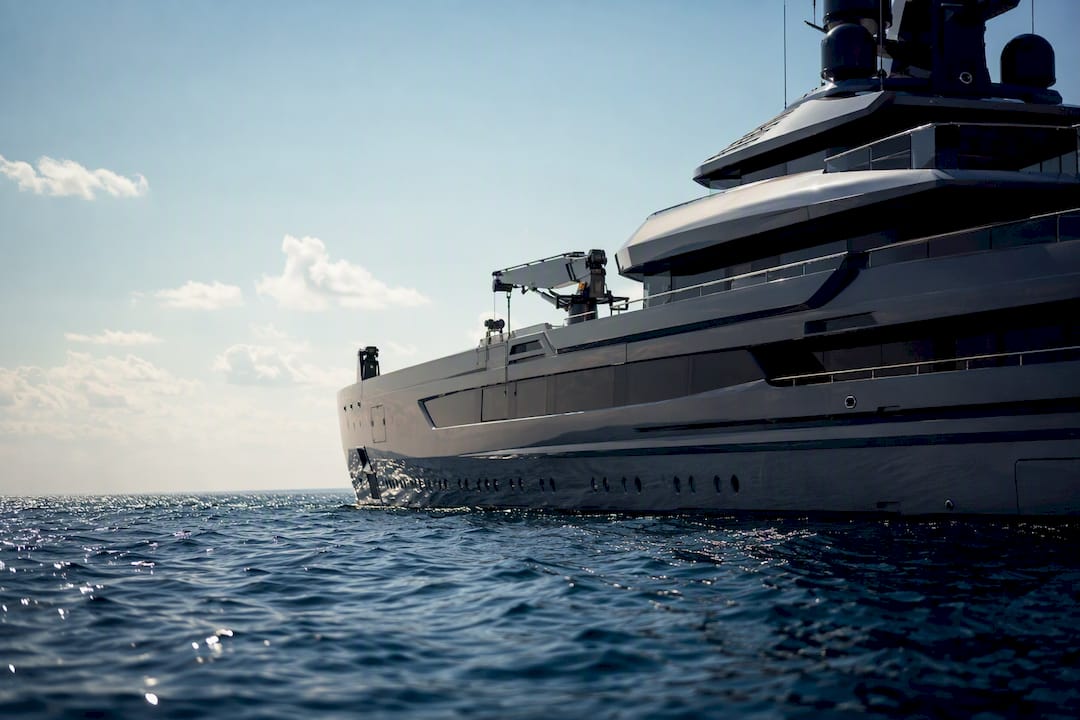
An explorer yacht is a long-range, highly autonomous luxury vessel engineered for remote, multi-season cruising rather than coastal hopping between marinas. The category exists because conventional motor yachts run out of fuel, storage, and structural margin exactly where the most interesting cruising grounds begin.
Three specification cues separate a true explorer from a yacht with expedition styling:
- Range: 3,000 to 5,000+ nautical miles at economical cruising speed, enough to cross an ocean or spend a season in the high latitudes without shore support.
- Tankage and stowage: heavy fuel capacity, expanded freshwater and waste systems, and dedicated space for spares, provisions, and toys.
- Structural margin: commercial-grade scantlings or an ice-belt where operations demand it, built to standards well beyond a standard pleasure-craft hull.
This vessel type suits owners who value autonomy over marina-hopping convenience, who want to carry serious toys and dive or scientific gear, and who plan itineraries measured in weeks of self-sufficiency rather than weekend range.
Key Takeaways
Explorer yacht design succeeds when redundancy, range, and toy-driven layout decisions are locked in before styling, not after.
| Point | Details |
|---|---|
| Define range before hull design | Set fuel tankage around your longest realistic leg plus a 25% safety margin. |
| Prioritize redundancy | Specify duplicate generators and backup steering to avoid single points of failure offshore. |
| Match material to mission | Choose steel with ice-belt for polar work; aluminum hybrid hulls for temperate, resale-focused builds. |
| Lock toy inventory early | Garage geometry and stern-door design should follow your actual tender and toy list, not styling. |
| Partner with an experienced project manager | Baranofyachts coordinates naval architects and shipyards from brief through delivery for expedition-class builds. |
Table of Contents
- What Makes Explorer Yacht Design Different From Standard Luxury Builds?
- Which Hull Materials and Structural Choices Suit Explorer Yachts?
- How Should You Plan Propulsion, Range, and Redundant Systems?
- Which Layout Choices Actually Matter on a Long-Range Cruise?
- What Regulatory and Environmental Factors Shape Explorer Yacht Operations?
- What Do Explorer Yacht Builds Actually Cost and How Long Do They Take?
- How Do You Commission an Explorer Yacht Design?
- How Baranof Yacht Sales Approaches Explorer Yacht Projects
- How Sustainable Is Modern Explorer Yacht Design?
- What Navigation and Communication Systems Do Explorer Yachts Need?
- What the Research Actually Supports
- Why Baranofyachts Is the Direct Path to Your Explorer Yacht
- Frequently Asked Questions
- Sources
What Makes Explorer Yacht Design Different From Standard Luxury Builds?
Good explorer yacht design starts with priorities most conventional builders never have to weigh. A coastal motor yacht optimizes for top speed and dockside presence, while an expedition vessel optimizes for how it behaves on day fourteen of a passage, in following seas, with the generator room running at capacity.
Seakeeping and hull form drive everything else. Full-displacement hulls give the most comfortable motion and the best fuel economy at cruising speed, but they cap top speed in the low teens. Fast-displacement hulls trade some of that efficiency for a few extra knots, useful when owners want to outrun weather windows rather than simply endure them. There is no universally correct answer here. It depends on whether the itinerary favors long, slow ocean crossings or shorter hops between anchorages with tighter weather margins.
Redundancy is the second pillar. A yacht 2,000 miles from the nearest parts supplier cannot afford single points of failure in propulsion, steering, or electrical generation. That means duplicate generators sized to run independently, backup steering systems, and enough spare capacity in HVAC and water systems that one failure does not cascade into an aborted voyage.
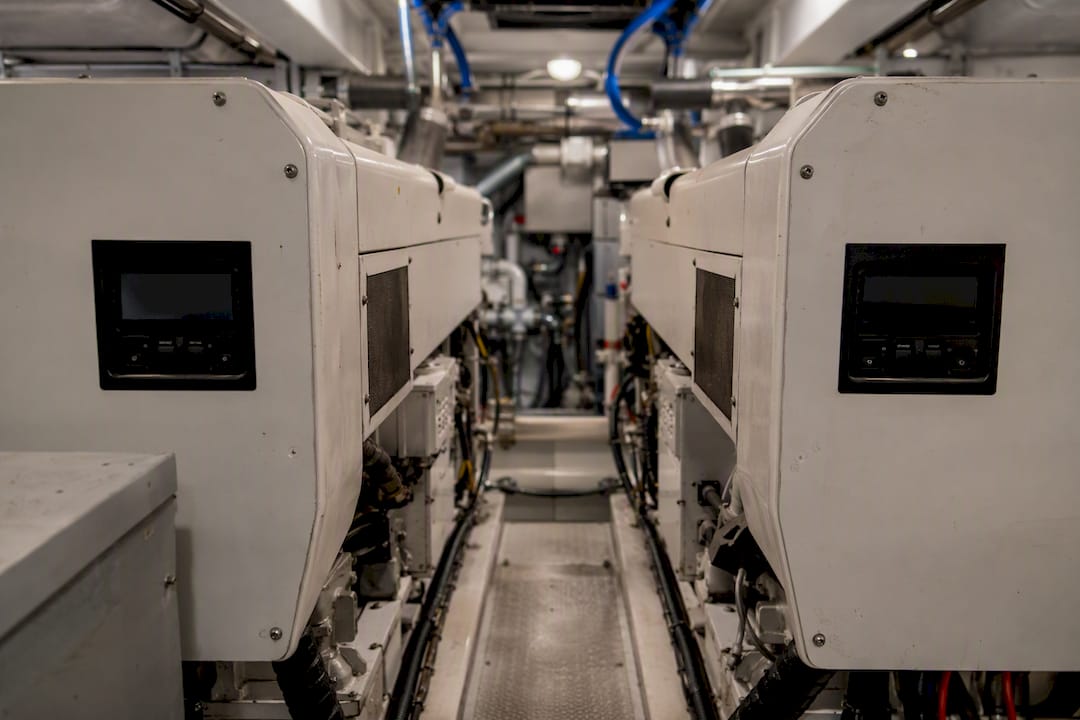
Volume allocation separates serious expedition builds from vessels wearing the aesthetic. Garage space, workshop area, and servicing access have to be locked in before anyone touches the interior design, because retrofitting a tender garage into a hull optimized for guest suites rarely works. Flexible operations and experience-driven design are what separate a vessel that merely looks expedition-ready from one that performs across environments while still delivering the comfort owners expect.
Exterior styling is where the category has matured the most. Early explorer conversions borrowed heavily from offshore supply vessels and looked the part. Design experts now argue that successful explorer yachts keep expedition-grade capability while avoiding a heavy commercial aesthetic, favoring cleaner, more sculptural profiles that still meet functional demands. Naval architect Veronika Schmid of Gill Schmid Design has noted that flexible operations and experiential planning are the real success factors, with the hull and systems needing to satisfy the mission profile without sacrificing the luxury experience owners are paying for.
Pro Tip: Decide your tender and toy inventory before finalizing exterior styling. Garage geometry, stern-door mechanisms, and crane placement all cascade from that single decision, and reversing it after the lines plan is locked usually means a costly redesign.
A useful reference point: designers increasingly favor forward-positioned superstructures that soften the profile visually while preserving functional aft deck space for tenders and toy handling, a layout choice that shows up repeatedly across recent expedition-class concepts.
Which Hull Materials and Structural Choices Suit Explorer Yachts?
Material choice determines how far you can go, how much it costs to maintain, and what happens on resale.
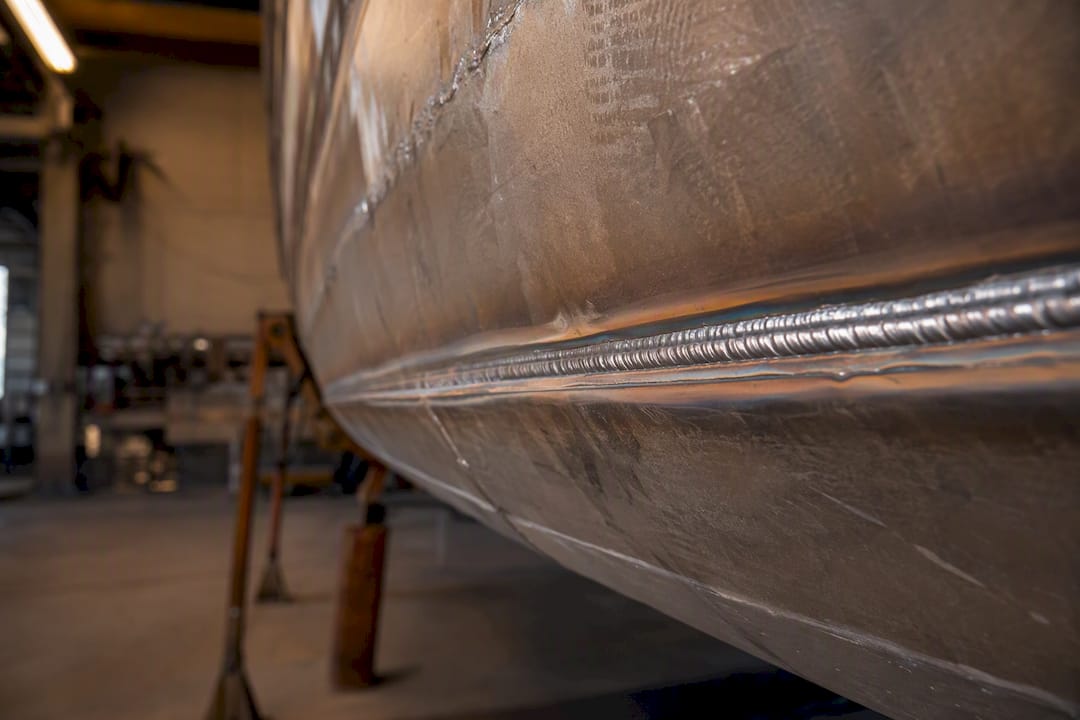
Steel remains the standard for serious explorer hulls. It absorbs impact better than any alternative, handles ice contact without catastrophic failure, and costs less per ton than aluminum or composite. The trade-off is weight, which pushes fuel consumption up and requires more powerful stabilization to manage motion.
Aluminum suits lighter-displacement explorers built for speed over pure ruggedness. It saves weight, resists corrosion better than steel in some environments, and simplifies certain repairs, but it is more expensive per ton and less forgiving of ice or grounding damage.
Composites appear mainly in superstructures rather than primary hulls on true expedition builds, valued for weight savings above the waterline where structural margin matters less.
Hull form matters as much as material. Full-displacement hulls remain the default for maximum range and comfort. Semi-displacement and fast-displacement forms, sometimes paired with a bulbous bow, claw back speed at some cost to fuel burn per mile.
Ice and polar capability change the calculation entirely. An ice-belt, thicker plating at the waterline, and a recognized ice-class notation aren’t cosmetic choices. Damen’s SeaXplorer line demonstrates this approach at production scale, pairing steel hulls and hybrid diesel-electric propulsion with an Ice Class hull rating built for extended-range autonomy. Insurance underwriters and port authorities in high-latitude regions will ask for that notation directly.
Owner priority mapping helps here:
- Maximum range and lowest maintenance: steel full-displacement hull, conventional diesel propulsion.
- Polar or high-latitude work: steel hull with ice-belt and formal ice-class notation.
- Best resale in temperate markets: aluminum semi-displacement hull with hybrid propulsion.
Material selection interacts directly with construction materials suited to luxury and longevity, and it is worth reviewing those trade-offs before locking a shipyard contract.
How Should You Plan Propulsion, Range, and Redundant Systems?
Range planning starts with an honest itinerary, not a marketing number. Multiply your longest realistic leg by a safety margin of at least 25%, then size fuel tankage to cover that distance at cruising speed, not top speed, since fuel burn rises sharply above the efficient displacement range. Water and waste capacity should scale to guest and crew count times the longest number of days between reliable shore facilities, doubled if you plan polar or remote tropical work.
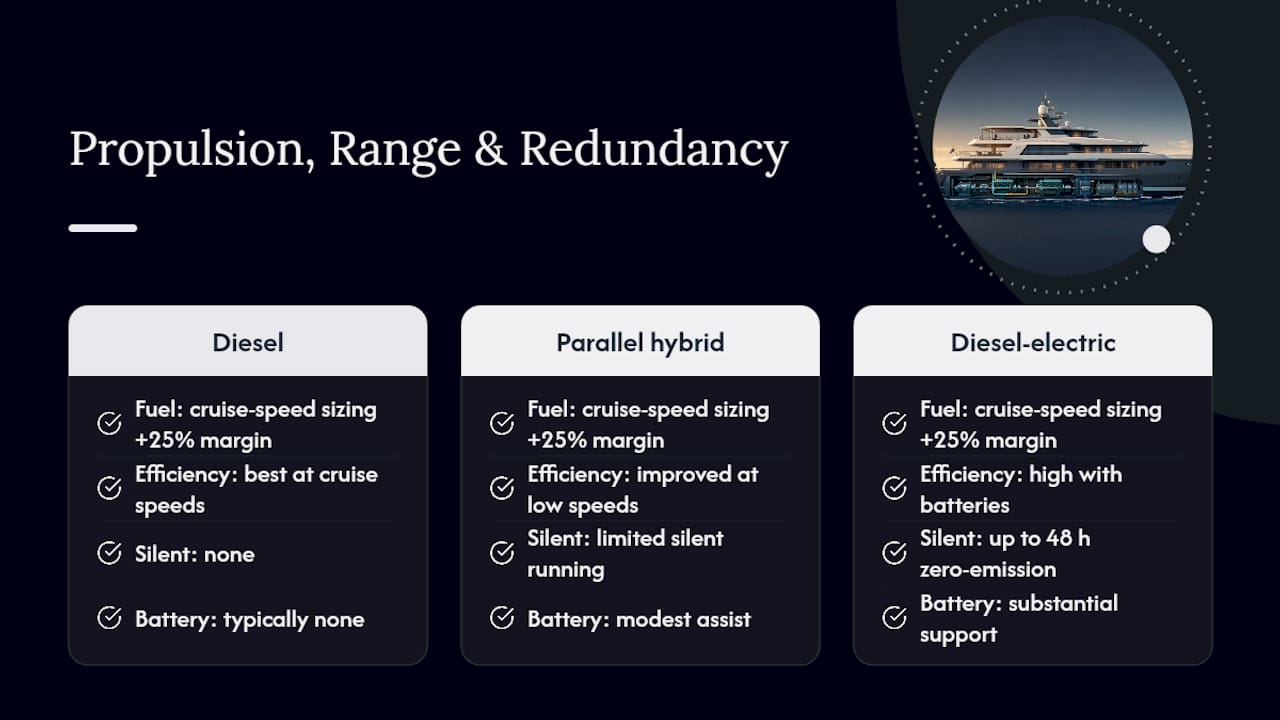
Propulsion choice shapes both economics and range. Conventional diesel remains the simplest and most serviceable option worldwide. Parallel-hybrid systems add an electric motor alongside the diesel, improving efficiency at low speeds and enabling limited silent running. Full diesel-electric setups, and hybrid configurations with substantial battery support, push further: Humphreys Yacht Design’s 50-meter custom explorer uses parallel hybrid propulsion validated through extensive CFD and model testing, reporting a range beyond 5,000 nautical miles at economical cruising speed.
Electrical redundancy deserves the same scrutiny as propulsion. Generator sizing needs to account for full hotel load plus a margin for failure of one unit, and battery banks paired with generators can now deliver meaningful stretches of near-silent operation. Feadship’s VALOR illustrates the upper end of this trend, running its hybrid FAED electrical system for up to 48 hours of zero-emission operation using stored battery power and solar input.
Stabilization is a comfort and fuel-economy decision at once. Active fins work well underway but do little at anchor; gyro stabilizers help at rest but add weight and draw power continuously. Most serious explorer builds now specify both.
Pro Tip: If silent operation in protected marine areas or wildlife zones matters to your itinerary, prioritize battery capacity and a modular generator layout in the earliest design phase. Retrofitting hybrid capability later is far more expensive than specifying it from day one.
Which Layout Choices Actually Matter on a Long-Range Cruise?
Layout decisions on an explorer yacht carry more weight than on a coastal motor yacht because there’s no marina nearby to compensate for a poor choice.
Tender and toy stowage should be sized around your largest planned toy, not the other way around. A 7-meter chase tender or a submersible dictates garage geometry and stern-door mechanism long before interior stylists get involved, and that geometry, in turn, drives hull beam and freeboard decisions aft.
Owner and guest accommodations need to sit apart from crew workflows, both for privacy and for practical circulation during watch changes and servicing runs. Placing the owner’s suite where it’s insulated from engine-room noise and crew traffic pays off over a multi-week passage in ways that aren’t obvious from a two-dimensional deck plan.
Workshops, spare-parts storage, and, increasingly, dive or basic medical facilities are what separate genuine expedition capability from expedition styling. A yacht that can’t perform its own minor repairs 2,000 miles from a shipyard isn’t really an explorer.
Owner-driven scope additions, such as expanded exterior amenity spaces or elaborate interior finishes, can be integrated with expedition capability, but each addition adds weight and complexity that ripples through stability and range calculations.
A short layout checklist for reviewing early concept sketches:
- Does garage geometry match your actual toy inventory, not an aspirational one?
- Is the owner’s suite isolated from engine and crew noise paths?
- Is there dedicated workshop and spare-parts space, not a converted storage closet?
- Do boarding platforms and deck access work in both calm anchorages and rougher sea states?
Ergonomic considerations around crew and guest circulation deserve early attention too, and reviewing ergonomic design guidance for yacht owners before finalizing a general arrangement plan tends to catch problems that are expensive to fix later.
What Regulatory and Environmental Factors Shape Explorer Yacht Operations?
Where you intend to cruise determines equipment and certification as much as personal preference does. Polar operations fall under the IMO Polar Code, which governs hull structure, safety equipment, and operational procedures for ice-affected waters. Tropical deployment brings a different set of demands: oversized HVAC capacity and aggressive corrosion mitigation for hardware exposed to constant heat and salt.
Sea ice, seasonal weather windows, and protected-area rules can compress a polar itinerary into a matter of weeks each year, and owners planning Antarctic voyages specifically need to work within IAATO’s operational guidance, which sets visitor limits and best practices for small vessels in the region.
Before contracting a high-latitude build, owners should confirm which class notations and certificates the yard can actually deliver, since ice-class ratings and Polar Code compliance are verified capabilities, not marketing claims.
What Do Explorer Yacht Builds Actually Cost and How Long Do They Take?
A bespoke new build from schematic design to delivery typically runs several years, with naval architecture, model testing, and class approval consuming a substantial share of that timeline before steel is even cut. Refits move faster, often 12 to 24 months depending on scope, but conversions carry their own risk: commercial-to-luxury conversions can be cost-effective but bring structural and integration complexity that deserves careful evaluation before signing a contract.
The primary cost drivers, in rough order of impact, are hull material and ice-classing, propulsion and hybrid system complexity, naval-architecture hours including CFD and model testing, and the bespoke interior fit-out. Early decisions on toy inventory, propulsion type, and ice-class ambition move these budget categories more than any later change order.
Timeline planning bullets worth locking in early:
- Confirm financing structure before committing to a hull material or ice-class target.
- Schedule crew recruitment to align with sea trials, not delivery date.
- Budget survey and class-society milestones as fixed checkpoints, not flexible dates.
How Do You Commission an Explorer Yacht Design?
Commissioning an explorer yacht follows a sequence, and skipping steps almost always costs more later than doing them in order.
- Define the mission and toy inventory. Decide where you’ll cruise and what you’ll carry before anyone sketches a hull.
- Write the naval-architecture brief. Translate mission and toys into range, tankage, and structural requirements.
- Select the shipyard. Match yard experience to your ice-class or hybrid-system ambitions.
- Negotiate contract stages. Tie payments to milestones, not calendar dates.
- Supervise the build. Independent project oversight catches drift before it compounds.
- Conduct sea trials. Verify range, systems, and redundancy claims against real performance.
Essential questions for designers and yards include how they verify range claims (model testing versus estimation), what ice-class projects they’ve delivered, which suppliers they use for hybrid systems, and what warranty and refit support looks like after delivery.
Selection criteria worth weighing:
- Prior expedition-class delivery experience, not just general superyacht credentials.
- Demonstrated ice-class or Polar Code project history if that’s part of your brief.
- Transparent CFD and model-testing documentation for range and seakeeping claims.
Lock in tankage calculations, a complete toy inventory, and maintenance access plans before finalizing the general arrangement. Reviewing custom naval architecture guidance at this stage helps owners ask sharper questions of prospective designers.
How Baranof Yacht Sales Approaches Explorer Yacht Projects
Baranofyachts builds explorer yacht projects around a client brief developed before naval architects are even engaged. We work through mission profile, toy inventory, and cruising ambitions first, then match that brief to naval-architecture resources with genuine expedition-class experience rather than general superyacht credentials. From there, our project management follows the build through construction milestones, class approval, and delivery, functioning as the client’s eyes on the yard floor.
Related services and resources include:
- Boat brokerage support for owners evaluating existing explorer-class listings.
- Custom build guidance for owners commissioning a new expedition vessel from scratch.
- Shipyard selection insight for owners weighing yard capability against ice-class or hybrid ambitions.
If you’re weighing a new build against an existing listing, a conversation with our team is the fastest way to pressure-test a brief before it becomes a contract.
How Sustainable Is Modern Explorer Yacht Design?
Environmental impact has moved from afterthought to design driver over the past several years. Hybrid propulsion, once a novelty, now shows up across a meaningful share of new expedition concepts, with battery banks sized not just for efficiency but for genuinely silent, low-emission operation in sensitive marine environments. Recent explorer deliveries increasingly pair hybrid systems with solar augmentation to manage hotel loads without running generators continuously.
This matters practically, not just ethically. Many of the destinations that draw explorer-yacht owners, from Antarctic anchorages to Pacific atolls, sit inside protected marine areas with noise and emissions restrictions that conventional diesel-only vessels struggle to meet gracefully. A hybrid system with real battery capacity lets an owner anchor overnight near wildlife without running a generator at 2 a.m.
Waste management and freshwater systems deserve the same scrutiny. Extended autonomy means more onboard treatment capacity, and owners cruising remote regions increasingly specify advanced wastewater treatment that exceeds baseline discharge requirements rather than meeting them at the minimum. Weight and complexity trade-offs apply here too. Every additional treatment system or battery bank adds tonnage that has to be justified against range and stability targets, which is precisely why sustainability decisions belong in the naval-architecture brief from day one rather than bolted on after the hull is built.
What Navigation and Communication Systems Do Explorer Yachts Need?
Explorer yachts operate where cellular coverage doesn’t exist and where local charting can be unreliable or outdated. That reality shapes the systems package more than owners often expect going in.
Satellite communication is non-negotiable for genuine remote operation, covering everything from weather routing to emergency contact and, increasingly, real-time system monitoring that lets shore-based technical teams diagnose a propulsion issue before the vessel even reaches port. Redundant satellite links matter here the same way redundant generators do: a single point of failure in communications during a polar transit is a serious operational risk, not an inconvenience.
Navigation systems for high-latitude and remote-water cruising benefit from ice radar and enhanced charting data beyond standard chartplotter packages, since official charts for many remote regions remain sparse or imprecise. Route-planning tools that integrate weather and sea-ice data have become standard equipment on serious expedition builds rather than optional extras. Owners and captains planning long passages often supplement onboard systems with dedicated marine weather and forecasting apps to cross-check routing decisions against multiple data sources, and pairing that with a broader set of navigation and trip-planning tools gives captains more confidence heading into data-sparse regions.
Integration matters as much as capability. A navigation suite that doesn’t talk to the stabilization system or the engine-monitoring platform creates blind spots exactly when a captain needs a unified picture most.
What the Research Actually Supports
Most explorer yacht content treats range and ice-class as the whole story, but the sharper lesson from recent builds is that redundancy and flexibility matter just as much as raw specification numbers. A yacht with a 5,000-nautical-mile range and no backup steering system is not more capable than one with a shorter range and genuine systems redundancy. It’s just further from help when something breaks.
The conventional advice tends to front-load styling and interior decisions, treating garage layout and systems architecture as details to sort out later. That sequencing is backward. Every project referenced here, from Damen’s SeaXplorer line to Feadship’s VALOR, locked in mission profile and toy inventory before finalizing exterior lines, and it shows in how well those layouts actually serve their owners underway.
If you’re commissioning your first explorer yacht, prioritize the naval-architecture brief and systems redundancy over interior finishes. The finishes are reversible. A hull optimized for the wrong mission is not.
Why Baranofyachts Is the Direct Path to Your Explorer Yacht
Unlike generic yacht marketplaces or design studios that hand you off after the concept sketch, Baranofyachts stays engaged from brief development through delivery, coordinating naval architects, shipyards, and systems suppliers under one project management structure. That matters most on explorer projects, where a single miscommunication between hull designer and hybrid-propulsion supplier can cost months.

If you’re weighing a custom build against an existing listing, our team can walk through range targets, ice-class requirements, and toy inventory with you before you commit to either path. Whether you’re drawn to a bespoke new build or want project oversight on a refit already underway, the next step is a conversation, not a brochure. Reach out to Baranofyachts to schedule a consultation and start turning your mission profile into a working naval-architecture brief.
Frequently Asked Questions
What is the minimum range for a yacht to qualify as a true explorer?
Most naval architects consider 3,000 nautical miles the practical floor for genuine ocean-crossing autonomy, with serious expedition builds targeting 5,000 or more at economical cruising speed.
Do I need ice class if I only plan to cruise temperate waters?
No. Ice class and an ice-belt add weight, cost, and complexity that only pay off if polar or high-latitude cruising is part of your actual itinerary.
How much does hybrid propulsion add to an explorer yacht build?
It varies by battery capacity and generator configuration, but hybrid systems generally add cost upfront in exchange for lower fuel burn and extended silent-running capability at anchor.
Is a refit a faster path to an explorer yacht than a new build?
Often yes, with refits typically running 12 to 24 months versus several years for a bespoke new build, though conversions carry their own structural and integration risks worth evaluating carefully.
What’s the biggest mistake owners make when commissioning an explorer yacht?
Finalizing exterior styling before locking in toy inventory and systems redundancy, which forces expensive rework once the naval-architecture brief catches up to reality.
Sources
- ER yacht design explorer concept ER 40
- How to design the perfect explorer yacht
- Information for yachts | IAATO
Recommended
Sold Listings


Design Your Yacht
"*" indicates required fields
Maximus III - PNW
As you step aboard MAXIMUS III, the first impression is her scale.
At 120 feet with an 8-meter beam and 294 GT of interior volume, this 2025 Crescent Custom tri-deck immediately feels open, balanced, and estate-like. A timeless look while still feeling fresh from the shipyard.
Currently Available


Get your yacht value Estimate
"*" indicates required fields