

For any new build or substantial refit, engage an owner’s-advocate yacht construction manager before design work begins. Arrange a scoping call with Baranof Yacht Sales as your first step.
- A dedicated project manager reduces cost overruns by keeping milestone invoicing, change-order claims, and procurement aligned with your approved budget.
- Independent technical oversight protects your warranty and ensures classification society requirements are met at every stage.
- Early engagement, before the design brief is finalized, gives you the most leverage over schedule, materials, and shipyard selection.
Key Takeaways
Engaging an owner’s-advocate project manager before design work begins is the single most effective way to protect budget, schedule, and technical quality on a luxury yacht build or refit.
| Point | Details |
|---|---|
| Engage early | Appoint a project manager before the design brief is finalized to retain maximum commercial leverage. |
| Verify technical credentials | Confirm classification society experience, QA record production, and owner references before hiring. |
| Require contractual scope | Insist on a detailed scope schedule as a contract exhibit, with defined deliverables at each milestone. |
| Budget for PM fees | Project management fees are a control mechanism, not an overhead; they reduce change-order exposure. |
| Baranofyachts as advocate | Baranofyachts acts as a pure owner’s advocate with no shipyard or supplier financial ties, from brief to aftercare. |
Table of Contents
- What does yacht construction management actually cover?
- How do new-build and refit projects differ in practice?
- What timelines and fee models should you expect?
- How do you choose the right yacht construction manager?
- How does Baranofyachts run a project from start to finish?
- What proof of competence should a project manager provide?
- What should you prepare before your first scoping call?
- What contract terms matter most when hiring a project manager?
- What we believe owners consistently underestimate
- Baranofyachts: your owner’s advocate from brief to first season
- Sources
What does yacht construction management actually cover?
Yacht construction management, known in the industry as owner’s-representative project management, spans every phase from design translation through post-delivery aftercare. It is not a single service but a layered set of responsibilities that a qualified manager holds simultaneously on your behalf.
Technical services form the core:
- Design oversight and brief translation into build-ready specifications
- Technical supervision of hull, systems, and outfitting at the shipyard
- Shipyard coordination and schedule management
- Contract and specification review before you sign
- Procurement support for long-lead equipment and materials
- QA inspections, commissioning, and acceptance sign-off
Commercial services protect your budget:
- Budget oversight and cash-flow forecasting
- Milestone invoice review and approval
- Change-order and claims management
Operational handover prepares your crew:
- Crew training on vessel systems
- Operational manuals and systems documentation
- Formal acceptance certificates and handover records
Understanding delivery logistics and turnkey handover is part of this final phase, since commissioning and transport to your home port are rarely as straightforward as builders suggest.
| Service Area | Key Deliverables |
|---|---|
| Technical oversight | Spec packs, inspection reports, QA records |
| Commercial control | Budget tracker, invoice approvals, change-order log |
| Crew and ops handover | Training records, operational manuals, acceptance certificates |
How do new-build and refit projects differ in practice?
The scope of work looks different depending on whether you are commissioning a vessel from the keel up or upgrading an existing hull. Both demand rigorous oversight, but the risk profile and timing of critical decisions diverge sharply.
New-build responsibilities include:
- Translating your ownership vision into a formal design brief and technical specification
- Evaluating and selecting a shipyard based on capability, capacity, and track record
- Overseeing keel-laying, hull construction, and systems integration milestones
- Conducting pre-outfitting inspections before interiors and electronics are installed
- Managing classification society surveys at each mandatory hold point
Converting owner preferences into a design brief is where most cost surprises originate. Vague briefs produce change orders; precise briefs produce yachts that match expectations.
Refit responsibilities look different:
- Defining scope for upgrades without disturbing class certification or existing warranties
- Coordinating drydock scheduling, which is often the longest lead-time item
- Managing systems retrofits where new equipment must integrate with legacy wiring and plumbing
- Preserving flag-state compliance throughout the work period
The choice of oversight model follows from the project type. Fixed-scope oversight suits refits with a defined work list and a hard deadline. Flexible, milestone-based oversight suits new builds where design evolution is expected and scope changes are a normal part of the process.
Material choices drive cost and schedule differently in each scenario: a new build allows you to specify carbon fiber or aluminum from the outset, while a refit must work within the existing hull’s structural constraints.

What timelines and fee models should you expect?
The Mastt yacht construction guide outlines typical build timelines and cost drivers that owners should budget for before approaching any shipyard or project manager.
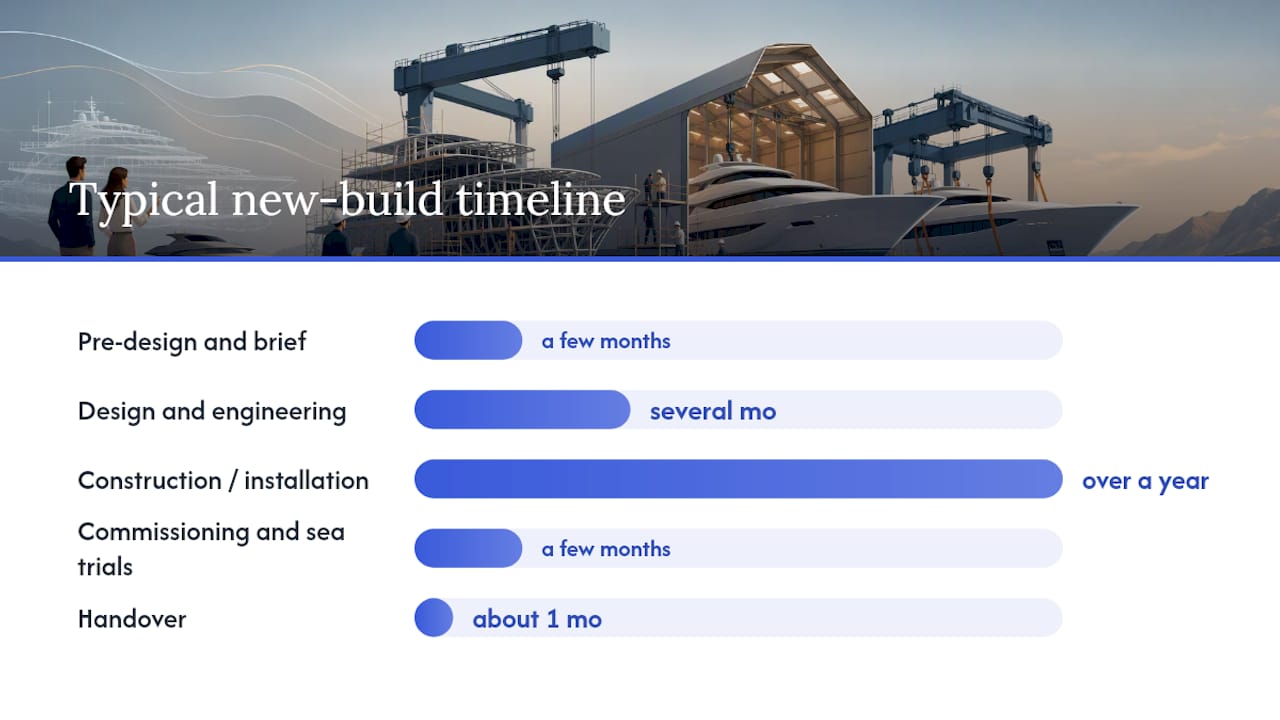
| Phase | New Build (typical) | Refit (typical) |
|---|---|---|
| Pre-design and brief | a few months | a shorter period |
| Design and engineering | several months | a shorter period |
| Construction / installation | a lengthy period spanning over a year | a variable period depending on scope |
| Commissioning and sea trials | a few months | a shorter period |
| Handover | about one month | about one month |
Key milestones owners should insist on receiving formal deliverables at:
- Design freeze sign-off with approved specification
- Keel-laying or drydock entry confirmation
- Systems integration inspection report
- Classification society survey completion
- Sea trial acceptance certificate
- Final handover documentation package
Fee models vary, and each has trade-offs:
- Fixed fee: Predictable cost; works best for well-defined refits with limited scope risk.
- Percentage of contract value: Aligns the manager’s incentive with quality, but requires clear contract-value definition upfront.
- Retainer plus hourly: Suits long new builds where scope evolves; keeps the manager engaged without penalizing efficiency.
- Blended model: A fixed retainer for core oversight with a performance fee tied to on-time, on-budget delivery.
For full budget context, the 2026 yacht cost breakdown from Baranofyachts covers market pricing across vessel categories. Shipyard selection is consistently one of the primary cost and schedule drivers: a yard with strong subcontractor relationships and a proven QA process reduces both change-order frequency and rework costs.
How do you choose the right yacht construction manager?
The hiring decision is where most owners make their most consequential mistake: prioritizing personal rapport over verifiable technical competence. A manager who communicates well but cannot read a structural drawing or challenge a shipyard’s QA record is a liability.
Hiring criteria, in priority order:
- Demonstrable new-build and refit experience with vessels of comparable size and complexity to yours.
- Naval architecture and marine engineering literacy sufficient to interrogate shipyard drawings and specifications.
- Classification society experience (Lloyd’s Register, Bureau Veritas, DNV, or RINA) and knowledge of survey hold points.
- Crew handover capability, including the ability to produce operational manuals and run systems training.
- Verifiable references from owners, not just shipyards or designers.
Questions to ask in the interview:
- “Walk me through a change-order dispute you managed and how it was resolved.”
- “Which classification society surveys did you attend on your last new build, and what deficiencies were raised?”
- “How do you structure your QA inspection schedule, and what documentation do you produce?”
- “Can you provide two owner references from projects of similar scope?”
Red flags that should end the conversation:
- No verifiable owner references, only shipyard or designer endorsements.
- Inability to produce sample QA records, inspection reports, or milestone sign-off documents.
- Fee structures that are opaque or tied exclusively to the shipyard’s own invoicing.
- Communication cadence described as “as needed” rather than a defined reporting schedule.
- No clear escalation protocol for technical disputes with the shipyard.
How does Baranofyachts run a project from start to finish?
Baranofyachts operates as a pure owner’s advocate: we hold no financial interest in any shipyard, designer, or equipment supplier, which means every recommendation we make is calibrated to your outcome, not ours. Our project-management methodology follows a structured process flow with defined communication touchpoints at each phase.
Process flow:
- Discovery: We review your ownership goals, usage profile, budget, and timeline to establish a realistic project framework.
- Design translation: We convert your brief into a technical specification that a shipyard can price and build to, with no ambiguity that could generate change orders later.
- Shipyard oversight: We conduct scheduled and unannounced inspections, attend all classification society surveys, and maintain a live QA log.
- Commissioning: We manage sea trials, systems acceptance, and punch-list resolution before any handover documents are signed.
- Aftercare: We coordinate warranty claims, defect rectification, and crew support through the first operational season.
Communication cadence includes weekly written progress reports, milestone sign-off calls with you or your chief of staff, and a defined escalation protocol for any technical or commercial dispute that cannot be resolved at site level within 48 hours.
Pro Tip: Require an independent QA audit at the systems integration stage, before interiors are installed. Once joinery and paneling are in place, access to wiring runs, plumbing chases, and structural connections is severely restricted. Defects found at this stage cost a fraction of what they cost to rectify post-outfitting.
What proof of competence should a project manager provide?
A credible manager’s portfolio tells you more than any brochure. Look for specifics: vessel type, LOA, build yard, classification society, and a brief outcome summary. Testimonials that mention budget control and launch readiness carry more weight than general praise.
Baranofyachts brings multi-project experience across custom new builds and complex refits, with classification society engagement across Lloyd’s Register and Bureau Veritas programs. Our team has managed projects from initial design brief through to offshore delivery and first-season crew support.
Technical credentials our clients rely on include naval architecture literacy, marine systems engineering oversight, classification society survey attendance, and structured crew handover programs that include live systems walkthroughs and written operational documentation.
What should you prepare before your first scoping call?
Arriving at a scoping call with the right information cuts the time to a formal proposal significantly. Before building your yacht, gather the following:
- Project goals: New build or refit, vessel type, LOA range, intended use (private, charter, corporate).
- Budget range: A realistic total budget, including a contingency allowance to cover potential change orders and unforeseen scope.
- Timeline: Your target delivery or relaunch date, and any fixed constraints (charter season, delivery port, flag-state registration).
- Vessel documents: For refits, current class certificate, flag-state registration, and any existing survey reports.
- Previous project references: Records of prior refits, upgrades, or build experience that give context to your expectations.
Engagement steps after the call:
- Scoping call to align on project parameters and confirm fit.
- Site or shipyard visit (for refits, an onboard survey; for new builds, a shipyard capability review).
- Written proposal with scope, fee model, and milestone schedule.
- Contract execution and project kick-off meeting.
What contract terms matter most when hiring a project manager?
The contract between you and your project manager is the document that protects you if the relationship or the build goes wrong. Several terms deserve close attention before you sign.
Scope definition must be explicit. A contract that describes services as “general oversight” gives the manager latitude to deprioritize tasks that are inconvenient. Require a detailed scope schedule as an exhibit, listing every deliverable and the milestone it is tied to.
Reporting obligations should be contractually specified: frequency, format, and who receives them. A weekly written report and a monthly milestone sign-off call are reasonable minimums for a new build.
Fee and payment terms need a clear change-order mechanism. If the project scope expands, how is additional fee calculated and approved? Without this, disputes are almost inevitable on long builds.
Termination rights should be mutual and tied to performance, not just convenience. You need the right to terminate for cause (missed deliverables, loss of key personnel, conflict of interest) with a defined notice period and a handover protocol that protects continuity.
Conflict-of-interest provisions are non-negotiable. The contract should prohibit the manager from receiving commissions, referral fees, or any financial benefit from shipyards, designers, or suppliers engaged on your project.
Finally, warranty and aftercare obligations should extend beyond delivery. Specify the period during which the manager remains responsible for coordinating defect rectification and warranty claims on your behalf.
What we believe owners consistently underestimate
The most common mistake we see is treating project management as a cost rather than a control mechanism. Owners who engage a manager late, after the shipyard contract is signed, lose the two most valuable intervention points: specification quality and commercial terms.
A shipyard contract signed without independent review almost always contains clauses that favor the yard on change orders, milestone payments, and defect liability. By the time an owner realizes this, the leverage is gone. The manager’s fee, paid from the outset, is the most cost-effective insurance available in luxury yacht building.
We also see owners underestimate the crew handover phase. A vessel that is technically complete but operationally undocumented creates risk from the first day of use. Systems that were never formally accepted, manuals that were never written, and crew who were never trained are the source of most first-season incidents and warranty disputes.
Baranofyachts: your owner’s advocate from brief to first season
Baranofyachts gives you a single point of accountability across every phase of your build or refit, with no financial ties to any shipyard, designer, or supplier. Where other routes leave you coordinating between parties with competing interests, we hold the conductor’s role: one team, one contract, one clear line of responsibility from design brief to delivery day.

Our clients arrive at handover with complete QA records, trained crews, and warranty protections that are documented and enforceable. We manage the commercial pressure so you can focus on the ownership experience. For corporate clients and family offices, we provide the reporting cadence and audit trail that principals and boards require.
To take the next step, request a scoping call with our project team. We will review your project parameters, confirm fit, and deliver a written proposal within five business days.
Sources
- Yacht Construction Guide: Types, Timeline, and Costs
Recommended
Sold Listings


Design Your Yacht
"*" indicates required fields
Maximus III - PNW
As you step aboard MAXIMUS III, the first impression is her scale.
At 120 feet with an 8-meter beam and 294 GT of interior volume, this 2025 Crescent Custom tri-deck immediately feels open, balanced, and estate-like. A timeless look while still feeling fresh from the shipyard.
Currently Available


Get your yacht value Estimate
"*" indicates required fields