

High-end yachts are defined by a short set of signature features: expansive beach clubs, spa and wellness suites, bespoke interiors, advanced stabilization and propulsion, extensive water-toy arsenals, aviation access, and the engineered systems that make every one of those amenities reliable at sea. What separates a true superyacht from an upscale recreational boat is not a single standout amenity but the orchestrated integration of all these systems, built to SOLAS and LY2 standards where commercial use applies, and specified with the kind of material and craft discipline that holds value over decades. Baranof Yacht Sales works with owners and buyers at every stage of that process, from initial brief through delivery, and the sections below reflect what we consistently see matter most when a client is evaluating, commissioning, or refitting a vessel.
The hallmark features to look for at a glance:
- Beach club and waterside living spaces with hydraulic platforms and spa integration
- Spa, wellness, and gym facilities sized for full-guest-service loads
- Cinema and immersive AV systems with acoustic isolation and satellite connectivity
- Water-toy garage stocked with Seabobs, eFoils, jet skis, and professional dive gear
- Helipad or hangar for private arrival and itinerary flexibility
- Bespoke interiors in fine wood, marble, and custom joinery
- Stabilizers, hybrid propulsion, and automation for comfort and efficiency
- Safety and regulatory compliance aligned with U.S. and international codes
- Sustainability systems covering waste management and energy efficiency
Table of Contents
- 1. The beach club is the social heart of a modern superyacht
- 2. Spa, wellness, and gym spaces define the onboard living standard
- 3. Onboard cinema and AV systems reward careful specification
- 4. Water toys, tenders, and the garage separate good yachts from great ones
- 5. Aviation access changes what a superyacht can do
- 6. Bespoke interiors: materials, joinery, and the quiet-luxury standard
- 7. Engineering systems are what make luxury features actually work
- 8. Safety, capacity, and U.S. regulatory basics every owner should know
- 9. What ownership actually costs: the 10% rule and annual operating budgets
- 10. Build and refit timelines: what actually drives the schedule
- 11. How to match a yacht’s features to your actual lifestyle
- 12. Quiet luxury and wellness-forward design are reshaping next-gen yachts
- Key Takeaways
- Why craft and project oversight determine what you actually receive
- Baranofyachts: your partner from specification to delivery
- Useful sources and references
1. The beach club is the social heart of a modern superyacht
The beach club has evolved far beyond a simple swim platform. On today’s high-end yachts, it functions as a multi-level resort space at the waterline, combining direct sea access with lounge seating, dining, spa pools, steam rooms, and integrated bar service. Guests move from the main salon down to the water without passing through crew corridors, and that flow is what makes the space feel genuinely resort-grade rather than merely functional.
When evaluating a beach club, look at these design and operational factors:
- Crew workflow: — a separate crew access route so provisioning and toy retrieval do not interrupt guest time
Beach-club design also has a direct effect on charter appeal and resale value. Owners who prioritize a seamless spa and beach-club flow consistently see stronger charter interest and higher guest satisfaction scores. When reviewing a specification sheet, confirm the platform lift capacity, the footprint in square meters, and whether the garage door opens independently of the platform.
Pro Tip: Ask the yard or broker for the beach-club drainage plan. Poor wash-down drainage is one of the most common sources of corrosion and odor complaints on vessels that are otherwise beautifully finished.
2. Spa, wellness, and gym spaces define the onboard living standard
A well-designed wellness suite is not a luxury add-on; it is a primary driver of how guests experience a long passage. On vessels above 40 meters, buyers should expect dedicated massage suites, a sauna or steam room, treatment rooms with plumbed beauty-salon capability, and a medical first-aid station with defibrillator and oxygen. The gym typically occupies a sea-view position on the upper deck, with equipment choices ranging from Technogym cardio machines to free-weight stations and yoga mats, and storage for all of it when underway.
Key considerations when evaluating wellness spaces:
- HVAC and humidity control: steam rooms and treatment areas require independent ventilation circuits to prevent moisture migration into adjacent cabins
- Noise and vibration isolation: mechanical equipment beneath a spa deck must be acoustically decoupled, or the experience is undermined by engine noise
- Drainage sizing: spa pools and treatment wet areas need drains sized for full-load use, not just incidental splash
- Staffing logistics: a dedicated treatment room is only as useful as the ability to embark a therapist; confirm crew berthing capacity and whether the vessel’s charter profile includes wellness staff
For charter use, ask the broker whether the vessel’s spa has been certified for commercial operation and whether the medical station meets the flag state’s minimum requirements. For private use, the same questions apply to your own peace of mind on extended passages.

3. Onboard cinema and AV systems reward careful specification
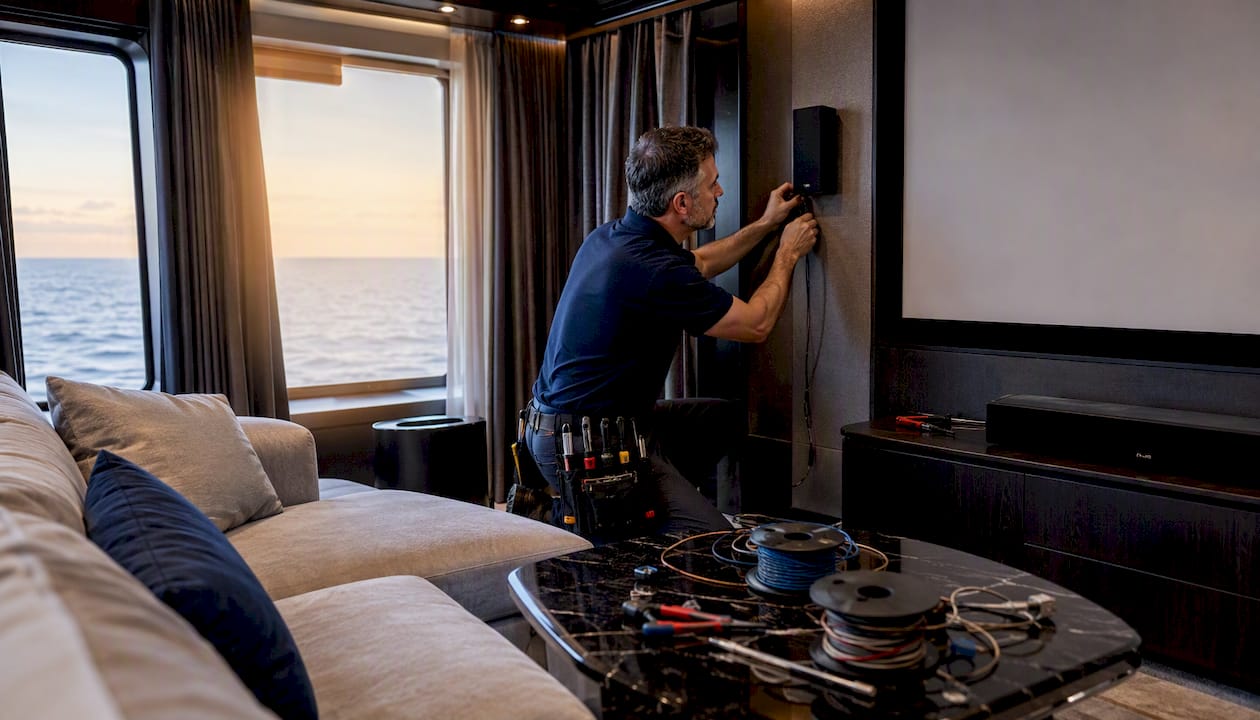
Private cinemas and high-end AV systems are standard on superyachts above a certain size, and the gap between a well-specified installation and a poorly integrated one is immediately apparent to any guest who has experienced both. The best installations offer three distinct experiences: a dedicated indoor theater with acoustic isolation and a 4K laser projector, an open-air cinema on the sundeck with a retractable screen, and a convertible sky-lounge that shifts from dining to screening mode at the touch of a panel.
What to assess when evaluating AV quality:
- Acoustic isolation: cinema doors and bulkheads should be lined with mass-loaded vinyl or equivalent treatments so sound does not bleed into adjacent cabins
- Vibration decoupling: subwoofer and speaker mounts must be isolated from the hull structure, or engine and sea-state vibration corrupts the listening experience
- Satellite connectivity: a VSAT or Starlink Maritime installation with adequate bandwidth for 4K streaming and simultaneous guest device use
- Content libraries and ease of use: a Crestron or Savant control system that guests can operate without crew assistance, with pre-loaded content libraries for areas with limited connectivity
- Serviceability: confirm that the AV rack is accessible for on-passage maintenance and that the integrator has a service agreement covering the vessel’s operating regions
Weight and power draw are real constraints. A full cinema installation with acoustic treatment, projection, and surround sound can add meaningful tonnage and electrical load, both of which affect range and generator sizing. Verify those trade-offs in the vessel’s stability booklet and electrical load analysis before signing off on a specification.
4. Water toys, tenders, and the garage separate good yachts from great ones
Modern water-toy inventories on high-end yachts now routinely include Seabobs, eFoils, jet skis, towable inflatables, professional-grade dive gear with compressors, and in some cases small sailboats or hydrofoil boards. Crew members are trained to provide instruction and safety briefings for all of it, which is a meaningful operational commitment that affects crew size and training budgets.
Toy inventory at a glance: Seabobs, eFoils, jet skis, inflatable slides, towables, dive compressors, and kayaks are now considered baseline on charter-grade superyachts. Vessels that cannot launch and retrieve the full inventory safely in a reasonable sea state lose charter bookings to those that can.
The garage design determines how much of that inventory is actually usable:
- Garage volume and door configuration: a fold-down transom door or side-opening garage with a ramp system allows faster, safer launches than a crane-only arrangement
- Lift capacity: the crane or davit must handle the heaviest tender plus a safety margin; confirm the rated capacity against the tender’s wet weight
- Fuel and charging infrastructure: jet skis need dedicated fuel lines and spill containment; eFoils and electric Seabobs need 240V charging stations with adequate amperage
- Maintenance access: tools, spare parts, and a workbench should be integrated into the garage so the crew can service toys without bringing equipment through guest spaces
Toy selection also affects payload and trim. A heavy dive compressor, multiple jet skis, and a large tender can shift the vessel’s center of gravity enough to affect stability calculations. Verify the combined weight of the intended toy inventory against the vessel’s payload margin in the stability booklet.
5. Aviation access changes what a superyacht can do
Vessels above 60 meters frequently include private helidecks, and the operational flexibility that comes with a certified helipad is substantial: guests can arrive directly from a private terminal, transfer between vessels in a fleet, or take scenic flights without coordinating tender logistics. The difference between a touch-and-go pad and an enclosed hangar is significant in both cost and design complexity.
- Touch-and-go pad: the more common arrangement, typically positioned on the bow or sundeck, certified to a specific maximum take-off weight (MTOW) and requiring deck reinforcement, non-slip surfacing, and a firefighting system
- Enclosed hangar: allows the helicopter to be stowed aboard, protecting it from salt air and freeing the pad for other uses; adds considerable weight and structural complexity, and is typically found on vessels above 70–80 meters
- Deck reinforcement and fuel handling: a helipad requires structural engineering to distribute dynamic loads, and aviation fuel storage must meet SOLAS fire-safety requirements with dedicated suppression systems
- Marina and port clearances: a helipad on the bow affects the vessel’s air draft and may restrict access to certain marinas or bridges; confirm clearances for your intended cruising area before specifying the pad location
Pro Tip: Plan guest transfer logistics before the vessel is designed, not after. The helipad location affects tender launch zones, deck furniture placement, and crew workflow. A pad positioned for operational convenience during the design phase saves significant retrofit cost later.
For owners who want aviation capability without the structural commitment of a full helipad, a support vessel carrying the helicopter is a practical alternative. Many owners of large superyachts use a shadow vessel to carry bulky equipment, preserving the mothership’s payload balance and living space.
6. Bespoke interiors: materials, joinery, and the quiet-luxury standard
Interior finish quality is the single most visible expression of a yacht’s luxury level, and it is also where specification drift most commonly occurs during a build. Fine woods, marble, high-grade leathers, and custom textiles create the sensory environment guests remember, but their long-term performance depends entirely on how they are specified, installed, and maintained.
What to look for in a specification or walkthrough:
- Joinery tolerances: gaps between panels, drawer faces, and door frames should be consistent to within a millimeter; inconsistency is a sign of rushed outfitting
- Acoustic lining: bulkhead panels in cabins and the cinema should have mass-loaded backing, not just decorative veneer over bare structure
- Material maintenance implications: marble requires sealing and is vulnerable to acidic cleaners; exotic woods need UV-stable finishes; leather in high-UV areas fades without protective treatment
- Bespoke furniture design: custom pieces should come with shop drawings and material specifications so they can be replicated or repaired during a refit
The quiet-luxury aesthetic favors restrained palettes, integrated technology (flush-mounted screens, concealed speakers, hidden lighting channels), and daylight control through motorized shading. Ask to see the lighting design drawings and the acoustic treatment schedule, not just the material sample boards, when evaluating a build proposal. For a deeper look at how artisan craftsmanship shapes long-term value, the Baranofyachts guide on artisan craftsmanship in luxury yachts is a useful reference.
7. Engineering systems are what make luxury features actually work
The amenities on a high-end yacht are only as good as the systems behind them. A spa pool that vibrates with engine noise, a cinema that loses satellite signal in open water, or a beach club that cannot be used at anchor because the stabilizers are off — these are failures of engineering integration, not design.
Stabilization is the foundation of guest comfort. Fin stabilizers reduce roll at speed; gyroscopic stabilizers (such as those from Seakeeper) provide zero-speed stabilization at anchor, which is when guests are most likely to be using the spa, pool, or cinema. For vessels where pool and spa use at anchor is a priority, active zero-speed stabilization is not optional.
On propulsion: Diesel-electric and hybrid systems are increasingly specified on new builds because they reduce noise and vibration in guest spaces, lower fuel consumption at displacement speeds, and allow the generators to run at optimal load regardless of propulsion demand. Hull type and propulsion choice together determine the structural trade-offs that affect interior layout and finish longevity.
Key engineering systems to verify in a specification:
- HVAC capacity: sized for full-guest-service loads in the vessel’s intended operating climate, with independent zones for each cabin and the wellness areas
- Fresh-water production: watermakers sized to supply the spa, laundry, galley, and all guest cabins simultaneously without drawing down the tanks
- Waste management: holding tanks, macerators, and treatment systems that comply with MARPOL and U.S. EPA discharge regulations
- Automation and integrated bridge systems: a Kongsberg, Furuno, or equivalent integrated bridge with remote monitoring, engine management, and alarm systems accessible from the captain’s station and, increasingly, from a tablet
The environmental footprint of large superyachts is a genuine concern. Industry sources note measurable CO2 output from top superyachts, particularly from generators running at anchor. Hybrid power systems and shore-power connections at marinas are the most practical mitigations currently available, and they are worth specifying at the design stage rather than retrofitting later.
8. Safety, capacity, and U.S. regulatory basics every owner should know
The 12-passenger threshold is the most consequential regulatory line in superyacht ownership. Carrying more than 12 passengers triggers commercial codes, including SOLAS and the Large Yacht Code (LY2/LY3), which impose significantly higher structural, safety, and operational requirements. Many owners deliberately limit their guest count to 12 to operate under the simpler private-yacht framework, even on vessels large enough to carry more.
The 12-passenger rule: crossing this threshold means commercial certification, additional life-saving appliances, stricter crew qualification requirements, and more frequent flag-state inspections. The design implications alone, including liferaft placement, fire-zone separation, and emergency lighting, can add meaningful cost and complexity to a build.
For U.S. owners and operators, the U.S. Coast Guard (USCG) sets additional requirements for vessels documented under U.S. flag, including stability testing, safety equipment standards, and crew certification under STCW. Key points to confirm with your flag state and classification society:
- Crew accommodation standards: SOLAS and MLC 2006 set minimum cabin sizes, ventilation, and rest-hour requirements for professional crew; these directly affect layout and operating cost
- Life-saving appliances: liferaft capacity, EPIRB registration, and fire-suppression systems must be certified and current
- Stability booklet: a current, flag-state-approved stability booklet is required for all commercial operations and is a critical due-diligence document for any purchase
Crew structure on a superyacht is multi-disciplined, covering captain, engineers, interior staff, and deck crew, and crew accommodation planning materially affects both layout efficiency and operating cost. For guidance on building and managing a professional crew, the Baranofyachts resource on crew management for luxury yachts covers the operational planning side in detail.
9. What ownership actually costs: the 10% rule and annual operating budgets
The industry’s most widely used budgeting heuristic is the “10% rule”: annual operating costs typically run approximately 10% of the vessel’s purchase price. A $10 million yacht costs roughly $1 million per year to operate; a $50 million vessel, approximately $5 million. The rule is a starting point, not a guarantee, and vessels with large crews, extensive toy inventories, or frequent charter use will often exceed it.
Major annual operating cost categories:
| Cost Category | Typical Share of Annual Budget |
|---|---|
| Crew payroll and benefits | 40–50% |
| Maintenance and yard work | 15% |
| Insurance | 5–10% |
| Fuel | 10–15% |
| Dockage and marina fees | 5–10% |
| Provisions and consumables | 5–8% |
| Seasonal refit and surveys | 5–10% |
Charter pricing for large superyachts can exceed €100,000 per week, which gives a useful benchmark: a vessel generating charter revenue at that level still requires careful cost management to run profitably. For private owners, the operating budget is a pure expense, and verifying the seller’s actual operating-cost history, not just the broker’s estimate, is one of the most important steps in due diligence.
Practical budgeting advice:
- Request three years of operating accounts from the seller, broken down by category
- Build a 10–15% contingency into the first year’s budget for unexpected maintenance
- Confirm whether the quoted crew payroll includes all benefits, travel, and training costs
- Factor in the cost of yacht provisions management as a separate line item if the vessel operates on charter
10. Build and refit timelines: what actually drives the schedule
A new superyacht build typically runs 24–48 months from signed contract to delivery, depending on vessel size, customization depth, and yard capacity. Refits range from a few weeks for a cosmetic refresh to 18 months or more for a full systems overhaul. The single biggest schedule risk in both cases is specification change after the detailed engineering phase has begun.
Key timeline phases for a new build:
- Concept and design: naval architecture, interior design, and regulatory pre-approval, typically 3–6 months
- Detailed engineering: structural drawings, systems engineering, and classification society review, 4–8 months
- Hull construction and outfitting: steel or aluminum hull, composite superstructure, and systems installation, 12–24 months
- Systems integration and commissioning: AV, automation, stabilizers, HVAC, and all subsystems tested together, 2–4 months
- Sea trials and delivery: flag-state inspection, stability testing, and owner acceptance, 1–2 months
Factors that extend schedules:
- Bespoke customization: custom joinery, one-off furniture pieces, and specialty finishes require longer lead times and more quality-control iterations than standard options
- Material lead times: carbon fiber composites, specialty marbles, and custom-woven textiles can have lead times of 6–12 months; ordering late pushes the outfitting phase
- Regulatory certification: classification society reviews and flag-state approvals add time at each phase; plan for them, not around them
- Subcontractor capacity: top AV integrators, joinery workshops, and systems engineers are often booked 12–18 months in advance
Request a milestone schedule with float identified at each phase, and ask the project manager to show you the critical path. A yard that cannot identify its critical path has not planned the project rigorously enough.
11. How to match a yacht’s features to your actual lifestyle
The most common mistake buyers make is specifying a vessel for an idealized version of how they will use it rather than their actual patterns. A 70-meter yacht with a full helipad, a 12-person spa, and a garage for eight toys requires a crew of 18–22 and a budget to match. If you cruise two weeks a year with four guests, that specification is working against you.
A practical prioritization checklist for broker conversations:
- Intended use: private owner, charter revenue, expedition, or corporate hospitality — each drives different feature priorities
- Guest count and profile: families with children need different spaces than corporate groups or couples
- Cruising areas: the Caribbean and Mediterranean have different draft constraints, marina access, and weather profiles than the Pacific Northwest or Alaska
- Storage and toy needs: match the toy inventory to the crew capacity to operate it safely
- Environmental preferences: hybrid propulsion and shore-power capability matter more for owners who spend extended time at anchor in sensitive areas
- Resale horizon: features that add charter appeal (beach club, large toy garage, helipad) also tend to support resale value
Trade-off examples worth discussing with your broker: a long-range fuel capacity comes at the cost of payload for toys and provisions; a large beach club on a 40-meter vessel may reduce the aft cabin footprint; a heavy toy inventory affects trim and may require ballast adjustment.
Pro Tip: Align your crew size to your amenity choices before you finalize the specification. A spa, cinema, beach club, and full toy garage each require dedicated crew time to operate and maintain. Undercrewing a well-specified vessel is one of the fastest ways to degrade the guest experience.
For corporate use cases, the Baranofyachts guide on yachts in corporate hospitality outlines how specific amenities map to business entertainment priorities.
12. Quiet luxury and wellness-forward design are reshaping next-gen yachts
The dominant design direction in new superyacht commissions right now is what the industry calls “quiet luxury”: material restraint over visual maximalism, acoustic-first design decisions, and wellness systems integrated into the vessel’s core layout rather than added as afterthoughts. This is not a passing aesthetic trend. It reflects a genuine shift in how owners and their guests want to experience time aboard.
What this means in practice for buyers evaluating a specification:
- Material restraint: fewer contrasting finishes, more tonal consistency, and a preference for natural materials with visible grain and texture over high-gloss laminates
- Acoustic-first decisions: mass-loaded bulkhead linings, floating floor systems in cabins, and acoustic-rated doors throughout, not just in the cinema
- Wellness integration: the spa, gym, and beach club should connect as a continuous circuit, not as separate rooms accessed through crew corridors
- Circadian lighting: tunable LED systems that shift color temperature through the day, supporting sleep quality on long passages
- Air quality: HEPA filtration in HVAC systems and low-VOC finishes throughout, particularly in cabins where guests spend eight or more hours
The Baranofyachts insight piece on quiet luxury design moves covers these trends in detail and is a practical reference for validating a shipyard’s proposal against current best practice. Owners considering a refit should also review the upgrade and sustainability guide for a prioritized list of improvements that deliver measurable returns.
Key Takeaways
The features of high-end yachts are most valuable when they are integrated as a system, specified with precision, and supported by a crew and budget sized to operate them reliably.
| Point | Details |
|---|---|
| Beach club and wellness integration | Seamless spa-to-water flow is now the primary differentiator for charter desirability and resale value. |
| The 10% rule is a floor, not a ceiling | Annual operating costs typically start at 10% of purchase price; heavy use, large crews, and charter operations push that figure higher. |
| The 12-passenger threshold matters | Carrying more than 12 passengers triggers commercial codes (SOLAS/LY2), adding structural, safety, and certification costs that reshape the design. |
| Quiet luxury requires acoustic specification | Restrained materials and integrated wellness systems must be engineered at the design stage; retrofitting acoustic treatment is costly and rarely fully effective. |
| Baranofyachts guides the full process | From feature prioritization and specification review to custom build project management, Baranofyachts supports owners from initial brief through delivery. |
Why craft and project oversight determine what you actually receive
The gap between a beautifully rendered specification and a delivered vessel that lives up to it comes down to one thing: disciplined oversight at every stage of the build or refit. We have seen projects where the material selections were impeccable and the design intent was clear, yet the delivered interior fell short because joinery tolerances were not enforced during outfitting, acoustic treatments were value-engineered out in the final weeks, or systems integration was rushed to meet a delivery date.
The failure modes are predictable. Mis-specified HVAC systems that cannot handle the spa load in a tropical climate. Crew workflow plans that look logical on paper but create bottlenecks at the beach club during peak guest hours. Finish-quality drift in the final outfitting phase, when yard pressure to close out the project is highest and the owner’s representative is least present.
What prevents these outcomes is not a better specification document. It is someone with the authority and the technical depth to hold the yard accountable at every milestone, review shop drawings against the approved design, and escalate when a subcontractor proposes a substitution that saves them time but costs the owner quality. Request QA checklists, shop drawings, and photographic records from the build as standard deliverables, not as special requests. A yard that resists providing them is telling you something important.
Baranofyachts: your partner from specification to delivery
Baranofyachts brings together brokerage, custom build coordination, and project management under one roof, which means you work with a team that understands both the market and the yard floor. Whether you are sourcing an existing vessel, commissioning a new build, or planning a refit, we review specifications against current best practice, verify operating-cost histories, and manage the build process with the conductor’s eye that complex projects require.

For owners focused on quiet luxury and wellness-forward design, our design trends guide is a practical starting point for briefing a shipyard or evaluating an existing proposal. If you are considering a custom build, the bespoke build overview outlines the process and what to expect at each phase. To begin, contact us for an initial consultation and specification checklist review. We will tell you exactly what to ask for, and what the answers should look like.
Useful sources and references
- Superyacht — Wikipedia: covers vessel classification, the 12-passenger regulatory threshold, crew structure, environmental impact, and charter pricing benchmarks
- What Makes a Yacht a Luxury? — Cannes Yachting Festival Blog: covers interior materials, joinery standards, and the role of finish quality in defining luxury level
- What Makes a Boat a Yacht — Yacht Aid Marine: explains hull types, materials, and propulsion options and their structural trade-offs
- Quiet Luxury on the Water: 5 Design Moves — Baranofyachts: Baranofyachts insight piece on acoustic design, wellness integration, and material restraint in next-gen superyacht builds
- Luxury Yacht Hospitality Best Practices — Sphynx BCN: operational guidance on guest experience design, beach-club service, and charter hospitality standards
Recommended
Sold Listings


Design Your Yacht
"*" indicates required fields
Maximus III - PNW
As you step aboard MAXIMUS III, the first impression is her scale.
At 120 feet with an 8-meter beam and 294 GT of interior volume, this 2025 Crescent Custom tri-deck immediately feels open, balanced, and estate-like. A timeless look while still feeling fresh from the shipyard.
Currently Available


Get your yacht value Estimate
"*" indicates required fields