

Living aboard a bespoke luxury yacht is entirely feasible for affluent U.S. owners — provided you pair the right vessel with a disciplined compliance strategy and a project team that treats the build or acquisition as a capital project, not a leisure purchase. Three actions move you from intention to execution:
- Commission a feasibility inspection or pre-purchase survey before any commitment, so you understand hull condition, systems integrity, and residential-habitability gaps.
- Decide your path — buy, custom-build, or refit — based on your move-in timeline, customization priorities, and budget envelope.
- Engage a project lead or Baranofyachts representative to scope a design brief, establish a budget framework, and map U.S. Coast Guard (USCG) and IRS compliance requirements from day one.
The U.S. regulatory environment adds meaningful complexity: the IRS evaluates yacht ownership on operational substance — profit motive, documented business conduct, and personal-use limits — not on entity location alone. Engaging tax counsel before you sign anything is not optional.
Table of Contents
- Is luxury yacht residence right for your use case?
- Choosing your path: buy, build, or refit for residence
- Budgeting for boat living: costs, financing, and taxes
- What technical specs make a yacht livable year-round?
- How do you manage a build or refit from brief to handover?
- What operating model fits your residential yacht?
- U.S. registration, tax, and compliance checklist
- Survey, sea trials, and acceptance before you move aboard
- What timeline should you plan for each path?
- Key Takeaways
- Why the design brief is the most underrated document in yacht ownership
- How Baranofyachts helps you move from decision to living aboard
- Authoritative U.S. sources and further reading
Is luxury yacht residence right for your use case?
Not every owner profile maps cleanly to full-time boat living. The decision turns on five practical variables: how much space your household genuinely needs, whether you plan to cruise continuously or berth in one home port, whether family members or corporate staff require regular access, your privacy and security requirements, and your long-term budget tolerance for operating costs that scale with vessel size.
A residential yacht is not a floating apartment. It is a self-contained operational system that demands active governance — crew, maintenance cycles, regulatory compliance, and provisioning — from the day you move aboard. Owners who treat it as a passive asset quickly discover that the vessel runs them rather than the other way around.
Three owner profiles dominate this space, each pointing toward a different path:
- Full-time resident owner: Needs maximum habitability, redundant systems, and a home-port berth with liveaboard rights. A purpose-configured custom build or a deep residential refit is almost always the right answer.
- Corporate hospitality base: Prioritizes guest-cabin count, entertainment spaces, and branded fit-out. A brokerage acquisition with a targeted refit often delivers faster than a ground-up build, and the vessel can generate charter revenue when not in corporate use.
- Seasonal resident: Splits time between the yacht and a land residence. A well-specified brokerage purchase with selective upgrades typically offers the best balance of speed and cost.
Residency expectations also reshape technical requirements. A full-time live-aboard demands HVAC redundancy, higher freshwater capacity, and marina access with shore-power hookups. A seasonal vessel can tolerate lighter systems, but still needs generator resilience and satcom connectivity for extended passages.
Choosing your path: buy, build, or refit for residence
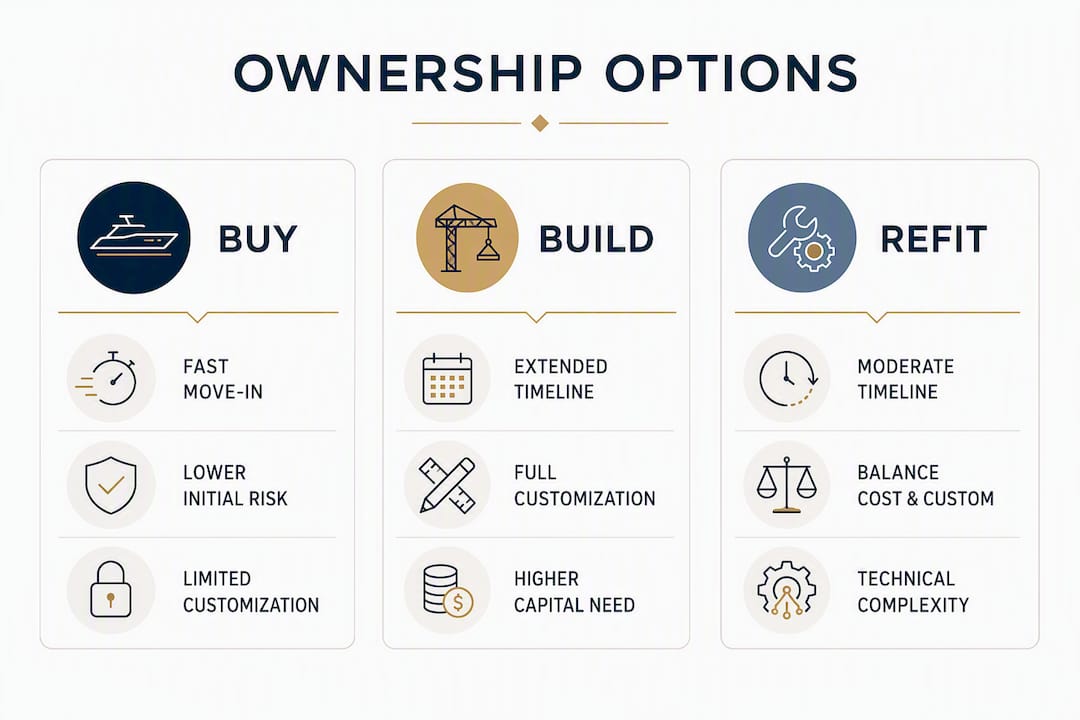
Each route carries a distinct risk profile, timeline, and capital shape. The table below compares them across the dimensions that matter most to a residential buyer.
| Dimension | Buy (brokerage) | Custom build | Refit acquisition |
|---|---|---|---|
| Timeline to move-in | Weeks to 6 months | 24–48+ months | 6–18+ months |
| Customization depth | Low to moderate | Full | Moderate to high |
| CAPEX shape | Single lump sum | Staged payments over build | Purchase + refit budget |
| Risk profile | Condition/survey risk | Schedule and cost overrun risk | Scope creep risk |
| Best owner fit | Seasonal or fast-entry | Full-time, bespoke needs | Corporate or specific-use |
A custom build follows a staged process: client meetings, yard tours, design development, pre-engineering, YBA contract execution, hull and superstructure construction, outfitting, commissioning, sea trials, and warranty support. The engineering phase alone can span 20–26 months for larger vessels, with the design phase adding up to nine months before a single steel plate is cut.
Key trade-offs to weigh:
- Custom building — gives you full control over every subsystem, accommodation plan, and finish — at the cost of time and the highest CAPEX exposure.
Budgeting for boat living: costs, financing, and taxes
Capital costs for a residential luxury yacht span a wide range depending on size and specification. Purchase prices for capable brokerage vessels start in the low millions; purpose-built residential yachts of 100 feet and above routinely exceed $10 million before outfitting. Refit budgets for a meaningful residential conversion can be a significant portion of the vessel’s acquisition value, sometimes more when structural or propulsion work is involved. Treat those figures as orientation points, not quotes — a detailed operational budget should be built line by line with your project team.
Recurring annual costs include:
- Management fees: — Third-party yacht management typically charges a percentage of operating costs or a fixed monthly retainer.
Financing for luxury yacht acquisitions typically involves marine lenders, private banks, or family-office credit facilities. Staged payment structures are standard for custom builds: an initial deposit at contract signing, progress payments tied to construction milestones, and a retention holdback released after successful sea trials. A contingency reserve of 10–15% of total project cost is prudent for any new build or major refit.
The tax dimension deserves specific attention. U.S. tax authorities evaluate yacht ownership through a facts-and-circumstances profit-motive test under IRC §183. Owners who claim business deductions while operating the vessel primarily for personal use risk disallowance of depreciation and expenses. Sections §274, §469, §280A, and §280F each impose additional limits depending on how the vessel is used and structured. Registration choices also affect tax exposure: Florida, U.S. NVDC documentation, and foreign flags such as the Marshall Islands or Cayman Islands each carry different operational, crew, and customs implications. Engage qualified maritime tax counsel before you select an ownership entity or registry. For additional internal guidance, Baranofyachts’s yacht-as-business-expense resource maps the key IRS sections to practical ownership decisions.
What technical specs make a yacht livable year-round?
A yacht configured for residence is a different specification exercise than one built for weekend cruising. The systems checklist below reflects minimum standards for comfortable, safe full-time habitation:
- Stabilizers: Active fin or gyroscopic stabilizers for at-anchor and underway comfort.
- HVAC: Zoned climate control with redundant chillers; HEPA-grade filtration for air quality.
- Freshwater: High-capacity tanks plus watermaker redundancy; minimum 500 liters per day production for a full household.
- Power generation: Twin gensets with automatic changeover; hybrid or shore-power integration for marina use.
- Waste management: Type II or Type III MSD systems compliant with USCG regulations; holding tank capacity for extended offshore passages.
- Connectivity: Dual-band satcom (VSAT plus a backup LEO system such as Starlink Maritime) and cellular boosters for coastal use.
- Storage and provisioning: Cold storage sized for 2–4 weeks of provisions; dedicated dry storage and crew quarters separate from owner accommodation.
Pro Tip: Design redundancy into propulsion, power, and freshwater systems from the outset. A single-point failure in any of these three categories forces a dock call that disrupts your residence. Owners who specify twin-engine configurations, parallel genset capacity, and dual watermakers rarely face forced haul-outs for system failures alone.
Interior volume and cabin count matter as much as mechanical specification. A residential yacht for a couple with occasional guests needs a minimum owner’s suite with a dedicated office or study, two to four guest cabins, crew quarters fully separated from owner spaces, and a laundry facility sized for daily use. For bespoke interior programs that address long-term comfort, Baranofyachts works with owners to develop accommodation plans before the design brief is finalized.

How do you manage a build or refit from brief to handover?
A project-managed build or refit with staged acceptance gates and an owner’s representative materially lowers delivery risk. The milestone sequence below applies to both new builds and major refits:
- Design brief finalization — use profile, accommodation plan, must-have systems, regulatory target, and sustainability goals documented and signed off.
- LOI and YBA/contract execution — maker lists, technical specifications, staged payment schedule, and contingency provisions locked in.
- Pre-engineering and procurement — major equipment ordered; lead times for propulsion, HVAC, and electronics confirmed.
- Construction or refit phases — hull, superstructure, and systems installation with owner’s rep attending key milestone inspections.
- Outfitting and commissioning — interior fit-out, systems integration, and dock trials.
- Sea trials — full-load validation of range, stabilizers, HVAC, generators, and noise/vibration targets.
- Acceptance and snag-list sign-off — retention holdback released only after all snag items are closed or formally scheduled within the warranty window.
At each gate, ask your project manager three questions: What is the current schedule variance and its cause? What contingency remains in the budget? What documentation — maker lists, test certificates, class survey records — is complete and in hand?
Baranofyachts’s project management methodology applies this conductor’s-eye discipline across every phase, coordinating shipyard, subcontractors, and owner decisions so the build moves like a well-rehearsed symphony rather than a series of reactive corrections.
What operating model fits your residential yacht?
Three operating models cover most owner situations, and the right choice depends on privacy requirements, corporate-use frequency, and cost tolerance.
- Full private crew: Maximum privacy and operational control; highest fixed cost. Best for full-time residents and corporate hospitality programs where the vessel is in constant use.
- Third-party yacht management: Lower fixed overhead; the management company handles crew employment, maintenance scheduling, insurance administration, and regulatory compliance. Chartering potential is easier to activate. For a detailed breakdown of crew management trade-offs, Baranofyachts has published specific guidance.
- Hybrid arrangement: Owner retains a captain and one or two permanent crew; management company handles shore-side administration and relief crew. Common for seasonal residents who want continuity without full-time overhead.
Key contract points to negotiate with any management company: scope of services and exclusions, monthly reporting format and cadence, crew employment terms and liability allocation, insurance responsibilities, emergency-response protocol, and termination notice periods. Corporate clients adding hospitality staff or branded fit-outs should specify those requirements in the management mandate, not as verbal add-ons.
U.S. registration, tax, and compliance checklist
Registration and compliance decisions made at acquisition are difficult and expensive to reverse. Work through the following checklist before closing:
- Maritime regulations compliance: Registration choice affects crew nationality requirements, chartering options, and USCG inspection obligations.
As Justin Boodram of McGregor Financial Services has noted, U.S. tax efficiency for yacht owners stems from operational substance rather than corporate complexity. The IRS weighs facts and business conduct over where an entity is formed. Owners who document profit motive, limit personal use, and maintain business-like operations are in a materially stronger position than those who rely on structure alone — regardless of flag state.
This section is general information, not legal or tax advice. Confirm current rules with a qualified maritime attorney and a CPA experienced in yacht ownership before making registration or entity decisions.
Survey, sea trials, and acceptance before you move aboard
The survey and acceptance phase is where residential-specific defects surface — or get transferred to you if you skip it. A pre-purchase survey for a residential acquisition should cover:
- Hull integrity (ultrasonic thickness testing, osmotic survey for GRP vessels).
- Engine and propulsion condition, hours, and service history.
- All habitability systems: HVAC, watermaker, generators, waste treatment, and galley equipment.
- Documentation completeness: class certificates, USCG documentation, maker lists, and warranty records.
Sea trials must validate stabilizer performance at cruising speed and at anchor, HVAC output under full occupancy load, generator changeover under load, and noise/vibration levels in the owner’s suite. Any item that fails to meet specification goes onto a formal snag list with a remediation deadline and a corresponding retention holdback. Warranty and life-cycle support should be programmed into the contract so remedial windows are scheduled, not improvised.
What timeline should you plan for each path?
- Custom build: — 24–48+ months from LOI to delivery for vessels above 80 feet; larger or more complex projects extend further. Pre-engineering and procurement run in parallel to compress schedule where possible.
Critical lead times to plan around: liveaboard-permitted berth reservations (often 6–12 months in major U.S. marinas), crew recruitment and STCW certification, USCG documentation processing, and technology provisioning for satcom and AV systems. Align your financing draw schedule to construction milestones so retention holdbacks remain in place until acceptance gates are closed — that leverage is your primary tool for resolving snag items before final payment.
Key Takeaways
Living aboard a bespoke luxury yacht is a capital project first and a lifestyle choice second — owners who govern it with the same rigor they apply to real estate or business acquisitions consistently achieve better delivery, lower operating costs, and stronger resale positions.
| Point | Details |
|---|---|
| Feasibility verdict | Full-time or seasonal yacht residence is viable for U.S. owners with the right vessel, team, and compliance strategy in place from day one. |
| Path decision | Buy for speed, custom-build for full control (24–48+ months), or refit for a middle path — match the route to your timeline and use case. |
| Budget posture | Recurring costs (crew, management, insurance, fuel, berthing) often equal or exceed 10% of vessel value annually; build that into your financial model. |
| Legal and tax caution | The IRS evaluates yacht ownership on operational substance under §183, §280A, and related sections — engage maritime tax counsel before selecting an entity or registry. |
| Baranofyachts engagement | Baranofyachts provides feasibility surveys, design-brief facilitation, custom build management, and refit project management as a structured path from concept to move-in. |
Why the design brief is the most underrated document in yacht ownership
Most owners spend more time selecting exterior paint than they do writing their design brief. That imbalance is where residential yacht projects go wrong. A vague brief produces a vessel that performs beautifully on a charter brochure and frustrates you within six months of living aboard — the galley is undersized, the owner’s suite has no dedicated workspace, the HVAC zones don’t match how you actually use the spaces.
The owners who end up genuinely satisfied with their residential yachts are the ones who treated the brief as a governance document: specific about accommodation hierarchy, explicit about systems redundancy requirements, clear about itinerary range and the ports they intend to use. That specificity gives the shipyard and project manager something to be held accountable to at every milestone gate.
We’ve seen this play out directly. The 50-foot trawler refit Baranofyachts managed is a clear example: by going back to root causes rather than patching symptoms, the project resolved defects that three previous yard visits had missed. Proactive owner governance — an owner’s representative attending key inspections, phased acceptance gates, and a formal snag list with retention holdbacks — is what separates a yacht that works from one that merely floats.
How Baranofyachts helps you move from decision to living aboard
For owners ready to act, Baranofyachts delivers the full path from feasibility to handover. Whether you are evaluating a brokerage acquisition, commissioning a custom build, or planning a residential refit, we structure the engagement so every decision point is governed, documented, and tied to a clear acceptance gate.

Our services relevant to residential yacht ownership include feasibility surveys and pre-purchase inspection coordination, design-brief facilitation, custom build project management, refit oversight, and yacht management onboarding. Corporate clients benefit from our yacht ownership and corporate image advisory, which aligns the vessel’s specification and operating model to hospitality and branding objectives.
The engagement path is straightforward: introductory call to scope your requirements, site or yard visit to evaluate candidate vessels or shipyards, LOI and mandate execution, project plan development, and delivery oversight through to your first night aboard. Contact Baranofyachts to schedule your feasibility consultation and take the first concrete step toward living aboard the vessel you actually want.
Authoritative U.S. sources and further reading
- Corporate Superyacht Ownership: Why U.S. Tax Structure Matters as Much as Your Flag State — McGregor Financial Services
- Buying a Yacht? Navigating the Legal Waters — Warner Norcross + Judd LLP
- Yacht Registration Guide: US vs. Florida vs. Foreign Flags — Power & Motoryacht
- A superyacht owner’s guide on how to build a new custom yacht — Boat International
- Maritime Registration Trends — Vessel Flag
- From Dockside Rattle to Offshore Confidence — Baranofyachts Case Study
Recommended
Sold Listings


Design Your Yacht
"*" indicates required fields
Maximus III - PNW
As you step aboard MAXIMUS III, the first impression is her scale.
At 120 feet with an 8-meter beam and 294 GT of interior volume, this 2025 Crescent Custom tri-deck immediately feels open, balanced, and estate-like. A timeless look while still feeling fresh from the shipyard.
Currently Available


Get your yacht value Estimate
"*" indicates required fields