
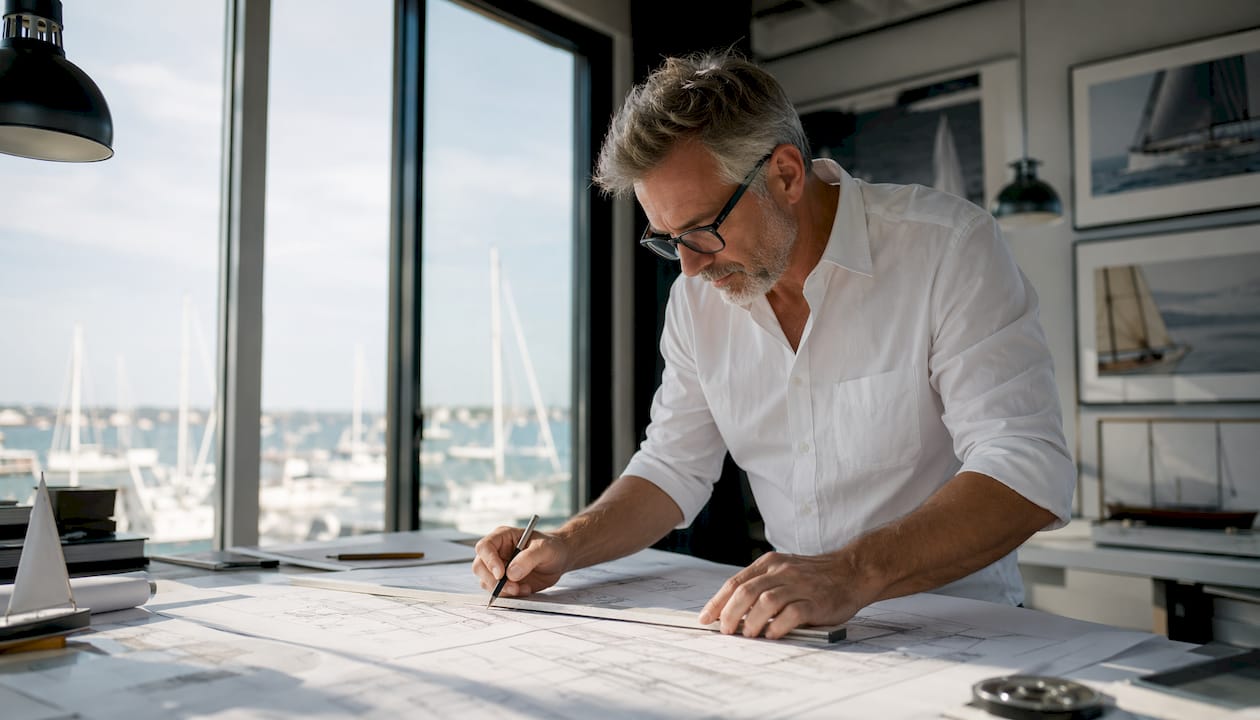
Custom naval architecture design is the disciplined process of translating an owner’s mission, lifestyle, and performance expectations into a vessel that is safe, structurally sound, and certified to meet United States Coast Guard (USCG) and, where applicable, American Bureau of Shipping (ABS) standards. As bespoke builds now represent the majority of luxury orders, understanding this process is no longer optional for serious buyers.
Before you commission anything, know these four realities:
- Design is an engineering discipline first. As Britannica’s naval architecture overview confirms, a naval architect integrates hydrodynamics, structural mechanics, and economics — aesthetics come after function is resolved.
- Timeline runs long. From briefing to handover, a custom luxury yacht project often takes multiple years depending on size, complexity, and shipyard schedule.
- Cost drivers are controllable early. Hull material, systems complexity, and interior finish level are the three biggest levers — and all three are locked in during the design phase.
- Regulatory compliance is non-negotiable. USCG documentation and ABS classification (when elected or required) must be scoped into the project from day one, not retrofitted.
Your immediate next step: prepare a concise design brief covering intended use, home port, crew model, and performance priorities, then request a consultation with a qualified naval architect or contact Baranofyachts to begin the process with professional guidance.
Table of Contents
- What does custom naval architecture actually cover?
- What are the stages of a custom yacht project?
- Key technical trade-offs every owner needs to understand
- How do USCG and ABS requirements affect your project?
- How do you choose the right naval architect, shipyard, and project manager?
- What drives the cost of a custom yacht build?
- How your lifestyle shapes the architecture of your yacht
- What are the most common risks in custom yacht projects?
- Post-delivery support and maintenance after a custom build
- Key Takeaways
- What we have learned from working with owners on custom projects
- How Baranofyachts supports your custom design project
- Authoritative sources and further reading
What does custom naval architecture actually cover?
Naval architecture principles span six core disciplines, all of which interact on a custom yacht project: hull hydrodynamics, structural engineering, intact and damage stability, systems engineering (electrical, HVAC, plumbing, fire suppression), propulsion and powering, and weight and center-of-gravity management. Interior architecture and outfitting sit adjacent to these disciplines but are governed by them — a grand saloon that shifts the center of gravity too far aft will compromise seakeeping regardless of how beautifully it is finished.
Knowing who owns each discipline prevents costly gaps in accountability.
| Role | Primary Responsibility | When They Are Active |
|---|---|---|
| Owner / Client | Mission brief, approvals, change decisions | Throughout |
| Naval Architect | Hull form, hydrostatics, stability, structures, weight control | Concept through sea trials |
| Exterior Stylist | Superstructure aesthetics, deck layout | Concept and design development |
| Interior Architect | Accommodation layout, finishes, furniture | Design development and build |
| Shipyard (Builder) | Construction, systems installation, commissioning | Build through handover |
| Systems Integrator | Electrical, AV, HVAC, automation | Design development and build |
| Project Manager | Schedule, budget, coordination, risk | Concept through handover |
| Surveyor | Compliance verification, condition assessment | Build milestones and delivery |
What are the stages of a custom yacht project?
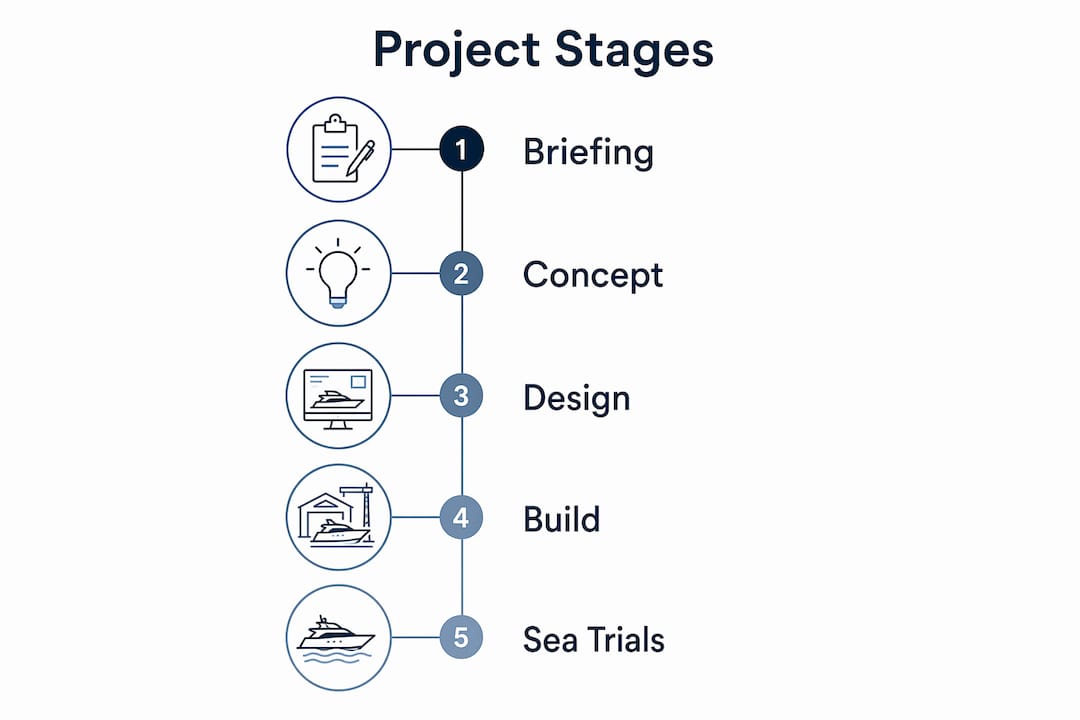
Custom design typically starts with owner concept discussions and preliminary drawings, then iterates through engineering and construction before culminating in sea trials and handover. The table below reflects typical durations for a mid-size luxury motor yacht.

| Stage | Typical Duration | Key Deliverables |
|---|---|---|
| Briefing and feasibility | Several weeks | Design brief, budget envelope, preliminary specification |
| Concept design | Several weeks to few months | Concept sketches, preliminary lines plan, hydrostatic report |
| Design development | Few months | 3-D surface model, stability booklet, systems schematics |
| Construction drawings | Several months | Structural drawings, weight schedule, equipment specs |
| Procurement and build | Up to several years | Hull, systems, outfitting, classification surveys |
| Commissioning and sea trials | Several weeks | Acceptance criteria, trial log, USCG documentation |
| Handover | Brief period | Manuals, certificates, crew training, warranty records |
Attend sea trials personally and request written acceptance criteria in your contract before the build begins. Designers who monitor construction and sea trials protect owner interests and preserve resale value — this is standard practice among experienced firms, not an optional add-on.
Key technical trade-offs every owner needs to understand
Functional parameters — mission, propulsion type, speed, and stability requirements — narrow hull-form choices before aesthetics are ever finalized. Three owner scenarios illustrate how these choices cascade:
- Transoceanic explorer: Prioritizes range and seakeeping. Leads to a displacement or semi-displacement hull, larger fuel capacity, conservative stability margins, and often steel or aluminum construction for structural robustness over long passages.
- Near-shore high-speed dayboat: Prioritizes top speed and agility. Leads to a planing hull, lighter composite construction, reduced fuel capacity, and a propulsion system optimized for sprint performance rather than economy.
- Extended-stay charter yacht: Balances volume, comfort, and moderate range. Drives a wider beam, higher freeboard, and a systems-heavy electrical architecture to support guest amenities.
Preliminary 2-D drawings and a 3-D surface model feed hydrostatics, stability checks, and early speed/power estimates. For larger yachts, full 3-D structural models are standard, and modern firms increasingly include CFD hull simulation and FEA of lifting points as part of their fixed-price design packages.
Weight estimation and ongoing center-of-gravity tracking must begin at concept stage. Weight growth during build is the single most common source of performance shortfall and post-launch remediation cost.
Pro Tip: Build a 15–20% margin for growth into your electrical load budget from the outset. Hybrid propulsion systems, satellite communications upgrades, and new entertainment technology all draw more power than the original specification anticipated — and retrofitting a larger generator or battery bank after launch is significantly more expensive than sizing the architecture correctly on paper.
How do USCG and ABS requirements affect your project?
For U.S.-flagged or U.S.-operated luxury yachts, two authorities shape the compliance landscape.
| Authority | Role | When Classification Is Required |
|---|---|---|
| United States Coast Guard (USCG) | Federal safety regulation, documentation, load-line inspection for vessels over certain thresholds | Always for U.S.-flagged vessels; documentation required at or above 5 net tons |
| American Bureau of Shipping (ABS) | Voluntary classification society for private yachts; mandatory for commercially operated vessels and some charter operations | Required for USCG-inspected vessels in commercial service; elected voluntarily for private yachts seeking insurance or resale advantages |
The practical documents owners should require in their contracts include: a stability booklet approved by the naval architect, source-control documentation for all safety-critical equipment, USCG Certificate of Documentation, and ABS class certificates where classification is elected.
Safety systems — fire detection, flooding alarms, life-saving appliances, and bilge systems — must be specified to USCG standards from the design phase. Retrofitting these systems after build completion adds both cost and schedule risk, and some installations require structural penetrations that are far simpler to plan during construction.
How do you choose the right naval architect, shipyard, and project manager?
Selection criteria matter more than portfolio aesthetics. Evaluate candidates on demonstrated hydrostatics and stability experience, proficiency with current naval architecture software and 3-D modeling tools, a track record in your chosen material (composite, aluminum, or steel), and a defined project management process with clear change-order protocols.
Use these questions in every interview:
- Can you provide references from owners of similar builds, including contact details?
- What software do you use for hull modeling, hydrostatics, and structural analysis — and can we see sample deliverables?
- How frequently will you or a representative visit the shipyard during construction?
- How do you manage weight growth, and at what intervals do you update the weight schedule?
- What are your sea-trial acceptance criteria, and how are deficiencies documented and resolved?
- How are change orders priced, and what triggers a formal change-order process?
Red flags to watch for: unclear responsibility for weight growth between the architect and shipyard, ambiguous change-order terms that allow scope creep without cost transparency, and the absence of written sea-trial acceptance criteria. Owners who treat the naval architect as their primary technical agent through builder selection and construction monitoring materially reduce risk and unexpected post-launch costs. Understanding how shipyards shape outcomes is equally important when evaluating build partners.
What drives the cost of a custom yacht build?
Capital costs and operating costs respond to different levers, and confusing the two leads to budget surprises after delivery.
| Cost Category | Primary Driver | Practical Guidance |
|---|---|---|
| Design fees | Complexity and scope | Typically 7%–10% of build cost, billed as progress payments |
| Hull and structure | Material choice and build method | Composite is lightest; aluminum balances weight and repairability; steel suits large, long-range hulls |
| Systems and automation | Specification level | High-automation systems add capital cost but reduce crewing expense over time |
| Interior finish | Craft and material selection | The single most variable line item; bespoke woodwork and stone can double interior budgets |
| Contingency | Complexity and novelty | Allocate 10%–15% of total build cost for unforeseen changes |
| Annual operating costs | Fuel, crew, maintenance | Typically estimated as a percentage of vessel value; propulsion choice is the largest variable |
Choosing hull materials early and holding to that decision through design development is one of the most effective ways to protect the budget. Late material changes trigger cascading redesign across structural, weight, and systems drawings.
How your lifestyle shapes the architecture of your yacht
Your operating profile is not background information — it is the primary input that determines hull form, range, stability margins, and systems architecture. An owner who plans extended offshore passages in the North Atlantic requires fundamentally different engineering than one who entertains guests on protected coastal waters. The naval architect’s first job is to translate lifestyle into a technical specification before a single line is drawn.
Crew model matters as much as owner preference. A vessel managed by a professional captain and full crew can accommodate more complex systems and tighter clearances than one operated semi-professionally. Galley placement, crew quarters, and wash-down drainage all shift based on how the vessel will actually be used, not how it looks in a rendering. Vessel consultants can help owners articulate these operational requirements before the design brief is finalized.
Entertainment priorities, tender and toy storage, and range between fuel stops each impose structural and spatial constraints that compound quickly. Resolving these priorities in the brief stage costs almost nothing; resolving them during construction can cost hundreds of thousands of dollars in redesign and delay.
What are the most common risks in custom yacht projects?
Weight growth is the most predictable risk and the most frequently underestimated. Systems added during build, owner-driven specification upgrades, and heavier-than-estimated outfitting all shift the center of gravity and reduce freeboard. A disciplined weight-control process, updated at every major milestone, is the primary mitigation.
Schedule compression is the second major risk. Owners who push for faster delivery often accept incomplete commissioning, which surfaces as post-delivery defects and warranty disputes. Building realistic float into the schedule, particularly around sea trials, protects both the owner and the builder.
Change orders without cost transparency create the most contentious disputes. Every design change after construction drawings are approved should trigger a written change order with a defined cost and schedule impact before work proceeds. Owners who skip this discipline routinely find their final invoice significantly above the original contract value.
Post-delivery support and maintenance after a custom build
The relationship with your naval architect and project manager should not end at handover. The stability booklet, weight schedule, and as-built drawings are living documents — any significant refit, systems upgrade, or structural modification requires them to be updated to maintain USCG compliance and ABS class standing where applicable.
Planned maintenance intervals for hull coatings, running gear, and safety systems should be established in the delivery documentation and tied to the vessel’s operating profile. A vessel that spends six months per year in tropical waters has a different antifouling and corrosion schedule than one based in the Pacific Northwest. Yacht management strategies that account for these regional differences reduce lifecycle costs materially.
Insurance underwriters increasingly require updated stability documentation after refits. Budgeting for periodic naval architect reviews — not just reactive repairs — keeps the vessel insurable, classifiable, and positioned well for eventual resale. Understanding vessel insurance considerations from the outset helps owners structure their coverage correctly from delivery day forward.
Key Takeaways
Custom naval architecture design succeeds when owners engage a qualified naval architect early, lock in hull material and mission parameters before construction drawings begin, and maintain disciplined weight and change-order control throughout the build.
| Point | Details |
|---|---|
| Engage the architect early | Early naval architect involvement reduces risk and prevents costly redesign during build. |
| Design fees typically represent a moderate percentage of the build cost, billed as progress payments. | Expect design fees of roughly 7%–10% of build cost, billed as progress payments separate from the yard contract. |
| USCG and ABS shape compliance | U.S.-flagged vessels require USCG documentation; ABS classification adds insurance and resale value for private yachts. |
| Weight control is non-negotiable | Update the weight schedule at every major milestone to prevent performance shortfall and post-launch remediation. |
| Baranofyachts guides the process | Baranofyachts provides design coordination, project management, and build oversight from brief through handover. |
What we have learned from working with owners on custom projects
The gap between what owners expect from a custom build and what actually drives cost and schedule is almost always the same: the brief arrives too late and too vague. By the time a naval architect is engaged, owners have often formed strong aesthetic preferences without having resolved the fundamental operating questions — home port, passage length, crew size, and tender requirements. Those unresolved questions become change orders.
The owners who have the best outcomes are the ones who treat the design brief as a serious document, not a starting point for negotiation. When weight and center-of-gravity tracking begins at concept stage, when shipyard selection happens before construction drawings are finalized, and when the naval architect attends sea trials with written acceptance criteria in hand, the project delivers on its promise. We have seen that discipline prevent six-figure post-launch corrections on more than one occasion. Our portfolio and project case studies reflect the outcomes that early alignment produces, and our client engagement portal gives owners visibility into every stage of the process.
How Baranofyachts supports your custom design project
Baranofyachts brings design coordination, project management, build oversight, and refit consulting together under one mandate, so you are not managing a fragmented team of specialists alone.

Our team works alongside your naval architect and shipyard as a conductor’s eye across the full project, tracking weight schedules, reviewing change orders, and attending key milestones so nothing falls through the gaps between disciplines. We provide access to our build-process guides and our client engagement portal, where you can follow progress, review documentation, and access our network of vetted shipyards and craftsmen. For owners evaluating design directions, our resource on next-generation design moves is a practical starting point. To begin, submit your design brief or request a consultation through our project management services page — the earlier we are involved, the more value we can protect.
Authoritative sources and further reading
- MIT OpenCourseWare: Principles of Naval Architecture — graduate-level course covering hydrostatics, stability, hull structure, and resistance; best for technical depth on engineering fundamentals.
- SNAME: Principles of Naval Architecture series — the defining professional reference for stability, strength, resistance, propulsion, and vibration; essential for architects and informed owners.
- Britannica: Naval Architecture — accessible overview of design disciplines, construction, and stability for owners new to the field.
- Eric W. Sponberg: How to Commission a Yacht Design and Have It Built — practical procurement and contract guidance covering design fees, builder selection, and sea-trial processes; best for contract and procurement preparation.
- Benford Design Group: The Custom Design Process — detailed walkthrough of the client-designer iteration loop, weight management, and designer participation through construction and trials.
Recommended
Sold Listings


Design Your Yacht
"*" indicates required fields
Maximus III - PNW
As you step aboard MAXIMUS III, the first impression is her scale.
At 120 feet with an 8-meter beam and 294 GT of interior volume, this 2025 Crescent Custom tri-deck immediately feels open, balanced, and estate-like. A timeless look while still feeling fresh from the shipyard.
Currently Available


Get your yacht value Estimate
"*" indicates required fields