
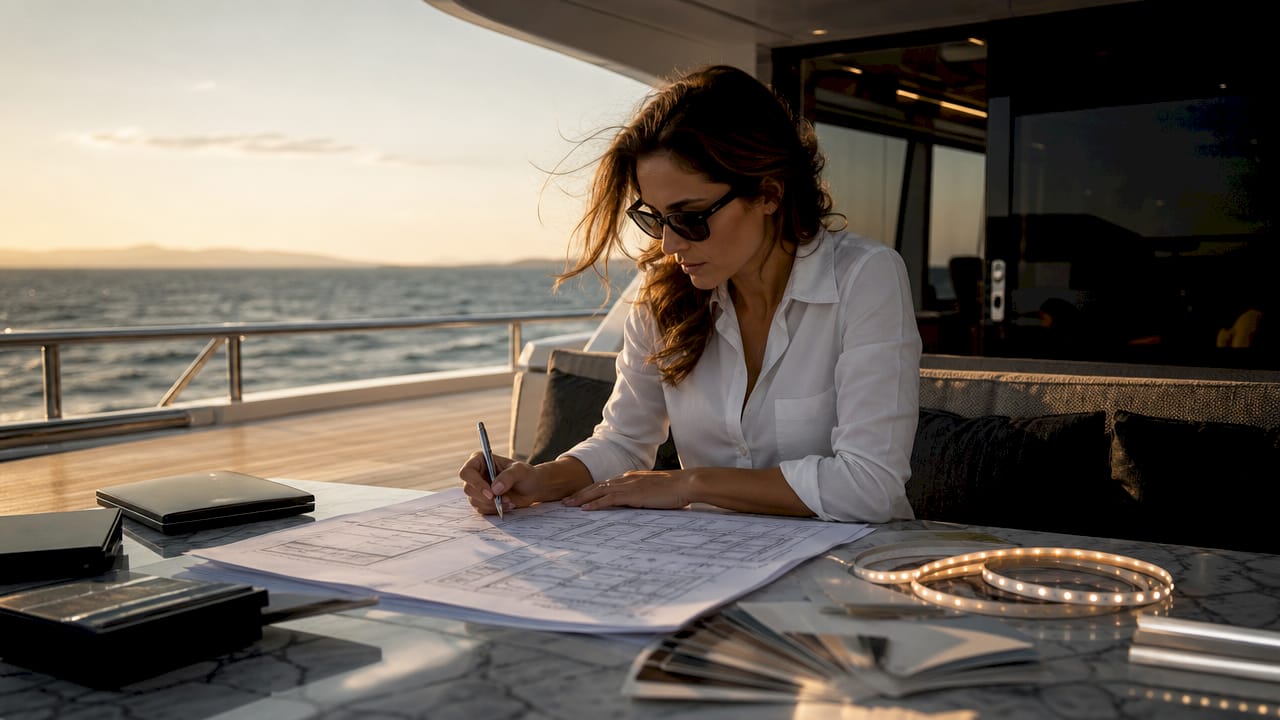
A yacht lighting design scheme is the integrated, bespoke plan for all lighting systems across a vessel, covering ambient, task, accent, exterior, and navigation layers to define both function and mood on board. The standard industry term for this discipline is marine lighting design, though “yacht lighting design scheme” accurately describes the full scope of planning involved. Getting this right separates a yacht that feels like a luxury residence from one that merely looks like one. At Baranofyachts, we treat marine lighting design as a core element of every build, not an afterthought. A well-executed scheme shapes how owners and guests experience every space, from the saloon at sunset to the deck at midnight.
What is a yacht lighting design scheme, and why does it matter?
A yacht lighting design scheme is a bespoke, integrated plan that considers technical constraints, marine regulations, material finishes, and owner lifestyle patterns to create a cohesive lighting environment. It is not a fixture list. It is a discipline that defines mood, flow, and identity across every space on the vessel.
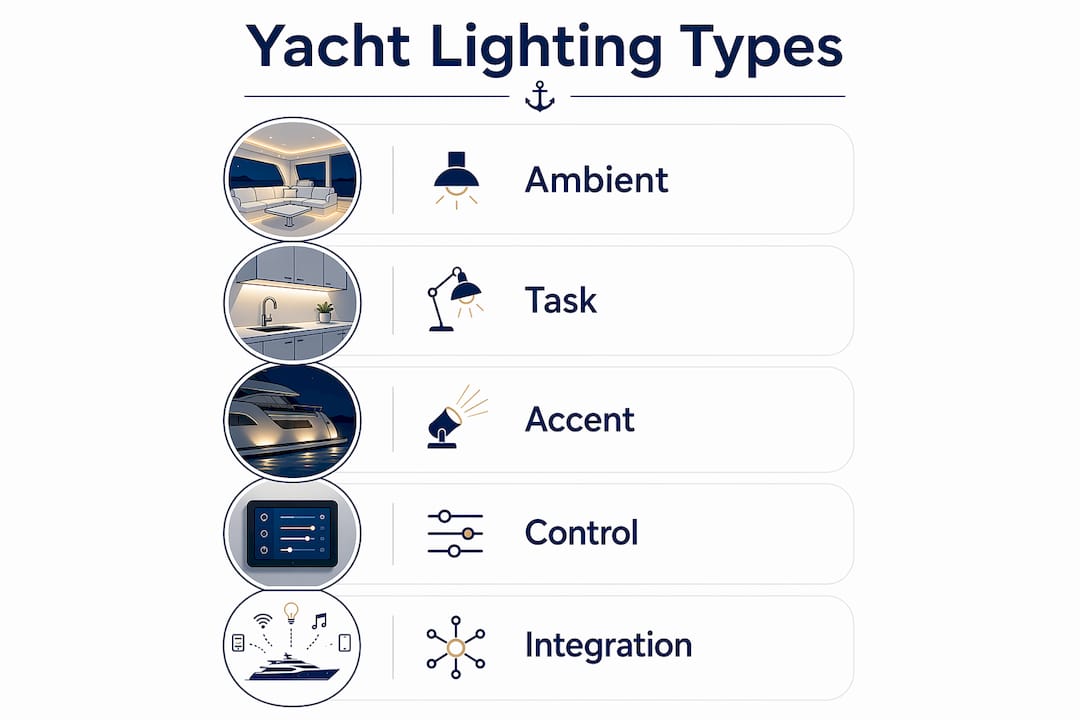
The scheme layers three primary lighting types: ambient, task, and accent. Ambient, task, and accent layers work together to create dynamic, adaptable environments that shift with the time of day, activity, and owner preference. Ambient lighting sets the general tone of a space. Task lighting serves specific functional needs. Accent lighting draws attention to architecture, artwork, or decorative detail.
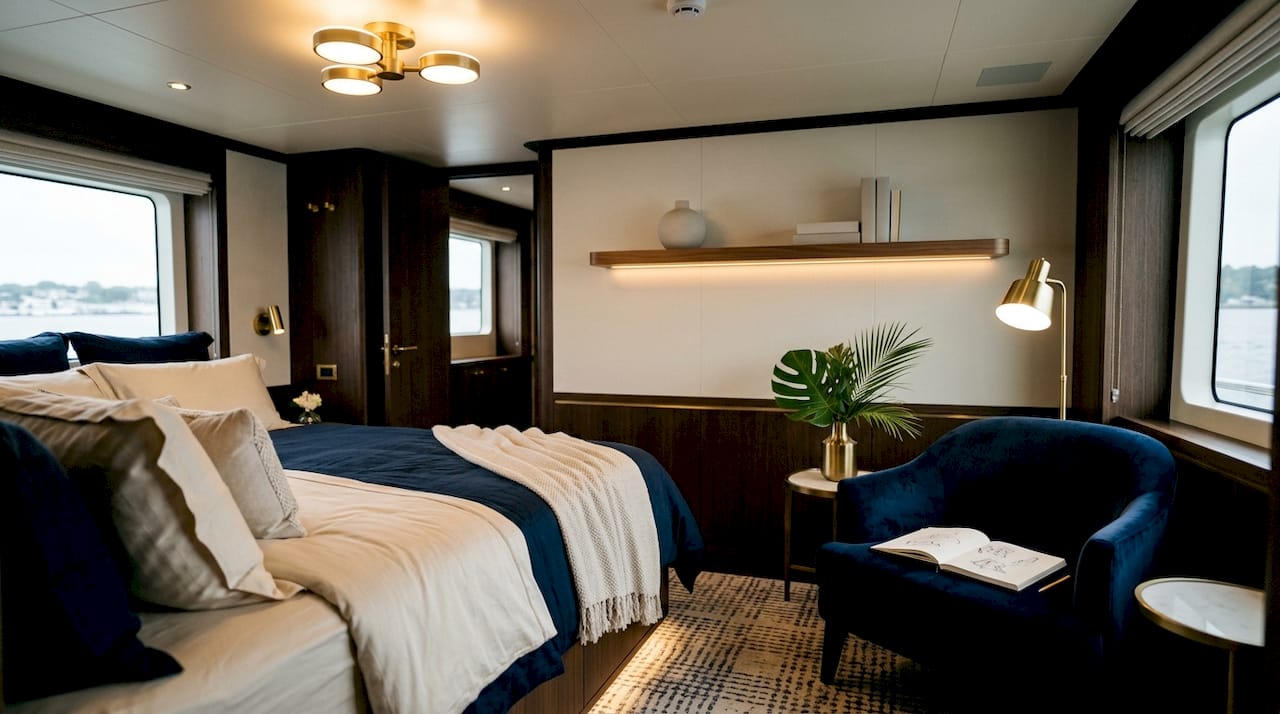
Intelligent control systems tie these layers together. Scene presets, zoned dimming, and integration with other onboard systems allow the entire atmosphere of a yacht to shift with a single command. This is what transforms a technically competent lighting installation into a genuinely expressive design scheme.
What are the key components and types of yacht lighting?
Every well-designed marine lighting scheme relies on five distinct lighting categories, each with a specific role.
- Ambient lighting provides general illumination across cabins, saloons, and passageways. It establishes the baseline mood of a space and prevents visual fatigue during extended time on board.
- Task lighting serves focused, functional purposes. Navigation stations, galleys, and reading areas all require directed light that does not bleed into adjacent zones or compromise night vision.
- Accent lighting highlights architectural features, joinery details, artwork, and decorative surfaces. It adds depth and visual interest without adding visual noise.
- Exterior and deck lighting serves both safety and atmosphere. Deck lights guide movement safely at night, while profile lighting and underwater illumination define the yacht’s visual presence on the water.
- Navigation and safety lighting must comply with maritime standards, including International Regulations for Preventing Collisions at Sea (COLREGS). These fixtures are non-negotiable and must be positioned and rated to meet regulatory requirements.
LED and fiber optic systems dominate modern yacht lighting due to their longevity, low power draw, and adaptability to complex architectures. Warm color temperatures in the 2700K to 3500K range are standard practice for creating inviting interior atmospheres. That range replicates the warmth of incandescent light while consuming a fraction of the energy.
Pro Tip: Layer your color temperatures deliberately. Use warmer tones (2700K) in sleeping and dining areas for relaxation, and cooler tones (3000K–3500K) in working areas like the galley and navigation station for clarity and focus.
How do technical and environmental factors shape yacht lighting schemes?
Marine environments impose constraints that simply do not exist in residential or commercial design. Every fixture, fitting, and control component must be specified with the sea in mind.
Ingress protection ratings are the starting point. Interior marine lighting requires a minimum IP65 rating to protect against condensation and spray, while deck-level fixtures must meet IP67. IP65 means the fixture is dust-tight and protected against water jets. IP67 means it can withstand temporary immersion. Specifying below these thresholds is a reliability failure waiting to happen.
Electrical systems add another layer of complexity. Yacht electrical systems operate on 12V or 24V DC, so all lighting hardware must cover a voltage range of 10–30V DC to handle fluctuations without flickering or failure. Fixtures rated for a narrower voltage band will degrade faster and create maintenance headaches mid-voyage.
Space is perhaps the most underestimated constraint. Millimeter-level precision is required because ceiling void space is congested with cables, ducting, and structural elements. A fixture that works perfectly in a showroom may be physically impossible to install in a given overhead without compromising adjacent systems. This is why fixture selection cannot happen in isolation from the structural drawings.
| Factor | Requirement | Consequence of ignoring |
|---|---|---|
| IP rating (interior) | IP65 minimum | Corrosion, failure from condensation |
| IP rating (deck) | IP67 minimum | Water ingress, short circuits |
| Voltage range | 10–30V DC | Flickering, premature fixture failure |
| Ceiling void space | Millimeter precision | Installation conflicts, redesign costs |
| Corrosion resistance | Marine-grade materials | Rapid degradation from salt spray |
Pro Tip: Specify fixtures with marine-grade stainless steel or anodized aluminum housings as a baseline. Decorative finishes can be applied over structural marine-grade components, but the reverse approach always fails in a salt environment.
What roles do intelligent control and scene-setting systems play?
Modern yacht lighting schemes are inseparable from their control systems. A fixture without intelligent control is a missed opportunity. A control system without well-specified fixtures is equally incomplete.
Intelligent lighting controls enable scene setting, zoned dimming, and integration with other onboard systems. The practical result is that a single preset can shift the saloon from bright daytime mode to a warm, low-lit dinner setting in seconds. Control interfaces now range from tactile wall switches to remote apps and voice commands, giving owners and crew multiple ways to manage the environment.
The most effective schemes use scene presets built around real activities:
- Daytime cruising: Full ambient light with task zones active in the galley and navigation station.
- Dining: Warm, dimmed ambient light with accent lighting on table centerpieces and joinery details.
- Entertaining on deck: Exterior profile lighting active, underwater lights on, interior ambient at low levels to draw guests outward.
- Night cruise: Navigation lights fully active, interior ambient at minimum, red-tinted task lighting at the helm to preserve night vision.
- Sleep mode: All non-essential lighting off, with low-level corridor lighting for safe movement.
Integration with AV systems, security, and safety systems adds further value. When a fire alarm triggers, the lighting system can automatically shift to full brightness across all zones, overriding any active scene preset. That kind of integration requires planning from the earliest design stage, not a retrofit conversation at the end of the build.
Energy management is a practical benefit that owners often underestimate. Zoned dimming and scene presets reduce total electrical load, which matters significantly on a vessel running on battery banks or generator power during anchor stays.
How is a bespoke lighting scheme developed during a build or refit?
The single most important decision in yacht lighting design is when to start. Early integration into the yacht’s architecture produces clean detailing, concealed wiring, and refined atmospheric control. Starting late produces visible conduit runs, compromised fixture positions, and control systems bolted onto a structure that was never designed to accommodate them.
The development process for a custom yacht build follows a clear sequence:
- Concept alignment: The owner, interior designer, naval architect, and lighting specialist align on the aesthetic direction, functional requirements, and control philosophy before any fixtures are specified.
- Scheme development: Lighting layouts are drawn against the structural and interior drawings, with fixture positions coordinated against ceiling voids, structural members, and mechanical systems.
- Fixture specification: Custom fixtures are prototyped where standard products cannot meet the spatial or aesthetic requirements. This is common in superyacht builds where ceiling profiles are unique to the vessel.
- Onboard mockups: Mock-up lighting installations onboard allow owners and designers to validate beam angles, color temperature, and ambiance in real spaces before final installation. This step eliminates the most expensive surprises.
- Installation and commissioning: Fixtures are installed, control systems are programmed, and scene presets are tuned with the owner present where possible.
Refit projects introduce a different set of constraints. Existing structure limits fixture positions, and legacy wiring may not support modern control systems without significant remediation. Superyacht build timelines can extend over several years, which means fixture technology specified at concept stage may be superseded before installation. Future-proofing the control infrastructure, even if the fixtures themselves are replaced, protects the investment.
The collaboration between owner, designer, and yard is the conductor’s eye in this process. When all three are aligned from the outset, the lighting scheme arrives at commissioning as a coherent, tested system rather than a collection of individually specified products.
What are the current trends shaping yacht lighting schemes in 2026?
Lighting integration is a key factor in charter differentiation, owner experience, and resale value in 2026. The market has moved decisively away from decorative fixtures as focal points toward concealed, architectural lighting that makes the space itself the statement.
The defining trends this year include:
- Fully concealed systems: Coves, reveals, and integrated profiles replace surface-mounted fixtures wherever possible. The light source disappears; only the effect remains.
- Underwater and deck branding lighting: Underwater lighting and illuminated deck features now serve as brand identity elements, particularly for charter yachts where visual presence at anchor drives bookings. Explore how luxury yachts in Lisbon use underwater lighting to create a distinctive presence in busy marinas.
- Dynamic color temperature tuning: Circadian-aware lighting that shifts color temperature across the day is moving from residential design into the marine sector. It supports crew wellbeing on long passages and creates a more natural living environment below decks.
- Minimalist fixture design: Where fixtures are visible, the trend favors architectural simplicity. Flush trims, thin profiles, and materials that integrate with surrounding joinery.
- Energy efficiency as a design constraint: Battery technology advances and environmental expectations are pushing designers to treat energy load as a design parameter, not an afterthought. LED efficiency gains make this achievable without sacrificing output quality.
These trends reflect a broader shift in next-generation yacht design toward quiet luxury. The most sophisticated yachts in 2026 do not announce their quality loudly. They demonstrate it through the quality of light, the precision of detail, and the ease with which the environment adapts to the owner’s needs.
Key Takeaways
A yacht lighting design scheme is the most consequential design decision on a luxury vessel, because it defines how every other design choice is perceived.
| Point | Details |
|---|---|
| Start at the architectural stage | Lighting integration must begin with structural drawings, not after the interior is defined. |
| Layer all five lighting types | Ambient, task, accent, exterior, and navigation lighting each serve distinct roles and must be coordinated. |
| Specify for the marine environment | IP65 minimum for interiors, IP67 for decks, and 10–30V DC voltage tolerance are non-negotiable baselines. |
| Use intelligent control systems | Scene presets and zoned dimming transform a static installation into a dynamic, adaptable environment. |
| Validate with onboard mockups | Testing beam angles and color temperatures in the actual space eliminates costly surprises before final installation. |
Why lighting is the most underestimated decision in a yacht build
I have watched owners spend months selecting marble for a saloon sole and then approve a lighting scheme in a single meeting. That imbalance is the most common and most costly mistake in luxury yacht design. Marble looks the same under any light. The lighting scheme determines whether the marble looks like a five-star hotel or a hospital corridor.
The customization process for a luxury yacht involves hundreds of decisions, and lighting touches every single one of them. The color of a hull paint, the grain of a veneer, the texture of a fabric: all of these are experienced through light. Get the scheme wrong and you undermine every other investment on board.
The second mistake I see consistently is treating lighting as a late-stage specification. By the time a yard is fitting out an interior, the structural decisions that determine fixture positions, ceiling void depths, and wiring routes have already been made. Retrofitting a thoughtful lighting scheme into a structure that was not designed for it is expensive, compromised, and always visible to anyone who knows what to look for.
My honest view is that lighting deserves a dedicated specialist on the project team from day one, with the same authority as the naval architect and interior designer. Not as a supplier, but as a collaborator. The schemes that genuinely define a yacht’s character are always the product of that kind of integration.
— Jason
Baranofyachts and the art of lighting a luxury yacht
At Baranofyachts, lighting design is part of the build conversation from the first planning session, not a specification added when the interior is already framed.

We work with owners, interior designers, and shipyards to develop lighting schemes that reflect the owner’s lifestyle and the vessel’s architecture in equal measure. Our project management approach means that fixture positions, control systems, and wiring routes are coordinated against structural drawings before a single panel is cut. The result is a scheme that arrives at commissioning as a tested, coherent system. If you are planning a new build or a refit and want lighting that genuinely defines the vessel, we would welcome the conversation. Learn more about next-gen yacht design or contact Baranofyachts directly to discuss your project.
FAQ
What is a yacht lighting design scheme?
A yacht lighting design scheme is an integrated, bespoke plan for all lighting systems on a vessel, layering ambient, task, accent, exterior, and navigation lighting to define both function and atmosphere on board.
What IP rating does yacht lighting require?
Interior marine lighting requires a minimum IP65 rating to protect against condensation and spray, while deck-level fixtures must meet IP67 to withstand temporary immersion.
When should lighting design begin in a yacht build?
Lighting design must begin at the architectural stage, alongside structural and interior drawings, to allow for concealed wiring, correct fixture positioning, and integrated control systems.
How do intelligent control systems improve yacht lighting?
Intelligent control systems enable scene presets, zoned dimming, and integration with onboard AV and safety systems, allowing the entire atmosphere of a yacht to shift with a single command.
What voltage range should yacht lighting fixtures support?
Yacht lighting fixtures should cover a voltage range of 10–30V DC to handle the fluctuations common in 12V and 24V DC marine electrical systems without flickering or premature failure.
Recommended
Sold Listings


Design Your Yacht
"*" indicates required fields
Maximus III - PNW
As you step aboard MAXIMUS III, the first impression is her scale.
At 120 feet with an 8-meter beam and 294 GT of interior volume, this 2025 Crescent Custom tri-deck immediately feels open, balanced, and estate-like. A timeless look while still feeling fresh from the shipyard.
Currently Available


Get your yacht value Estimate
"*" indicates required fields