
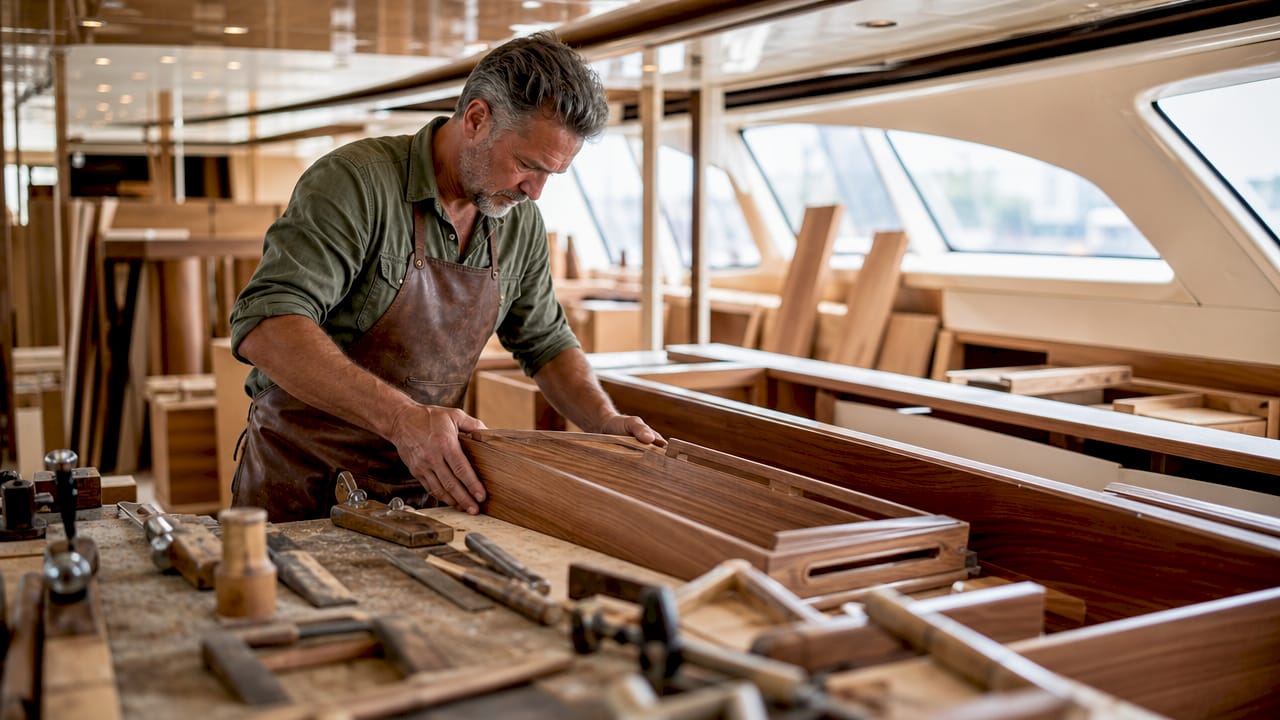
Artisan craftsmen are the defining force behind every truly bespoke luxury yacht, translating design visions into physical reality through skills no machine can replicate. The role of artisan craftsmen in luxury yachts spans cabinetry, marquetry, upholstery, surface finishing, and structural joinery, each discipline requiring years of mastery. The 2026 BOAT Artistry & Craft Awards brought this world into sharp focus, celebrating the individuals whose hands shape the most extraordinary vessels afloat. At Baranofyachts, we work closely with these specialists because we know that the difference between a fine yacht and an extraordinary one lives in the details only a master craftsman can deliver.
How do artisan craftsmen shape luxury yacht interiors and exteriors?
Artisan yacht builders work across a network of specialized trades, each contributing a distinct layer of quality to the finished vessel. The coordination required is substantial. Bespoke marquetry, custom furniture, and surface treatments require coordination across multiple specialized craftspeople over more than six months. That timeline reflects not inefficiency but the depth of attention each element demands.
The design documentation alone signals the complexity involved. Custom yacht projects can require 60 detailed drawings alongside 3D renderings before a single piece of timber is cut. Those drawings serve as the shared language between designers and artisans, ensuring that a curve envisioned on screen becomes a curve executed in wood or leather with complete fidelity.
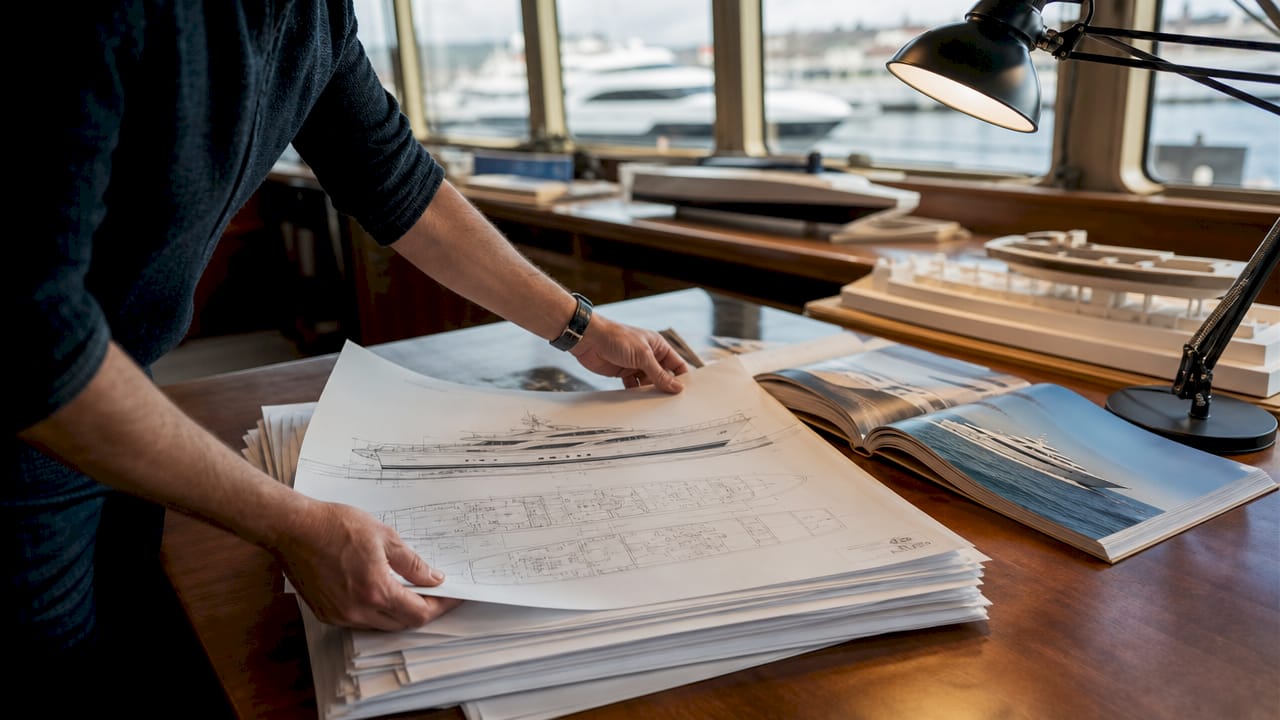
Bespoke projects also require embedding designers in shipyards from the project’s start to ensure faithful execution of the vision. This close collaboration prevents the costly misalignments that arise when design and production operate in isolation. The result is an interior where every element, from the veneer grain direction to the leather stitch pattern, reflects a single coherent intention.
The specialist crafts involved in a typical luxury interior build include:
- Cabinetry and joinery: Structural and aesthetic woodwork, including full-scale mock-ups to refine spatial relationships before final production
- Marquetry and inlay: Decorative wood, stone, or metal patterns cut and fitted by hand to fractions of a millimeter
- Upholstery and leatherwork: Custom seating, wall panels, and headliners shaped to the vessel’s geometry
- Surface treatments and finishing: Lacquering, veneering, and polishing processes that determine the final visual and tactile quality
- Metalwork and hardware: Custom fittings, handrails, and decorative elements fabricated to match the overall design language
Pro Tip: When reviewing a yacht’s interior, run your hand along cabinet door edges and check how drawers close. Doors that close with a soft, even resistance and veneer cuts measured to fractions of a millimeter are the clearest signs of master artisan work.
Technology supports but does not replace this work. CNC and laser tools handle repetitive or precision cutting, freeing craftsmen to focus on the skill-intensive tasks that define quality. A CNC router can cut a veneer panel to specification, but only a trained eye and practiced hand can assess the grain, match the pattern, and lay the piece so it reads as part of a living surface.
What distinguishes artisan craftsmanship from standard yacht manufacturing?
The clearest distinction between artisan-built and mass-produced yachts is the degree of in-house control over quality and customization. Top luxury shipyards perform up to 90% of yacht production internally with teams of 50 or more in-house artisans. That level of vertical integration means every decision, from material selection to finishing sequence, stays within a single quality framework.
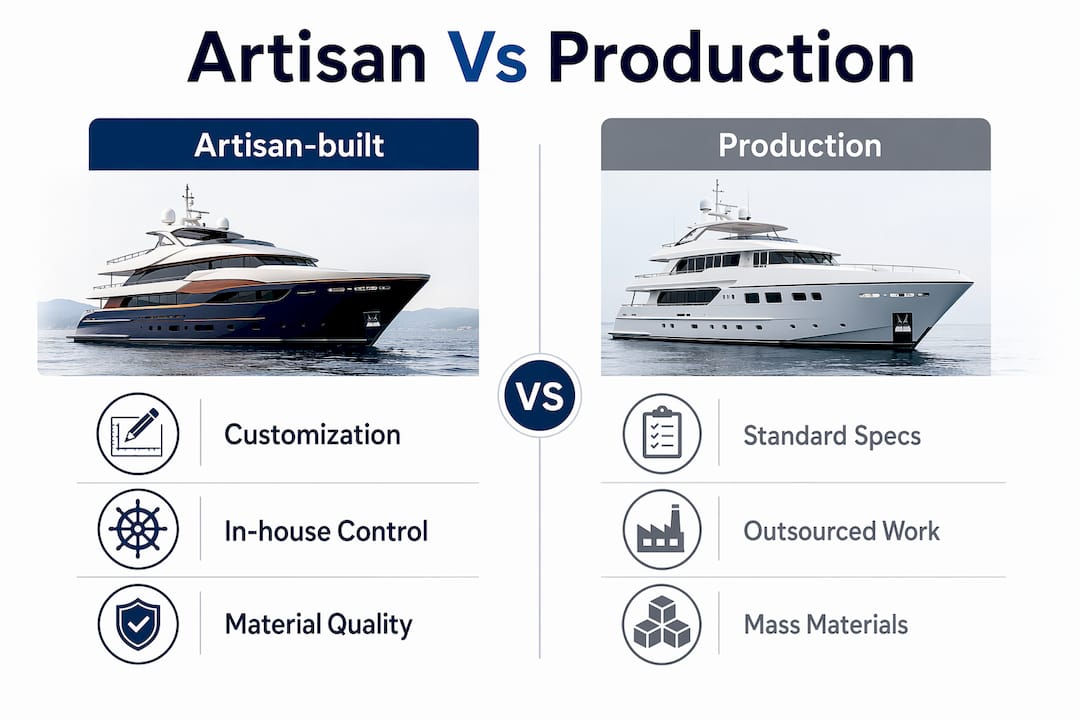
| Factor | Artisan-built luxury yacht | Standard production yacht |
|---|---|---|
| Customization depth | Fully bespoke to owner specification | Limited to factory option packages |
| Interior production | Up to 90% in-house artisan teams | Outsourced to third-party suppliers |
| Design collaboration | Designers embedded with craftsmen | Design finalized before production begins |
| Quality control | Continuous, hands-on at each stage | Inspection at defined production checkpoints |
| Timeline | Six months or more for interiors alone | Fixed production schedule, weeks not months |
| Resale and emotional value | Higher, due to uniqueness and craftsmanship | Lower, due to standardization |
Luxury yacht cabinetry is both functional structure and a work of art, requiring precision engineering paired with master craftsmanship and quality materials. In a production yacht, cabinetry is a module installed from a catalog. In an artisan-built vessel, it is designed around the specific space, the owner’s storage habits, and the visual weight of the surrounding materials.
The materials used in artisan-crafted interiors also differ fundamentally from production-grade alternatives. Artisans select timber for grain character, stone for veining continuity, and leather for hide quality, choices that a production line cannot accommodate. This selectivity is what gives a bespoke yacht its sense of coherence and depth.
What challenges and future outlook exist for artisan craftsmen in luxury yachting?
The most pressing challenge facing artisan yacht builders is visibility. Jay Rushton emphasizes that the effort and skill behind artisan details often goes unseen, advocating for active mentoring and recognition. A yacht owner may spend years aboard a vessel without knowing the name of the craftsman who built the dining table they use every day. That anonymity is not neutral. It affects how the industry values, trains, and retains skilled people.
“The effort and skill behind artisan details often goes unseen.” — Jay Rushton, as recognized at the BOAT International Artistry & Craft Awards 2026
Skill transfer is the second major challenge. Master artisans train apprentices through long-term mentoring, which is the primary mechanism for preserving rare techniques. Marquetry, for example, cannot be learned from a manual. It requires years of supervised practice, feedback, and repetition under a craftsman who has already internalized the standards. When a master retires without a trained successor, that knowledge leaves the industry permanently.
Industry recognition programs address both challenges at once. The 2026 BOAT Artistry & Craft Awards created a public record of individual artisan achievement, giving craftsmen a professional identity beyond the shipyard floor. Recognition of this kind attracts younger talent into the trades and signals to clients that the people behind their yacht’s interior are worth knowing by name.
Pro Tip: Ask your yacht builder or broker to name the lead artisans on a project and describe their backgrounds. A builder who can answer that question in detail is one who genuinely values the craftsmanship in their vessels.
Balancing tradition with technology allows artisans to focus on high-skill work, preserving craftsmanship within modern production constraints. The shipyards that get this balance right use technology as a preparation tool, not a replacement. CNC cuts the blank; the artisan finishes the surface. That division of labor keeps production viable while protecting the quality that defines the category.
How can buyers recognize and engage with artisan craftsmanship?
Artisan-crafted details are identifiable once you know what to look for. Custom interiors like marquetry and artisan furniture significantly increase the value and uniqueness of a yacht, adding both emotional and monetary worth for owners. Understanding what you are looking at transforms a yacht tour from a visual experience into an informed evaluation.
- Examine joinery transitions. Where two materials meet, such as wood veneer joining stone or leather meeting lacquered panel, look for clean, tight seams with no visible filler. Artisan work shows no gaps.
- Test moving parts. Open drawers, close cabinet doors, and operate hardware. Artisan cabinetry moves with consistent, calibrated resistance. Anything that rattles, sticks, or requires force signals a production shortcut.
- Check pattern continuity. In marquetry or veneered surfaces, the grain or pattern should flow across panels as if the surface were a single piece. Matching grain across multiple panels is a time-intensive artisan skill.
- Ask about the production model. Request the percentage of work completed in-house versus outsourced. A shipyard with dedicated in-house artisan teams and a high internal production rate is making a structural commitment to quality.
- Research industry recognition. Shipyards and individual craftsmen recognized by programs like the BOAT Artistry & Craft Awards have passed independent evaluation. That recognition is a reliable quality signal when comparing builders.
Understanding how to evaluate yacht craftsmanship before you tour a vessel gives you a framework for asking the right questions. The difference between a well-finished production yacht and a true artisan build is not always visible at first glance. It reveals itself in the details you touch, test, and trace across a surface.
One additional consideration for corporate clients: artisan-built yachts hold their character over time in ways production vessels do not. The materials are selected for longevity, the joinery is built to be repaired rather than replaced, and the overall construction reflects a philosophy of permanence. That durability translates directly into lower lifecycle costs and higher residual value.
Key Takeaways
Artisan craftsmanship is the single most reliable indicator of quality in a luxury yacht, visible in joinery precision, material selection, and the depth of collaboration between designers and craftsmen.
| Point | Details |
|---|---|
| Artisan coordination takes time | Bespoke interior projects require six months or more of multi-trade coordination to complete. |
| In-house production signals quality | Top shipyards complete up to 90% of work internally, maintaining direct control over every artisan stage. |
| Technology supports, not replaces | CNC and laser tools handle preparation work; artisans apply the skill-intensive finishing that defines quality. |
| Visibility drives sustainability | Recognition programs like the BOAT Artistry & Craft Awards help retain talent and attract new craftsmen to the trades. |
| Buyers can evaluate craftsmanship directly | Testing joinery, checking pattern continuity, and asking about in-house production rates reveals true artisan quality. |
Why artisan craftsmanship will always define true luxury at sea
I have spent years working alongside shipyards, designers, and the craftsmen who rarely get named in the brochure. What strikes me every time is how much of a yacht’s character lives in decisions made by hand, not by machine. The way a veneer wraps a curved bulkhead, the weight of a custom drawer pull, the silence of a well-fitted door. These are not decorative extras. They are the substance of the experience.
The industry is at an interesting point right now. Technology has made production faster and more consistent, which is genuinely useful. But the shipyards I respect most use that efficiency to protect time for the work that cannot be automated. They are not replacing artisans with CNC machines. They are freeing artisans from the repetitive cuts so they can spend more hours on the details that matter.
What I find underappreciated is the project management dimension of artisan work. A custom 40-footer build involved 16 employees and collaboration with over 40 specialists from about 30 vendors. That is not just craftsmanship. That is orchestration. The best artisan builders are also the best coordinators, and that combination is genuinely rare.
My honest view: if you are considering a luxury yacht purchase and the builder cannot tell you who their lead craftsmen are, that is a meaningful data point. The builders who take artisanship seriously know their people by name and by specialty. That accountability is what separates a vessel built to impress from one built to last.
— Jason
Baranofyachts and the craft behind every custom build
At Baranofyachts, we believe the artisan is the author of a yacht’s identity. Every custom build we manage involves direct collaboration with specialist craftsmen across joinery, upholstery, marquetry, and finishing, with our project team maintaining the conductor’s eye across every stage.

We do not treat artisan selection as a secondary decision. We treat it as the foundation of the entire build. Our clients tell us that the details they return to again and again, years after delivery, are the ones a craftsman spent the most time on. If you are ready to understand how artisan craftsmanship can shape your next vessel, our yacht customization guide walks through the full process from concept to delivery. For clients who want to go deeper before committing, our project management approach explains exactly how we coordinate artisan teams to protect quality at every stage.
FAQ
What is the role of artisan craftsmen in luxury yachts?
Artisan craftsmen design and build the bespoke interiors and structural details of luxury yachts, covering cabinetry, marquetry, upholstery, and surface finishing. Their work defines the quality, uniqueness, and long-term value of the vessel.
How long does artisan work take on a luxury yacht?
Coordinating specialist artisan networks for a bespoke interior project typically takes over six months. That timeline reflects the complexity of multi-trade collaboration and the precision required at each stage.
What percentage of a luxury yacht is built by in-house artisans?
Top luxury shipyards complete up to 90% of production internally using teams of 50 or more dedicated artisans. That level of in-house control directly supports consistent quality and deep customization.
How do CNC machines affect artisan craftsmanship in yachts?
CNC and laser tools handle repetitive precision cutting, which frees artisans to focus on the high-skill finishing work that defines quality. Technology supports the process but does not replace the craftsman’s judgment or hand.
How can I identify artisan craftsmanship when viewing a yacht?
Check joinery seams for tight, filler-free transitions, test drawers and doors for calibrated movement, and look for pattern continuity across veneered surfaces. Asking the builder about their in-house artisan team and production percentage also reveals their commitment to craft.
Recommended
Sold Listings


Design Your Yacht
"*" indicates required fields
Maximus III - PNW
As you step aboard MAXIMUS III, the first impression is her scale.
At 120 feet with an 8-meter beam and 294 GT of interior volume, this 2025 Crescent Custom tri-deck immediately feels open, balanced, and estate-like. A timeless look while still feeling fresh from the shipyard.
Currently Available


Get your yacht value Estimate
"*" indicates required fields