

Hull material selection is the process of choosing the structural material for a yacht’s hull based on strength, weight, corrosion resistance, cost, and design objectives. The decision shapes every downstream outcome in a build, from fuel efficiency and speed to maintenance schedules and classification compliance. Materials like steel, aluminum, fiberglass, and advanced composites each carry distinct trade-offs that no single formula resolves. Understanding those trade-offs, and knowing how classification bodies like Lloyd’s Register and the International Association of Classification Societies (IACS) govern them, is the foundation of any serious yacht construction project.
What is hull material selection and why does it matter?
Hull material selection, known in naval architecture as structural material specification, determines the physical backbone of your vessel. Every performance characteristic you care about, from top speed to corrosion tolerance to interior volume, traces back to this single decision. Naval architects integrate material choice with structural scantlings, corrosion allowances, and fatigue margins from the earliest design stage. Treating it as an afterthought is one of the most costly mistakes a yacht owner can make.
The choice also carries regulatory weight. IACS Common Structural Rules specify technical requirements around hull structure strength and corrosion protection, meaning your material selection must satisfy classification standards before a single plate is cut. This is not a bureaucratic formality. Classification directly affects insurability, resale value, and the safety of everyone aboard.
What are the common hull material choices and their properties?
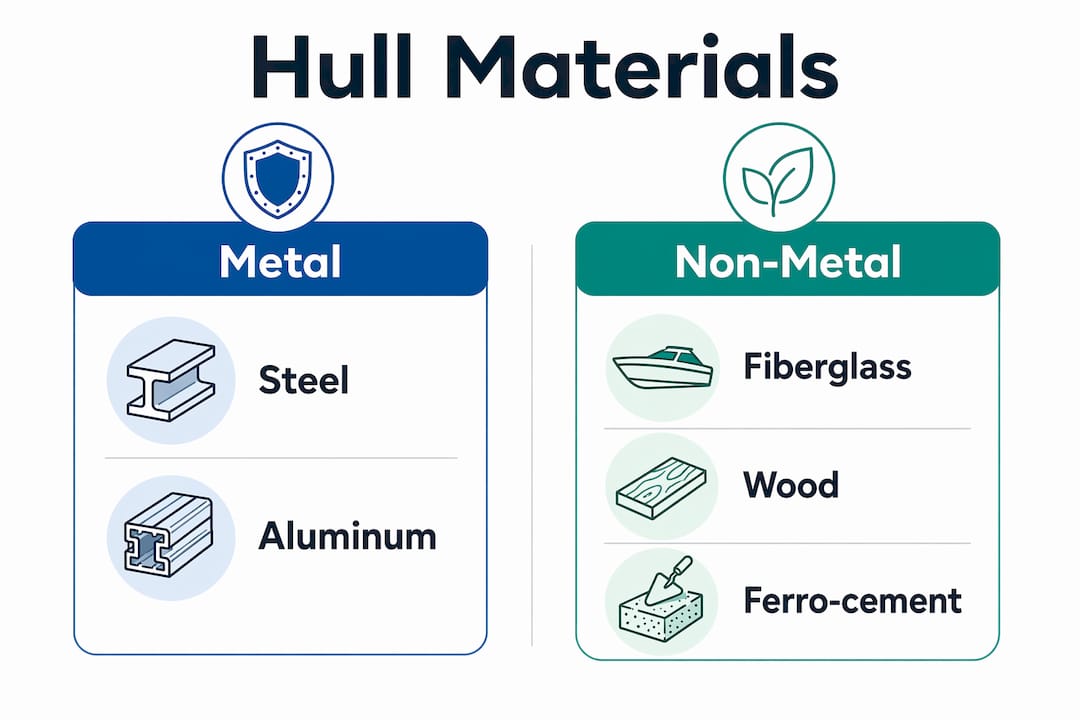
Four materials dominate modern yacht construction, each with a distinct performance profile.
Steel
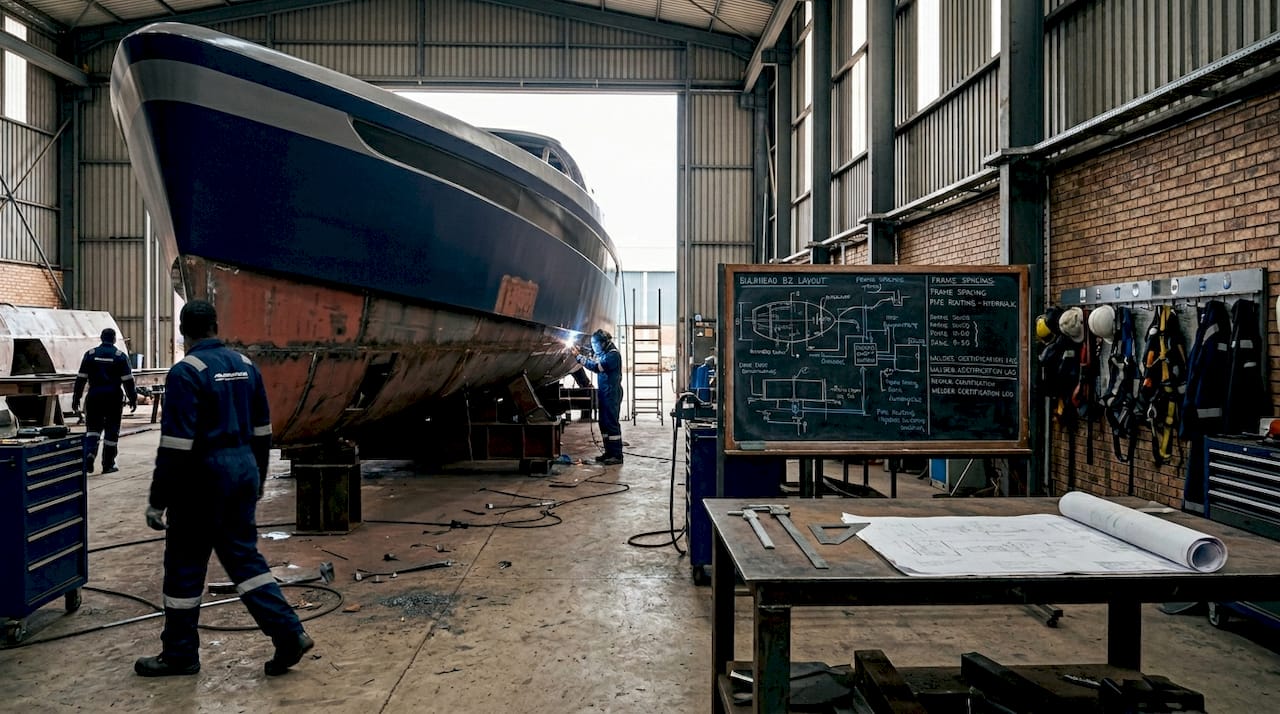
Steel provides high strength and toughness, making it the default choice for large displacement yachts and expedition vessels that must absorb significant structural loads. Its primary liability is weight. A steel hull adds displacement that reduces speed and increases fuel consumption, which matters considerably in a performance-oriented build. Corrosion protection through epoxy coatings, zinc anodes, and impressed current cathodic protection systems is non-negotiable with steel. Properly maintained, a steel hull can last 40 to 50 years. Neglected, it deteriorates faster than any other common material.
Aluminum
Aluminum offers light weight and natural corrosion resistance, making it the preferred material for performance-oriented and expedition yachts in the 30 to 80 meter range. It shapes well, allowing hull form complexity that steel resists. The trade-off is cost. Aluminum plate and the specialized welding it requires run significantly higher than equivalent steel work. Galvanic corrosion is also a real risk when aluminum contacts dissimilar metals, so through-hull fittings and keel attachments require careful engineering.
Fiberglass and composites
Fiberglass allows complex shapes and delivers a smooth, impact-resistant hull at a cost accessible to the mid-market. Carbon fiber and other advanced composites push the weight-to-strength ratio further, producing hulls that are lighter than aluminum while matching or exceeding its stiffness. Composite materials carry higher costs and require specialized engineering and lamination expertise, but they are increasingly the material of choice for high-performance racing yachts and bespoke luxury builds where weight savings translate directly into speed and range.
Wood and ferro-cement
Wood remains relevant for custom heritage builds and restoration projects where aesthetic character is the primary driver. Ferro-cement, a steel-reinforced mortar shell, was popular in amateur construction during the 1970s and 1980s but has largely fallen out of favor due to weight penalties and difficulty in quality control. Neither material is a realistic choice for a new luxury build today, though wood composite systems using cold-molded epoxy techniques do appear in high-end custom yards.
Pro Tip: When comparing materials, calculate lifecycle cost rather than build cost alone. An aluminum hull costs more upfront than fiberglass but typically requires less remedial maintenance over a 20-year ownership period, particularly in saltwater environments.
| Material | Weight | Corrosion resistance | Relative build cost | Maintenance demand |
|---|---|---|---|---|
| Steel | Heavy | Moderate (requires coatings) | Low to moderate | High |
| Aluminum | Light | High (natural oxide layer) | High | Moderate |
| Fiberglass | Light to moderate | High | Moderate | Low to moderate |
| Carbon fiber composite | Very light | Very high | Very high | Low |
| Wood (cold-molded) | Moderate | Low to moderate | High | High |
How do classification rules shape hull material decisions?
Classification societies do not simply approve a finished design. They govern the engineering process from material specification through to structural analysis. The IACS Common Structural Rules set minimum plate thickness, section moduli, frame spacing, and fatigue strength requirements that directly constrain which materials are viable for a given hull form and operating profile. This means your material choice and your structural design are inseparable decisions.
“Classification society rules formalize material selection alongside corrosion and fatigue considerations as integral to hull safety, not afterthoughts.” — IACS Common Structural Rules, Lloyd’s Register
The practical implications for a yacht build include:
- Corrosion allowances: Classification rules require additional plate thickness to account for material loss over the vessel’s service life. Steel requires larger allowances than aluminum, which affects overall displacement calculations.
- Fatigue margins: High-cycle fatigue from wave loading is a primary failure mode in offshore vessels. Minimum structural requirements like plate thickness and frame spacing are set to address this, and the material’s fatigue strength determines how those requirements translate into actual scantlings.
- Material certification: Classification societies require mill certificates for all structural steel and aluminum plate, confirming yield strength, tensile strength, and chemical composition meet specified grades.
- Design approval: Any deviation from standard scantlings, such as using carbon fiber in a structural application, requires direct approval from the classification society and typically involves finite element analysis to demonstrate equivalence.
Understanding yacht classification standards before committing to a material saves significant redesign cost later. We have seen projects where an owner selected a material based on aesthetic preference, only to discover mid-design that it required a structural redesign to meet class rules. That is an expensive lesson.
What performance and design factors drive hull material decisions?
Performance goals are the clearest driver of hull material decisions, and weight is the central variable. Material weight affects fuel efficiency and speed directly. A lighter hull requires less power to achieve a given speed, which either reduces engine size and fuel consumption or frees that power for higher top-end performance. For a 30-meter yacht, the difference between a steel and aluminum hull can represent 15 to 20 tons of displacement, a figure that reshapes the entire propulsion and stability calculation.
Design flexibility is the second major driver. Consider how each material responds to complex hull forms:
- Carbon fiber composites allow the most geometric freedom. Curved surfaces, integrated structural members, and complex hull appendages like bulbous bows and lifting strakes are all achievable without the fabrication penalties that metal imposes.
- Aluminum shapes well with modern CNC cutting and press-brake forming, making it suitable for semi-custom hull forms with moderate complexity.
- Steel is the least geometrically flexible of the primary materials. Compound curves require significant labor, which drives up cost in complex hull forms.
- Fiberglass uses molds, so the initial tooling cost is high but subsequent units are inexpensive. For production builds, this makes fiberglass the most cost-effective path to complex shapes.
Durability versus maintenance is the third axis. A carbon fiber hull requires almost no structural maintenance over its service life but is expensive to repair when damaged. Steel requires consistent coating maintenance but is straightforward to repair anywhere in the world with basic welding equipment. For a yacht that will spend time in remote locations, repairability is a genuine operational consideration, not just a theoretical one.
Pro Tip: Racing yacht builds almost universally specify carbon fiber composites for the weight advantage. Long-range cruising yachts, particularly those intended for polar or high-latitude passages, frequently specify aluminum for its combination of light weight, corrosion resistance, and field repairability.
How to practically select a hull material for your yacht build
Selecting the right material requires a structured evaluation across five dimensions. Working through each one with your naval architect before committing to a design direction prevents the costly mid-project pivots we described earlier.
- Define your operating profile first. A Mediterranean charter yacht and a circumnavigation vessel have fundamentally different material requirements. Saltwater exposure, passage length, port infrastructure, and crew capability all influence which material performs best over a 20-year ownership horizon.
- Set a realistic lifecycle budget. Maintenance costs and environmental exposure drive long-term ownership costs as much as the initial build price. A fiberglass hull may cost less to build than aluminum but require more frequent osmotic blister treatment in warm, tropical waters.
- Consult your classification society early. Bring your material preference to your naval architect and classification society at the concept design stage, not after the lines plan is complete. Early alignment prevents structural redesigns that add months and significant cost to a project.
- Evaluate repair infrastructure. If your yacht will operate in regions where specialized composite repair is unavailable, a material that a local yard can weld or patch is worth serious consideration regardless of its theoretical performance disadvantage.
- Weigh resale value. Custom builds with expert material selection retain value better than builds where material choice was driven by short-term cost reduction. Buyers and surveyors scrutinize hull material and construction quality closely, and a well-specified aluminum or composite hull commands a premium in the secondary market.
Key takeaways
Hull material selection determines yacht performance, durability, and classification compliance simultaneously, making it the single most consequential structural decision in any build.
| Point | Details |
|---|---|
| Material choice drives performance | Weight differences between steel, aluminum, and composites directly affect speed, fuel use, and range. |
| Classification rules are binding | IACS Common Structural Rules set minimum plate thickness, fatigue margins, and corrosion allowances that constrain material options. |
| Lifecycle cost beats build cost | Aluminum costs more upfront than steel but typically delivers lower maintenance costs over a 20-year service life. |
| Composites lead in performance builds | Carbon fiber composites offer the best strength-to-weight ratio but require specialized engineering and higher investment. |
| Early consultation prevents redesigns | Aligning material choice with naval architects and classification societies at concept stage avoids costly structural revisions. |
Why experience changes everything in hull material selection
I have worked through enough custom builds to say with confidence that the biggest mistakes in hull material selection do not come from choosing the wrong material. They come from choosing the right material for the wrong reasons. I have seen owners specify carbon fiber composites because they read about racing yachts, without accounting for the fact that their intended use was long-range cruising in areas where composite repair expertise simply does not exist. The hull performed beautifully. The first time it needed structural repair in a remote port, the project became a logistics nightmare.
The conventional wisdom that composites are always superior to metal is worth questioning. For a bespoke expedition yacht intended to operate in high-latitude environments, aluminum remains the most complete solution available. It is light, corrosion-resistant, weldable by any competent fabricator worldwide, and it satisfies classification requirements without the specialized engineering overhead that carbon fiber demands. The systems view matters here: material, structural scantlings, corrosion protection, and fatigue allowances all interact. Optimizing one in isolation while ignoring the others produces a hull that looks good on paper and underperforms in service.
What I find most valuable in working with experienced naval architects is their ability to hold all of those variables simultaneously. Material selection is not a catalog choice. It is an engineering decision that cascades through every system on the vessel, and the teams that understand that produce builds that perform as promised for decades.
— Jason
Build your yacht with the right material from day one

At Baranofyachts, we approach hull material selection the way a conductor approaches an orchestra: every element must work in harmony for the performance to succeed. Our naval architects evaluate your operating profile, budget, classification requirements, and design objectives together, then recommend the material specification that delivers the best outcome across all four dimensions. Whether you are drawn to the weight efficiency of aluminum, the performance ceiling of carbon fiber composites, or the proven durability of steel for an expedition build, we have the expertise to translate that preference into a classification-compliant, performance-optimized design. Start by configuring your ideal yacht or explore our pre-build consultation process to understand how material decisions fit into the full build sequence.
FAQ
What is hull material selection in yacht construction?
Hull material selection is the process of specifying the structural material for a yacht’s hull, balancing strength, weight, corrosion resistance, cost, and classification compliance. It is one of the earliest and most consequential decisions in any yacht build.
Which hull material is best for a luxury yacht?
Aluminum is the most common choice for custom luxury yachts in the 30 to 80 meter range due to its combination of light weight, corrosion resistance, and design flexibility. Carbon fiber composites are preferred when maximum performance is the primary objective and budget allows for specialized engineering.
How do IACS rules affect hull material choices?
The IACS Common Structural Rules set minimum plate thickness, fatigue strength requirements, and corrosion allowances that all structural materials must satisfy. These rules effectively define the engineering parameters within which any material selection must operate.
Does hull material affect resale value?
Hull material and construction quality are among the first factors a marine surveyor evaluates during a pre-purchase inspection. A well-specified aluminum or composite hull built to classification standards commands a measurable premium over a steel hull requiring remedial corrosion work.
When should I consult a naval architect about hull materials?
Consult a naval architect at the concept design stage, before the lines plan is finalized. Early alignment between material preference, structural requirements, and classification rules prevents redesigns that add significant cost and time to the project.
Recommended
Sold Listings


Design Your Yacht
"*" indicates required fields
Maximus III - PNW
As you step aboard MAXIMUS III, the first impression is her scale.
At 120 feet with an 8-meter beam and 294 GT of interior volume, this 2025 Crescent Custom tri-deck immediately feels open, balanced, and estate-like. A timeless look while still feeling fresh from the shipyard.
Currently Available


Get your yacht value Estimate
"*" indicates required fields