
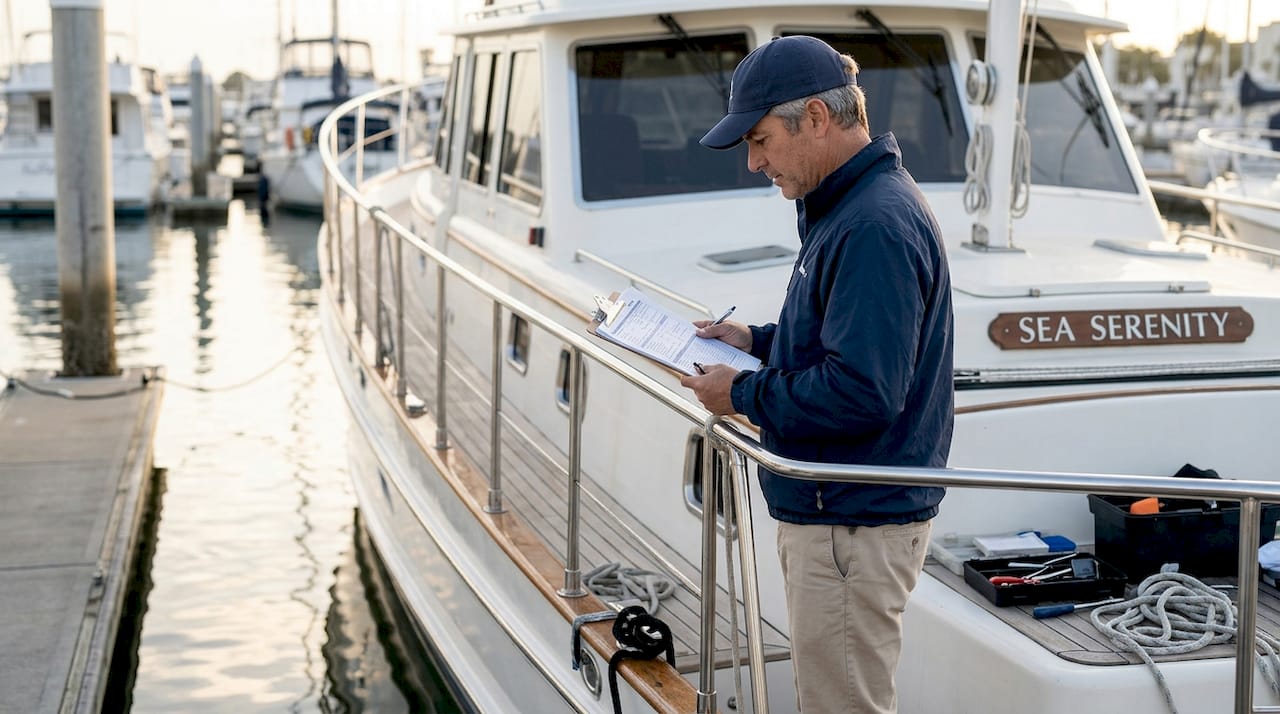
Nearly all luxury yachts commanding the highest insurance terms and resale premiums carry a ‘classed’ designation, yet a surprising number of buyers and builders treat classification as little more than a formality. That assumption is costly. Yacht classification shapes everything from structural integrity and insurance eligibility to charter viability and what you can realistically expect when you sell. Understanding the mechanics, the societies, and the notations behind classification gives you a decisive edge, whether you’re commissioning a new build, acquiring an existing vessel, or planning a significant refit. This guide walks you through every layer of the process, clearly and without unnecessary complexity.
Table of Contents
- What is yacht classification?
- Understanding class notations and compliance
- Alternatives for smaller yachts and entry superyachts
- Edge cases, refits, and evolving standards
- A fresh perspective: Why yacht classification pays off beyond the paperwork
- Connect with experts to maximize your yacht investment
- Frequently asked questions
Key Takeaways
| Point | Details |
|---|---|
| Classification boosts value | Classed yachts achieve higher resale prices, better insurance rates, and more demand in charter markets. |
| Societies define standards | Independent organizations oversee technical rules that enhance safety, reliability, and market quality. |
| Notations tailor compliance | Owners can select class notations to match usage and improve eligibility for insurance or charters. |
| Alternatives exist for smaller yachts | CE and ABYC standards offer routes for smaller vessels, but classification becomes essential above certain thresholds and uses. |
| Class is not static | Refits or modifications require ongoing society approval—loss of class risks insurance and legal complications. |
What is yacht classification?
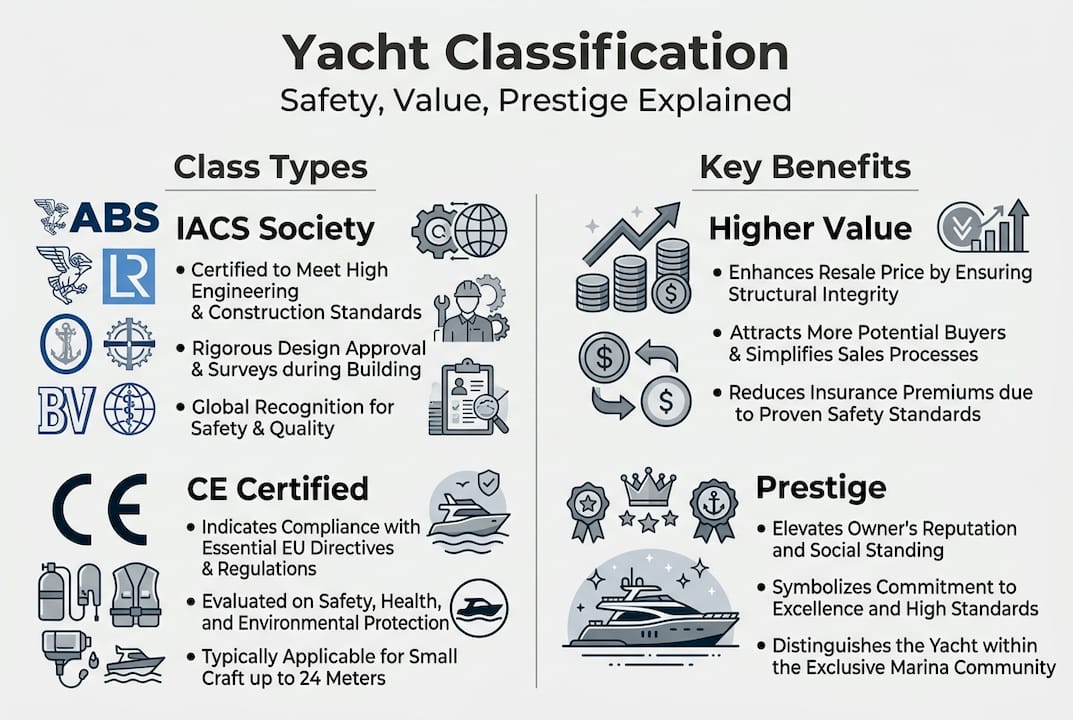
Yacht classification is a voluntary but commercially essential system through which independent, non-governmental societies evaluate a vessel’s design, construction, materials, and ongoing maintenance against internationally recognized technical standards. These societies are not government regulators, meaning compliance is not legally mandated by a flag state in the same way that safety regulations are. Yet their influence over the global fleet is enormous, precisely because financiers, insurers, charterers, and ports all recognize their standards as the benchmark for seaworthiness.
The major players you will encounter are Lloyd’s Register, ABS, Bureau Veritas, DNV, and RINA, each operating under rules that address hull structure, stability, machinery, electrical systems, fire protection, and more. Together, these societies form the International Association of Classification Societies (IACS), and their collective reach is staggering.
Over 90% of global fleet tonnage is classed by IACS member societies, a figure that underscores just how thoroughly these organizations have shaped modern shipbuilding and yacht construction norms.
For buyers interested in yacht ownership exclusivity, this matters because classification is not a one-time inspection. Societies conduct surveys at defined intervals throughout a vessel’s life, creating a continuous, documented record of structural and mechanical integrity. That record is exactly what sophisticated insurers and brokers look for when assessing risk and resale value.
Key areas classification standards address include:
- Hull and structural design reviewed against hydrodynamic and load-bearing specifications
- Machinery and propulsion systems evaluated for reliability and safety redundancy
- Electrical and fire systems assessed for compliance with internationally accepted thresholds
- Materials and welding standards verified through third-party survey rather than builder self-certification
The practical outcome is straightforward: a classed yacht demonstrates verified quality rather than claimed quality. When you purchase a vessel carrying a recognized class certificate, you are buying independent verification that the vessel was built and maintained to measurable standards. That distinction has real dollar value, and we see it consistently reflected in premium insurance terms and stronger resale negotiations.
Understanding class notations and compliance
Class notations are the specific designations added to a vessel’s base class certificate to indicate compliance with standards beyond the fundamental hull and machinery requirements. Think of the base class as the foundation, and notations as specialized features that document exactly what additional systems have been built, surveyed, and approved.
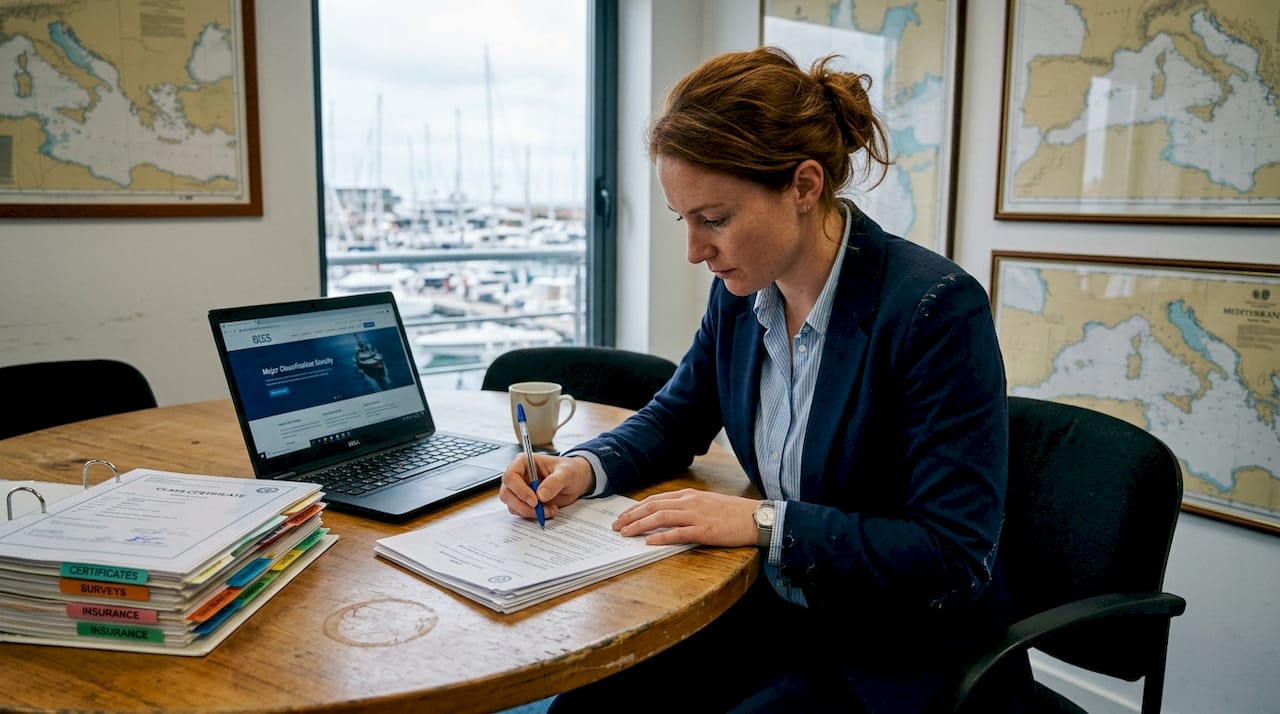
ABS notations offer a clear illustration. AMS (Additional Machinery Survey) confirms enhanced oversight of machinery systems. ACCU (Air Conditioning) documents that climate systems meet defined standards. APS (Propulsion) verifies advanced propulsion configurations. Owners can choose which optional notations to pursue based on how the vessel will be used, and notations can be added or removed as equipment changes, subject to the relevant society’s approval and re-survey.
Here’s how leading societies align on common notation categories:
| Society | Machinery notation | Environmental notation | Dynamic positioning | Special service |
|---|---|---|---|---|
| ABS | AMS | ENVIRO | DPS | SPS |
| Bureau Veritas | AUT-UMS | GREEN PASSPORT | DP | YC |
| Lloyd’s Register | UMS | ENV PASSPORT | DP(AA) | LY3 |
| DNV | E0 | CLEAN | DYNPOS | YACHT |
| RINA | AUT-UMS | GREEN STAR | DP | HSC |
For luxury yacht buyers, the table above is more than a technical reference. Notations directly affect resale negotiations, charter licensing, and insurance underwriting. A yacht with documented DP (dynamic positioning) notation, for example, commands significantly different market positioning than one without it.
From our experience working with clients across yacht configuration options, the most common mistake we see is owners selecting notations based on current needs alone, without planning for how upgrades might interact with existing class records. A notation added later can require retroactive surveys that become expensive if the vessel’s systems were not built with that pathway in mind. Similarly, the relationship between notations and design and maintenance reliability is tight: systems designed for a specific notation must be maintained to that standard consistently.
Pro Tip: Before finalizing your vessel’s specifications at the pre-build yacht steps stage, map out the full lifecycle of notations you may want, including any planned future upgrades. This foresight prevents costly re-engineering later and keeps your class record clean and attractive to future buyers.
Alternatives for smaller yachts and entry superyachts
Full classification by a major IACS society is not universally required. For yachts under approximately 24 meters, or for entry-level superyachts intended for private use, alternatives such as CE (Conformité Européenne) marking in Europe or ABYC (American Boat and Yacht Council) standards in the United States may satisfy both regulatory and insurance requirements without the cost and process of full classification.
The distinction matters because CE and ABYC standards are primarily design and manufacturing benchmarks. They confirm that a vessel was built to a defined code, but they do not provide the same ongoing lifecycle survey structure that full classification delivers. Insurance underwriters know this difference well, and it shows in premium pricing.
| Feature | Classed yacht | CE or ABYC certified yacht |
|---|---|---|
| Ongoing periodic surveys | Yes, mandatory | No, design-stage only |
| Insurance premium position | Typically lower premiums | Higher premiums common |
| Charter eligibility (commercial) | Supported for larger vessels | Limited above size thresholds |
| Resale value premium | Documented and consistent | Less predictable |
| Flag state recognition | Global recognition | Primarily regional |
Several scenarios make full classification mandatory rather than optional:
- Vessels operating commercially or for charter above specific flag state thresholds
- Yachts exceeding 24 meters in length operating under certain flag states
- Vessels carrying more than 12 passengers, which triggers passenger ship rules
- Any vessel where the financing institution or insurer requires it contractually
Pro Tip: Even when classification is not required for your current vessel size or use case, pursuing class voluntarily can add meaningful long-term value. Many clients who commission custom yacht builds opt for classification proactively, knowing that ownership intentions can evolve and a classed vessel is simply easier to insure, charter, and sell at any point in its life.
Edge cases, refits, and evolving standards
Classification is not a status you achieve once and retain indefinitely without effort. It requires active maintenance, and certain events can put it at risk faster than most owners anticipate. Refits and modifications are the most common trigger. Any structural alteration, major system replacement, or change in operational profile that was not pre-approved by the relevant society can result in the vessel falling out of class, sometimes without the owner realizing it until a survey reveals the gap.
The regulatory thresholds that intersect with classification are worth knowing precisely. Carrying more than 12 passengers triggers full SOLAS (Safety of Life at Sea) passenger ship rules, fundamentally changing safety requirements. Reaching 500 gross tons (GT) activates the full ISM (International Safety Management) Code, the ISPS (International Ship and Port Facility Security) Code, and MLC (Maritime Labour Convention) obligations. These thresholds create what we call knock-on effects: a refit that adds guest capacity or volume must be carefully engineered to stay below, or fully comply with, these regulatory bands.
Steps to maintain class status after modifications:
- Notify the relevant classification society before beginning any refit or structural modification.
- Submit design drawings and specifications for pre-approval to avoid non-conformance findings.
- Engage a surveyor at key construction milestones during the refit, not just at completion.
- Document all approved changes to the vessel’s technical file and class record.
- Schedule the appropriate renewal survey promptly after the refit is completed.
Falling out of class has cascading consequences. Insurers can deny coverage immediately. Ports in many jurisdictions can refuse entry or require costly additional surveys before granting clearance. Resale value drops sharply, because any informed buyer or broker will identify the gap in the class record during due diligence. We’ve guided clients through maintaining class after refits and the consistent lesson is that proactive communication with the society is always less expensive than remediation. Real-world refit success stories confirm this: the owners who fare best treat their classification society as a project partner, not a compliance obstacle.
Industry perspective: Classification societies are actively updating their technical rules to address new propulsion technologies, hybrid systems, and sustainability requirements, making it more important than ever for owners to stay engaged with society representatives throughout the vessel’s lifecycle.
A fresh perspective: Why yacht classification pays off beyond the paperwork
We hear a common argument from owners who view classification as optional interference: the yacht was built by a reputable yard, the systems are reliable, and adding a society’s oversight feels redundant. We understand that perspective, and we respectfully disagree with it.
The core issue is independent verification. Builder reputations matter, but a classification society’s survey is structurally independent of any commercial relationship with the yard. That independence is precisely what classification empirically delivers in terms of resale value, favorable insurance terms, and charter viability. Brokers and captains who have managed vessels through incidents consistently report that classed vessels recover faster, both operationally and commercially, because their documentation withstands scrutiny.
There’s a contrarian view worth acknowledging honestly. Some owners favor classification only when commercially required, seeing it as an added cost and survey burden. For very small, privately used vessels, that calculus can be reasonable. But as yacht size, ambition, and investment value grow, the risk mitigation argument becomes overwhelmingly stronger.
Pro Tip: Treat your vessel’s class certificate not as paperwork but as strategic leverage when purchasing, chartering, or planning refits. In a negotiation, a clean, current class record is a tangible asset that commands a better price and a faster close.
Connect with experts to maximize your yacht investment
Classification, notations, and compliance form a system that rewards careful planning from the very beginning of any yacht project. Getting those decisions right means working with advisors who understand not just the paperwork, but the full lifecycle implications for your investment.

At Baranof Yachts, we guide clients through every stage, from initial personalized yacht configuration and bespoke yacht builds to detailed pre-purchase yacht planning that accounts for classification strategy from day one. Whether you’re evaluating your first superyacht or managing a complex refit, our team brings the conductor’s eye to every detail, ensuring your vessel is positioned for safety, performance, and long-term value. Reach out and let’s map out your next step together.
Frequently asked questions
Do all luxury yachts need to be classed?
Not all luxury yachts require classification. Smaller or private vessels may satisfy requirements through CE or ABYC standards, but full class is mandatory for commercial and charter yachts above specific size and passenger thresholds set by flag states.
How does yacht classification impact resale value?
Classed yachts consistently command higher resale premiums and more favorable insurance terms because classification boosts resale value through independent, documented verification of structural and mechanical integrity across the vessel’s life.
What happens if my yacht loses its class after a modification?
Losing class status can trigger insurance denial and port access refusal. Refits require class approval before work begins; owners who skip this step often face expensive retroactive surveys and remediation before coverage is reinstated.
Are class notations permanent or can they be changed?
Optional notations can be added or dropped based on upgrades, operational changes, or equipment modifications, provided the vessel passes the required society survey confirming compliance with the relevant standard.
Is classification only for new yachts, or can it apply to older vessels?
Classification applies to both new and existing vessels. Older yachts can be classed after refits or major upgrades, provided they meet the society’s current technical standards through a full entry-into-class survey process.
Recommended
Sold Listings


Design Your Yacht
"*" indicates required fields
Maximus III - PNW
As you step aboard MAXIMUS III, the first impression is her scale.
At 120 feet with an 8-meter beam and 294 GT of interior volume, this 2025 Crescent Custom tri-deck immediately feels open, balanced, and estate-like. A timeless look while still feeling fresh from the shipyard.
Currently Available


Get your yacht value Estimate
"*" indicates required fields