
Yacht sales tax is a state matter, not a federal one, and the state that taxes your purchase is ordinarily wherever the vessel is registered or principally used, not where you signed the closing documents. For buyers of high-value yachts, the real planning lever isn’t avoiding tax. It’s choosing among states that cap the bill or skip statewide sales tax entirely, since those caps can shrink your effective rate to a fraction of a percent.
TL;DR:
- Buyers should focus on purchasing in states with caps or no statewide sales tax, as caps can significantly lower the effective tax rate on high-value yachts.
- States like Florida and Texas cap the total yacht sales tax owed at around $18,000 for vessels over $300,000, meaning higher-priced yachts pay the same tax as much cheaper ones.
- The actual tax liability depends on the state of registration and use, not where the deal closes, with use tax often self-reported at registration for out-of-state purchases.
- Properly itemized invoices and documentation are crucial for accurately calculating and claiming caps, especially regarding accessories and trade-ins that can inflate taxable bases.
- Strategies like Montana LLCs or offshore registration offer limited tax avoidance benefits if the yacht’s principal use is in a taxable state, and thorough planning is essential before signing any paperwork.
Table of Contents
- What Is Yacht Sales Tax and Who Actually Owes It?
- Which States Cap Yacht Sales Tax, and by How Much?
- Sales Tax or Use Tax: Which One Applies to Your Purchase?
- What Exemptions and Cap Exclusions Should You Know About?
- Do Tax Reduction Strategies Like Montana LLCs Actually Work?
- How Do You Calculate the Yacht Sales Tax You’ll Owe?
- How Baranof Yacht Sales Supports a Tax-Aware Closing
- Jason’s Take: Stop Optimizing for the Wrong Number
- Sources
What Is Yacht Sales Tax and Who Actually Owes It?
There is no federal yacht sales tax. Every dollar you owe traces back to a state statute, and each state writes its own rules on rate, cap, and timing. That single fact drives almost every planning decision a serious buyer makes.
The general principle: tax follows use, not the closing table. If you buy a boat in Rhode Island but register and dock it in Connecticut, Connecticut is typically the state with a claim on your money, collected as use tax rather than sales tax. Dealers usually handle sales tax collection at the point of sale when the transaction and delivery happen in the same taxing state. Private sales and out-of-state purchases shift that burden to you, the buyer, who self-reports use tax at registration.
We’ve walked enough clients through closings at Baranof Yacht Sales to know that the buyers who get surprised by a tax bill are almost always the ones who assumed “where I signed” and “where I owe” were the same place. They rarely are.
Which States Cap Yacht Sales Tax, and by How Much?
Several states charge no general statewide sales tax, including Alaska, Delaware, Montana, New Hampshire, and Oregon. That sounds like a clean answer until you register the boat somewhere else. If your home marina sits in a state that taxes use, buying in a zero-tax state doesn’t erase the bill. It just delays the conversation, according to state-by-state guidance from BoatRegistrationUSA.
For buyers who will actually register and use their yacht in a taxing state, capped states are the more realistic lever. Several major boating states cap the total tax owed regardless of purchase price, which matters enormously once you cross into seven or eight figures.
| State | Rate | Cap | Where the cap binds |
|---|---|---|---|
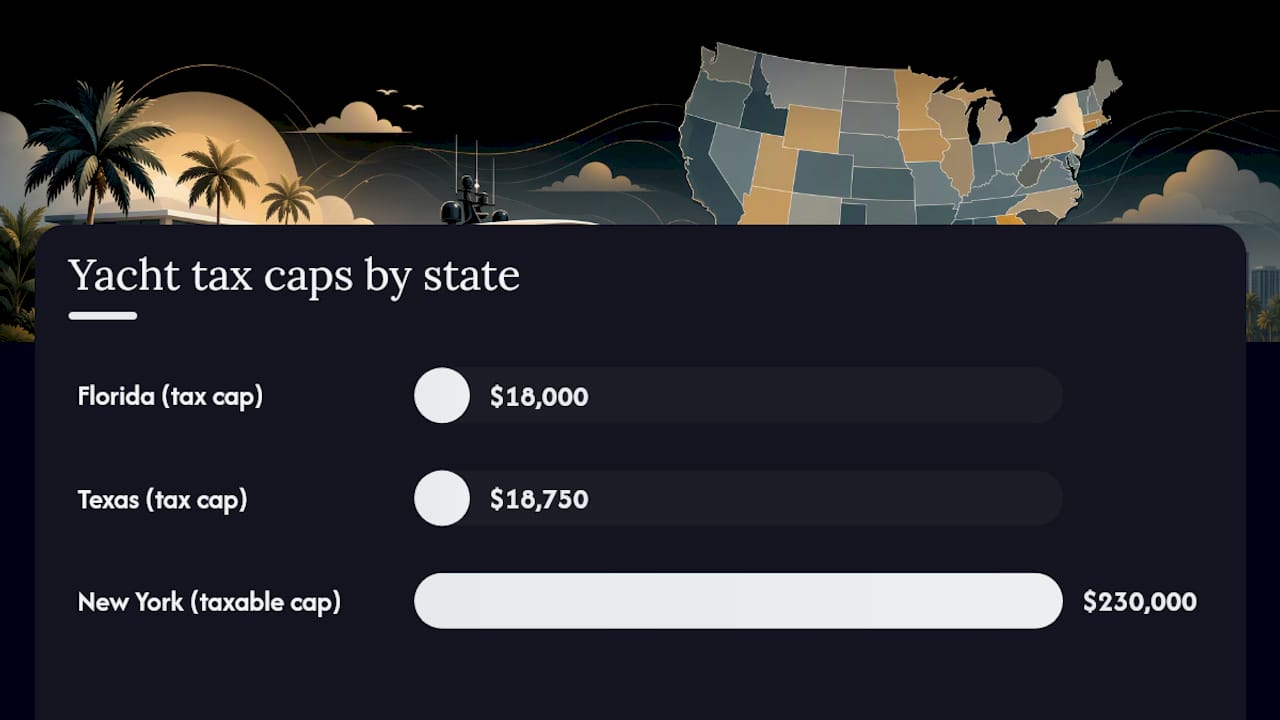
| Florida | 6% state (plus limited county surtax) | $18,000 per vessel | Roughly $300,000 taxable price |
| Texas | 6.25% | $18,750 per sale | Roughly $300,000 taxable price |
| New York | Standard local/state rate | Taxable receipt capped at $230,000 | Any price above $230,000 |
| New Jersey | Partial exemption applies | effective rate reduction on qualifying sales | varies by transaction |
Florida’s $18,000 cap means a $2 million yacht and a $300,000 yacht owe the same state tax once you cross that threshold. Florida’s county discretionary surtax only applies to the first $5,000 of the purchase price, so it barely moves the needle on a high-value sale. Texas mirrors that structure with a $18,750 cap on boats and motors, applied at a 6.25% headline rate that would otherwise produce a much larger bill on an expensive vessel.
New York takes a different approach: instead of capping the tax dollar amount, it caps the taxable receipt itself at $230,000, meaning anything above that price point pays zero additional state tax. New Jersey publishes its own partial exemption structure for boats and vessels, with FAQ guidance worth reading before you assume the standard rate applies. County and local surtaxes rarely change this math meaningfully. Most either cap out at a small dollar threshold or apply only to the base rate, not the capped amount.
Sales Tax or Use Tax: Which One Applies to Your Purchase?
The distinction between sales tax and use tax comes down to who collects it and when the obligation kicks in.
- Dealer sales: the dealer typically collects and remits sales tax at the point of sale when the transaction closes in the same state where the boat will be used.
- Private-party and out-of-state sales: no one collects tax at closing, so the buyer self-reports use tax, usually triggered at registration.
- Timing triggers: liability generally attaches at whichever comes first among required registration, actual registration, or continued use beyond a state’s grace period (often 30 to 90 days).
- Reciprocal credit: most states credit tax already paid to another state against what’s owed at home, but the credit is capped by whatever the new state’s own cap allows. New York’s $230,000 receipt cap, for example, limits how much credit a buyer can claim even if they paid tax on a higher purchase price elsewhere.
California adds a wrinkle worth flagging separately. Documented vessels are presumed taxable unless a specific exemption applies, and the California Department of Tax and Fee Administration can audit use tax reporting for up to eight years in some circumstances. That’s a long tail of exposure for a transaction many buyers assume is closed the day they take delivery.
What Exemptions and Cap Exclusions Should You Know About?
Not every dollar spent on a yacht purchase counts toward the taxable base, and not every yacht qualifies for the same treatment.
- Commercial-use exemptions: charter operations, documented commercial vessels, and some nonprofit-owned boats qualify for reduced or exempt treatment, but states typically require proof of registered commercial activity, not just intent.
- What counts toward a cap: New York’s guidance draws a clear line between built-in equipment (counted in the taxable receipt) and separately invoiced ancillary accessories, which may be taxed differently.
- Trailers and motors: these are frequently taxed as separate line items rather than folded into the vessel’s cap, so a bundled invoice can accidentally push you over a threshold you thought you’d stayed under.
- Documentation requirements: exemption claims almost always require paperwork filed at or before closing, not after the fact.
Pro Tip: Ask your broker to itemize the invoice before closing, separating hull and built-in equipment from accessories, delivery charges, and add-ons. A poorly itemized invoice can quietly inflate your taxable base above a state’s cap threshold, even when the underlying purchase would have qualified for the lower number.
Do Tax Reduction Strategies Like Montana LLCs Actually Work?
Buyers hear about Montana LLCs and offshore closings constantly, and the strategies aren’t fictional. They’re just narrower than the pitch suggests.
- Montana LLC registration avoids Montana’s lack of sales tax on the paperwork, but if the yacht is principally used and moored in a taxing state, that state can still assess use tax and treat the LLC as a formality rather than a shield.
- Offshore closings or foreign flag registration rarely eliminate U.S. state tax exposure once the vessel returns to U.S. waters for regular use, since tax liability follows where the boat actually operates.
- Trade-in credits through a licensed dealer or broker typically reduce the taxable base dollar-for-dollar, while private-party trade arrangements often don’t receive the same credit treatment.
Pro Tip: If a strategy sounds too clean to be legal, ask your tax counsel how the state defines “principal use,” because that phrase is where most Montana LLC challenges begin.
How Do You Calculate the Yacht Sales Tax You’ll Owe?
The calculation itself follows a repeatable sequence, even though the inputs change state to state.
- Identify the registration state, since that state’s rate, cap, and rules govern the transaction.
- Establish the taxable base, subtracting any allowed trade-in credit from the negotiated purchase price.
- Apply the rate, then check for a cap, since a capped state may owe far less than the headline rate suggests.
- Subtract credited tax already paid to another state, up to whatever limit the new state allows.
The effective-rate difference is dramatic at the high end. A $300,000 yacht in Florida hits the $18,000 cap almost exactly, producing a 6% effective rate, according to modeling from industry calculators. A $1 million yacht in that same state still owes only $18,000, dropping the effective rate to 1.8%. Push to $2 million and the effective rate falls to 0.9%. Texas follows a similar curve around its $18,750 cap. Virginia and California, by contrast, apply their rates without the same statutory ceiling, so tax scales closer to linearly with price in those states.
Keep the closing statement, trade-in documentation, and any tax paid to another state on file. Those documents are what support your reciprocal credit claim if a registration state ever asks you to prove it.
How Baranof Yacht Sales Supports a Tax-Aware Closing
Getting the invoice structure right the first time is worth more than fixing it after a registration office flags a problem. Our team at Baranof Yacht Sales manages that structure directly.
- Itemized invoicing that separates hull, equipment, and accessories to align with cap calculations in states like New York and Florida
- Trade-in processing through proper broker channels, which typically preserves the taxable-base reduction that private sales lose
- Coordination with state registration offices on timing, so use-tax triggers don’t catch clients off guard
- A working relationship with tax counsel for clients weighing commercial-use structures, including sale-leaseback arrangements, before the closing date locks in
We’d rather answer the registration question before you sign than after.
Jason’s Take: Stop Optimizing for the Wrong Number
Most yacht tax advice fixates on finding the state with the lowest headline rate. That’s backwards.
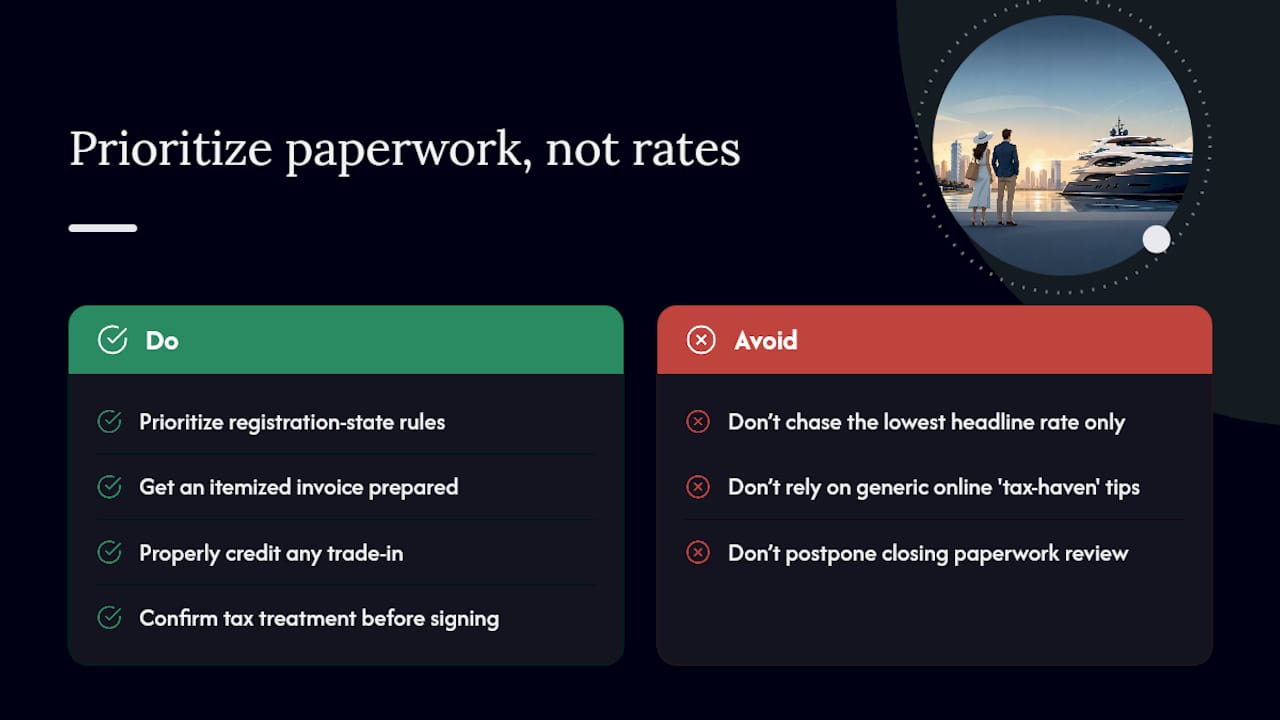
What actually separates a clean closing from an expensive mistake is documentation discipline: an itemized invoice, a properly credited trade-in, and paperwork that survives a use-tax audit years later. I’d rather see a buyer spend an extra hour with their broker structuring the invoice than an extra week chasing a Montana LLC strategy that a home state’s auditor is likely to unwind anyway.
Prioritize the registration state’s actual rules over generic tax-haven advice you found online. Every state cap has fine print about what counts toward the taxable receipt, and that fine print is where money gets saved or lost. Get that answer before you sign anything, not after a registration clerk asks a question you can’t answer.
— Jason
If you’re weighing a purchase against these state-by-state variables, our team can walk through registration and closing structure before you commit. Explore how thoughtful design choices shape today’s most sought-after builds while your tax and registration plan comes together in parallel. For a broader view of ownership costs on the water, Golden Water Sports offers useful local pricing context for recreational vessels.
This article is general information, not a substitute for advice from a qualified financial advisor. Consult a qualified financial professional about your own circumstances before acting on anything here.
Sources
- TSB‑M‑15(2)S — Changes to the Application of Sales and Use Tax to Vessels (New York State)
- Boat and Boat Motor Taxes – Texas Comptroller
- Yacht Sales Tax Calculator by State — Caps & Tax Havens (2026)
- Boat Sales Tax by State: Rates, Caps & How to Save (2026)
- Pub 79 — Documented Vessels and California Tax (CDTFA)
Recommended
Sold Listings


Design Your Yacht
"*" indicates required fields
Maximus III - PNW
As you step aboard MAXIMUS III, the first impression is her scale.
At 120 feet with an 8-meter beam and 294 GT of interior volume, this 2025 Crescent Custom tri-deck immediately feels open, balanced, and estate-like. A timeless look while still feeling fresh from the shipyard.
Currently Available


Get your yacht value Estimate
"*" indicates required fields