

Yacht displacement is defined as the total weight of water a vessel pushes aside, and it equals the yacht’s own weight. This single measurement shapes everything you experience on the water: how steady the boat feels in a beam sea, how much fuel you burn on a long passage, and how much you pay at the marina. Understanding displacement is not optional knowledge for serious owners. It is the foundation of every performance, comfort, and cost decision you will make. At Baranofyachts, we treat displacement as the starting point of every design conversation, because getting it right from the beginning prevents expensive corrections later.
Why yacht displacement matters to owners: the core principle
Displacement is measured in long tons or metric tons and directly corresponds to the vessel’s total weight when fully loaded. Naval architects express this relationship through the displacement-length ratio, a figure that tells you whether a hull is light and fast or heavy and steady. A low displacement-length ratio indicates a lighter boat with higher speed potential but less comfort in rough conditions. A high displacement-length ratio signals a heavier, more sea-kindly vessel built for endurance and stability. The ballast ratio and center of buoyancy are two additional technical markers that every owner should understand before signing a purchase contract.
The center of buoyancy is the geometric center of the underwater volume of the hull. When displacement changes, because you add fuel, fill water tanks, or load provisions, the center of buoyancy shifts. That shift alters how the boat moves through the water and how it responds to waves. Baranofyachts engineers account for these load variations during the design phase, not as an afterthought.

How does displacement affect stability and seaworthiness?
Stability in a yacht comes from two sources: form stability, which is driven by beam, and ballast stability, which is driven by weight placed low in the hull. Displacement hulls rely heavily on ballast stability. High ballast ratios lower the center of gravity, which improves the angle of vanishing stability. That angle is the point at which a capsized boat stops wanting to right itself. A higher angle means a safer boat in extreme conditions.
Beam creates a different kind of stability. A wide beam gives a yacht strong initial resistance to heeling, which feels reassuring at the dock. The problem is that a wider beam creates snappier roll behavior in beam seas compared to deeper displacement hulls. Snappy rolling is fatiguing and disorienting on a long passage. Owners often discover this trade-off only after they have spent 48 hours at sea in a wide, shallow hull.
The key stability factors tied to displacement include:
- Ballast ratio: A higher ratio lowers the center of gravity and improves ultimate stability in knockdown conditions.
- Roll period: Heavier displacement yachts roll more slowly, which reduces crew fatigue and seasickness on extended passages.
- Angle of vanishing stability: Displacement and ballast placement directly determine how far a yacht can heel before recovery becomes impossible.
- Lateral acceleration: Heavier yachts exhibit less lateral acceleration, which measurably reduces motion-induced discomfort in rough seas.
Pro Tip: When evaluating a yacht’s sea-keeping ability, ask for the vessel’s displacement-length ratio and ballast ratio together. Neither figure tells the full story alone.
What is the relationship between displacement and performance?
Speed and displacement exist in direct tension. Every hull has a theoretical hull speed, calculated from its waterline length. A displacement hull cannot exceed this speed without an enormous increase in power, because wave-making resistance rises sharply as the hull approaches hull speed. Higher displacement increases wetted surface area and wave-making resistance, which raises fuel consumption and engine load across the entire speed range.
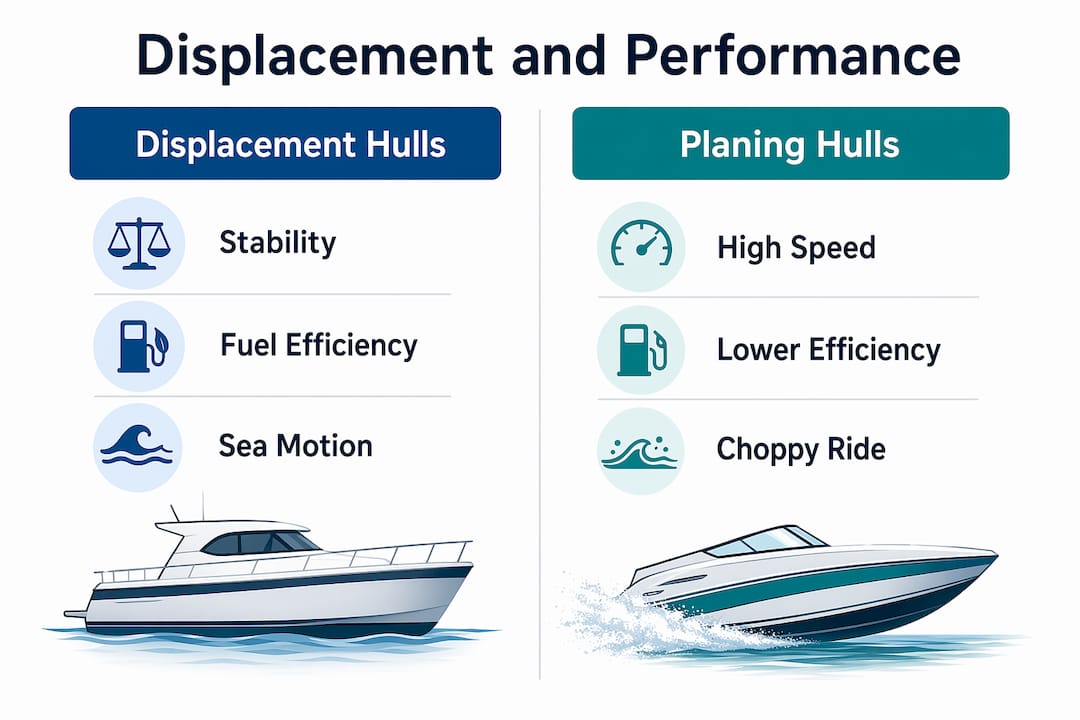
This does not mean heavier is always worse. At displacement speeds, typically below 10 knots for most cruising yachts, a heavier vessel can actually be more fuel-efficient per nautical mile than a lighter planing hull running at the same speed. Full displacement vessels operate efficiently at slower speeds with lower engine output, which also promotes longer engine life. Owners who prioritize range over sprint speed consistently choose displacement hulls for this reason.
The performance trade-offs between hull types break down as follows:
- Displacement hulls: Maximum efficiency at 7–10 knots, excellent range, lower engine wear, limited top speed.
- Semi-displacement hulls: Moderate efficiency across a wider speed band, capable of exceeding hull speed with sufficient power, but at a fuel cost.
- Planing hulls: High top speeds, but fuel consumption rises steeply and range drops significantly at planing speeds.
Pro Tip: If your typical passage involves overnight runs at steady cruising speed rather than day trips at full throttle, a displacement hull will cost you less per mile over the life of the vessel.
What are the practical implications of displacement for owners?
Displacement affects your operating budget in ways that many buyers do not anticipate before purchase. Marina fees and haul-out costs often scale with yacht size and draft, both of which correlate directly with displacement. A heavier yacht with deeper draft may be excluded from certain marinas entirely, particularly in shallow-water cruising grounds like the Bahamas or parts of the Mediterranean.
Displacement also fluctuates throughout every voyage. Fuel, fresh water, provisions, and gear all add weight. These load changes shift the center of buoyancy and alter lateral acceleration, particularly in beam seas. An owner who loads a yacht heavily for a transatlantic passage is sailing a fundamentally different vessel than the one tested at the dock.
The practical ownership implications of displacement, ranked by frequency of impact, are:
- Docking and haul-out fees: Heavier, deeper-draft yachts pay more at most facilities. Budget for this in your annual operating cost.
- Marina access: Draft restrictions eliminate certain anchorages and marinas. Verify your vessel’s loaded draft against your intended cruising region before purchase.
- Fuel planning: Displacement directly determines your fuel burn rate. Calculate range at your intended cruising speed using loaded displacement, not the manufacturer’s light-ship figure.
- Comfort underway: Higher displacement reduces lateral acceleration and slows the roll period, making long passages more tolerable for crew and guests.
- Resale value: Well-built displacement hulls retain value because their construction quality and sea-keeping reputation attract serious buyers.
Understanding hull material choices also matters here, because material selection directly affects the final displacement figure and long-term structural integrity.
How do displacement hulls compare to other hull types?
The distinction between hull types is not purely technical. It reflects a lifestyle choice about how you intend to use your yacht. Displacement hulls are designed to move through the water rather than over it. They are defined by a round or semi-round bilge, a deep keel, and a hull form that generates minimal wave-making resistance at cruising speed.
| Hull type | Typical speed range | Fuel efficiency | Sea-keeping comfort | Best use case |
|---|---|---|---|---|
| Full displacement | 6–10 knots | Excellent | Superior | Long-range cruising, offshore passages |
| Semi-displacement | 10–20 knots | Moderate | Good | Coastal cruising, mixed-use |
| Planing | 20+ knots | Poor at speed | Fair in calm water | Day trips, performance boating |
Displacement hulls provide better sea-kindly motion but sacrifice top-end speed compared to planing hulls. That trade-off defines the cruising style and expectations of the owner. For owners who plan extended offshore passages, the displacement hull is not a compromise. It is the correct tool for the job. Full keel and skeg arrangements typical of full displacement yachts also protect propulsion gear in debris-laden waters, reducing damage risk and maintenance costs over time.
Experienced cruisers consistently report that smooth, steady motion provided by displacement hulls cannot be replicated by modern hull technologies alone. The physics of weight and water are not negotiable. You can refine them with design, but you cannot replace them.
Key Takeaways
Yacht displacement is the single most consequential specification in any owner’s purchase decision, because it determines stability, speed, fuel economy, and total cost of ownership simultaneously.
| Point | Details |
|---|---|
| Displacement defines stability | High ballast ratios and low centers of gravity improve the angle of vanishing stability in rough seas. |
| Heavier hulls burn less fuel per mile | Full displacement vessels operate efficiently at slow speeds, extending engine life and reducing fuel costs. |
| Load changes alter performance | Fuel, water, and stores shift the center of buoyancy and change how the yacht handles in beam seas. |
| Draft affects marina access | Loaded displacement determines draft, which restricts access to shallow marinas and anchorages. |
| Hull type reflects lifestyle | Displacement hulls suit long-range cruising; planing hulls suit speed-focused, short-range use. |
Displacement is the decision most owners get wrong
I have watched buyers spend months agonizing over interior finishes and engine brand, then sign a contract on a hull with a displacement-length ratio that is completely mismatched to their intended cruising style. The finish work is visible at the boat show. Displacement only reveals itself at sea, usually in conditions that are less forgiving than the ones you planned for.
The owners I have seen most satisfied with their vessels, years after purchase, almost always chose a hull with more displacement than they thought they needed. The extra weight felt like a penalty on paper. On a 36-hour passage in 15-foot swells, it felt like the right decision. Stability at sea is not a luxury feature. It is the baseline condition that makes everything else on the boat enjoyable.
Technology has improved hull efficiency, stabilization systems, and ride comfort across all hull types. None of that changes the underlying physics. A lighter hull will always accelerate faster in a seaway. A heavier hull will always recover more predictably. Owners who value comfort and safety over top-end speed should weight displacement accordingly in their evaluation criteria. If you are considering a yacht license or certification process, understanding displacement is foundational knowledge that examiners expect you to demonstrate.
My honest recommendation: before you evaluate any other specification, calculate the displacement-length ratio of every vessel on your shortlist. Then ask your broker to show you the loaded displacement figure, not the light-ship number. Those two data points will tell you more about how the yacht will actually perform than any other specification on the sheet.
— Jason
Baranofyachts and the art of getting displacement right
At Baranofyachts, displacement is not a number we arrive at by accident. Every custom build begins with a detailed analysis of how the owner intends to use the vessel, what sea conditions they will regularly encounter, and what balance of speed, range, and comfort they require. That analysis drives the displacement target, which then shapes every subsequent design decision from hull form to engine selection.

We work with owners who have made displacement mistakes on previous vessels and come to us knowing exactly what they want to correct. We also work with first-time buyers who need a trusted guide through the technical decisions that will define their experience at sea. Our next-generation yacht designs reflect years of refinement in balancing displacement with luxury, efficiency, and long-range capability. If you are ready to make a purchase decision grounded in the right specifications, our boat brokerage team is available to guide you through every step.
FAQ
What does yacht displacement mean?
Yacht displacement is the weight of water the vessel pushes aside, which equals the yacht’s total weight. It is measured in metric tons or long tons and is the primary factor governing stability, speed, and fuel efficiency.
How does displacement affect fuel consumption?
Higher displacement increases wetted surface area and wave-making resistance, which raises fuel consumption at any given speed. Full displacement hulls compensate by operating efficiently at slower speeds, reducing fuel burn per nautical mile on long passages.
What is a displacement-length ratio?
The displacement-length ratio compares a yacht’s displacement to its waterline length. A low ratio indicates a lighter, faster hull. A high ratio indicates a heavier, more stable hull suited to offshore and long-range cruising.
Does displacement change during a voyage?
Yes. Fuel, fresh water, provisions, and gear all add weight and shift the center of buoyancy. Owners should calculate performance and range using loaded displacement, not the manufacturer’s light-ship figure.
Why do displacement hulls perform better offshore?
Displacement hulls generate less wave-making resistance at cruising speed, roll more slowly, and recover more predictably from knockdowns. These characteristics make them the preferred choice for extended offshore passages and rough-water conditions.
Recommended
Sold Listings


Design Your Yacht
"*" indicates required fields
Maximus III - PNW
As you step aboard MAXIMUS III, the first impression is her scale.
At 120 feet with an 8-meter beam and 294 GT of interior volume, this 2025 Crescent Custom tri-deck immediately feels open, balanced, and estate-like. A timeless look while still feeling fresh from the shipyard.
Currently Available


Get your yacht value Estimate
"*" indicates required fields