
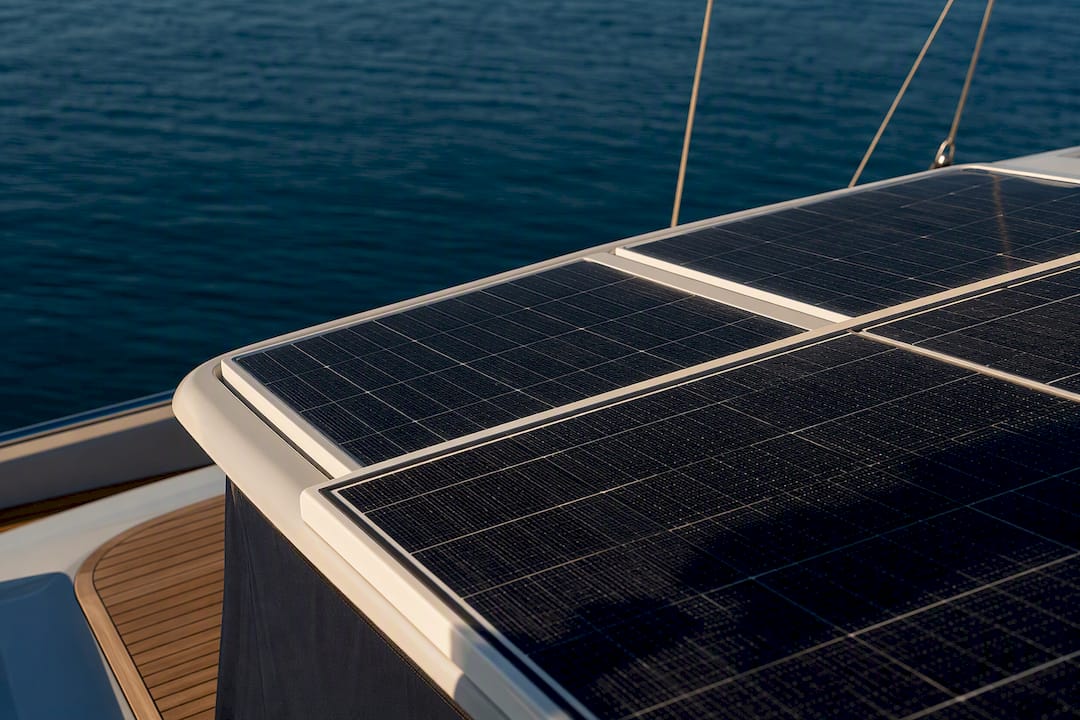
For most yacht owners, the fastest, most reliable upgrade is a mixed approach: flexible panels like the SunPower E-Flex on curved biminis, rigid framed panels on flat hardtops where efficiency matters most, and a fully integrated system reserved for new builds or major refits. Space, shading, and how the yacht is actually used should drive that choice, not the sticker price. Review the shortlist below, then size your system before you commission anything.
TL;DR:
- Rigid panels are ideal for flat, large surface areas like hardtops, but add weight and require a flat, walkable surface with reinforcement.
- Flexible panels suit curved surfaces like biminis but are more shade-sensitive and less efficient in low-light conditions.
- Proper system sizing begins with accurate load calculations, dividing by peak sun hours, and including a 20-25% efficiency loss factor.
- Shade management relies heavily on electrical solutions like independent MPPT trackers and pre-installation shading studies to maximize output.
- Installation costs vary: retail kits suit simple, flat surfaces, while custom, integrated systems suited for complex layouts are significantly more expensive.
Table of Contents
- What Are the Best Solar Panel Options for Yachts?
- How Do You Size a Solar Array for Your Yacht’s Power Needs?
- Mounting, Placement, and Shade Management That Actually Works
- Charge Controllers, MPPT Setup, and Battery Compatibility
- Kits vs Custom Integration: What Installation Actually Costs
- Maintenance, Durability, and How Long Marine Solar Panels Last
- How Professional Refit Teams Scope a Solar Integration
- Does Solar Power Actually Integrate With Your Yacht’s Existing Systems?
- What Safety Standards Apply to Marine Solar Installations?
- What Does the Actual Installation Process Look Like?
- How Yacht Type and Usage Change What You Should Build
- Author’s Quick Checklist Before You Call an Installer
- Ready to Plan Your Yacht’s Solar Refit?
- Sources
What Are the Best Solar Panel Options for Yachts?
Choosing solar power for yachts starts with matching panel geometry to the surfaces you actually have. A 62 foot flybridge motoryacht with a flat hardtop has different constraints than a 78 foot sailing yacht with a curved bimini and a boom that sweeps across half the usable roof. Here is how the main categories stack up.
- Flexible panels (SunPower E-Flex): Bond directly to curved biminis and coachroofs, shave weight versus framed glass, but run a shade tolerance lower than rigid alternatives, according to Yachting Monthly.
- Semi-flexible bespoke arrays (Solbian-style): Built for large custom installs where shape and shade tolerance both matter, using multiple bypass diodes and independent MPPT strings.
- Rigid marine panels: Framed monocrystalline modules that exceed 20% efficiency in many cases, per Yachting Monthly, but need a genuinely flat, walkable surface and add real weight aloft.
- Integrated solar-yacht systems: Builder-delivered architectures like those from Silent Yachts, where the array is engineered into the hull and electrical plan from day one.
| Panel type | Relative efficiency | Weight/fit | Best for | Typical cost band |
|---|---|---|---|---|
| Flexible (SunPower E-Flex) | Good, slightly below rigid | Very light, curved fit | Limited flat roof area, biminis | $$ |
| Semi-flexible bespoke arrays | Good to high with proper string design | Light to moderate, custom shaped | Large yachts needing shade tolerance | $$$ |
| Rigid framed panels | Highest per m² | Heavier, needs flat surface | Flat hardtops, gantries | $$ |
| Integrated builder systems | System-optimized | Engineered into structure | New builds, major refits | $$$$ |
How Do You Size a Solar Array for Your Yacht’s Power Needs?
Sizing starts with your loads, not your roof. Add up every device’s daily watt-hour draw, from the refrigeration compressor to the chartplotter, and you get your baseline demand in Wh/day.
- Total your daily loads. A modest cruiser might draw 2,000 Wh/day for lights, fridge, and electronics; a liveaboard with air conditioning and entertainment systems can easily hit 8,000 to 10,000 Wh/day.
- Divide by peak sun hours. Most cruising latitudes offer 4 to 6 peak sun hours; dividing daily Wh by that figure gives you a rough wattage target.
- Apply a loss factor. Build in a 20-25% derate for MPPT conversion, cable runs, and heat, since panels rarely deliver nameplate output at sea.
- Size your battery bank. LiFePO4 chemistry is the default for weight-sensitive yachts because it holds more usable capacity per pound than lead-acid.
A 12.5 meter sailing yacht modeled with roughly 1.35 kWp of bimini-mounted PV produced about 6-7 kWh/day under summer conditions, enough for meaningful autonomy when paired with other renewables and adequate storage, according to a study in Sustainability.
Mounting, Placement, and Shade Management That Actually Works
Where you put the panels matters more than which brand you buy. Hardtops give you the flattest, most walkable surface, but booms, radar arches, and rigging cast moving shadows that change throughout the day. Biminis carry flexible panels well but flex in a breeze, which stresses laminate bonds over time.
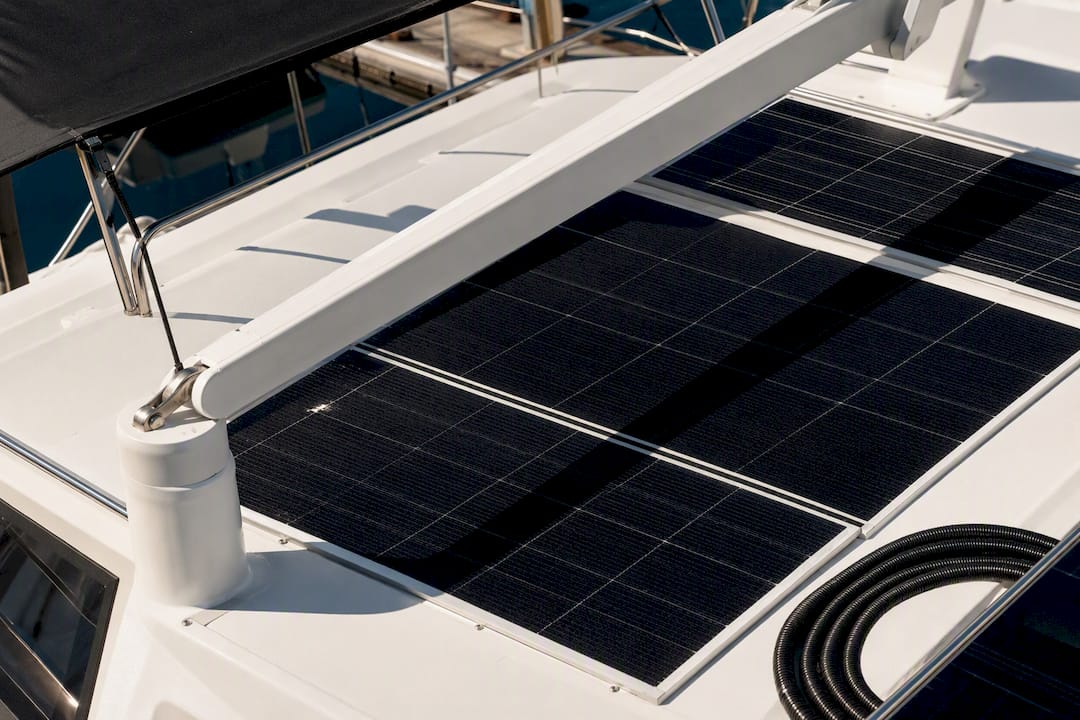
Shading is the single biggest yield killer on a yacht roof, and the fix is electrical, not just physical: independent MPPT trackers per string, generous bypass diode counts, and string layouts planned around where shadows actually fall at 9 a.m. and 3 p.m., not just noon. Sunreef’s Solar Skin 3.0 uses cell-level, AI-driven optimization to squeeze output from partially shaded arrays, a sign of where the technology is heading, per Electrek.
Pro Tip: Ask your installer for a 3D CAD shading study before panels are ordered, not after. Catching a boom shadow on paper costs nothing; catching it after installation means re-wiring strings.
- Confirm whether the mounting area is walkable or must be roped off.
- Verify deck reinforcement under any rigid panel’s mounting feet.
- Route cabling through waterproof glands, never surface-taped runs.
- Consider tiltable or portable panels for cockpit or swim platform use.
Charge Controllers, MPPT Setup, and Battery Compatibility
The controller architecture decides whether your array performs to spec or leaves power on the table every time a sail casts a shadow. Independent MPPT channels, rather than one controller serving multiple strings, let each string track its own optimal voltage, which matters enormously the moment part of the array falls into shade.
Voltage bus selection should match your battery bank, not the other way around: 12V systems suit smaller cruisers, while 24V or 48V architectures reduce cable losses on larger yachts running higher loads. LiFePO4 banks pair naturally with these buses because they tolerate higher charge rates and hold voltage more consistently under load than lead-acid.
- Specify separate MPPT channels for any string that can be partially shaded independently.
- Match controller voltage rating to your battery bus, with margin for panel open-circuit voltage in cold conditions.
- Ask your electrician about overcurrent protection and disconnect placement for each string.
- Confirm the controller’s marine certification and IP rating before it goes anywhere near a wet locker.
Kits vs Custom Integration: What Installation Actually Costs
A retail marine solar kit typically bundles panels, a single MPPT controller, mounting brackets, and cabling, and it is the fastest path onto the water for owners handling their own project management. A custom integrated system adds naval architecture coordination, structural reinforcement, multi-string CAD layout, and commissioning by a marine electrician, which is why the price gap between the two is so wide.
- Choose a kit if you have one or two flat, unshaded surfaces and want a straightforward retrofit.
- Hire a marine electrician when your layout involves multiple strings, mixed panel types, or an existing battery bank that needs matching.
- Schedule shipyard integration for new builds, major refits, or any yacht where solar needs to blend into the hull’s electrical architecture from the start.
Costs are best understood as bands rather than fixed prices: flexible panels generally sit at a different per-watt price point than rigid framed modules, and bespoke arrays like the Baltic 146 installation, which used 154 bypass diodes and 12 independent MPPT trackers across an 8.7 kWp system, sit well above either. That project delivered 30 to 50 kWh per day, illustrating what a properly engineered large array can actually produce.
Maintenance, Durability, and How Long Marine Solar Panels Last
Salt film and airborne grime cut output steadily, and Yachting Monthly’s guidance puts the improvement from regular cleaning at roughly 15%. That is a meaningful swing for zero cost beyond a bucket of distilled water and a soft brush.
Flexible panels face UV breakdown and delamination risk over years of flex and heat cycling; rigid framed panels face frame corrosion and connector fatigue instead. Each needs a different inspection routine.
- Clean panels early morning with distilled water to avoid mineral spotting.
- Inspect junction box seals and flexible-panel edges each season for lifting or bubbling.
- Check frame fasteners and grounding points on rigid panels for corrosion.
- Ask suppliers whether warranties explicitly cover saltwater delamination, not just output degradation.
Pro Tip: Marine-rated coatings matter more than the panel’s rated efficiency. A panel that loses 2% efficiency but survives ten seasons beats one that starts stronger and delaminates in three.
How Professional Refit Teams Scope a Solar Integration
Baranofyachts approaches a solar refit the same way it approaches any structural upgrade: with a feasibility study before a single panel is ordered. That means mapping shade patterns across the deck plan, coordinating reinforcement needs with naval architecture, and confirming the electrical bus can absorb the new charge source without overloading existing wiring.
A project manager’s real value shows up in what gets avoided, not just what gets built. Misrouted cabling, under-specified MPPT counts, and panels mounted where a boom shadow crosses twice a day are the most common pitfalls we see on unmanaged installs. Coordinated commissioning and load testing before delivery catch these issues while they are still cheap to fix.
Does Solar Power Actually Integrate With Your Yacht’s Existing Systems?
Solar panels do not replace your generator or shore power connection; they supplement both, and the integration point is your charge controller and battery bank, not your AC inverter directly. The MPPT controller feeds DC power into the battery bus, and your existing inverter then converts that stored energy to AC for onboard appliances exactly as it already does from batteries charged by shore power or the generator.
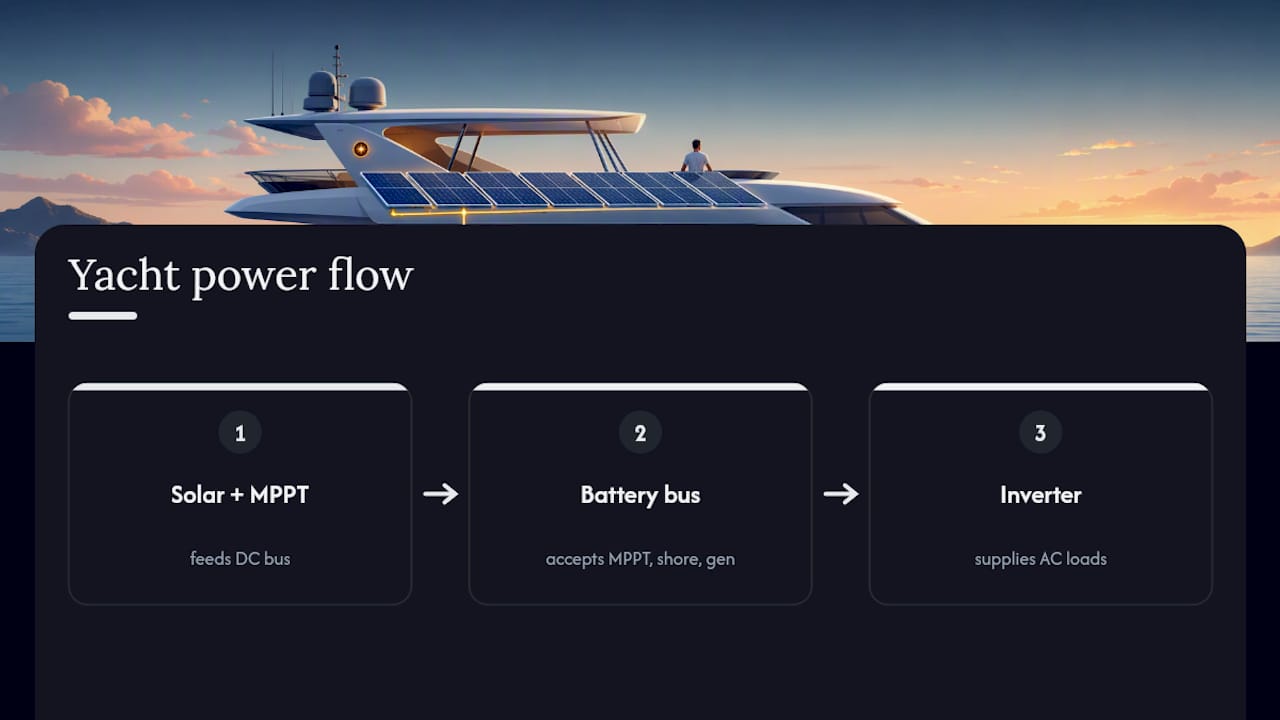
This matters for compatibility planning: your inverter’s rated capacity and your battery bank’s charge acceptance rate need to accommodate the solar input alongside whatever else is charging the bank at the same time. A yacht that charges from shore power at the dock and solar at anchor needs a battery management system that can handle both inputs without conflicting charge profiles, particularly with LiFePO4 chemistry, which is sensitive to overcharging from multiple simultaneous sources.
Shore power itself stays untouched by adding solar. When you are plugged into a marina pedestal, the shore charger typically takes priority and the solar array simply tops off whatever capacity remains, or gets diverted through a dump load if the bank is already full. The practical takeaway for owners: solar works best as a passive supplement that reduces generator runtime at anchor, not as a system that needs to be “switched over” from other power sources. A qualified marine electrician should verify your inverter/charger combo unit explicitly supports multiple simultaneous DC inputs before any array goes in, since older combo units were not designed with solar in mind.
What Safety Standards Apply to Marine Solar Installations?
Marine solar installations fall under general recreational vessel electrical standards rather than a dedicated solar code, which means the wiring, grounding, and overcurrent protection requirements that already govern your yacht’s DC system extend to the new array. In the United States, that generally means American Boat and Yacht Council (ABYC) guidelines for DC electrical systems, covering conductor sizing, fusing, and corrosion-resistant connections in wet environments.
The practical safety concerns that matter most on a yacht are moisture ingress at junction boxes, proper fusing on each MPPT string to prevent a fault from propagating through the bank, and secure mounting that will not become a projectile in a hard sea state. Marine-grade components exist specifically because standard land-based solar hardware is not rated for salt spray, constant vibration, or the flex a hull experiences underway.
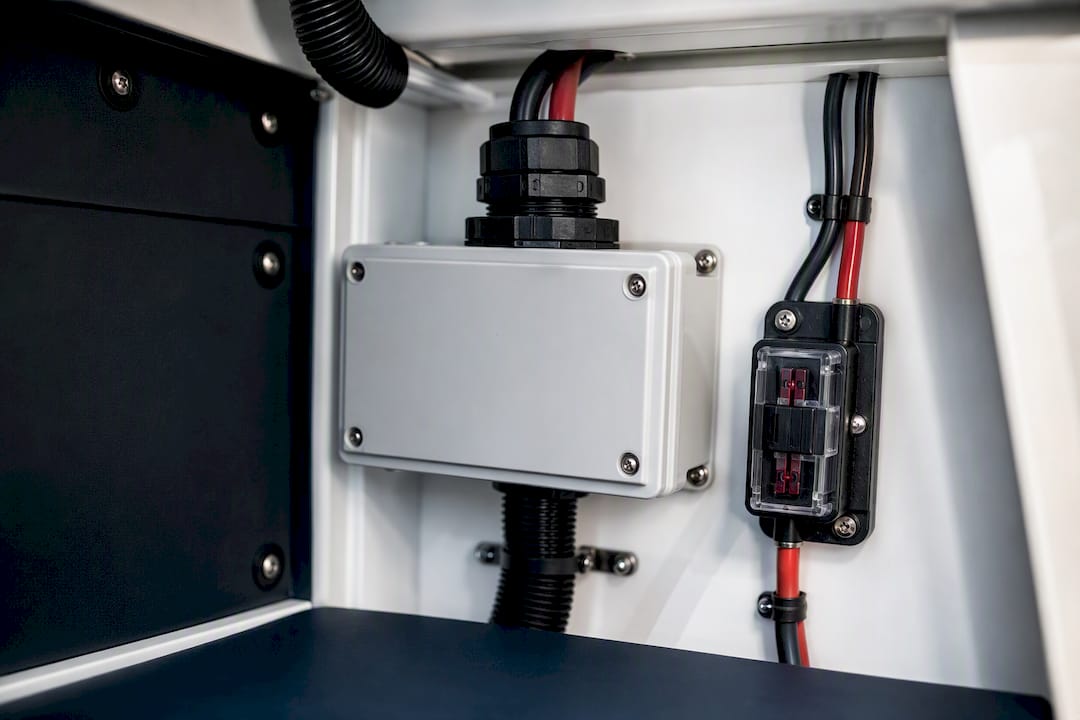
Any installation that ties into an existing battery bank or inverter should be signed off by a marine electrician familiar with ABYC standards, not just a general solar installer, since the two trades approach grounding and bonding differently. If your yacht is flagged or classed under a specific maritime authority, check whether that class society has additional requirements for onboard renewable energy systems, as some do for larger vessels. The safest path is treating a solar array as a full electrical system addition, with the same inspection rigor you would apply to a new generator, not as an accessory that bolts on without review.
What Does the Actual Installation Process Look Like?
A well-run installation follows a sequence, and skipping steps is where most owner headaches start. First comes a shading survey across a full day, mapping exactly where booms, rigging, and radar arches cast shadows at different sun angles. Second is the electrical plan: string layout, MPPT channel count, wire gauge, and where the controller physically lives relative to the battery bank.
Third is mechanical mounting, which differs sharply by panel type. Rigid panels need standoffs for airflow and vibration isolation; flexible panels need a clean, void-free adhesive bond to the substrate, since trapped air under a flexible laminate accelerates delamination. Fourth is cable routing through waterproof glands, followed by controller wiring, fusing, and grounding. Fifth is commissioning: verifying each string’s voltage and current under load, confirming MPPT tracking behaves correctly across partial shade, and checking the battery management system accepts the new charge source correctly.
The most common pitfalls are predictable. Owners skip the shading survey and discover a boom shadow splits their array in half every afternoon. Installers run a single MPPT across multiple strings with different shade exposure, throttling the whole array to match the weakest string. Cable runs get taped along a deck edge instead of routed through a proper gland, and saltwater finds its way in within a season. Panels get bonded without allowing for hull flex, and the bond fails at the edges within a year or two. Each of these is avoidable with a proper plan drawn up before anyone picks up a tool.
How Yacht Type and Usage Change What You Should Build
A weekend coastal cruiser and a full-time liveaboard crossing oceans need fundamentally different solar strategies, even at the same hull length. The coastal cruiser spends most nights at a dock or mooring with shore power available, so solar mainly extends time at anchor without running the generator, meaning a modest flexible-panel array on the bimini often covers it.
A liveaboard or long-range cruiser has a different math problem entirely: continuous hotel loads, no shore power for weeks at a stretch, and a battery bank that needs real daily replenishment. That usage pattern justifies the heavier investment in rigid panels, multiple MPPT strings, and a larger LiFePO4 bank, because the daily energy deficit without solar would otherwise fall entirely on generator hours.
Sailing yachts and motoryachts also diverge structurally. A sailboat’s boom and rigging create moving, predictable shadows that a fixed panel layout can plan around, but usable flat deck space is limited by the sail plan itself. A motoryacht’s flybridge and hardtop often offer generous flat area with fewer moving shade sources, which is exactly why rigid, higher-efficiency panels make more sense there. Charter yachts add another variable: guest usage patterns spike loads unpredictably, from air conditioning to entertainment systems, so their arrays are typically oversized relative to average daily draw to handle peak demand without generator backup. Matching the array to how the yacht is actually used, not just its length overall, is the detail most first-time buyers miss.
Author’s Quick Checklist Before You Call an Installer
Before you contact anyone, pull together a load spreadsheet and photos of every candidate mounting surface. Decide which panel family fits your space: flexible for curves, rigid for flat hardtops. Then request two quotes, one for a retail kit and one for a custom integration, so you can see the real cost gap.
Ask installers directly how many independent MPPT strings they plan and how they mapped shading. Shade and integration complexity remain the two things that separate a satisfying solar upgrade from a disappointing one.
— Jason
Ready to Plan Your Yacht’s Solar Refit?
Baranofyachts manages solar integrations the way we manage every structural upgrade: with a feasibility study, a 3D shading and layout plan, and hands-on project management through commissioning. That’s the real advantage over piecing together a kit yourself or hoping a generalist electrician gets the string layout right on the first try. We coordinate the naval architecture, the reinforcement, and the electrical commissioning as one sequence, not three separate vendors hoping their work lines up.

If you’re weighing a flexible-panel retrofit against a full custom array, or planning solar into a new build from the keel up, a consultation gives you a realistic scope and cost band before you commit to either path. Explore how bespoke refit work comes together in our guide to custom yacht building, and get in touch to schedule a feasibility assessment for your yacht.
Sources
- Everything you need to know about yacht solar power – Yachting Monthly
- Sunreef Solar Skin 3.0 — Electrek
- Baltic 146 PATH – SOLBIAN Solar
- Decarbonizing a sailboat using solar panels, wind turbines, and hydro-generation (Sustainability)
Recommended
Sold Listings


Design Your Yacht
"*" indicates required fields
Maximus III - PNW
As you step aboard MAXIMUS III, the first impression is her scale.
At 120 feet with an 8-meter beam and 294 GT of interior volume, this 2025 Crescent Custom tri-deck immediately feels open, balanced, and estate-like. A timeless look while still feeling fresh from the shipyard.
Currently Available


Get your yacht value Estimate
"*" indicates required fields