
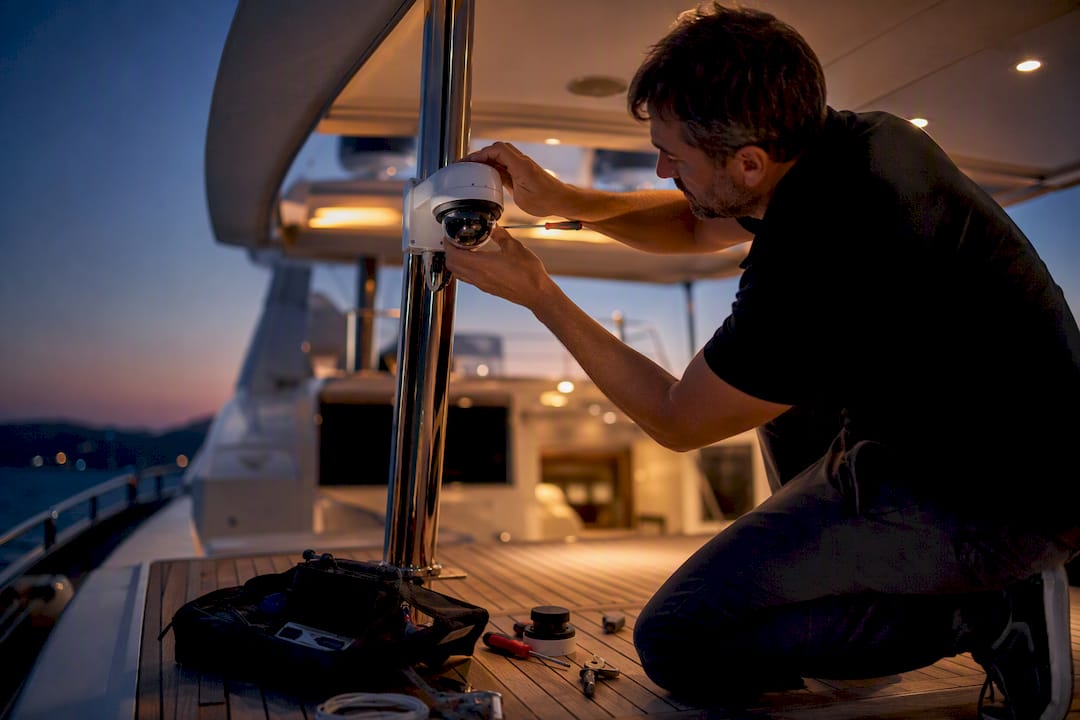
The most effective yacht security approach is a layered, integrated system combining perimeter detection, marine-grade CCTV, access control, network segregation, and a unified vessel management system (VMS). No single sensor or camera does this job alone. If you own or manage a yacht and want to know where to start, do this today: run a security audit of every existing sensor and camera, segregate your bridge and NMEA networks from guest Wi‑Fi, and install at least one perimeter sensor wired into a VMS or mobile app.
This works on a 60-foot flybridge motoryacht the same way it works on a 200-foot superyacht. Only the scale changes, not the architecture.
- Audit first: know what you already have and where the gaps sit
- Segregate networks: isolate navigation and safety systems from entertainment systems
- Start with one integrated sensor: a single connected perimeter device beats five disconnected gadgets
Pro Tip: A single radar sensor wired into a VMS will outperform three standalone alarm boxes that never talk to each other.
Key Takeaways
A layered, integrated security system built around perimeter detection, marine-grade cameras, access control, and network segregation outperforms any single device or standalone gadget.
| Point | Details |
|---|---|
| Start with an audit | Map existing sensors, cameras, and access points before adding new hardware. |
| Segregate networks first | Isolate NMEA and bridge systems from guest Wi‑Fi to block lateral cyber intrusion. |
| Match sensors to risk | Use radar for open water, LIDAR for precise detection with privacy benefits, sonar only for high-risk anchorages. |
| Require a live FAT | Demand integrators demonstrate automatic camera cueing before final payment. |
| Get expert project management | Baranofyachts coordinates integrator, shipyard, and crew training schedules on builds and refits. |
Table of Contents
- What Are the Layers of a Yacht Security System?
- Which Detection Technology Is Right for Your Yacht?
- Do You Need Thermal Cameras and a VMS?
- How Should You Control Access to the Bridge and Engine Room?
- How Do You Protect a Yacht’s Onboard Network?
- Are Wireless Retrofit Kits Good Enough for an Older Yacht?
- How Do You Choose and Commission a Security System?
- How Does Baranofyachts Coordinate a Security Fit-Out?
- What Should You Know About Alarm Systems and Intrusion Detection?
- How Should a Yacht Security System Connect to Emergency Response?
- What Physical Deterrents Actually Stop an Intrusion Attempt?
- How Often Should You Test and Maintain a Security System?
- Integrated Platforms vs. Retrofit Kits: What Actually Matters
- How Baranofyachts Manages Your Yacht Security Project
- Sources
What Are the Layers of a Yacht Security System?
Yacht security works best as concentric rings, not a single wall. The outer ring covers long-range detection, typically radar, LIDAR, or sonar scanning the water around the vessel. The middle ring covers deck and near-hull sensors, motion detectors, and door/hatch contacts. The inner ring covers interior cameras and access points on the bridge, engine room, and safe areas. A fourth layer, geofencing, tracks the vessel’s own position and alerts crew if it drifts from an anchorage or mooring without authorization.
- Perimeter layer: radar, LIDAR, or sonar detects approach before contact
- Deck and interior layer: motion sensors and door contacts catch anyone who gets past the perimeter
- Geofence layer: GPS-based boundaries flag unauthorized movement of the vessel itself
- Response layer: crew and watchkeeping judgment decide what a triggered alert actually means
Layering matters because it reduces false alarms. A single motion sensor near a swim platform will trigger on waves, seabirds, and dock lines slapping the hull. Cross-reference that same trigger against a radar contact or a geofence breach, and the system escalates only when two independent layers agree. Crew still make the final call. No sensor stack replaces a watch officer’s judgment, but it gives that officer better information faster.
Which Detection Technology Is Right for Your Yacht?
Radar, LIDAR, and sonar solve different problems, and picking the wrong one wastes money without closing the actual gap. Cutting-edge yacht security setups typically combine LIDAR or radar for long-range intrusion detection with thermal cameras and access control layered on top.
- Radar covers the longest range and tracks small surface contacts, boats, tenders, and swimmers approaching from open water. It struggles in cluttered marinas where dozens of hulls and docks create reflective noise.
- LIDAR measures precise shape and distance, distinguishing a person from a piece of debris with far less ambiguity than radar. It also offers a privacy advantage: shape-based detection can flag an intrusion without recording continuous video of guest areas. Heavy spray, rain, or fog reduce its effective range.
- Sonar and diver-detection systems matter almost exclusively for larger yachts anchored in high-risk waters, where an underwater approach is a real threat and the extra system cost is justified.
Owners rarely need all three. A typical mid-sized coastal cruising yacht generally needs radar and some deck sensors. A superyacht anchoring off contested coastlines may justify the full stack, and integrators such as MarineGuard build scaled variants depending on vessel size and risk profile.
Do You Need Thermal Cameras and a VMS?
Marine-grade CCTV means housings rated for salt spray, vibration-dampened mounts, and image stabilization that keeps footage usable in a rolling sea state. Standard consumer cameras fail fast in this environment. Thermal imaging closes the gap that visible-light cameras leave open at night, in fog, or against a glare-heavy sunrise approach, where a person on the deck is invisible to a regular lens but glows clearly on thermal.
The camera hardware is only half the system. A video management system (VMS) is what makes the cameras useful rather than just recorded. A strong VMS should:
- Cue the nearest camera automatically when a perimeter sensor triggers, rather than making a crew member scroll through sixteen feeds
- Log every event with a timestamp for later review or insurance claims
- Store footage locally first, then selectively upload only flagged clips when connectivity allows
- Give crew one unified interface instead of separate apps for cameras, alarms, and access logs
That last point is the difference between a pile of hardware and a real system. Unified vessel-awareness platforms consolidate CCTV, sensors, and access control into a single operational picture, which is exactly what cuts response time when an alert actually matters. Offshore, bandwidth becomes the constraint: full remote video streaming eats satellite data fast, so most crews rely on local recording with retention windows and only push flagged events to shore.
How Should You Control Access to the Bridge and Engine Room?
The bridge, engine room, and tender garage carry the highest consequence if the wrong person walks in, so access control there earns a different standard than the guest cabins. Biometric readers and RFID cards work well for crew-only zones because they create a permanent, timestamped log of exactly who entered and when. Contractors and dockside technicians should get temporary credentials that expire automatically rather than a master key that someone forgets to collect.
- Bridge and engine room: biometric or RFID access, logged and audited
- Tender garage and lazarette: RFID or keypad, tied into the same log
- Guest areas: privacy-first detection rather than constant camera coverage
Zone policies matter more than the hardware itself. Every access point should log who entered, and that log should be reviewable during any incident review, insurance claim, or crew handover. For guest cabins and social spaces, LIDAR-based shape detection offers a genuine privacy advantage over cameras. It confirms someone entered an unauthorized area without recording continuous footage of a private space.
Pro Tip: Ask your integrator for a hybrid design that only starts recording once a tiered sensor threshold triggers, not a system that films guest areas around the clock.
How Do You Protect a Yacht’s Onboard Network?
Every sensor, camera, and access point on a modern yacht runs on a network, and that network is now part of the attack surface. NMEA-based navigation systems and bridge electronics must sit on a separate network segment from guest and entertainment Wi‑Fi. Industry guidance is blunt about this: NMEA and guest networks need to be isolated to prevent a compromised streaming device or smart TV from becoming a path into steering or engine controls.
- Segment networks with VLANs and firewalls, keeping navigation, safety, and security systems isolated from anything guests touch
- Use VPNs for remote diagnostic access rather than open ports
- Patch firmware on every connected device on a fixed schedule, not an ad hoc one
- Rotate credentials on all onboard systems, especially after a crew change
Connectivity choices affect this directly. If your crew relies on satellite internet for remote monitoring, review how that link is configured before assuming it is secure, and see our guide on Starlink on yachts for the connectivity tradeoffs involved. Beyond the technical setup, someone on board needs to own a vendor patch policy and keep an incident contact list current, because a strong network design still fails if nobody applies the updates.
Are Wireless Retrofit Kits Good Enough for an Older Yacht?
Wireless retrofit kits make sense when you need protection fast and don’t want to open up bulkheads for a full wired install. Systems built on low-power protocols like ZigBee offer scalable motion, leak, and intrusion detection with battery life measured in months rather than days, which suits a yacht that sits unattended for stretches at a time.
- Retrofit kits install in hours, not days, and cost a fraction of a wired system
- Battery-powered sensors need a replacement schedule; don’t assume “set and forget”
- Wired installs remain the better choice for the engine room and bridge on larger yachts, where reliability can’t depend on a battery
- SIM or 4G fallback keeps a hub reporting even when onboard Wi‑Fi drops, which matters most at anchor
The tradeoff is honest: retrofit kits are convenient, but consumer-grade alarm hardware often lacks a genuine marine rating. Vet that rating and toughen the antenna and power setup before trusting a kit offshore, since general alarm shops sell equipment built for houses, not for salt air and constant vibration.
How Do You Choose and Commission a Security System?
Buying the hardware is the easy part. Commissioning it properly, so it still works the way you expect six months from now, is where most projects go wrong.
- Ask integrators direct questions: How does the system handle a false alarm at 2 a.m.? What’s the maintenance SLA, and who answers the phone if a sensor fails offshore?
- Match coverage to vessel size: yachts in the 60 to 90-foot range generally require radar coverage of the full approach zone, camera coverage of exterior decks and entry points, and access control at several critical doors. Superyachts scale up from there.
- Require a factory acceptance test (FAT) before final payment, where the integrator demonstrates automatic camera cueing and alarm escalation in front of you and your captain.
- Schedule crew training as its own line item, not an afterthought bolted onto delivery day.
- Sign a maintenance contract that specifies response time, not just “support included.”
Pro Tip: During the FAT, insist the integrator trigger a live perimeter alert and watch whether the correct camera pulls up automatically. If crew have to hunt for the right feed, the system isn’t ready.
Crew training deserves particular weight here. Our crew training workflow guide walks through the acceptance and onboarding steps in more detail, and it pairs well with the security commissioning checklist above.
How Does Baranofyachts Coordinate a Security Fit-Out?
Coordinating a security retrofit or new-build integration means managing three separate schedules at once: the shipyard’s structural and electrical timeline, the integrator’s installation window, and the crew’s availability for training. Baranofyachts manages that sequencing directly, so cabling for cameras and sensors happens before interior finishing closes up the walls, not after.
- We align integrator installation windows with shipyard electrical phases to avoid rework
- Handover includes full documentation, as-built network diagrams, and a maintenance contract
- Crew training happens before delivery day, not during it, following the workflow outlined in our crew management guidance
What Should You Know About Alarm Systems and Intrusion Detection?
An alarm system is only as good as its escalation logic. A siren that fires every time a bird lands on the swim platform trains crew to ignore alerts, and that habit is dangerous the one time the alarm is real. Modern intrusion detection avoids this by requiring corroboration: a door contact plus a motion sensor, or a perimeter radar hit plus a geofence breach, before escalating to a full alert.
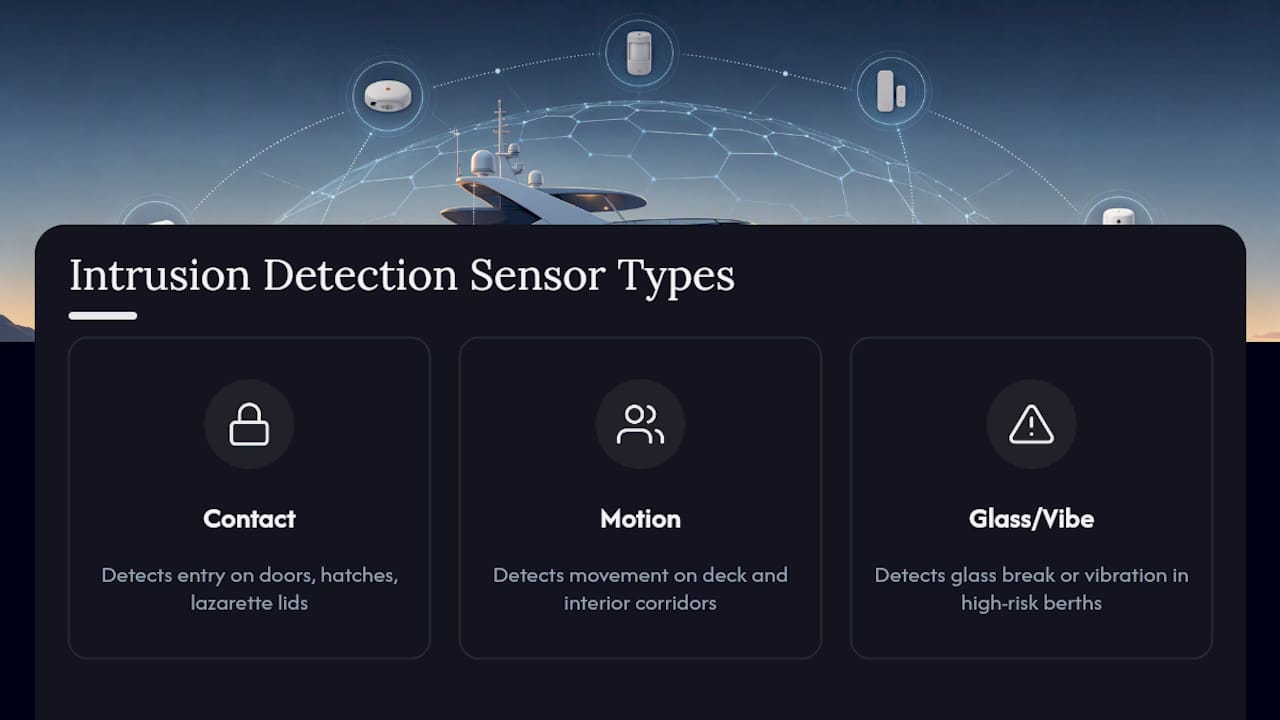
Intrusion detection on a yacht typically covers three categories. Contact sensors on doors, hatches, and lazarette lids catch physical entry. Motion sensors on deck and in interior corridors catch movement in spaces that should be empty. Glass-break and vibration sensors, less common but useful in high-risk berths, catch forced entry attempts before someone actually gets inside.
The alert itself needs a destination. A siren alone does little good if the yacht is unattended at the dock. Remote notification, pushed to the captain’s phone, the owner’s representative, and a monitoring service if one is contracted, turns a local alarm into something actionable. Integrators who combine marine-grade CCTV, thermal imaging, and AI-enabled analytics report meaningfully fewer false alarms than systems relying on a single sensor type, because the analytics layer filters out wave motion, wildlife, and weather before anything reaches a human.
Set alert thresholds deliberately rather than accepting factory defaults. A sensitivity level tuned for a marina berth surrounded by other boats should differ from one tuned for an isolated anchorage. Review and adjust these thresholds whenever the vessel changes cruising grounds.
How Should a Yacht Security System Connect to Emergency Response?
A security system that only alerts the crew stops short of its real job. The stronger design routes qualifying alerts, an intrusion confirmed across two sensor layers, a fire signal, or a man-overboard trigger, toward an actual response path, not just a phone notification that might go unanswered at 3 a.m.
For vessels operating in coastal waters, that means having a documented protocol for contacting local maritime authorities or a coast guard equivalent, with the yacht’s position, registration, and emergency contact details ready to transmit immediately rather than assembled during the crisis. For superyachts running private security or a contracted monitoring service, the alert should reach that provider directly, with an agreed response time built into the contract rather than assumed.
Connectivity underpins all of it. An alert system that depends entirely on onboard Wi‑Fi fails the moment that Wi‑Fi does, which is precisely when the alert matters most. A SIM or satellite fallback keeps the notification path alive regardless of local network status. Review your onboard communication redundancy as part of this planning. A useful reference here is this breakdown of yacht charter communication systems, which covers the layered connectivity options relevant to keeping an alert path open offshore.
Build the emergency contact list into the VMS itself where possible, so an escalation triggers the call automatically rather than depending on a crew member remembering a number during a stressful moment.
What Physical Deterrents Actually Stop an Intrusion Attempt?
Sensors and cameras detect a problem. Physical deterrents try to stop it from starting. The two categories work together, and skipping the physical layer because the electronic layer looks sufficient is a common and avoidable mistake.
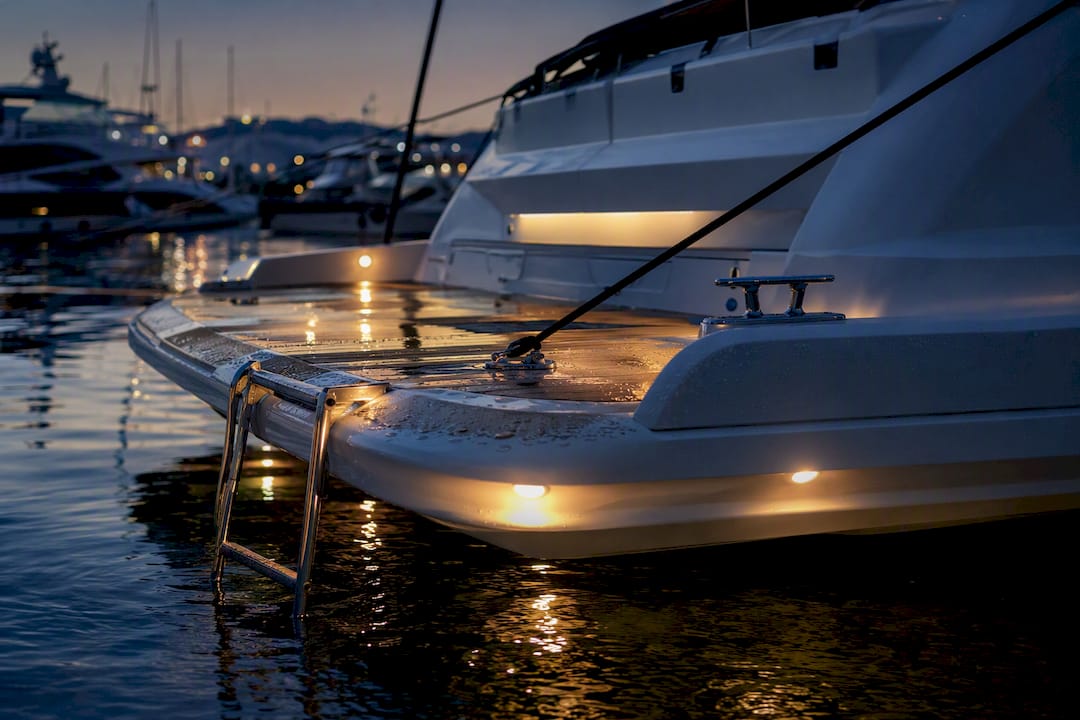
Deck lighting remains one of the most underrated deterrents available. A well-lit swim platform, boarding ladder, and tender garage removes the cover that an opportunistic intruder relies on, and motion-activated lighting adds a layer of surprise that a constantly lit deck doesn’t. Locking mechanisms on exterior doors, hatches, and lazarettes should meet a marine-grade standard, since standard residential hardware corrodes and fails faster in a salt environment than owners expect.
Physical barriers matter most at the boarding points themselves. Retractable boarding ladders, lockable gates on swim platforms, and secured tender access all reduce the number of unguarded entry paths into the vessel. On larger yachts, a simple structural choice, keeping crew and guest access routes separate, limits how far an intruder can move even after getting past the first barrier.
None of this replaces detection technology. It buys time, which is the entire point. A deterrent that slows an intruder by even sixty seconds gives a radar or LIDAR alert time to reach the crew and gives the crew time to respond before the intrusion becomes a boarding.
How Often Should You Test and Maintain a Security System?
A security system that hasn’t been tested since installation day is a system you’re guessing about, not one you’re relying on. Salt air, vibration, and constant sun exposure degrade marine electronics faster than most owners expect, and a sensor that worked perfectly at commissioning can drift out of calibration within a season.
Build a maintenance cadence around three intervals. Weekly, crew should run a basic function check: confirm cameras are recording, sensors are reporting to the VMS, and access logs are populating correctly. Monthly, test the full alarm chain end to end, triggering an actual sensor and confirming the alert reaches the right phone, not just the local console. Annually, bring in the integrator for a full inspection covering wiring integrity, battery replacement on any wireless sensors, firmware updates, and a review of camera positioning against any changes to the vessel’s layout.
Battery-powered retrofit sensors need their own replacement schedule tracked separately, since a dead battery on a hatch sensor often goes unnoticed until the moment it matters. Firmware updates deserve the same discipline as the network segmentation covered earlier: an unpatched camera or sensor is a potential entry point into the onboard network, not just a maintenance inconvenience.
Document every test. When you sell the yacht, refit it, or bring on new crew, a maintenance log proves the system has been reliable rather than merely installed.
Integrated Platforms vs. Retrofit Kits: What Actually Matters
The research on this topic keeps circling back to one uncomfortable truth: most yacht owners overinvest in sensor count and underinvest in integration. A vessel with six disconnected alarm boxes is worse off than one with three sensors feeding a single VMS, because the disconnected setup trains crew to ignore alerts rather than trust them.
Retrofit wireless kits earn their reputation for good reason. They’re fast, affordable, and genuinely adequate for a yacht that spends most of its time at a monitored marina berth. Where the conventional advice falls short is treating retrofit kits as equivalent to a full integrated platform once a yacht starts cruising remote anchorages or carrying higher-value contents. That’s a different risk profile, and it deserves a different architecture, not just more of the same battery-powered sensors.
What should an owner prioritize first? Not the sensor brand. The integration layer. Ask any integrator to prove, during acceptance testing, that a triggered sensor pulls up the right camera automatically. If they can’t demonstrate that live, the system will fail exactly when it matters. Baranofyachts sees this pattern repeatedly on refit projects: owners who specify the integration requirement upfront get a system crew actually trust. Owners who buy hardware first and hope it talks to itself later usually don’t.
— Jason
How Baranofyachts Manages Your Yacht Security Project
Baranofyachts is the direct alternative to piecing a security fit-out together yourself, one vendor call at a time. Where retrofit kit sellers and standalone integrators each solve one part of the problem, we manage the whole sequence: specification, integrator selection, on-site acceptance testing, and crew handover, coordinated against your shipyard or refit timeline so cabling and camera runs happen at the right construction phase instead of as an expensive afterthought.

A specialist project manager on a security fit-out reduces the single biggest risk owners face on these projects: a system that looks complete on paper but fails its first real test because nobody coordinated the integrator’s install window against the yard’s electrical schedule. We’ve built that coordination into how we run new builds and refits, alongside the design decisions covered in our piece on next-gen yacht design moves.
If you’re planning a new build, a refit, or a security upgrade on an existing yacht, reach out to Baranofyachts to scope the project and get a specification tailored to your vessel and cruising plans.
Sources
Recommended
Sold Listings


Design Your Yacht
"*" indicates required fields
Maximus III - PNW
As you step aboard MAXIMUS III, the first impression is her scale.
At 120 feet with an 8-meter beam and 294 GT of interior volume, this 2025 Crescent Custom tri-deck immediately feels open, balanced, and estate-like. A timeless look while still feeling fresh from the shipyard.
Currently Available


Get your yacht value Estimate
"*" indicates required fields