
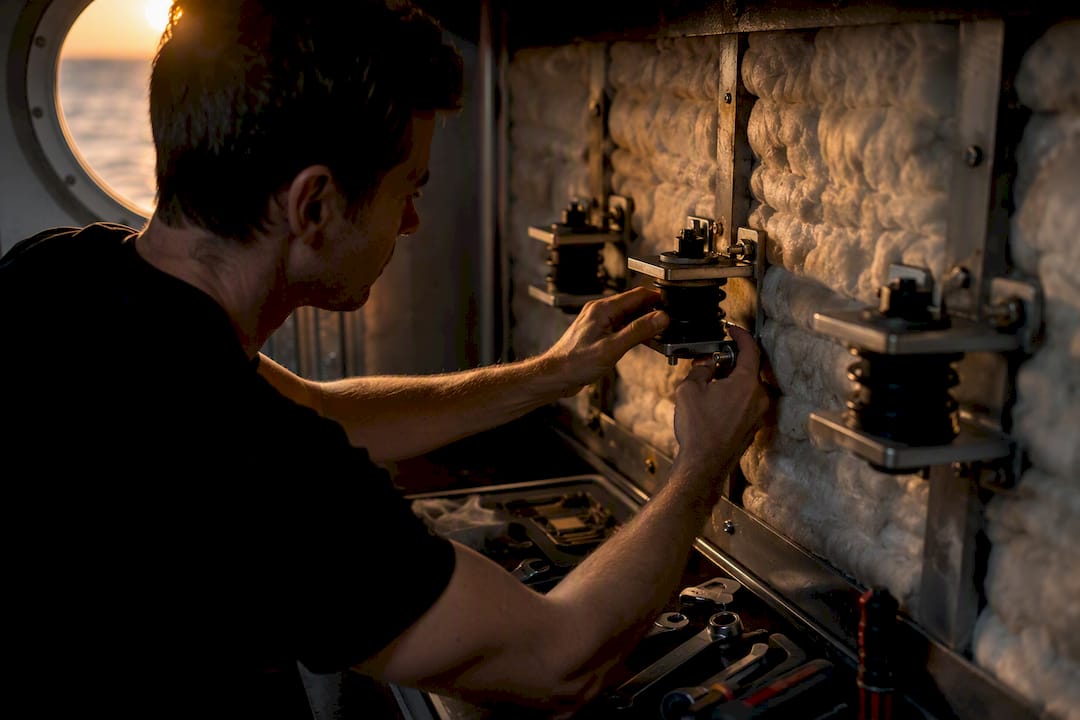
If you want the short version: specify these eight items in your owner or yard brief, and you will capture most of the crew comfort gains available on a new-build or refit. Request RINA Comfort Class notation for vessels over 65 meters. Reference MLC 2006 minimums as a floor, not a target. Cite the IRS Guide for Crew Habitability (ACCOM/ACCOM+/ACCOM++) for measurable acceptance criteria. Add single-occupancy cabins where layout allows. Zone HVAC with individual cabin control. Set acoustic limits in decibels for accommodation and mess spaces. Build in blackout lighting for night-watch crew. Schedule crew consultation before outfitting locks in. Baranofyachts writes every one of these into project management scopes for clients who want habitability treated as engineering, not decoration.
- Request RINA Comfort Class notation for suitably large vessels
- Cite MLC 2006 (Regulation 3.1) as the regulatory floor
- Specify ACCOM/ACCOM+/ACCOM++ per the IRS habitability guide
- Add single-occupancy cabins wherever layout permits
- Zone HVAC circuits with individual cabin temperature control
- Set measurable dB limits for accommodation, mess, and bridge
- Build in blackout and circadian lighting for watch rotations
- Run crew consultation before outfitting is finalized
Include these in your owner or yard brief.
Key Takeaways
Crew comfort improves fastest and cheapest when standards like RINA Comfort Class, ACCOM notations, and MLC 2006 are written into the brief before design finalizes, not added after launch.
| Point | Details |
|---|---|
| Specify a notation, not a wish | Request RINA Comfort Class (ACCOM/ACCOM+/ACCOM++) and cite MLC 2006 as the legal floor. |
| Fix noise and vibration early | Vibration prognosis and acoustic modeling during design cost far less than post-delivery retrofits. |
| Zone HVAC by cabin | Individual temperature control and night-mode setpoints matter more than overall system capacity. |
| Consult crew at four stages | Involve senior crew and the chief engineer at concept, pre-outfitting, mockup, and sea trials. |
| Baranofyachts manages the whole chain | Project management covers spec writing, third-party verification, and handover acceptance testing. |
Table of Contents
- How to Lock Crew Comfort Enhancement Tips Into Contracts
- Where to Spend Money on Noise and Vibration Control
- Which HVAC Setup Protects Crew Sleep and Health?
- What Lighting Design Supports Crew Sleep on Rotation?
- Cabin Design That Actually Improves Retention
- Which Communal Spaces Do Crew Actually Use?
- Galley, Laundry, and Service Flow That Reduce Strain
- Roadmap: Prioritizing Retrofits Without Blowing the Schedule
- How Should Owners Run Crew Consultation Before Handover?
- How Smart Technology Improves Crew Comfort Monitoring
- Controlling Noise and Odor at the Source, Not Just the Wall
- Maintenance Planning to Keep Comfort Systems Working
- Training Crew to Get Full Value From Comfort Systems
- Health and Safety Benefits of Comfort Upgrades
- Why Prioritizing Crew Comfort Reduces Lifecycle Cost
- How Baranofyachts Manages Crew Habitability From Brief to Handover
- Sources
How to Lock Crew Comfort Enhancement Tips Into Contracts
Good intentions do not survive a tight yard schedule. Standards do. The most reliable of the crew comfort enhancement tips we give clients is simple: never ask a shipyard to “make crew quarters comfortable.” Ask for a notation, a regulation, and a number.
RINA Comfort Class, with its ACCOM, ACCOM+, and ACCOM++ tiers, gives you a third-party benchmark for noise, whole-body vibration, lighting, and indoor climate. It is typically requested for yachts over 65 meters, where scale makes informal fixes unreliable. RINA’s own guidance recommends vibration prognosis and acoustic modeling using FEA and CFD during design, which catches problems before steel is cut rather than after.
Below that, MLC 2006 sets the legal floor. Regulation 3.1 requires at least 203 centimeters of headroom in spaces requiring free movement, plus adequate insulation, ventilation, and sanitary facilities. Treat MLC as the minimum you must clear, not the standard you aim for.
The IRS Guide for Crew Habitability (Part 14) bridges the two. It gives you measurement methodologies for accommodation area, vibration, noise, and lighting, letting you specify ACCOM, ACCOM+, or ACCOM++ as a contract deliverable rather than a vague aspiration.
- Cite RINA Comfort Class notation and tier explicitly in the brief
- Reference MLC 2006 Regulation 3.1 as the compliance baseline
- Specify an ACCOM tier from IRS Part 14 for measurable acceptance
- Require pre-delivery third-party measurement, not shipyard self-certification
Pro Tip: Paste this into your owner/yard brief: “Builder shall obtain RINA ACCOM+ notation for crew accommodation spaces, with third-party acoustic and vibration measurements conducted prior to delivery and results provided to the owner’s representative for sign-off.”
Where to Spend Money on Noise and Vibration Control
Whole-body vibration and structure-borne noise wear crew down faster than almost anything else onboard, and unlike a bad mattress, you cannot swap it out later. Both need limits written into the spec, not left to shipyard judgment.
Vibration is typically measured against acceptance methods tied to RINA’s Comfort Class framework, with different thresholds for accommodation, mess rooms, and bridge spaces. Noise limits run tighter in sleeping cabins than in day spaces, since airborne and structure-borne sound compound during rest hours. Experts note that soundproofing and vibration control must be addressed at the design stage; retrofitting a floating floor after launch means tearing out finished cabins.
Statistic Callout: RINA’s Comfort Class framework applies distinct noise and vibration limits by space typology, and its guidance explicitly recommends vibration prognosis using finite-element and computational fluid dynamics modeling during design rather than measurement after build.
- Specify resilient mounts under machinery generating vibration
- Require floating floors in crew accommodation directly above engine spaces
- Isolate HVAC units and ductwork with vibrational dampers, not just insulation
- Zone the general arrangement so noisy plant sits away from crew cabins
- Install duct silencers on air handling units serving crew spaces
Pro Tip: Write acceptance testing into the contract: “On-board acoustic and vibration measurements shall be taken during sea trials at cruising and full speed, in crew cabins and mess, with results compared against ACCOM+ thresholds before final payment milestone.”
Which HVAC Setup Protects Crew Sleep and Health?
Crew accommodation needs its own HVAC zoning, separate from guest circuits, with individual controls in every cabin. A single shared thermostat serving six cabins guarantees at least half the crew sleeps uncomfortably. Night-mode setpoints, run a few degrees cooler than daytime, support deeper sleep for crew coming off watch at odd hours.
Fresh-air rates and filtration matter as much as temperature. Active or HEPA-grade filtration reduces odor transfer between galley, engine room, and crew quarters, and helps prevent condensation in humid climates where mildew becomes a recurring maintenance headache.
Commissioning should confirm the system actually performs as designed:
- Map airflow at every cabin outlet against design specification
- Verify individual control response time and range in each cabin
- Run thermal imaging to catch hot spots behind bulkheads or under decks
- Confirm night-mode setpoints trigger correctly on schedule
- Separate crew HVAC circuits from guest and galley systems
- Specify minimum fresh-air exchange rates in the contract
- Require condensation control measures in wet-climate routing zones
Pro Tip: Ask for commissioning documentation showing cabin temperatures held within 1°C of setpoint across a 24-hour cycle before handover sign-off.
What Lighting Design Supports Crew Sleep on Rotation?
Watch schedules mean someone on your crew is always trying to sleep while the sun is up. Layered lighting, general, task, and berth-level, with independent dimming and adjustable color temperature gives each crew member control over their own environment instead of fighting a single overhead fixture.
Blackout performance deserves its own line item. Roller blinds with double-sill tracks and overlapping edges block light leakage far better than standard curtains, and door seals stop hallway light from bleeding under the frame. Program lighting scenes for day, night watch, and sleep mode, with low-glare, red-shifted task lighting for anyone checking instruments at 3 a.m. without waking a cabin mate.
- Specify independent dimming and color temperature control per berth
- Require double-sill blackout blinds with edge overlap
- Add door seals rated for light leakage, not just sound
- Program distinct day, watch, and sleep lighting scenes
Pro Tip: Set a maximum light-leak tolerance in the spec, no more than 1 lux measured at the berth with blinds closed, and verify it during a night-time walkthrough before handover.
Cabin Design That Actually Improves Retention
A crew cabin is where someone lives for months at a stretch, and the layout choices you make now shape whether they stay for the next contract. Single-occupancy cabins, where hull form allows, consistently outperform shared berths for both sleep quality and retention. Clear separation between sleep and day functions, even within a small footprint, lets crew rest without a roommate’s desk lamp interfering.
A crew-centered pre-study on indoor environmental quality identified privacy, personal space, and homeliness as recurring themes crew raised unprompted, alongside temperature and noise. That lines up with what practitioners see on delivery walkthroughs, where missing sockets and inadequate storage turn out to be common and costly to fix after the fact.
- Prioritize single-occupancy cabins wherever the general arrangement allows
- Separate sleep and day zones even in compact cabin footprints
- Add integrated lockers, personal charging points, and foldable desks
Homeliness comes from small, deliberate choices: neutral palettes that don’t fight personal items, magnetic photo panels instead of adhesive tape on bulkheads, and personalization limits that keep safety intact.
- Specify durable, easy-clean finishes in every crew cabin
- Allow controlled personalization zones without compromising fire safety
Pro Tip: Write into the brief: “Crew shower enclosures shall use nano-coated glass and surfaces; berth upholstery shall be washable-rated fabric,” which cuts housekeeping time and extends finish life by years.
Which Communal Spaces Do Crew Actually Use?
A gym nobody visits is wasted budget. Usability depends on access, not novelty: a crew gym tucked behind three watertight doors gets used far less than one on a direct route from cabins. Shade, privacy from guest sightlines, and furnishings that survive salt air matter more than square footage.
The 111-meter Oceanco superyacht Leviathan built its interior around crew-led choices, including a crew gym, whirlpool, and basketball court, on the logic that shared spaces reduce fatigue and build cohesion on long rotations. You don’t need a basketball court to apply the principle at smaller scale.
- Include a functional mess with flexible seating for staggered watch schedules
- Add a quiet lounge separate from the main mess for decompression
- Specify sheltered outdoor seating with sun and rain protection
Pro Tip: A minimum viable crew gym needs a rack, adjustable bench, cardio machine, and free weights in roughly 15 to 20 square meters, enough for real use without eating into tender garage or storage space.
Galley, Laundry, and Service Flow That Reduce Strain
Crew spend more waking hours in the galley and laundry than almost anywhere else onboard, and poor ergonomics there compounds into fatigue fast. A proper galley work triangle, between prep, cook, and wash stations, cuts unnecessary steps across a shift. Fixed, durable surfaces hold up better than decorative finishes under constant use, and noisy equipment like ice makers or compressors belongs away from adjacent sleeping cabins.
Laundry capacity should be sized to actual crew count and turnaround needs, with dirty and clean flow physically separated to avoid cross-contamination and confusion during busy charter weeks.
- Design galley layout around a tight, tested work triangle
- Separate dirty and clean laundry flow into distinct zones
- Route service corridors to avoid heavy manual carrying past guest areas
Pro Tip: Sketch the service flow from provisioning delivery to storage to galley before finalizing the general arrangement, and hand shipyards an ergonomic checklist covering lift heights and carry distances.
Roadmap: Prioritizing Retrofits Without Blowing the Schedule
Not every comfort upgrade belongs in the same yard period. Quick wins, blackout curtains, cabin lighting scenes, added storage, install in days with minimal disruption. Medium upgrades, HVAC rezoning, acoustic panels, filtration upgrades, need more yard time but rarely require structural work. Structural fixes, floating floors, engine isolation mounts, machinery relocation, demand the most disruption and cost the most if attempted after delivery.
That last category is exactly why vibration and acoustic countermeasures belong in the design phase whenever possible. If you’re weighing a major refit against rolling several structural items into a new-build instead, the new-build usually wins on total cost once you account for stripping finished interiors twice.
- Quick wins: lighting scenes, blackout curtains, storage additions
- Medium: HVAC zoning, filtration upgrades, acoustic panel installation
- Structural: floating floors, machinery isolation, layout reconfiguration
Pro Tip: Schedule quick wins into a one-week refit window; reserve medium and structural items for major refits of four weeks or longer, and never split a structural fix across two separate yard periods.
How Should Owners Run Crew Consultation Before Handover?
The single best sign-off tool available to you is the crew themselves, consulted early and tested against mockups before outfitting locks in. Bring in senior crew, the head of interior, and the chief engineer at concept stage, again before outfitting begins, and once more at sea trials. Crew consultation and mockups surface issues, socket placement, service route width, appliance noise, that aesthetic reviews routinely miss.
- Concept stage: senior crew review layout and cabin allocation
- Pre-outfitting: chief engineer walks service routes and equipment placement
- Mockup stage: test-fit cabin finishes and furniture with actual crew
- Sea trials: acoustic, HVAC airflow, and lighting scene acceptance checks
Pro Tip: Build a one-page crew consultation checklist into your project schedule with named sign-off owners at each of the four stages, so feedback has a clear path back into the drawings.
How Smart Technology Improves Crew Comfort Monitoring
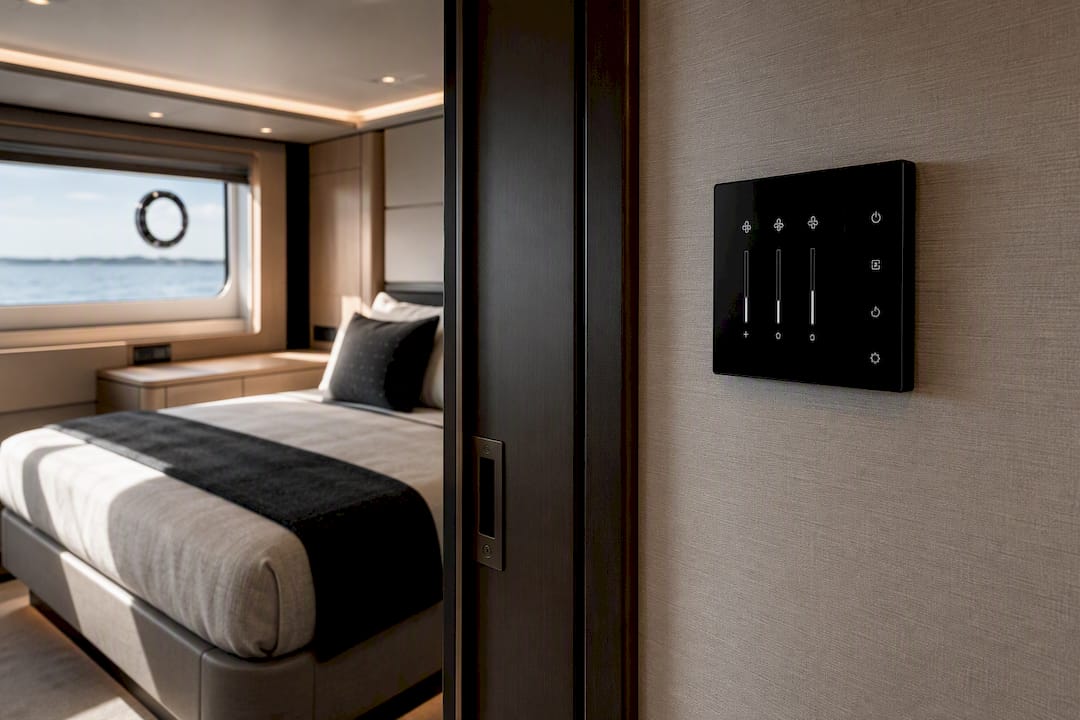
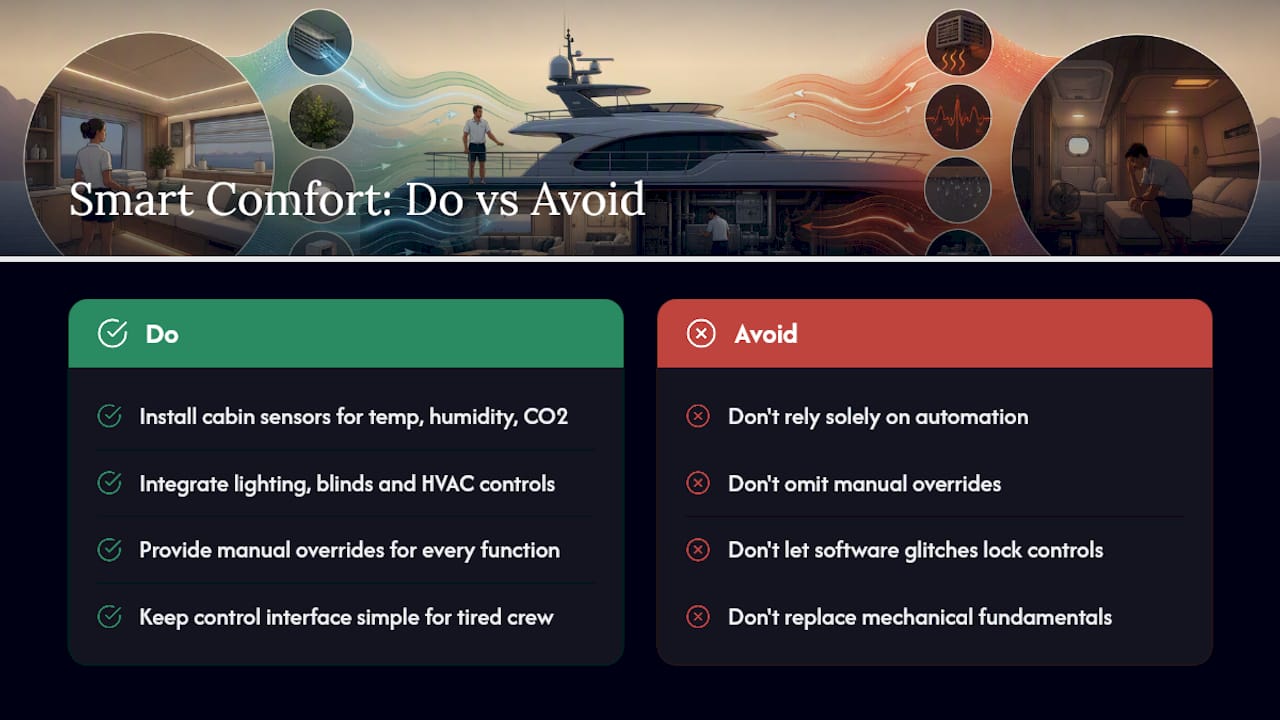
Automation now lets you monitor comfort conditions in real time rather than discovering problems through complaints. Cabin-level sensors tracking temperature, humidity, and CO2 feed into a central system that flags drift before it becomes a sleep-disrupting issue. Some newer builds tie lighting scenes, blackout blinds, and HVAC setpoints into a single control panel or app, so a crew member coming off watch can trigger “sleep mode” with one tap instead of adjusting three separate systems.
Automated monitoring also supports maintenance planning. A vibration sensor on a machinery mount that shows gradual drift gives you weeks of warning before a bearing failure turns into a noise problem in the cabin above it. Smart water quality monitoring in crew heads and galleys catches scaling or contamination before it affects daily use.
The tradeoff is complexity. Every automated system is another thing that can fail, and crew need a manual override for every automated function, especially lighting and climate control, since a software glitch at 2 a.m. should never leave someone stuck in a bright, overheated cabin. Specify manual overrides as a non-negotiable line item alongside any smart system you add, and keep the control interface simple enough that a tired crew member can operate it without a manual.
Baranofyachts recommends treating smart comfort systems as an enhancement layer over solid mechanical fundamentals, not a substitute for them. A well-zoned HVAC system with poor automation still works. A brilliantly automated system built on undersized ductwork does not.
Controlling Noise and Odor at the Source, Not Just the Wall
Insulation absorbs sound and blocks smell after the fact. Source control stops the problem before it reaches the wall, and it’s usually cheaper. Anti-vibration mounts under generators and pumps reduce structure-borne noise at the equipment itself, rather than asking a floating floor to compensate for a machine that vibrates more than it should. Duct silencers placed at the air handler, not just insulation wrapped around ductwork, cut fan noise before it travels through the whole HVAC network.
Odor control works the same way. Galley extraction hoods sized correctly, and ducted away from crew corridors rather than through them, prevent cooking smells from settling into cabin soft furnishings. Grease trap placement and cleaning access matter more than any air freshener ever will. Sewage and gray water routing, kept separate from crew accommodation risers wherever the general arrangement allows, removes another common source of persistent odor that insulation cannot fix.
Layout zoning is the most underused tool here. Separating noisy or odor-generating plant, generators, waste treatment, galley extraction, from crew accommodation at the general arrangement stage solves problems that no amount of acoustic foam or filtration can fully undo later. This is the same early-integration logic that applies to vibration prognosis during design: fix the source, and the insulation budget becomes a backup, not a primary defense.
Maintenance Planning to Keep Comfort Systems Working
A comfort system specified perfectly at delivery degrades within a year without a maintenance plan behind it. HVAC filters lose efficiency gradually, and a crew that doesn’t know the replacement schedule will simply run a dirtier system until airflow drops noticeably. Vibration isolation mounts compress and harden over time, quietly losing effectiveness long before anyone notices the noise creeping back.
Build a maintenance calendar into the handover package, not as an afterthought but as a deliverable with the same weight as the acceptance test results. Filter replacement intervals, isolation mount inspection dates, and lighting control recalibration schedules all belong in a single document the chief engineer can actually use, not buried across a dozen equipment manuals from different suppliers.
Spare parts planning matters just as much. Stocking replacement filters, mount hardware, and control system components onboard avoids weeks of downtime waiting on a part from a supplier halfway across the world. For systems with digital controls, firmware updates need a defined owner and schedule too, since a control panel running outdated software can quietly lose scheduling accuracy over a season.
Baranofyachts builds maintenance scheduling into project management scopes precisely because a comfort system that isn’t maintained is a comfort system that fails within eighteen months, regardless of how well it was specified at delivery.
Training Crew to Get Full Value From Comfort Systems
The best HVAC zoning in the world does nothing if nobody knows how to use the individual cabin controls. Training needs to happen at handover, not left for crew to figure out by trial and error over their first few weeks aboard.
Cover the basics clearly: how to set night-mode temperature, how to trigger lighting scenes, and how to reset a system that’s behaving oddly before assuming it’s broken. Chief engineers need a deeper technical briefing, covering filter locations, isolation mount inspection points, and how to read whatever monitoring dashboard the smart systems provide.
Written documentation matters, but hands-on walkthroughs during sea trials stick better than a manual that sits in a drawer. Have the same technician who commissioned the HVAC system walk incoming crew through the controls in their own cabins, not just in a common area demonstration. Refresh training with each crew change, since institutional knowledge about how a specific yacht’s systems behave otherwise walks off the boat with departing crew.
Health and Safety Benefits of Comfort Upgrades
Crew comfort upgrades aren’t just about morale. Poor sleep from vibration, noise, or bad lighting measurably affects reaction time and judgment, which matters directly for a crew member standing watch or handling lines in tight maneuvering situations. MLC 2006’s own rationale for accommodation standards rests on this connection between rest quality and seafarer welfare, not just comfort for its own sake.
Ventilation and filtration upgrades reduce respiratory irritation from galley smoke, engine room fumes, and mildew in humid crew spaces. Ergonomic galley and laundry layouts reduce repetitive strain injuries that accumulate over a multi-month contract, the kind of chronic back or shoulder issue that doesn’t show up as an incident report but quietly drives someone to leave the industry.
Blackout lighting and proper night-mode HVAC settings support the sleep quality that watch-keeping crew depend on for alertness during overnight shifts. None of this is separable from safety. A well-rested crew member catches problems a fatigued one misses.
Why Prioritizing Crew Comfort Reduces Lifecycle Cost
The business case is straightforward once you run the numbers: crew turnover is expensive, and comfortable crew stay longer. Every recruitment cycle costs training time and institutional knowledge. Every late-stage retrofit costs more than the same fix specified during design. We’ve seen owners who treated comfort as a line item to cut discover, two seasons later, that they were re-fitting the same cabins they’d shortchanged the first time, at triple the original cost. Baranofyachts builds these habitability items into project management scopes from day one because it’s cheaper to specify correctly once than to fix twice.
How Baranofyachts Manages Crew Habitability From Brief to Handover
Specifying comfort standards is one thing. Getting a shipyard to actually deliver against them is another, and that gap is where most crew habitability upgrades quietly disappear from a build. Baranofyachts’s project management service handles the whole chain: writing the acceptance criteria into the contract, coordinating third-party comfort-class verification, and running the pre-delivery measurement and sign-off checks so nothing gets waved through on a shipyard’s word alone.

That includes the details covered here, ACCOM notation requests, HVAC commissioning checks, acoustic sea-trial testing, and crew consultation scheduling, folded into a single project timeline instead of scattered across separate vendor relationships you’d otherwise have to manage yourself. If you’re starting to plan a new build or major refit, review what to settle before your first shipyard meeting and bring your crew comfort priorities into that conversation from the start.
Sources
- Rina
- RULES FOR BUILDING AND CLASSING STEEL VESSELS (Part 14: Habitability) – INTL REG
- Regulation 3.1 – Accommodation and recreational facilities – IMO rules
- Lighthouse
- Talking point: The overlooked experts — designing yachts with the end user in mind – ISWAN
Recommended
Sold Listings


Design Your Yacht
"*" indicates required fields
Maximus III - PNW
As you step aboard MAXIMUS III, the first impression is her scale.
At 120 feet with an 8-meter beam and 294 GT of interior volume, this 2025 Crescent Custom tri-deck immediately feels open, balanced, and estate-like. A timeless look while still feeling fresh from the shipyard.
Currently Available


Get your yacht value Estimate
"*" indicates required fields