
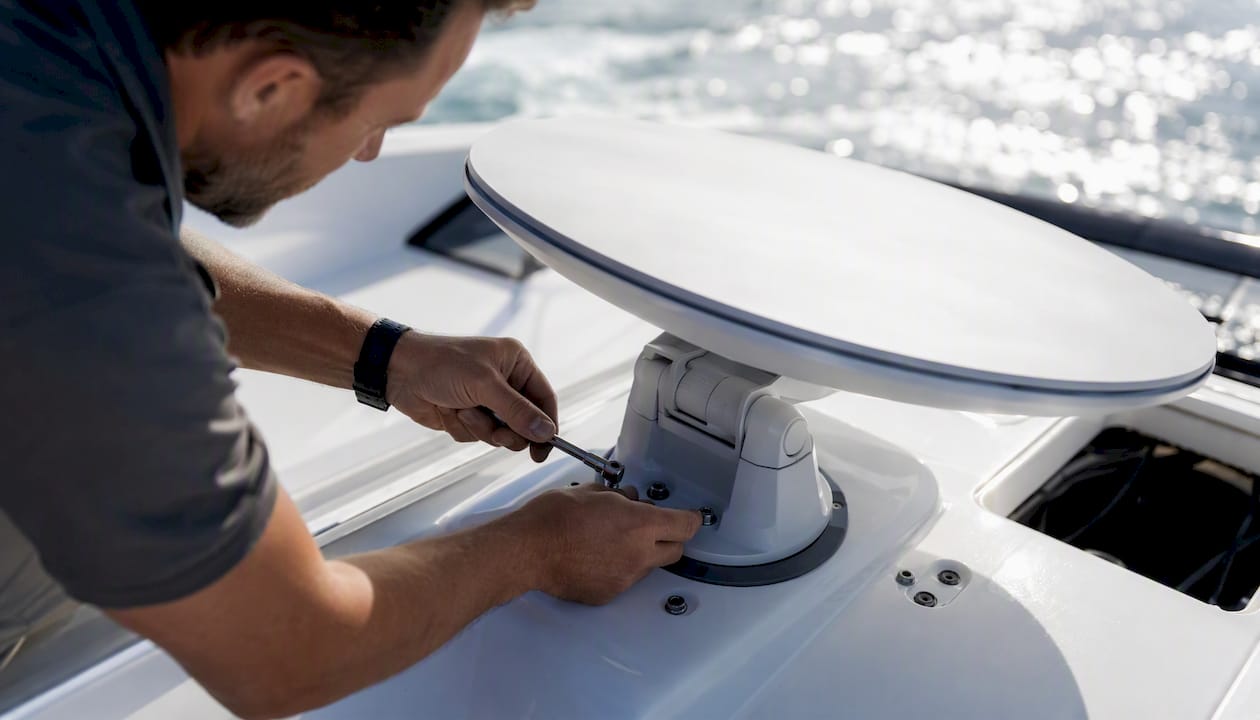
For most yachts operating in U.S. coastal and offshore waters, Starlink Maritime is the right primary internet choice — delivering real-world downloads of real-world downloads with latency around 30 to 50 milliseconds at a fraction of legacy VSAT costs. Pair it with an Iridium satellite phone and a registered EPIRB for safety-critical communications, and you have a network architecture that covers both daily connectivity and genuine emergencies. Baranofyachts can help you specify, integrate, and commission the right system from the outset.
Top picks at a glance:
- Best for most yachts (coastal through blue-water): Starlink Maritime with Global Priority data tier — high throughput, low latency approximations, marine-grade hardware
- Best for small yachts and low-power refits: Starlink Mini — compact footprint, DC-power capable, lower draw
- When to choose VSAT instead: Regulated charters, polar routes, or operations requiring contractual uptime SLAs where LEO coverage gaps are unacceptable
- Non-negotiable safety backup: Iridium satellite phone plus EPIRB — Starlink is not a certified distress signaling device
Key Takeaways
Starlink Maritime is the right primary internet choice for most yachts, but it requires a certified safety backup (Iridium/EPIRB) and professional installation to perform reliably offshore.
| Point | Details |
|---|---|
| Choose Starlink Maritime for most yachts | Global Priority tiers deliver real-world download speeds downloads and typical latency around 30 to 50 milliseconds latency for the majority of U.S. and offshore routes. |
| Use Starlink Mini for small vessels | Its 20–40W draw and DC compatibility make it the practical choice for yachts with limited power budgets. |
| Never rely on Starlink for distress comms | Carry a registered EPIRB and an Iridium satellite phone on every offshore passage, regardless of Starlink performance. |
| Plan installation early in any refit | Antenna placement, conduit routing, and electrical sizing cost far less when resolved during design than after launch. |
| Baranofyachts manages full integration | From site survey through crew handover, Baranofyachts coordinates Starlink specification and installation as part of a complete refit or new build project. |
Table of Contents
- How does Starlink compare to VSAT and other satellite options for yachts?
- What do Starlink Maritime plans and hardware actually include?
- How should you mount and install Starlink on a yacht?
- What are the power requirements for Starlink on a yacht?
- What real-world performance can you expect from Starlink at sea?
- Why Starlink alone is not enough for offshore safety
- How do you choose the right Starlink setup for your yacht?
- What does Starlink cost on a yacht? Hardware, installation, and monthly plans
- A builder’s perspective on Starlink and yacht design
- How Baranofyachts supports your Starlink integration from spec to sea
- Sources
How does Starlink compare to VSAT and other satellite options for yachts?
The table below covers the six primary options owners and captains evaluate. Starlink Maritime leads the comparison for the majority of private and charter yachts operating in U.S. and international waters.
Comparative field tests confirm Starlink Maritime typically delivers 50–200 Mbps at 20–60 ms latency, far outpacing legacy VSAT on speed, while VSAT retains a meaningful advantage in uninterrupted global coverage.
Key distinctions by option:
- Starlink Maritime (Global Priority tiers): The performance leader for private yachts. Priority data tiers let you guarantee bandwidth for video calls, remote work, and guest streaming. The main limitation is coverage gaps in a handful of ocean regions.
- Starlink Performance hardware: The Flat High-Performance antenna is the preferred physical installation for larger yachts — more durable, higher sustained throughput, and engineered for permanent deck mounting.
- Starlink Mini: Marine reviewers in 2026 highlight it as the standout option for smaller vessels and refits where power and mounting footprint are constrained.
- Inmarsat (VSAT/Fleet Xpress): Slower and far more expensive, but it carries certified GMDSS capability and predictable global coverage — the right call for commercial operations or polar passages where LEO gaps are unacceptable.
- Iridium: Narrowband data only, but true pole-to-pole voice coverage and certified distress capability. Every offshore yacht should carry one regardless of Starlink installation.
- Viasat: Mature commercial VSAT with enterprise support. Relevant for superyachts or charter vessels that need contractual uptime guarantees and have existing VSAT infrastructure.
Safety note: Neither Starlink nor Viasat is a certified replacement for emergency distress communications. Yachting World’s independent testing explicitly advises maintaining a separate Iridium satellite phone and registered EPIRB for all offshore passages.
What do Starlink Maritime plans and hardware actually include?
Service tiers and priority data
Starlink’s Maritime service is designed as a vessel-grade, permanent-install offering with hardware engineered to withstand extreme marine weather. The service structure centers on Global Priority data tiers — purchased allotments of priority bandwidth that ensure your vessel maintains high throughput even when the satellite network is under load. Once you exhaust your priority allocation, speeds depopulate to a lower-priority pool rather than cutting off entirely.
For most private yachts, a mid-tier priority allotment covers typical daily use: video conferencing, streaming, chart updates, and crew communications. Charter vessels and superyachts with heavy simultaneous user loads benefit from higher-tier allotments or multiple service lines.
Hardware variants
| Hardware | Typical Power Draw | Mounting Form | 12V/24V DC Native | Best Fit |
|---|---|---|---|---|
| Starlink Performance (Flat High-Performance) | ~75–100W | Low-profile permanent deck | No (AC, inverter or APS required) | Larger yachts, permanent installs |
| Starlink Mini | ~20–40W | Compact, portable or fixed | Yes (some setups) | Smaller yachts, refits, low-power budgets |
| Consumer Starlink (Standard) | ~50–75W | Tilt/fixed | No | Coastal use only; not recommended for offshore |
The Starlink Performance (Flat High-Performance antenna) is the workhorse for serious marine installations. Its low-profile form factor reduces windage, and its build tolerates the vibration, salt spray, and temperature cycling that a permanent offshore installation demands. The consumer Standard dish can function on a boat in calm coastal conditions, but it lacks the weather tolerance and mounting options of the marine-grade hardware.
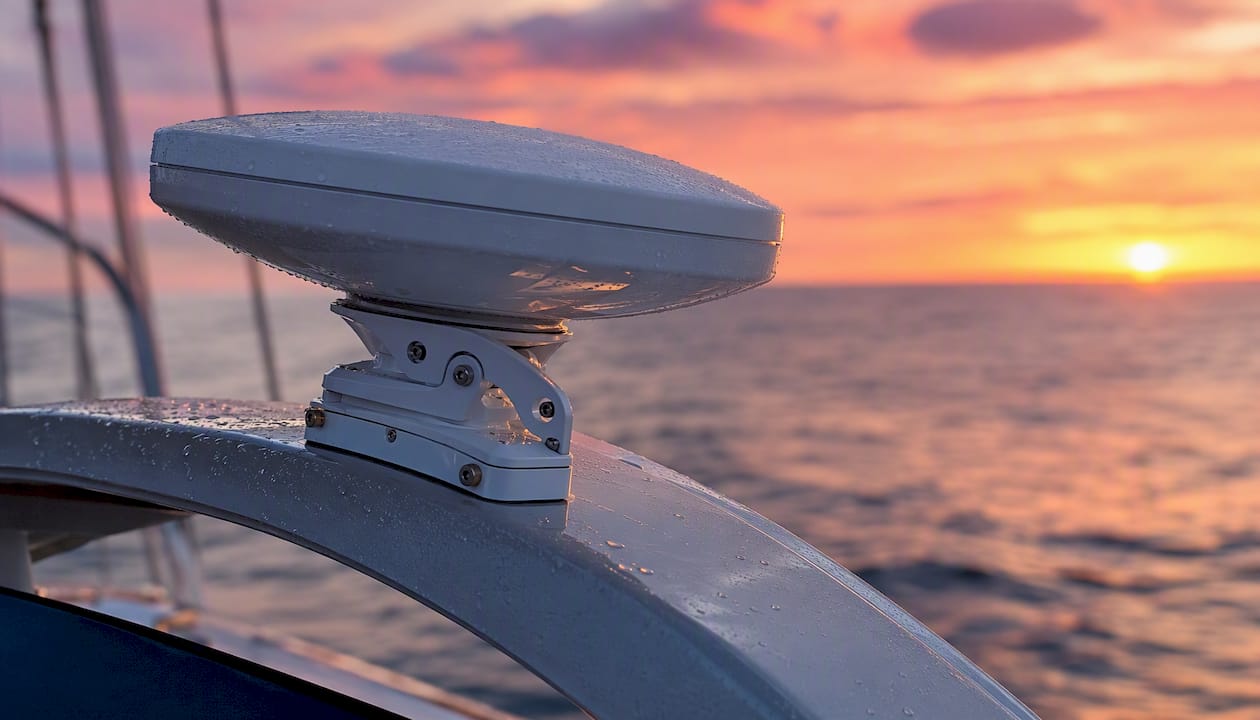
The Starlink Mini is widely recommended for smaller vessels precisely because it can run from 12V/24V DC in many configurations, eliminating the inverter requirement that adds complexity and power loss to smaller electrical systems.
A few practical notes on hardware selection:
- Consumer Starlink units are not designed for continuous motion and may require a “Portability” or “Maritime” service add-on to function legally on a moving vessel in U.S. waters.
- The Advanced Power Supply (APS) accessory allows the Performance dish to run from a DC source with a step-up converter, which is the preferred approach for larger yachts with 24V or 48V DC bus systems.
- Manufacturer warranty terms apply to hardware used within its rated operating conditions; using a consumer dish in a marine environment without the appropriate service tier may void coverage.
How should you mount and install Starlink on a yacht?
Placement is where most installation problems originate. The dish needs a clear hemisphere of sky — roughly 100 degrees of unobstructed arc above the horizon — to maintain reliable handoffs between low-earth-orbit satellites as they pass overhead. A radar arch, stacked antennas, a furled headsail, or even a tall mast can create obstruction shadows that cause intermittent dropouts.
Mount types and trade-offs
Permanent deck mounts on a hardtop or coachroof give the cleanest cable run and the most stable platform. They suit larger yachts where the dish can be positioned well clear of the radar dome and other electronics. Arch mounts are common on sailing yachts and motor yachts with radar arches, but require careful placement to avoid the radar’s own interference zone. Pushpit mounts work on smaller sailing yachts where deck real estate is limited, though they expose the dish to more motion and spray.
For owners who prioritize aesthetics, flush-integrated hardtop mounts with concealed cable runs are achievable during a new build or major refit. This is where early coordination between the network designer and the yacht builder pays dividends — a decision made at the coachroof fabrication stage costs a fraction of what a retrofit requires. Baranofyachts’s yacht customization process addresses exactly this kind of systems integration from the specification stage.
Installation checklist
- Pre-install site survey: Map all existing antennas, radar domes, solar panels, and rigging. Use the Starlink app’s obstruction tool to simulate the dish’s field of view from candidate mounting positions.
- Mount selection and fabrication: Choose mount type based on vessel structure, aesthetics, and motion profile. Stainless or anodized aluminum mounts with marine-grade sealant at every penetration.
- Cable routing: Run the proprietary Starlink cable (or a certified extension) through conduit where possible. Avoid routing near high-current DC cables or inverter wiring to minimize RF interference.
- Grounding and bonding: Bond the mount to the vessel’s grounding system. The dish itself is not a lightning rod, but proper bonding reduces corrosion and static buildup.
- Power feed: Size the circuit breaker and wire gauge to the dish’s peak draw plus a 20% safety margin. For AC-powered units, confirm the inverter is rated for continuous load.
- Router placement: Mount the Starlink router in a dry, ventilated space. For larger yachts, replace the stock router with a managed switch and enterprise-grade access points to support VLANs for guest, crew, and nav systems.
- Commissioning: Confirm satellite acquisition, run a speed test, and verify obstruction map matches the physical installation. Log baseline speeds for future reference.
Pro Tip: Before finalizing the mount position, run the vessel through a 360-degree slow turn at anchor and watch the Starlink app’s signal quality in real time. A position that looks clear on paper sometimes reveals a blind spot from the boom, furled sail, or radar arch that only appears at certain headings.
What are the power requirements for Starlink on a yacht?
Power planning is the detail most owners underestimate until the first offshore passage. The Starlink Performance dish draws roughly 75–100W continuously under normal operation, with brief peaks during satellite search. The Mini runs considerably lighter at approximately 20–40W, which is why it has become the preferred choice for sailing yachts with modest solar and battery capacity.
On a Performance dish installation, the Advanced Power Supply (APS) accessory handles DC-to-DC conversion more efficiently than a general-purpose inverter, and it reduces the electrical noise that can affect nearby navigation electronics.
Wiring and integration checklist:
- Dedicate a separate circuit breaker for the Starlink system, clearly labeled.
- Use marine-grade tinned copper wire throughout, sized for the run length and peak draw.
- Install a ferrite choke on the power lead near the router to suppress RF interference.
- If using an inverter, choose a pure sine wave unit — modified sine wave inverters can cause communication errors in the Starlink hardware.
- For vessels with generator charging, consider a small UPS between the inverter and the Starlink router to bridge the 5–10 second generator startup gap and prevent repeated reboots.
Pro Tip: On sailing yachts with limited solar, schedule high-bandwidth tasks (chart downloads, software updates, video calls) during daylight hours when solar input offsets the dish draw. At night, dropping to a lower-priority data mode reduces the system’s effective load and extends battery life without losing connectivity.
What real-world performance can you expect from Starlink at sea?
The honest answer is: excellent in most conditions, with predictable exceptions. Installer data from blue-water deployments puts typical Starlink Maritime downloads at real-world download speeds and uploads at typical upload speeds, with latency around 30 to 50 milliseconds under normal load. Those numbers hold well in open ocean across most of the Atlantic, Pacific, and Caribbean.
Speed context: Independent boating tests recorded downloads commonly between 40–220+ Mbps and uploads of 8–25+ Mbps during priority-data usage, with performance varying by region and network congestion.
Common failure modes and realistic expectations:
- Brief mid-ocean gaps: Parts of the South Pacific and Indian Ocean still have reduced satellite density, causing intermittent 1–5 minute outages. These are improving as SpaceX expands its constellation.
- Weather-related drops: Heavy precipitation can attenuate the signal, typically causing a 10–30% speed reduction rather than a full outage. The Performance dish handles this better than consumer hardware.
- Obstruction losses: Even a partially furled sail or a crew member standing near the dish can cause momentary dropouts. This is the most common complaint from sailing yachts and the strongest argument for careful mount placement.
- Network congestion: In busy anchorages or near coastal population centers, shared satellite capacity can reduce speeds during peak hours. Priority data tiers mitigate this significantly.
- Motion and handoffs: LEO satellites move across the sky continuously, and the dish tracks them automatically. In rough seas with significant roll, tracking can momentarily lag, causing brief interruptions. Most owners report this is barely noticeable in practice.
Why Starlink alone is not enough for offshore safety
Starlink is a data communications tool, not a safety communications system. The distinction matters enormously when something goes wrong 200 miles offshore. A damaged antenna, a power failure, or a software fault can render the dish inoperable at exactly the moment you need to call for help.
Mandatory and recommended safety devices:
- EPIRB (Emergency Position Indicating Radio Beacon): Registered with NOAA, activates automatically on immersion, transmits on the 406 MHz COSPAR-SARSAT network. This is the non-negotiable baseline for any offshore passage.
- Iridium satellite phone or communicator: True pole-to-pole coverage, certified for distress calling, and completely independent of your vessel’s power and data systems. Carry a handheld unit with a spare battery.
- DSC VHF radio: Required by U.S. Coast Guard regulations for vessels operating beyond coastal waters. Digital Selective Calling allows automated distress alerts with GPS position.
- SART (Search and Rescue Transponder): Activates on radar interrogation, guiding rescue vessels to your position. Required on many commercial vessels; strongly recommended for offshore private yachts.
Network redundancy for continuous operations
For charter vessels and superyachts where connectivity is a service commitment, a single Starlink installation is not sufficient architecture. Concord Marine recommends a hybrid approach: Starlink as the primary high-speed layer, a cellular bonding router (4G/5G) for inshore coverage and load balancing, and a VSAT connection (Inmarsat or Viasat) as the geographic fallback for ocean regions where LEO coverage is thin.
Emergency comms plan checklist:
- Register your EPIRB with NOAA and verify registration annually.
- Test your DSC VHF radio’s distress function monthly (non-transmitting test mode).
- Confirm Iridium account is active and the device holds a charge before every offshore departure.
- Brief all crew on the location of the EPIRB, SART, and Iridium phone, and the procedure for activating each.
- Test the Starlink system’s failover to the backup WAN (cellular or VSAT) before departure, not at sea.
For crew handover protocols following a Starlink installation, Baranofyachts’s crew training workflow guide covers the full commissioning and safety briefing process.
Pro Tip: Configure your Multi-WAN router (Peplink, Cradlepoint, or similar) with Starlink on WAN1, cellular on WAN2, and VSAT on WAN3 in a health-check failover chain. Set the health check to ping an external DNS server every 10 seconds. When Starlink drops, the router fails over to cellular in under 30 seconds without any crew intervention — and fails back automatically when Starlink recovers.
How do you choose the right Starlink setup for your yacht?
The right configuration depends on three variables: vessel size and electrical capacity, operating range, and whether the yacht operates commercially. Work through these questions before contacting an installer.
Decision checklist by vessel profile
-
Coastal weekend cruiser (under 45 ft, day/weekend use):
- Starlink Mini on a standard Maritime plan
- 4G/5G cellular router as secondary WAN for marina and inshore use
- Iridium handheld for offshore day passages
- No VSAT required
-
Blue-water offshore cruiser (45–80 ft, extended passages):
- Starlink Maritime with a mid-tier Global Priority allotment
- Starlink Performance (Flat High-Performance) antenna for durability
- Peplink or Cradlepoint Multi-WAN router with cellular bonding
- Iridium satellite phone and registered EPIRB mandatory
- VSAT optional unless passages include Indian Ocean or South Pacific
-
Superyacht or charter vessel (80 ft+, commercial or guest-intensive):
- Starlink Maritime with high-tier Global Priority, potentially dual antennas
- Inmarsat Fleet Xpress or Viasat as geographic fallback
- Managed network with guest/crew/nav VLANs and firewall
- Full GMDSS suite including EPIRB, SART, DSC VHF, and Iridium
- Professional network management service
Questions to ask your installer
- Can you provide a site survey report with obstruction mapping before any hardware is ordered?
- What cabling plan do you recommend for this vessel’s layout, and how are penetrations sealed?
- Which warranty applies to the hardware in a marine environment, and what is the replacement process?
- How does the router configuration handle failover, and can you demonstrate it before commissioning?
- Do you have experience integrating with this vessel’s existing nav electronics and NMEA network?
Red flags that indicate a more engineered solution is needed: regulated charter operations under SOLAS or MCA requirements, any route that transits polar regions above 70° latitude, vessels with contractual uptime SLAs for guest connectivity, and any installation where the owner cannot tolerate even brief outages.
What does Starlink cost on a yacht? Hardware, installation, and monthly plans
Budgeting for a Starlink installation involves three distinct cost layers: hardware, professional installation, and ongoing monthly service. Installer reports provide the most current order-of-magnitude figures, noting that actual quotes require a vessel-specific site survey. The figures below are sourced in euros from European installer data; U.S. pricing will vary and should be confirmed with a domestic installer.
Starlink Maritime plans offer monthly billing with the option to pause service during extended periods in port, which is a meaningful cost advantage over VSAT contracts that typically require annual commitments. Priority data tiers are additive: you purchase a base plan and add priority data blocks as your usage demands.
Common extra costs owners overlook:
- Antenna replacement after physical damage (collision, rigging strike) — not covered under standard warranty
- Cable reruns during a refit when the original routing conflicts with new interior work
- Network management services for superyachts that need 24/7 monitoring and remote support
- VLAN configuration and firewall setup if the installer is not a certified network engineer
- Cellular SIM cards and data plans for the bonding router’s secondary WAN
A builder’s perspective on Starlink and yacht design
The antenna is not just a piece of electronics — it is a design element that affects the silhouette, the radar arch geometry, and the weight distribution of the vessel. We see this clearly in new builds and major refits: owners who specify connectivity late in the process often end up with a dish mounted on a bracket that was never designed for it, cable runs that compromise interior joinery, and a radar arch that was not reinforced for the additional load.
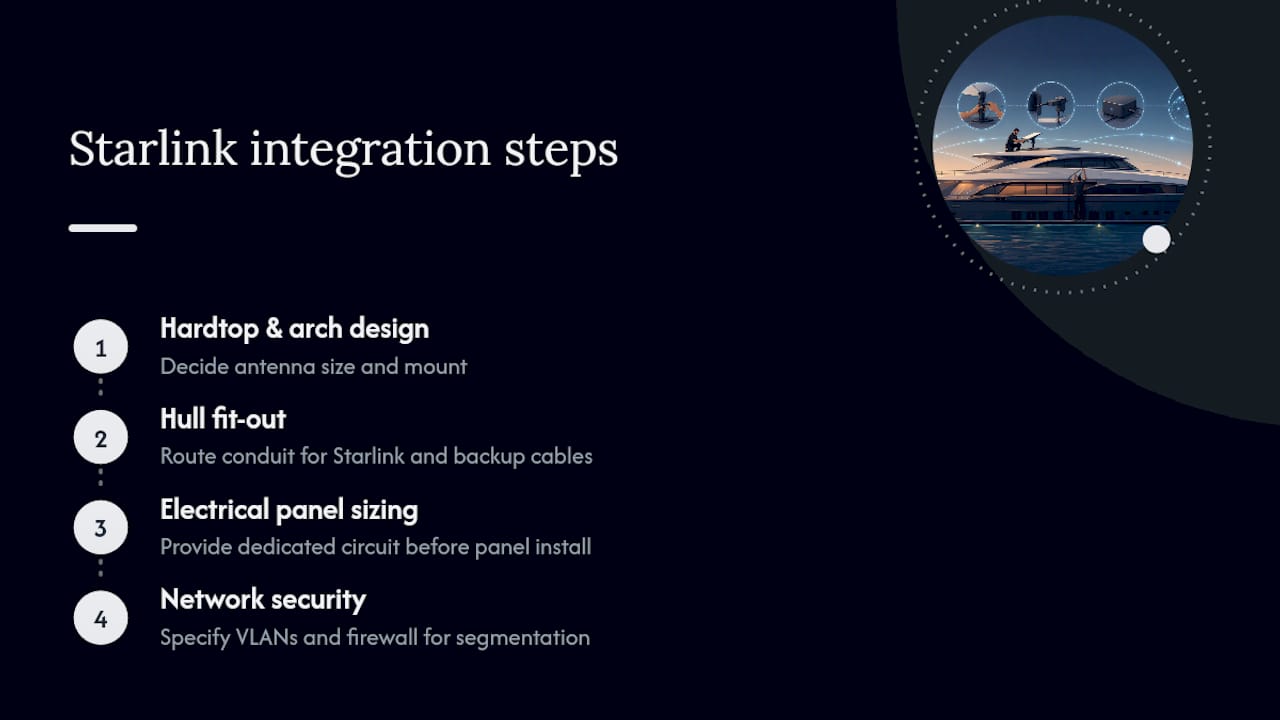
The smarter approach is to treat the network architecture as a vessel subsystem from day one. That means deciding on antenna size and mount type during the hardtop or arch design phase, routing conduit for Starlink and backup antenna cables during the hull fit-out, and sizing the electrical panel to accommodate the dish’s dedicated circuit before the panel is installed. These decisions cost almost nothing when made early and can run to significant retrofit expense when addressed after launch.
There is also a cybersecurity dimension that the industry is taking more seriously. High-speed satellite internet on a yacht creates a genuine attack surface — particularly on charter vessels where guests connect personal devices. Proper network segmentation (separate VLANs for guest Wi-Fi, crew systems, and navigation electronics) and a capable firewall are not optional extras on a modern superyacht; they are part of responsible systems integration. We incorporate these considerations into every connectivity specification we manage, treating them with the same rigor we apply to any other vessel subsystem.
How Baranofyachts supports your Starlink integration from spec to sea
Connectivity is now as integral to a luxury yacht as propulsion or climate control — and it deserves the same disciplined project management. Baranofyachts coordinates the full arc of a Starlink integration: from the initial site survey and hardware specification through installer selection, cable routing review, network commissioning, and crew handover. For new builds, we embed connectivity planning into the design brief so antenna placement, conduit runs, and electrical sizing are resolved before the first panel is cut. For refits, we manage the sequencing so network work does not create knock-on delays in joinery or systems commissioning.

Whether you are equipping a 50-foot bluewater cruiser or specifying a superyacht’s full managed network, our project management approach ensures every vendor, timeline, and technical decision is coordinated with a conductor’s eye. Owners who want reliable connectivity integrated discreetly into a vessel that reflects their standards are exactly who we work with. Contact Baranofyachts to request a connectivity consultation or site survey for your next build or refit.
Sources
The following sources informed the performance data, installation guidance, and safety recommendations in this article:
- Starlink Business | Maritime
- Starlink Priority Data for boating – tested and reviewed – Yachting World
- The connected yacht: best marine internet solutions for 2026 | Yachting Monthly
- Starlink vs VSAT for Yachts 2026: Honest Comparison From Installers
- Starlink Maritime vs. VSAT: Which Suits Your Yacht? | Concord Marine
- Starlink vs Traditional VSAT 2026 | Earth SIMs
Recommended
Sold Listings


Design Your Yacht
"*" indicates required fields
Maximus III - PNW
As you step aboard MAXIMUS III, the first impression is her scale.
At 120 feet with an 8-meter beam and 294 GT of interior volume, this 2025 Crescent Custom tri-deck immediately feels open, balanced, and estate-like. A timeless look while still feeling fresh from the shipyard.
Currently Available


Get your yacht value Estimate
"*" indicates required fields