
The fastest way to find motor sailers for sale in the U.S. is to run a filtered search on YachtWorld or BoatTrader, then contact a credentialed broker to build a vetted shortlist. Both platforms carry hundreds of active sail-motorsailer listings at any given time, spanning budget project boats to turnkey bluewater cruisers. SailboatListings rounds out the picture with owner-for-sale inventory that often goes unlisted on the major aggregators.
Three actions to take right now:
- Set your filters precisely. On YachtWorld or BoatTrader, filter by class (sail-motorsailer), LOA range, price band, and region. Adding “pilothouse” as a keyword narrows results to the helm-protected designs most buyers are actually after.
- Contact a broker with motorsailer inventory experience. A broker accelerates the shortlist, flags title issues early, and coordinates the independent survey. Baranof Yacht Sales handles brokerage, survey coordination, and delivery project management for buyers at every stage.
- Schedule surveys before you fall in love with a boat. An independent marine survey and sea trial are nonnegotiable trust signals. Prioritize listings that already show maintenance records, engine logbooks, USCG documentation, and a clear photo set covering hull, deck, rig, and engine compartment.
Brands that appear consistently in U.S. inventory include Island Packet, Cheoy Lee, Cape Dory, Gemini, MacGregor, and Nauticat. Each has a distinct design philosophy and price range, which the sections below map in detail.
Table of Contents
- Where do buyers actually find motor sailers for sale?
- Which motor sailer makes and models appear most in U.S. listings?
- How do you inspect and evaluate a motor sailer before making an offer?
- What does it cost to buy and own a motor sailer in the United States?
- What is the step-by-step buying process for a motor sailer in the U.S.?
- Why work with a yacht broker, and what does Baranofyachts offer buyers?
- Key Takeaways
- Why experienced buyers often choose pilothouse motorsailers for long cruising
- Baranofyachts: a managed path to finding and buying your motor sailer
- Useful sources and tools for U.S. motor sailer buyers
Where do buyers actually find motor sailers for sale?
The U.S. market for motor sailing vessels runs across four distinct channels, and each one rewards a different search strategy.

National marketplaces give you the broadest inventory sweep. YachtWorld lists hundreds of sail-motorsailer entries at any time, with filters for LOA, rig type, price, and region. BoatTrader skews toward U.S. dealer and brokerage listings, which means more standardized condition disclosures and easier escrow arrangements. Both platforms let you save searches and receive alerts, which matters when good boats move in days.
Dedicated brokerages add a layer of vetting that marketplaces cannot. A brokerage-listed boat typically comes with a documented condition summary, a clear title check, and a broker who has physically seen the vessel. That pre-screening is worth the commission when you are buying a complex motor sailing vessel with diesel systems, standing rigging, and pilothouse electronics to evaluate.
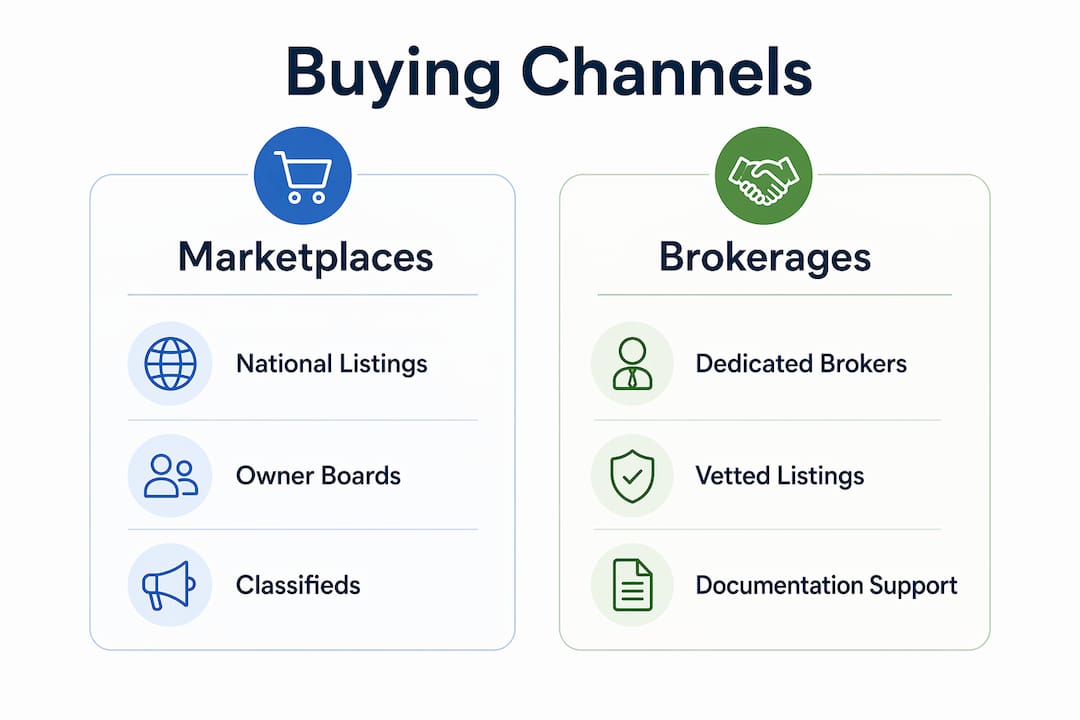
Owner-for-sale boards and classifieds, including SailboatListings and Craigslist marine sections, surface private listings that never reach the aggregators. Prices can be lower, but buyer protections are thinner. Budget extra time for independent verification of title, engine hours, and refit history.
Marina bulletin boards and regional auctions occasionally yield genuine finds, particularly for older motorsailers whose owners want a quick local sale. These require fast due diligence and a surveyor on short notice.
When filtering on any marketplace, use these parameters together: class = sail-motorsailer or power-motorsailer, LOA minimum 35 feet for offshore-capable designs, price band aligned to your condition tolerance, and keyword “pilothouse” when helm protection is a priority. Boats.com also carries motorsailer listings with a wide price spread, useful for benchmarking asking prices before you negotiate.
Pro Tip: A listing that shows engine hours without a service log, or photos of the cockpit but not the engine compartment, is signaling something. Listings from sellers who have nothing to hide typically include a full photo set, recent haul-out records, and a clear statement of known deficiencies. Treat incomplete photo sets as a reason to ask harder questions, not as a reason to pass entirely.
Which motor sailer makes and models appear most in U.S. listings?
A motorsailer is designed to derive meaningful independent propulsion from both sails and engine, typically with a sheltered pilothouse and a sail-to-engine ratio ranging from roughly 30/70 to 70/30. That ratio is the single most useful lens for comparing models, because it determines hull form, fuel tankage, and how the boat actually handles at sea.
Common makes and their typical positioning
Island Packet builds motorsailers designed for long-range comfort. The 42 MS, for example, features a protected helm, multi-tank fuel arrangements, and deck-level living spaces designed for extended passages. These boats appear in U.S. listings at mid-to-high price points and typically show well-documented service histories.
Cheoy Lee has a long, reputable shipyard history with documented construction standards. A well-known example is the 53-foot Cetacea, which highlights heavy construction, pilothouse layout, twin diesels, a cutter rig, and large fuel and water capacity as core selling points for bluewater passages. Builder records and documentary evidence matter more than model year alone with Cheoy Lee boats.
Cape Dory motorsailers are known for solid fiberglass construction and conservative hull forms. They appear frequently in the $40,000–$120,000 range and attract buyers who want a proven coastal or offshore cruiser with manageable maintenance costs.
Gemini catamarans with motorsailer configurations offer shallow draft and liveaboard volume at a lower price point than comparable monohulls. They suit buyers prioritizing interior space and coastal cruising over bluewater passage-making.
MacGregor motorsailers, particularly the 26M, are entry-level motor sail boats with a trailerable form factor. They are not bluewater vessels, but they serve buyers who want a dual-mode boat for protected waters at a budget price.
Nauticat (Finnish-built) is one of the most recognized pilothouse motorsailer brands in U.S. listings. The 33, 38, and 43 models appear regularly on YachtWorld and BoatTrader. Their enclosed pilothouse helms and ketch rigs make them a reference point for buyers prioritizing all-weather comfort.
Spec comparison across common types
| Make / Type | Typical asking range | LOA | Year / condition band | Engine type / hours | Fuel capacity | Berths | Rig type |
|---|---|---|---|---|---|---|---|
| Island Packet 42 MS | mid-to-high price range | 42 ft | cruise-ready models | single diesel engine | significant fuel capacity | suitable berths | sloop/cutter rig |
| Cheoy Lee 53 | mid-range price | 53 ft | various model years | twin diesel engines | large fuel tankage | 6–8 berths | cutter/ketch rig |
| Cape Dory motorsailer | lower to mid price range | — | older models, projects to good condition | single diesel engine | moderate fuel capacity | 4 berths | sloop/cutter rig |
| Nauticat 38/43 | moderate price range | 38–43 ft | cruise-ready models | single diesel engine | moderate to large fuel capacity | 4–6 berths | ketch/yawl rig |
| MacGregor 26M | entry-level price | 26 ft | used models | outboard or small inboard engine | small fuel capacity | 2–4 berths | sloop rig |
Spec thresholds buyers should flag:
- A larger fuel capacity signals genuine long-range motoring capability.
- A pilothouse helm is the single feature that separates fair-weather coastal boats from all-weather passage-makers.
- Split rigs (ketch, yawl, schooner) reduce individual sail size and improve short-handed handling, a practical advantage on longer passages.
- Sail-to-engine design ratios and hull coefficients directly affect light-air performance; modern hull forms with reduced wetted area outperform older full-keel designs in most conditions.
Baranofyachts brings brokerage expertise to this model landscape, with access to vetted listings and refit-supported yachts that go beyond what standard marketplace filters surface.
How do you inspect and evaluate a motor sailer before making an offer?
A disciplined inspection sequence protects you from expensive surprises and gives you documented negotiation leverage. Work through these steps in order.
-
Pre-qualify the listing remotely. Confirm a full photo set exists (hull topsides, underbody, deck, engine compartment, rig, interior), request the engine logbook and service records, verify USCG documentation or state title, and ask for any refit invoices. A seller who cannot produce these documents is telling you something important before you spend money on travel.
-
On-site hull and deck inspection. Tap the deck systematically for soft spots indicating delaminated core. Check thru-hulls for corrosion and seacock operation. Inspect the keel-to-hull joint for stress cracks or weeping. On pilothouse designs, examine window frames and seals carefully — these are common water intrusion points that lead to expensive interior damage.
-
Engine and systems check. Record the engine hours and cross-reference against the service log. Inspect the cooling system for scale and corrosion, check the fuel tanks for contamination and structural integrity, and test the gearbox engagement under load. Verify the generator, electrical charging system, and battery bank condition. Confirm fuel and water tank capacities match the listing claims.
-
Rigging and sail plan inspection. Check standing rigging age against manufacturer replacement recommendations (typically 10 years for stainless wire). Inspect the mast step for corrosion, spreader condition, and chainplate integrity. On split-rig vessels (ketch, yawl), inspect both masts and all associated chainplates. Sail condition affects value directly — a full inventory of sails in good condition can represent $15,000–$40,000 in replacement cost.
-
Sea trial under both sail and power. Test propulsion performance at various throttle settings, check for vibration or noise that suggests shaft or propeller issues, and evaluate helm responsiveness under load. Run all systems under power: electronics, autopilot, windlass, bilge pumps. Estimate range by calculating fuel burn against tank capacity.
-
Commission an independent marine survey. The surveyor’s scope should cover hull structure, deck integrity, mechanical systems, electrical systems, rigging, and safety equipment. Survey findings commonly generate conditional offers, and documented deficiencies translate directly into price negotiation leverage. Never waive the survey to speed a transaction.
Pro Tip: Request the vessel’s insurance claims history and any corrosion remediation records. Insurers require disclosure of prior claims, and a boat that has had a grounding, flooding event, or fire will have documentation. Builder or refit invoices are equally valuable — they confirm the scope and quality of work completed, and a previous owner who invested in major systems upgrades has effectively reduced your post-purchase cost.
What does it cost to buy and own a motor sailer in the United States?
Marketplace listings for motor sailing vessels span a wide price range, from inexpensive project boats to multi-million-dollar custom yachts. Condition bands are the most useful framework for setting realistic expectations.
Budget / project boats ($15,000–$60,000): Older motorsailers in this range typically need significant systems work, rigging replacement, and cosmetic attention. They suit buyers with time, skills, and a tolerance for a multi-year refit before extended cruising.
Mid-range, well-maintained cruisers ($60,000–$300,000): This is the most active segment of the U.S. market. Boats here are typically cruise-ready or close to it, with documented service histories and functional systems. Island Packet, Nauticat, and Cape Dory models appear frequently in this band.
High-end and custom builds ($300,000 and above): Bluewater-capable motorsailers with twin diesels, pilothouse layouts, and large tankage — including Cheoy Lee 50+ foot models and custom builds — occupy this range. New custom motorsailer builds can reach well above $1 million depending on specification.
Market note: Boatshop24 reports motorsailer listings ranging from approximately $10,195 for entry-level used boats to over $30 million for exclusive custom vessels, illustrating the full breadth of the market.
Annual ownership cost categories to budget:
- Insurance: Typically 1%–2% of insured value annually; bluewater cruising endorsements and liveaboard coverage add cost.
- Haul-out and bottom care: $2,000–$6,000 per year depending on vessel size and location.
- Routine maintenance: Budget 2%–5% of purchase price annually for a well-maintained used motorsailer.
- Dockage / berth fees: $400–$2,500 per month depending on marina and region.
- Winter storage: $1,500–$5,000 for covered or rack storage in northern climates.
- Fuel and operating costs: Highly dependent on the sail-to-engine ratio. A 70/30 motor-first vessel with a 300-gallon tank will cost significantly more to operate than a 70/30 sail-first design covering the same passage distance.
Financing: Marine lenders including Trident Funding, Essex Credit, and USAA (for eligible members) offer boat loans for vessels over $25,000. Typical down payments run 10%–20%, with loan terms of 10–20 years for larger vessels. Lenders require a current marine survey, proof of insurance, and USCG documentation or title. Boats over 26 feet are generally eligible for preferred ship mortgage financing under federal documentation.
What is the step-by-step buying process for a motor sailer in the U.S.?
A well-managed acquisition moves through eight sequential steps. Rushing any one of them tends to create problems in the next.
-
Search and shortlist (1–3 weeks). Filter marketplaces by class, LOA, price, and region. Build a shortlist of 5–10 listings that meet your baseline criteria. Contact listing brokers or sellers to request full documentation packages.
-
Broker or private negotiation (1–2 weeks). Discuss condition, history, and price. A broker-represented boat typically includes a formal counter-offer process; private sales are more fluid but require you to manage all documentation yourself.
-
Offer and deposit. Submit a written offer contingent on survey and sea trial. A good-faith deposit (typically 10% of the agreed price) is held in escrow, not released to the seller until closing conditions are met.
-
Survey and sea trial (1–2 weeks to schedule, 1–2 days to complete). Commission an independent marine surveyor. Schedule the sea trial for the same day or the day after the survey. Review findings carefully before proceeding.
-
Conditional purchase and sale agreement. After survey, negotiate any price adjustments based on findings. Execute a formal purchase and sale agreement with conditions clearly documented.
-
Closing and payment (2–6 weeks depending on financing). Wire funds through escrow. Confirm lien release and encumbrance clearance before funds are released to the seller.
-
Registration and USCG documentation. Vessels over 5 net tons used in commerce, or any vessel the owner chooses to document, can be registered with the U.S. Coast Guard National Vessel Documentation Center. State registration applies to vessels not federally documented. Title transfer must be recorded promptly to protect your ownership interest.
-
Delivery or transport. Overwater delivery is standard for coastal moves; trucking is practical for vessels up to approximately 65 feet on beam-limited routes. For planning yacht delivery logistics, including transit insurance and captain coordination, work with a specialist service. Baranofyachts can manage delivery as part of a full brokerage engagement.
Red flags that commonly slow or stop a transaction:
- Unclear or clouded title with undischarged liens
- Engine hours on the listing that do not match the logbook
- Missing maintenance records for the past 3–5 years
- Survey findings revealing structural issues the seller did not disclose
- Seller resistance to an independent survey or sea trial
Why work with a yacht broker, and what does Baranofyachts offer buyers?
A credentialed yacht broker accelerates every stage of a safe, documented acquisition. The practical value is not just access to listings — it is the broker’s ability to pre-screen vessels, coordinate the survey and sea trial, manage escrow, and handle the paperwork sequence that transfers clear title to you.
Naval architect Ted Brewer advises buyers to prioritize cruising style over vessel label when choosing between an auxiliary cruiser and a true motorsailer. A broker who understands that distinction can save you from buying the wrong boat, regardless of how well it photographs.
Core services to expect from a professional brokerage:
- Vetted listings with documented condition summaries and service histories
- Independent survey coordination with qualified ABYC or SAMS-credentialed surveyors
- Escrow management and title/lien clearance support
- Delivery and transport project management
- Negotiation support grounded in comparable market data
Baranofyachts brings both brokerage expertise and custom build capability to the motorsailer buyer’s process. Where a standard marketplace transaction ends at closing, Baranofyachts can extend into refit oversight, systems upgrades, and delivery management. The Maximus III listing illustrates the level of specification detail and project documentation we bring to every represented vessel.
For buyers considering a new-build motorsailer or a major refit rather than an off-the-shelf purchase, the custom build process Baranofyachts manages covers design brief, builder selection, construction oversight, and delivery, with a conductor’s-eye view across every subsystem and supplier.
Questions to ask any broker before engaging:
- How many motorsailer transactions have you closed in the past 24 months?
- Do you coordinate independent surveys, or do you recommend surveyors with whom you have a financial relationship?
- How is escrow managed, and who holds the deposit?
- Can you provide references from buyers of similar vessels?
- What is your process if survey findings require renegotiation?
Key Takeaways
The most reliable path to buying a motor sailer in the U.S. combines filtered marketplace searches on YachtWorld or BoatTrader with an independent marine survey and a credentialed broker who can manage documentation, escrow, and delivery.
| Point | Details |
|---|---|
| Start with filtered marketplace searches | YachtWorld and BoatTrader carry the broadest U.S. inventory; filter by class, LOA, price, and “pilothouse” keyword. |
| Match the sail-to-engine ratio to your cruising style | A 30/70 motor-first design needs large fuel capacity; a 70/30 sail-first design cuts operating costs significantly. |
| Never skip the independent survey | Survey findings are your primary negotiation lever and your protection against undisclosed structural or mechanical issues. |
| Budget 2%–5% of purchase price annually for maintenance | Ownership costs for a well-maintained used motorsailer include insurance, haul-out, dockage, and routine systems upkeep. |
| Baranofyachts for vetted brokerage and project management | Baranofyachts handles sourcing, survey coordination, escrow, refit oversight, and delivery for buyers who want a managed acquisition. |
Why experienced buyers often choose pilothouse motorsailers for long cruising
Experienced buyers gravitate toward pilothouse motorsailers for one reason that becomes obvious the first time you stand a night watch in rain and 20 knots of wind: the protected helm changes everything about long-passage comfort. You navigate from inside, with instruments at eye level, a chart table within reach, and a dry seat. That is not a luxury feature. For a couple or a short-handed crew covering 500-mile passages, it is a functional requirement.
The practical benefits compound quickly. A ketch or yawl rig reduces individual sail area, which means easier sail handling without a full crew on deck. Interior volume in a pilothouse design typically exceeds that of a comparably sized conventional sailboat, which matters enormously on passages of a week or more. And the ability to motor efficiently in calm conditions, without the guilt of burning fuel on a pure sailboat, gives you schedule flexibility that coastal cruisers genuinely value.
The trade-offs are real and worth acknowledging. Older full-keel pilothouse motorsailers carry more wetted surface and higher displacement than modern designs, which shows in light-air sailing performance. The answer is not to avoid the type but to evaluate hull form carefully. Modern motorsailers with refined hull coefficients and moderate prismatic coefficients close much of that performance gap. A refit that addresses rig tuning, sail inventory, and propeller pitch can recover meaningful performance from an older design.
The buyers who end up happiest are the ones who were honest with themselves about how they actually cruise. If your passages are mostly motoring with sails up for stability, a motor-first 30/70 design with large tankage serves you better than a performance cruiser you will never push to its potential. If you genuinely sail and want the engine as backup, a 70/30 sail-first motorsailer with a modern hull is the right frame. The pilothouse is the constant. Almost no one who has crossed an ocean in one wishes they had an open cockpit instead.
Baranofyachts: a managed path to finding and buying your motor sailer
Buying a motor sailer is a multi-step process with real financial and legal complexity at every stage. Baranofyachts offers buyers a managed acquisition path: we source vetted listings, coordinate independent surveys, handle escrow and title transfer, and manage delivery or transport from closing to your home port.

Our brokerage team brings the same project management discipline to a used motorsailer purchase that we apply to custom new builds. That means documented condition summaries, transparent negotiation support grounded in comparable market data, and refit oversight for buyers who want to upgrade systems before their first passage. For buyers weighing builder quality and construction standards across different vessel types, our yacht manufacturers guide covers build types, materials, and selection criteria in depth.
Whether you are shortlisting your first motorsailer or managing a complex acquisition with delivery across multiple states, we bring the expertise and the network to close it correctly. Contact Baranofyachts directly through baranofyachts.com to schedule a consultation, review current listings, or discuss a custom build brief.
Useful sources and tools for U.S. motor sailer buyers
A focused set of resources covers every stage of the transaction, from initial search to post-purchase registration.
- YachtWorld — Broadest U.S. and international sail-motorsailer inventory; use for initial market sweep and price benchmarking.
- BoatTrader — U.S. dealer and brokerage listings with standardized condition disclosures; good for buyers who want broker-represented boats.
- boats.com motorsailer listings — Aggregates listings with price history and average market data; useful for tracking price trends in specific model classes.
- SAMS (Society of Accredited Marine Surveyors) and NAMS (National Association of Marine Surveyors) — Directories for finding credentialed independent surveyors by region; use before any purchase offer is finalized.
- U.S. Coast Guard National Vessel Documentation Center (NVDC) — Primary source for federal vessel documentation, title searches, and lien verification; required for any USCG-documented vessel transfer.
- Vessel Flag yacht transportation — Overland and overwater transport options for buyers coordinating delivery of larger vessels after closing.
- Baranofyachts — Brokerage, survey coordination, refit oversight, and delivery project management for buyers who want a fully managed acquisition. Contact us at baranofyachts.com.
Recommended
Sold Listings


Design Your Yacht
"*" indicates required fields
Maximus III - PNW
As you step aboard MAXIMUS III, the first impression is her scale.
At 120 feet with an 8-meter beam and 294 GT of interior volume, this 2025 Crescent Custom tri-deck immediately feels open, balanced, and estate-like. A timeless look while still feeling fresh from the shipyard.
Currently Available


Get your yacht value Estimate
"*" indicates required fields